
What Is a Chunk-Friendly Paragraph? 5 Standards for AI Search
The short answer
A chunk-friendly paragraph answers a question standalone without surrounding context. Learn the 5 standards AI search engines use to extract and cite content.
When AI search engines cite an article, they rarely read the entire page from top to bottom. Instead, they retrieve candidate pages, filter the content, and slice the body text into discrete information chunks. Even if a paragraph makes perfect sense within your full article, once cut out, it can easily fail if it lacks a clear subject, conclusion, or verifiable source.
7 Key Facts to Know First
- AI search engines such as ChatGPT Search, Perplexity, and Google AI Overviews typically slice candidate web pages into information chunks of roughly 200 to 500 words before determining which sections answer the query and deserve a citation.
- Chunk-friendliness primarily impacts the answer generation stage: once an article is retrieved, can the AI identify and extract actionable information from it?
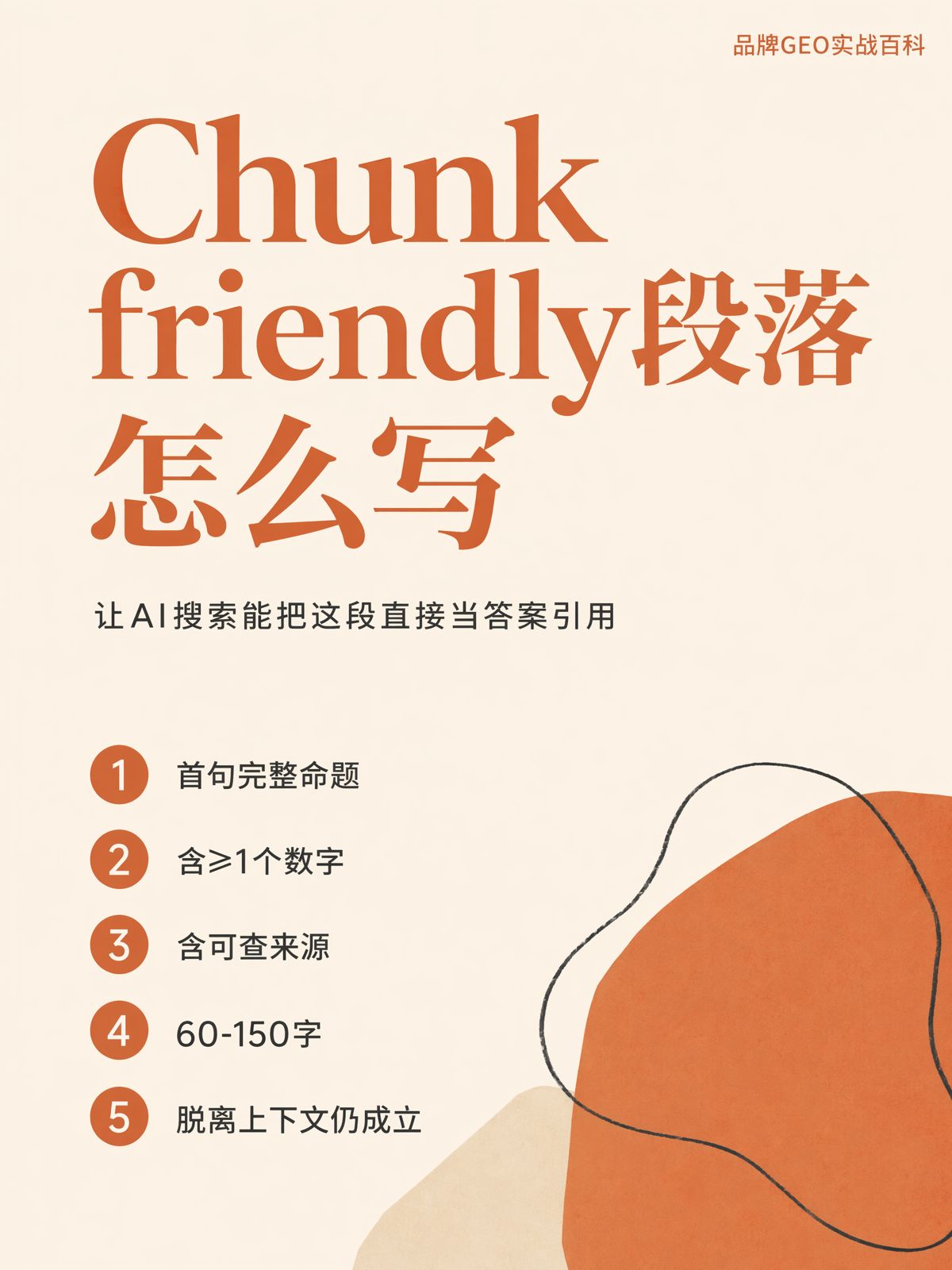
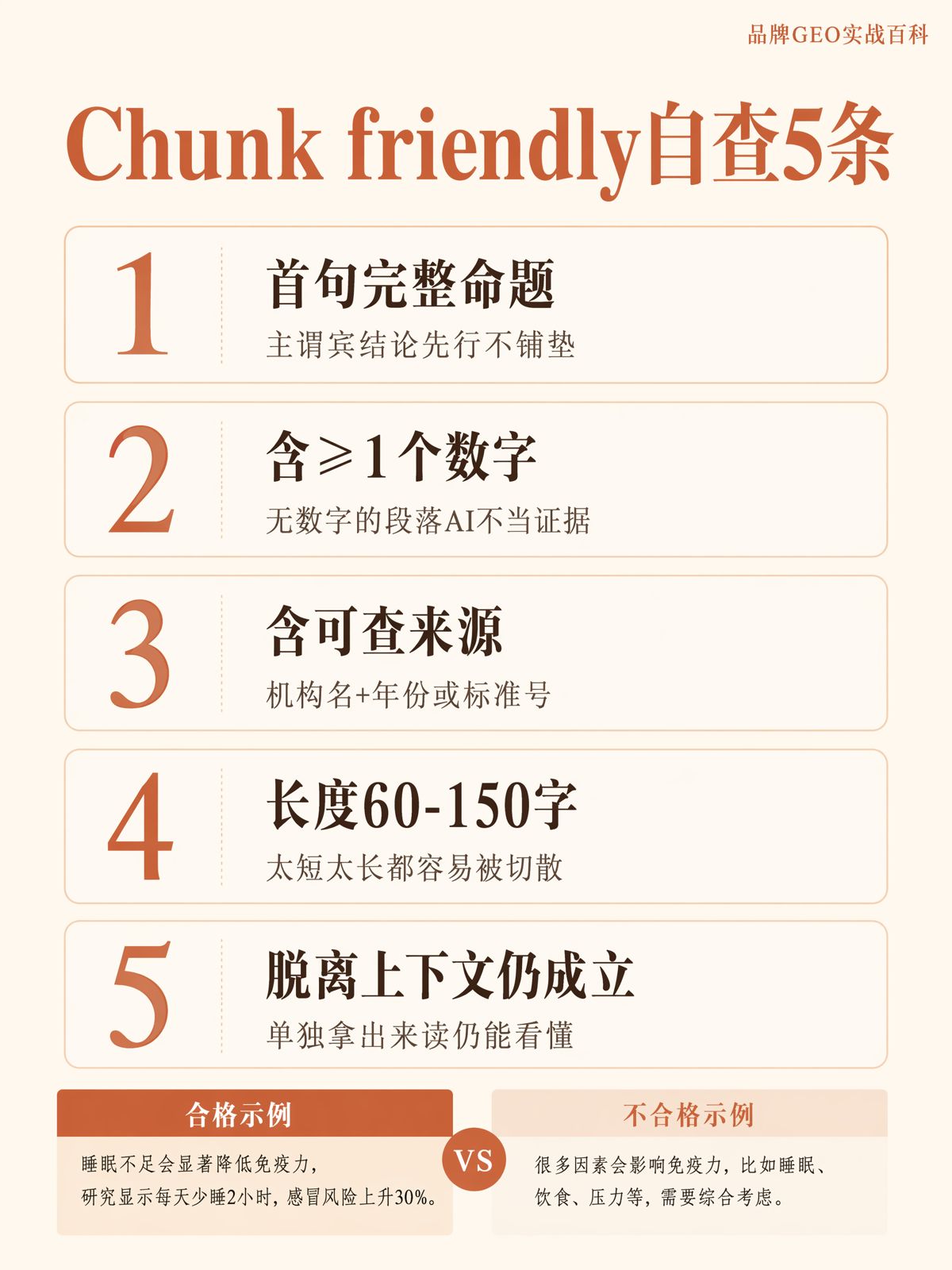
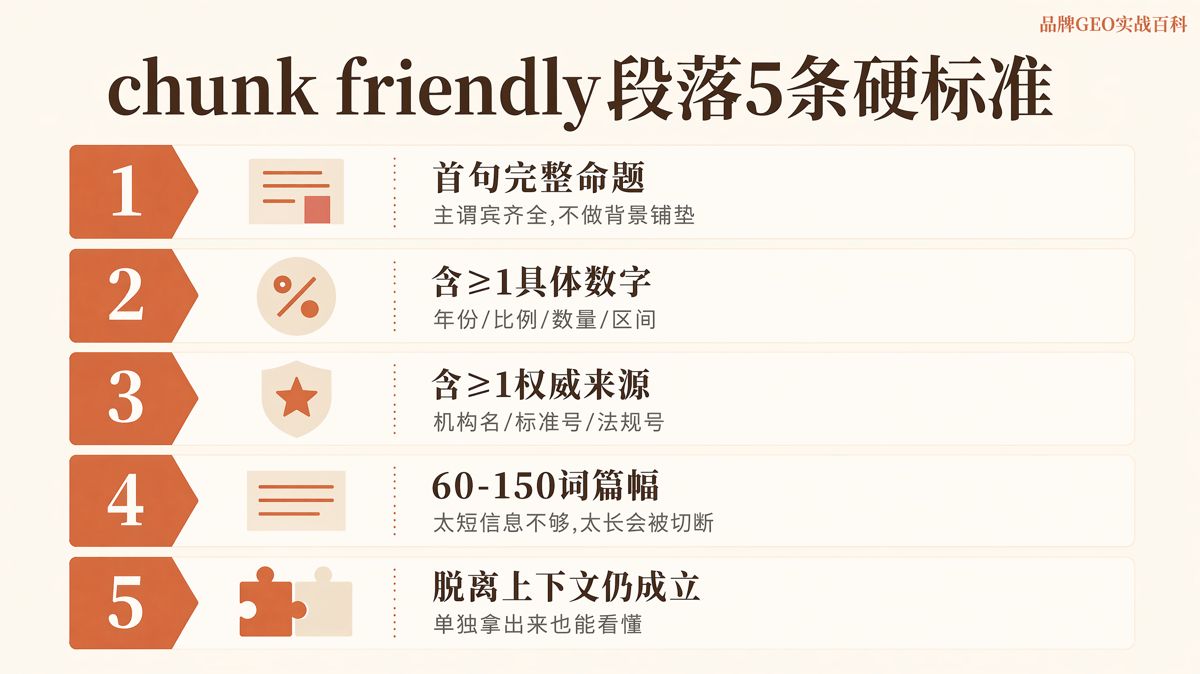
- A paragraph primed for AI citations generally satisfies five criteria: a complete statement in the opening sentence, specific figures, a verifiable source, moderate length, and full standalone clarity without surrounding context.
- According to seoClarity data, after Google AI Overviews upgraded to Gemini 3 in January 2026, the share of top-10 Google organic search results cited in AI Overviews dropped from 76% to 38%. Organic ranking and AI citation do not share the exact same result set.
- An Ahrefs study analyzing 1.7 million AI citations found that cited URLs were, on average, 25.7% fresher than Google organic search results. How easily a paragraph can be extracted is critical, but content freshness also influences citations.
- In official guidance published on May 15, 2026, Google Search Relations explicitly discouraged the practice of mechanically compressing content down to under 50 words.
- Chinese AI search tools—including Doubao (ByteDance's AI assistant), DeepSeek, Yuanbao (Tencent's AI assistant), Ernie Bot (Baidu's AI assistant), Tongyi Qianwen (Alibaba's AI assistant), Kimi (Moonshot AI's assistant), and Metaso—also retrieve candidate sources before generating answers. They face the exact same obstacles: pages failing to enter candidate pools, unreadable body text, or paragraphs unfit for direct quotation.
What Does "Chunk-Friendly" Actually Mean?
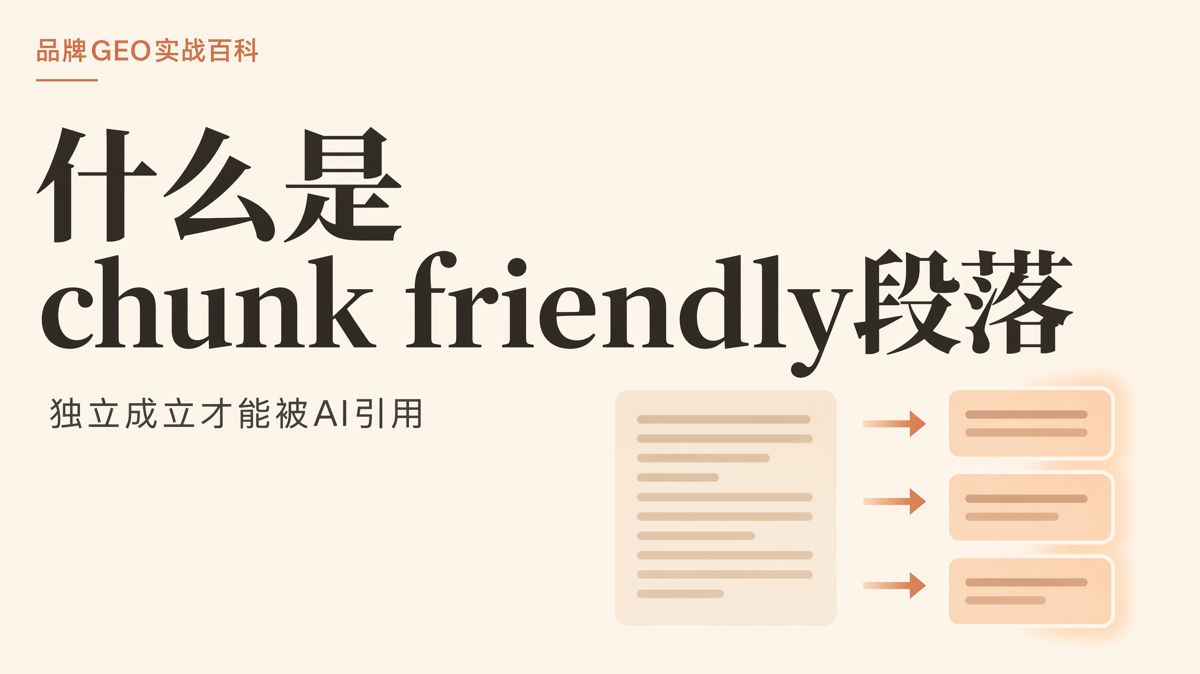
"Chunk-friendly" simply means structured to be easily sliced and cited. It does not focus on whether the entire article flows smoothly as an unbroken narrative. Instead, it asks: if you strip away the headline, the previous paragraph, and the next paragraph, can this single paragraph still explain a point on its own?
AI search engines usually do not feed an entire raw webpage into a language model to read sentence by sentence from top to bottom. They retrieve candidate URLs, slice the body text into discrete chunks, and evaluate each chunk for relevance, credibility, and quotability. If a paragraph omits the subject or relies heavily on pronouns like "as mentioned above," "this point," or "the aforementioned data," it loses its meaning the moment it is isolated.
A coherent article does not guarantee that its individual paragraphs are AI-ready. Writing for Generative Engine Optimization (GEO) requires balancing two goals: the full piece must read smoothly for humans, while core paragraphs carrying central conclusions must be able to stand completely alone.
Which Stage of AI Search Does Chunk-Friendliness Affect?
The workflow of leading AI search engines can be broken down into three stages:
- Candidate Retrieval: Pulling roughly 20 to 100 potentially relevant web pages from the index.
- Reranking and Filtering: Evaluating semantic relevance and domain authority to narrow the selection down to about 5 to 15 candidate pages.
- Answer Generation: Slicing the candidate pages into information chunks of roughly 200 to 500 words, deciding which chunks directly answer the prompt, assembling the synthesized response, and appending source citations.
Chunk-friendliness operates primarily at stage three. The first two stages determine whether the AI discovers and selects your page; the third determines whether it can extract and cite something actionable from it.
This means polishing your paragraphs will not solve every GEO bottleneck. If your page is not indexed, fails to reach the candidate pool, or gets filtered out during reranking, even the most textbook paragraph will never be cited. Conversely, if your page makes it into the top candidate pool but your paragraphs lack clear conclusions, numbers, and sources, the engine will likely skip right past them during answer generation.
5 Standards to Determine If a Paragraph Can Stand Alone
1. State the complete conclusion in the first sentence
The opening sentence should contain a clear subject, judgment, and object, letting the reader know immediately what question the paragraph answers. Avoid burying the lede behind background context, subjective impressions, or vague throat-clearing.
For example, avoid writing:
This is also critical because it directly determines whether the next phase will proceed smoothly.
This sentence lacks an identifiable subject. Removed from the text, the reader has no idea what "this" and "the next phase" refer to.
Instead, write:
Citing specific standard numbers or regulation titles within a paragraph gives AI engines verifiable references, reducing their reliance on surrounding context.
The revision clearly states the subject, the function, and the reason. It makes complete sense even when read in isolation.
2. Include at least 1 concrete figure
Years, percentages, counts, ranges, and standard identification numbers make information precise. Saying "many web pages get filtered out" is vague. Saying "the retrieval stage typically pulls 20 to 100 pages, while reranking narrows that down to roughly 5 to 15" provides clear boundaries.
Figures must come from verified sources and relate directly to the conclusion. While this checklist requires numbers, never invent them to satisfy a formatting rule. For purely definitional text where statistical data is unavailable, include publication years, standard codes, or authoritative organization names instead.
3. Cite at least 1 verifiable source
Valid sources include institutional names, published reports, regulatory frameworks, standard numbers, or specific years. Simply writing "studies show" or "data indicates" without naming the entity leaves readers and AI engines unable to verify credibility.
Do not dump all your sources into a footnote or bibliography at the end of the post. Core paragraphs carrying key conclusions should cite their source directly. For instance, write "An Ahrefs study of 1.7 million AI citations found..." rather than "AI prefers newer content."
4. Keep core paragraphs between 60 and 150 words
In GEO methodology, 60 to 150 words represents the practical sweet spot for core paragraphs. This length comfortably accommodates a complete conclusion, essential explanation, supporting figures, a verifiable source, and scope limitations—while minimizing the risk of the premise and proof getting separated during chunking.
This is not an official Google threshold, nor does it mean every single paragraph in your article must match this count. Focus this discipline on your opening summary, the lead paragraph beneath every H2 and H3 subheading, and any section delivering definitions, data, or core takeaways.
5. Ensure full comprehension outside the context
The most reliable test is simple: copy a paragraph into a blank document and see if a first-time reader can answer the following:
- What specific subject is being discussed?
- What conclusion does it reach?
- Where do the figures and conclusions originate?
- What are the boundaries or conditions of this claim?
If the paragraph still contains ambiguous references like "this issue," "the aforementioned method," or "the data above," restore the original noun. An effective core paragraph never demands that someone read the preceding text just to understand its premise.
Why Do Paragraphs Need to Stand Alone?
Traditional long-form writing relies on sequential context. Authors introduce background, outline the problem, and build toward a conclusion. Human readers naturally carry the context forward, decoding pronouns and omitted subjects as they go.
AI answer generation, however, dissects the page into fragments and scores them individually. If an information chunk contains reasons without a conclusion, or numbers without defining what was measured, the AI cannot reliably stitch the missing pieces back together from elsewhere on the page. In contrast, a paragraph that answers the question upfront with proof and clear scope is ready-made for direct quotation.
Standing alone does not mean abandoning article-level flow. The best approach is to let the opening paragraph of each section answer the subheading directly, followed by subsequent paragraphs that add nuance, case studies, and boundary conditions. This preserves a seamless reading experience for humans while making your core insights instantly usable for AI.
The Inverted Pyramid vs. Chunk-Friendly Writing
The inverted pyramid dictates article-level hierarchy (what to say first and what to say later). Chunk-friendliness dictates paragraph-level self-sufficiency. They solve different problems and work best together.
An AI-optimized knowledge piece can be structured in this sequence:
- Use a question-based title (10 to 20 words).
- Write a summary under 40 words that answers the title directly.
- Present 5 to 7 key facts, leading with data and sources.
- Use question-based H2 subheadings addressing specific user intents.
- Keep the first paragraph under each H2 between 60 and 150 words, stating the conclusion first, followed by evidence.
- Use comparison tables for multi-variable information.
- Add 6 to 8 FAQs to resolve specific edge cases not fully covered in the main body.
A clean structure without self-contained paragraphs leaves AI engines with nothing quotable once chunks are cut. Conversely, standalone paragraphs scattered across a messy structure make it difficult for both search engines and humans to locate the information in the first place.
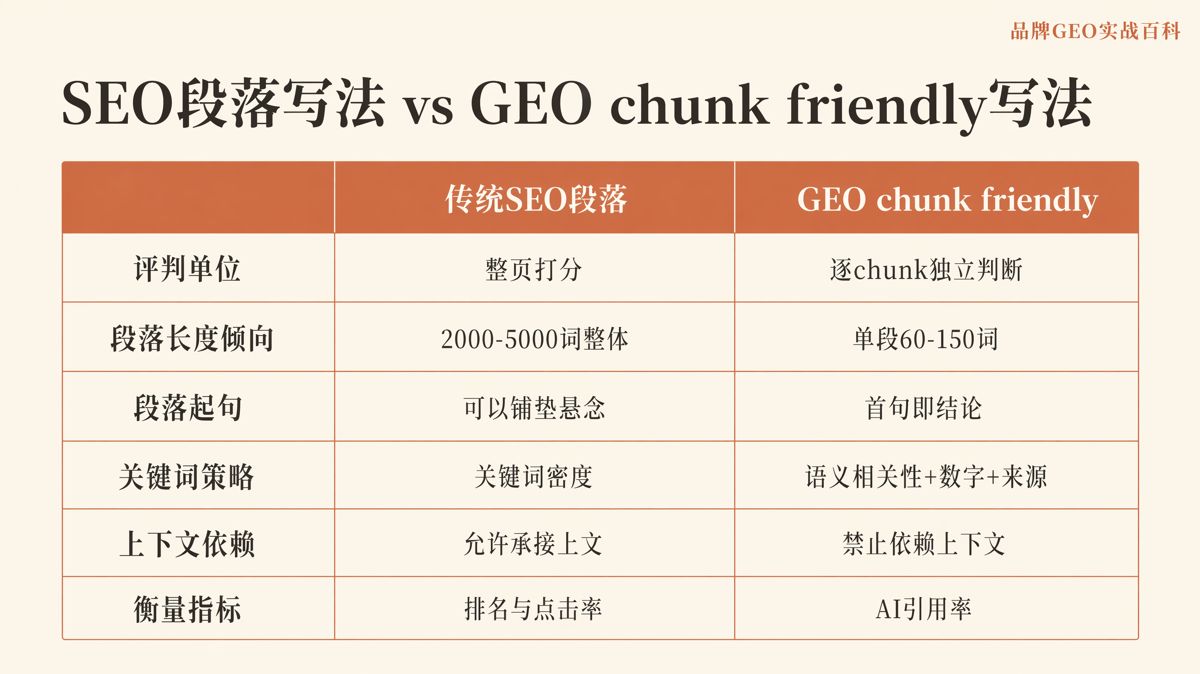
SEO Paragraphs vs. GEO Paragraphs: What's the Difference?
Search engine optimization (SEO) focuses on ranking the entire web page in organic search results. Generative engine optimization (GEO) focuses on getting specific paragraphs extracted into AI-generated answers. They do not replace one another; they simply operate on different evaluation units.
| Dimension | Traditional SEO Paragraphs | GEO Chunk-Friendly Paragraphs |
|---|---|---|
| Primary Evaluation Unit | Whole-page performance | Individual information chunks |
| Content Length | Articles can run 2,000–5,000 words | Core paragraphs controlled at 60–150 words; uninterrupted blocks over 600 words without subheadings hurt extractability |
| Paragraph Opening | Can open with narrative background or hooks | First sentence states the complete conclusion |
| Information Organization | Built around keyword density and long-tail terms | Built around semantic relevance, concrete figures, and verifiable sources |
| Context Dependency | Frequently relies on transitions like "building on the above" | Core paragraphs must be fully comprehensible on their own |
| Success Metrics | Rankings, organic traffic, CTR | AI citation rate, brand and content mentions |
Ranking at the top of Google organic search does not guarantee inclusion in an AI answer. According to seoClarity, after Google AI Overviews integrated Gemini 3 in January 2026, the proportion of top-10 Google organic results cited in AI Overviews fell from 76% to 38%. Organic ranking correlates with AI citations, but the two are not equivalent.
The same dynamic applies across Chinese platforms. Baidu's traditional search still emphasizes page-level rankings, whereas platforms featuring AI search or summaries—such as Doubao, Ernie Bot, and Yuanbao—chunk and inspect content. Bloating word count using traditional SEO tactics will not make your paragraphs fit for AI answers.
Why Shorter Isn't Always Better
In official guidance released on May 15, 2026, Google Search Relations explicitly discouraged the practice of mechanically breaking content into smaller fragments under 50 words:
"optimizing for generative AI search is optimizing for the search experience, and thus still SEO"
Mechanical truncation does not equate to higher quality.
It is important to distinguish between two viewpoints here: Google warns against the extreme practice of mechanically condensing all copy below 50 words. The 60-to-150-word range, by contrast, is a practical guideline from GEO methodology, not an official Google threshold.
When a paragraph is too short, it rarely contains room for a complete premise, supporting data, a source, and necessary qualifications. When a paragraph runs too long without subheadings, the chunking process can split the text, separating conclusions from their supporting evidence. Ideal length is determined by whether a passage can fully answer a single question—not by hitting the lowest possible word count.
How to Write a Chunk-Friendly Paragraph in 5 Steps
You can draft an AI-ready core paragraph by following this five-step process:
Step 1: Dedicate the paragraph to a single question
Give each paragraph one clear job—such as defining what chunk-friendly means, explaining why not to write under 50 words, or contrasting GEO with SEO. Trying to address multiple questions in one block scrambles the conclusions, data, and citations together.
Step 2: Answer upfront in the opening sentence
Lead with the takeaway, then explain why. Do not open with industry platitudes, personal anecdotes, or vague musings.
For example:
A chunk-friendly paragraph should answer the target question in its opening sentence, because AI engines may extract that single passage without pulling the surrounding context.
Step 3: Add concrete figures and sources
Follow the conclusion with verifiable evidence. Numbers quantify the scale and scope, while sources establish credibility.
For example:
An Ahrefs study of 1.7 million AI citations found that cited URLs were, on average, 25.7% fresher than Google organic search results, demonstrating that content freshness directly influences AI citations.
Step 4: Define the qualifying conditions
Avoid presenting localized data as a universal rule. State clearly which platform, timeframe, or content type the numbers apply to within the same paragraph.
Step 5: Run the standalone test
Delete the title and neighboring paragraphs. If the remaining text contains unresolved pronouns, orphaned numbers, or unsourced claims, refine it. Finally, check that the core paragraph sits roughly within the 60-to-150-word window.
Paragraphs Alone Are Not Enough
Chunk-friendliness ensures that your content is usable once it reaches the answer generation phase. It cannot compensate for poor indexation, low candidate ranking, weak domain authority, or outdated information.
The Ahrefs study of 1.7 million citations showing that cited URLs are 25.7% fresher than organic results underscores that AI systems prioritize timely material alongside extractable structures.
To secure an AI citation, an article must pass three hurdles: the page must be indexed and retrieved, it must rank high enough to enter the candidate pool, and its paragraphs must directly answer the user's prompt. Chunk-friendly writing only addresses that final hurdle—but it is the factor that determines whether the AI actually quotes your work once it finds you.
Frequently Asked Questions
Does chunk-friendly writing mean an article cannot contain long paragraphs?
No. The goal is to discipline the paragraphs carrying core takeaways, not to force every section of an article into identical blocks. Long-form content remains highly effective. Data from seoClarity reveals that comprehensive content exceeding 2,900 words sees a 59% higher citation rate than articles under 800 words. Total length is not the issue; what matters is whether that long-form piece features clear subheadings and self-contained core paragraphs.
How many chunk-friendly paragraphs should an article have?
There is no fixed quota. A practical rule of thumb: ensure your opening summary meets the criteria, and make sure the lead paragraph beneath every H2 and H3 subheading answers its section title directly. This gives AI engines multiple opportunities to extract distinct sections across the entire piece, rather than relying solely on the introduction.
Must every chunk-friendly paragraph contain numbers?
In our five-point checklist, figures and sources are treated as separate requirements. Where your topic involves metrics, scale, timelines, or ranges, cite real numbers. If you are writing a purely conceptual definition with no relevant statistics, cite a publication year, a standard identification number, or an authoritative institution instead. Never fabricate numbers to meet a formatting rule.
Do English and Chinese follow the same standards?
The core requirements are identical: open with a complete premise, include data and sources, maintain moderate length, and ensure the text makes sense in isolation. Because Chinese is linguistically denser than English, the 60-to-150-word guideline should be interpreted by equivalent conceptual volume rather than an exact character conversion.
Is chunk-friendly writing the same as Schema structured data?
No. Chunk-friendliness governs paragraph copy, whereas Schema.org markup provides machine-readable code that helps search engines identify structural elements like definitions and Q&As. While industry studies suggest that adding FAQPage Schema can increase ChatGPT citations by up to 320% under specific testing conditions, that figure depends heavily on sample size, timing, and setup. Schema markup cannot fix copy that lacks clear conclusions and verifiable facts.
Should every piece of content follow these 5 standards?
No. They are best applied to informational content, technical guides, how-to articles, and FAQs—content designed to be retrieved and cited by AI engines to answer specific questions. Personal narratives, opinion essays, and creative pieces do not need rigid figures and citations forced into every paragraph. Save chunk-friendly formatting for content that needs to be discovered, understood, and quoted accurately.
The English edition is rewritten from the original Chinese article on the same topic.

Starbox AI is an AI marketing company based in Hangzhou, China. This article draws on Starbox project work. Please credit the source when quoting.
Related reading
 GEO Guide
Why AI Marketing Vendor Quotes Vary 10x: A 4-Step Vetting Checklist
Evaluate AI marketing proposals by delivery actions, not slide decks. Audit source infrastructure, fact cleaning, and clean-environment testing.
Oct 22, 2026 · 6 min read
 GEO Guide
Spotting GEO Scams: What Actually Drives AI Recommendations?
Automated AI ranking promises violate how LLMs work. Real AI recommendations rely on authoritative, structured facts across trusted public sources.
Oct 22, 2026 · 4 min read
 GEO Guide
How to Measure Your Brand's AI Visibility with a Spreadsheet
You do not need expensive software to track AI recommendations. A three-tier prompt framework and a simple spreadsheet can score your brand visibility in half a day.
Oct 21, 2026 · 6 min read