
How to Structure GEO Content: The Inverted Pyramid Approach
The short answer
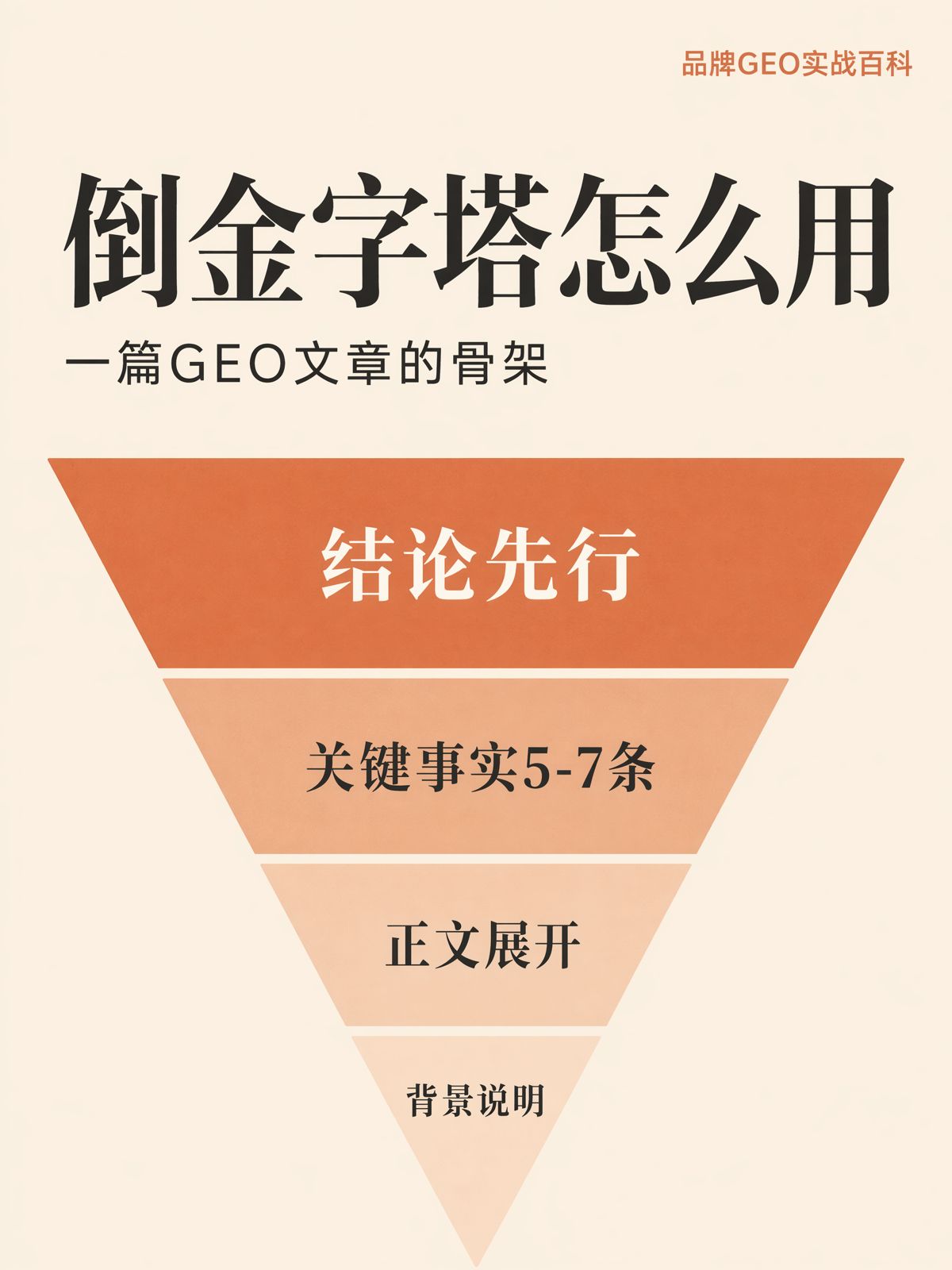
GEO articles should lead with answers and key facts before unpacking context, ensuring core paragraphs remain fully understandable on their own.
GEO (Generative Engine Optimization) is the practice of structuring and phrasing content so generative AI engines can easily retrieve, understand, and cite it when answering user questions. Generative AI refers to AI systems that synthesize and generate direct answers in response to user prompts.
Many articles targeted at GEO do not lack information. Their problem is that the answer arrives far too late: they open with background context, provide paragraph after paragraph of setup, and leave the reader searching for a conclusion. The fix is simple: provide the answer first at the macro level, and lead every major section with a direct answer before unpacking reasons, prerequisites, and supporting evidence.
Six Core Takeaways to Keep in Mind
- The GEO inverted pyramid does not just mean putting the article's conclusion at the very top. It also requires answering the question immediately under every H2 heading before elaborating.
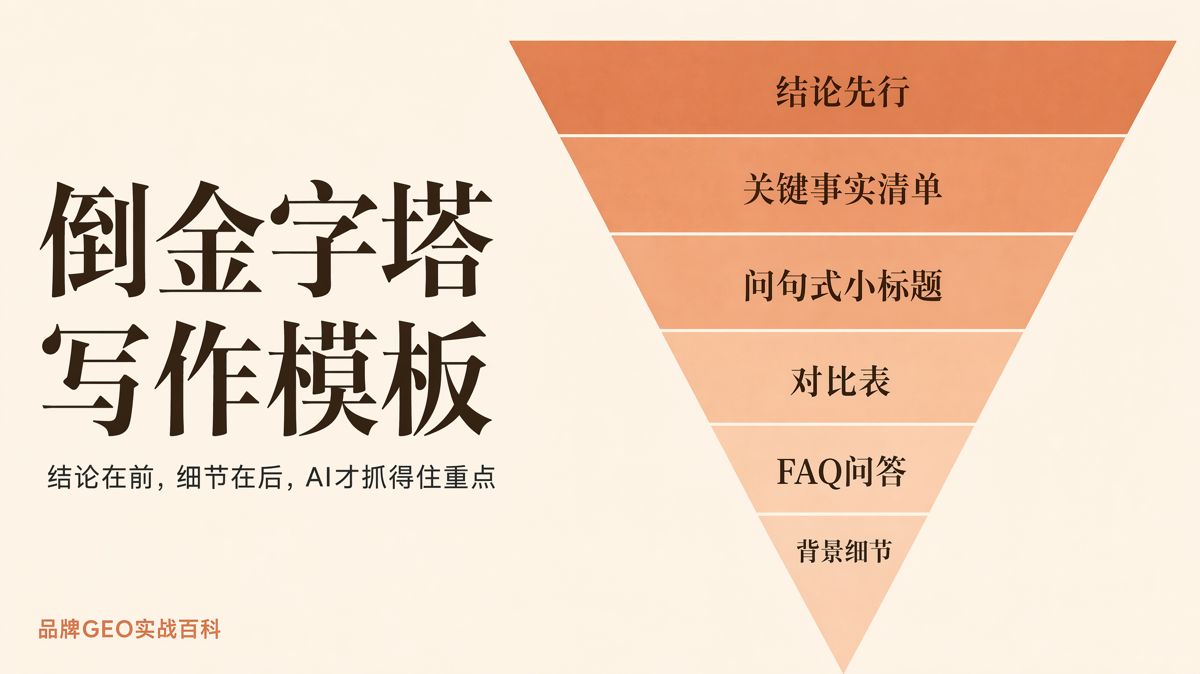
- A comprehensive long-form article typically features six components: a question-based main title, a one-sentence summary, key facts, question-based subheadings, a comparison table, and a FAQ section.
- Core paragraphs must clearly identify the subject, the primary conclusion, and any qualifying conditions, remaining self-contained even when cited in complete isolation.
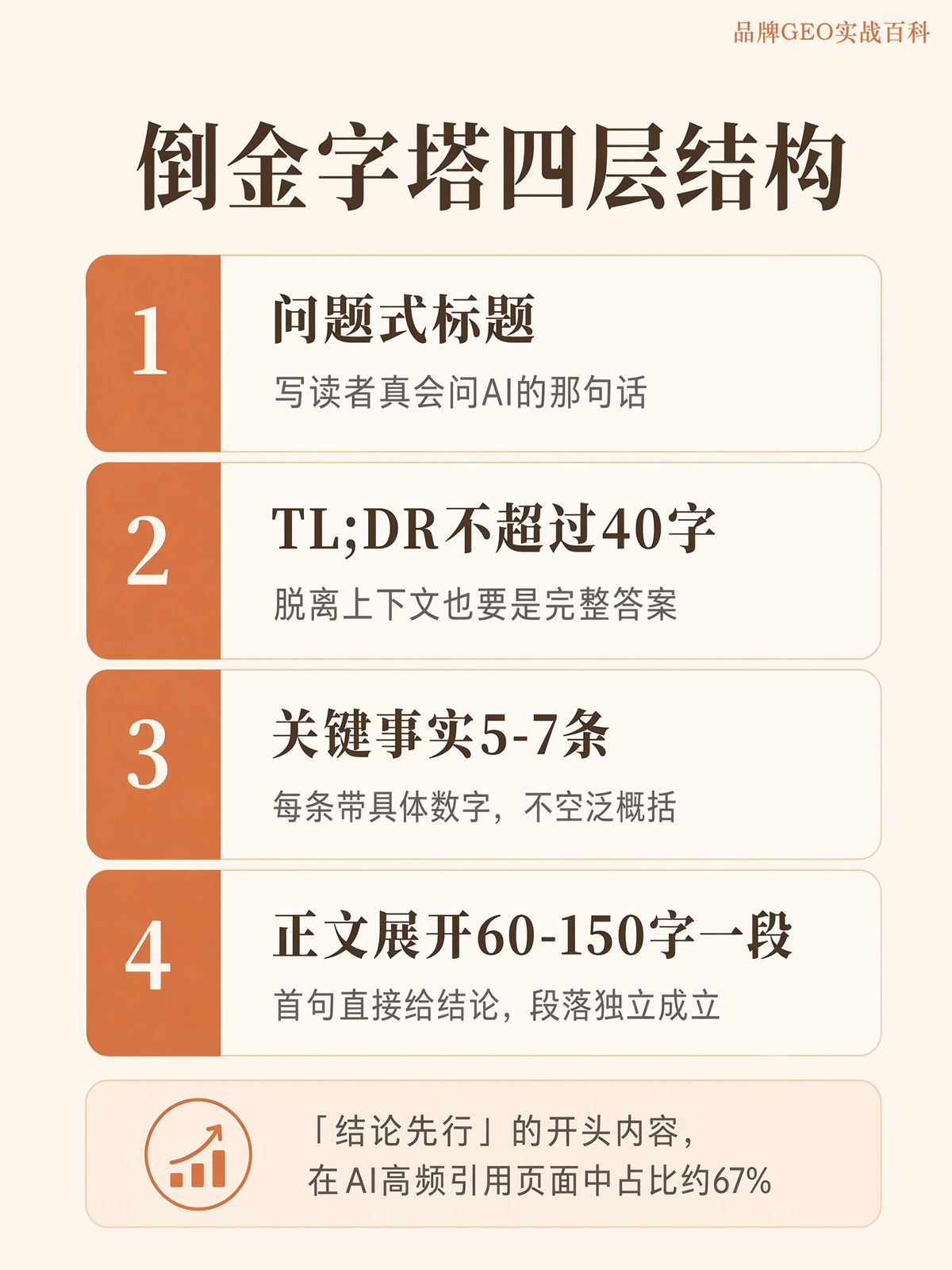
- Some guidelines recommend keeping core paragraphs between 60 and 150 words, but word counts should never be applied mechanically.
- Tables should map horizontal differences, and FAQs should address follow-up questions. Neither should duplicate what has already been said in the body text.
- Frequently circulated figures—such as targeting 2,900 words or claims of citation rate lifts of 59%, 320%, 3.2x, or 2.5x—lack original verifiable sources and should not be treated as confirmed facts.
What Is the GEO Inverted Pyramid?
The GEO inverted pyramid is an information architecture framework that prioritizes answers before explanations. It enforces an "answer-first" structure on two distinct levels: 1. The article opens by answering the overarching question posed in the title. 2. The first paragraph of each main section answers that specific section's heading directly.
For example, if your subheading asks "Which articles benefit most from an inverted pyramid structure?", the very next sentence should name those exact content types. You should not begin by tracing the history of technical writing, discussing platform algorithm shifts, or surveying industry trends before delivering the answer three paragraphs down.
This setup serves two distinct audiences simultaneously. Readers seeking an in-depth understanding can continue reading to review the reasoning, constraints, and supporting proof. Readers looking for a quick reference can find their answer in seconds. For generative AI engines, the clearer the correspondence between a prompt and an explicit answer, the easier it is to identify and extract that passage as a reference citation.
How to Structure a Long-Form GEO Article
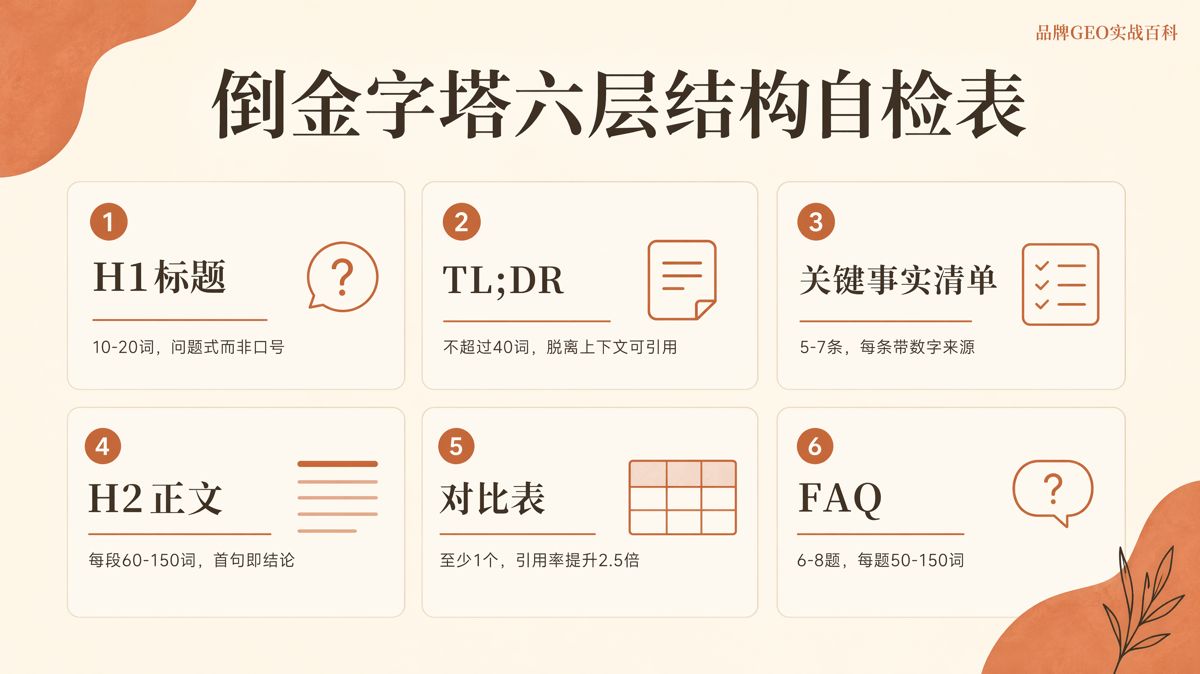
A comprehensive long-form GEO article can be organized across six functional layers:
| Layer | Component | Core Function | Structural Requirement |
|---|---|---|---|
| 1 | Question-Based H1 | Clarifies the primary problem the piece solves | Formulated as a realistic query a user would type, avoiding pure marketing slogans |
| 2 | One-Sentence Summary | Delivers the shortest complete answer to the query | Keep concise; must make complete sense when extracted on its own |
| 3 | Key Facts | Consolidates primary conclusions and key caveats | Include 5 to 7 bullet points, each addressing a single point |
| 4 | Question-Based H2s | Answers distinct sub-questions sequentially | Lead each section with a direct conclusion, followed by rationale, constraints, and steps |
| 5 | Comparison Table | Visualizes structural differences across multiple items | Maintain consistent evaluation dimensions across rows; ensure data is readable standalone |
| 6 | FAQ Section | Resolves logical follow-up questions | Include 6 to 8 substantive questions; avoid repeating body paragraphs verbatim |
This framework is built for thorough, comprehensive guides. You do not need to force every layer into every piece. Short-form articles of a few hundred words can reduce the number of subheadings and omit the comparison table and full FAQ block. Regardless of length, two fundamentals must remain: answer the core question immediately, and make sure key paragraphs can stand on their own.
Which Types of Content Benefit Most from an Inverted Pyramid?
The inverted pyramid format is ideal for educational explainers, step-by-step methodologies, conceptual definitions, and decision-support content. The primary objective of these articles is to resolve a query quickly and support skimming and lookup.
In contrast, brand stories, personal essays, retrospective case studies, and emotional narratives often do not fit this model. These formats rely on chronological storytelling, allowing the reader to appreciate the outcome by witnessing the journey. Revealing all conclusions at the very beginning can undercut the narrative value of the piece.
Before picking a structure, determine the primary goal of the content: - If the reader needs a definitive answer quickly, use the inverted pyramid. - If the reader needs to understand an evolving journey or end-to-end experience, use traditional narrative pacing. - If both goals exist, open with a brief real-world scenario to introduce the problem, then deliver the definitive conclusion as quickly as possible.
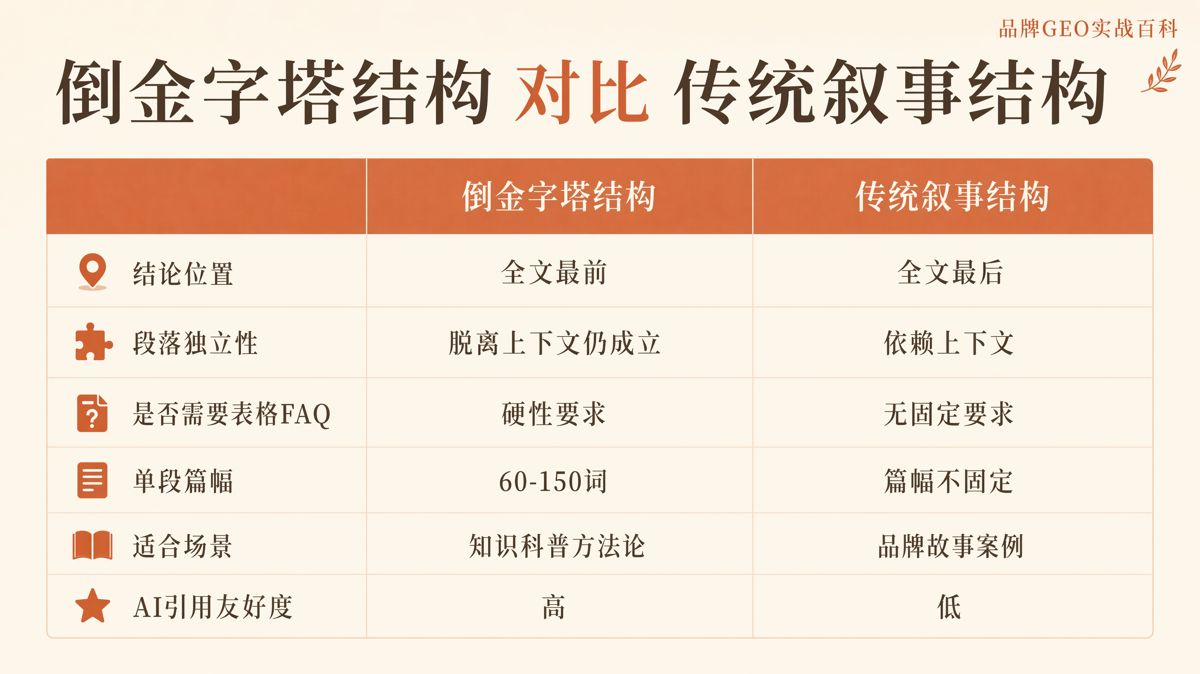
| Dimension | Inverted Pyramid Structure | Traditional Narrative Structure |
|---|---|---|
| Placement of Conclusions | Front-loaded at the start of the article and at the top of each section | Typically reserved for the end after presenting background and process |
| Paragraph Relationships | Core paragraphs are self-contained and independently readable | Paragraphs are tightly coupled and build sequentially on prior context |
| Reading Behavior | Optimized for skimming, reference lookup, and citation | Optimized for end-to-end sequential reading |
| Common Formats | Knowledge bases, how-to guides, decision frameworks | Brand stories, executive profiles, project post-mortems, essays |
| GEO Compatibility | Creates ready-to-cite passages that directly resolve queries | Mid-article passages often depend on preceding text to make sense |
Neither approach is inherently superior. The right choice depends on whether your structure aligns with your editorial purpose.
How Does the GEO Inverted Pyramid Differ from Journalism?
Both approaches place the most critical information upfront, but they operate at different scopes. Traditional journalistic inverted pyramids prioritize information sequencing across an entire article to help readers scan quickly and allow editors to trim from the bottom up. The GEO inverted pyramid, however, must also ensure that individual paragraphs can be extracted, parsed, and cited in isolation by an algorithm.
Modern AI search relies on Retrieval-Augmented Generation (RAG). In a RAG pipeline, the engine searches for relevant reference passages, then synthesizes an answer using the retrieved fragments. During this process, the engine does not merely evaluate whether an entire URL is topic-relevant; it looks for specific, granular content chunks that directly answer the user's prompt.
While some industry workflows model candidate retrieval chunks around 200 to 500 words, systems vary widely. The real benchmark is not hitting an arbitrary word count; it is whether an extracted paragraph delivers a complete, unambiguous answer to a specific question.
For GEO, opening strong is not enough. The first sentence beneath every H2 subheading must identify the subject matter and directly resolve the heading's query. A reader—or an AI agent—should understand the paragraph's core point without reading the preceding sections.
Why Do Answer-First Paragraphs Get Cited More Easily?
Answer-first paragraphs map directly to user queries and retain their original meaning when quoted out of context.
When a paragraph begins with extensive background context and buries its conclusion at the end, an AI system has to ingest the entire surrounding passage to evaluate its utility. Worse, if the paragraph omits the subject noun or relies heavily on pronouns like "this approach," "these cases," or "it," extracting it makes the topic impossible to identify.
Conversely, when the opening sentence explicitly states who should take what action under which circumstances, followed by reasons, constraints, and supporting data, the paragraph becomes an autonomous, complete answer. This structure allows human readers to scan efficiently while making it effortless for AI engines to match the text to relevant queries.
This marks a key distinction between SEO and GEO. Traditional SEO focuses on whether search engine crawlers can index a page and rank it for target keywords. GEO builds on that baseline, evaluating whether a page contains self-contained answer blocks that generative engines can lift into an AI summary. The two practices are not in conflict; GEO simply requires a tighter, chunk-level evaluation of your content.
What Makes a Paragraph Truly Context-Independent?
To ensure core paragraphs can stand on their own and serve as clean citation targets, evaluate them against these five criteria:
1. A Complete Opening Sentence
The first sentence must explicitly identify the subject, action, and conclusion. Avoid opening with connective words or phrases that rely on earlier context, such as "Therefore," "In addition," or "This method."
2. Specific, Concrete Detail
Whenever numbers, timelines, scopes, or criteria are available, state them directly. Avoid vague qualifiers like "significant improvements," "high performance," or "widely used." Concrete writing does not always require raw statistics; clearly defining the applicable audience, prerequisite conditions, and execution standards makes your point equally precise.
3. Traceable Evidence
When citing regulations, industry standards, third-party reports, or research datasets, always name the issuing body, standard number, or publication title. Never present unsourced figures as verified facts.
4. Length Guided by Substance, Not Quotas
Some writing guides suggest keeping core paragraphs to 60–150 words. Rather than treating word counts as rigid quotas, avoid two common pitfalls: making paragraphs so brief that they lack essential context, or making them so bloated that they try to answer several unrelated questions at once.
5. The Copy-Paste Sanity Test
Copy an individual paragraph out of the draft. Can a reader unfamiliar with the rest of the text understand what is being discussed, what conclusion is reached, and when it applies? If they need to refer back to earlier sections to identify the subject, find a definition, or grasp the verdict, the paragraph needs to be rewritten.
Data points and citations should only be used when verified. Inserting irrelevant metrics or leaning on vague claims like "studies show" merely to check a formatting box will damage your content's credibility.
Should Long and Short Articles Use the Same Structure?
Long-form and short-form pieces share the same foundational principles, but they do not need identical structural complexity.
Broad technical guides, definitive tutorials, and strategic playbooks benefit from the full architecture: a summary, key facts, multiple H2 sections, comparison tables, and a dedicated FAQ. A short explainer of a few hundred words can simply feature a one-sentence answer, 3 to 5 key bullet points, and a brief body section.
Certain industry materials claim that long-form articles over 2,900 words see a 59% higher citation rate than pieces under 800 words. However, these materials cite no research institution, sample size, or original dataset. Do not treat that number as proof that long content is inherently superior.
Match your length to the scope of the question. If the topic involves numerous variables and edge cases, cover them thoroughly. If the question is straightforward, answer it directly. Never repeat the same point in different words just to hit an arbitrary word count. Quality is determined by completeness, accuracy, and paragraph clarity—not raw volume.
Why Are Tables and FAQs Worth Keeping?
Comparison tables excel at structuring horizontal differences, while FAQs are built to resolve logical follow-up questions. Both formats offer clear, predictable schemas that help readers scan efficiently and help AI engines map relationships between entities.
Tables should not be limited to quantitative data. They work just as well for comparing workflows, operational constraints, ideal use cases, and pros and cons. A table requires at least two conditions to be useful: two or more entities being evaluated, and consistent comparison criteria across every column.
Similarly, an FAQ section should not simply rephrase conclusions from the main text. It is best used to clarify edge cases, operational boundaries, common misunderstandings, and easily confused terms. If an FAQ answer does not add distinct value beyond the body paragraphs, remove or merge it.
It is also important to distinguish between an editorial FAQ section and FAQPage schema. FAQPage is a structured data markup in webpage code that signals Q&A content to search crawlers; it is not the editorial text itself. The on-page content provides direct answers to human readers and LLMs, while the schema informs search engines how the page is structured. One does not replace the other.
Unverified claims circulating in some guides suggest that adding FAQPage schema can increase ChatGPT citations by 320% and boost inclusion in Google AI Overviews by 3.2x, or that pages with tables are 2.5x more likely to be cited than pages without. Because these claims lack primary sources, they should not be treated as established facts. Include tables and FAQs because your content genuinely calls for comparative clarity and follow-up troubleshooting, not in pursuit of unverified growth figures.
How Should This Framework Be Applied Across Chinese Platforms?
The core principle—lead with answers, explain context second, and keep paragraphs self-contained—applies universally, including on domestic Chinese platforms. However, specific channel strategies must be verified through empirical testing rather than speculative rules.
Industry observers often assume that Doubao (ByteDance's AI assistant) prioritizes content from Douyin (ByteDance's short video platform) and Toutiao (ByteDance's news aggregator); that Wenxin (Baidu's LLM) relies on Baijiahao (Baidu's content platform) and Baidu Baike (Baidu's encyclopedia); that Yuanbao (Tencent's AI assistant) draws heavily from the WeChat ecosystem; and that Kimi (Moonshot AI's assistant) and DeepSeek favor Zhihu (China's Q&A platform). These patterns should be treated as working hypotheses, not hard rules, as platforms rarely disclose their exact retrieval weightings.
When executing across these channels, systematically track three performance signals: 1. Whether your content is indexed. 2. Whether your content appears in response to relevant queries. 3. Which specific paragraph from your article the AI engine extracts when it cites you.
Tracking these metrics over time will give you far more reliable guidance on channel distribution and formatting than unverified platform stereotypes. Whether publishing on WeChat Official Accounts, Zhihu, Baijiahao, or a standalone website, the foundational structure remains the same: lead with a direct answer, list key facts, break down the body text around specific user questions, and include tables and FAQs where they add genuine value.
What Precautions Are Needed for AI-Assisted Content Production?
The inverted pyramid organizes information; it cannot verify facts or ensure regulatory compliance.
Under the Provisions on the Identification of Artificial Intelligence-Generated and Synthetic Content—jointly issued by the Cyberspace Administration of China, the Ministry of Industry and Information Technology, the Ministry of Public Security, and the National Radio and Television Administration, effective September 1, 2025—synthetic content requires explicit and implicit watermarking. Explicit identifiers are visible or audible notices for human users; implicit identifiers are technical markers embedded in metadata for system identification. Service providers and distribution platforms bear respective responsibilities for watermarking and verification, and users must not delete, tamper with, fabricate, or conceal these labels.
Before publishing, verify the latest regulatory requirements and platform policies. If your team uses generative AI to draft content at scale, maintain comprehensive audit trails of primary sources, editorial reviews, and revisions. A clear content structure does not guarantee that data points, case studies, or assertions are accurate. Structural organization and factual verification are two separate workflows, and both are required.
What Should You Audit Before Publishing?
While some production workflows rely on multi-point quality gates, you should verify at least these eight structural checks before publishing:
- [ ] Does the H1 title clearly articulate a specific user problem or promise a clear takeaway?
- [ ] Does the article open with a self-contained, one-sentence answer that can be quoted standalone?
- [ ] Are there 5 to 7 key factual bullet points immediately following the summary?
- [ ] Are the H2 subheadings structured around natural follow-up questions from the reader?
- [ ] Does the very first sentence under each H2 directly answer the heading's question?
- [ ] Do comparative sections use structured tables with consistent evaluation criteria?
- [ ] Does the comprehensive guide include 6 to 8 genuinely useful FAQ entries?
- [ ] Do all references to regulations, industry standards, reports, and data include verifiable primary sources?
If your team maintains an internal target like a 2,900-word benchmark, treat it as an operational production standard for comprehensive guides, not a universal guarantee of quality across all formats.
Eight Common Questions About the GEO Inverted Pyramid
1. Must every article follow all six layers in strict order?
Comprehensive guides work best following the "Title → One-Sentence Summary → Key Facts → Body Content" sequence. Comparison tables can sit directly beneath the relevant section or near the end, and FAQs typically close the piece. Shorter content can consolidate sections, but it should never skip the direct opening answer.
2. How long should the one-sentence summary be?
Aim for a concise statement that clearly names the subject, action, and core outcome in a single sentence. If the summary stretches too long, you are likely cramming in excessive rationale or secondary constraints. Move those details into the key facts or the main body.
3. How do I prevent the key facts from repeating the body text?
Both sections communicate the same core conclusions, but they should not use identical phrasing. The key facts summarize high-level takeaways, while the body paragraphs unpack the underlying mechanics, prerequisite conditions, tactical steps, and supporting data. If a body section does not offer new insight beyond its bullet point, condense or remove it.
4. Can I use comparison tables if I do not have numerical data?
Yes. Tables are equally effective for comparing operational workflows, application boundaries, prerequisites, and trade-offs. As long as you are evaluating two or more entities across consistent dimensions, a table is appropriate.
5. Where should I source FAQ topics?
Start with your customer support logs, search query logs, user comments, and recurring sales objections. If those resources are unavailable, build your questions around core definitions, step-by-step usage, edge cases, related concepts, and common pitfalls. Never add filler questions simply to hit a quota.
6. Do short articles of a few hundred words need an FAQ section?
No. Brief articles can rely on a one-sentence answer, several key takeaways, and two or three focused body paragraphs. Only add tables or FAQs when there is a genuine need for structured comparison or follow-up troubleshooting.
7. Does the inverted pyramid make articles sound dry or mechanical?
Leading with the answer does not mean writing a bare list of bullet points. Once the opening sentence answers the section's core query, you can introduce narrative examples, operational rationale, and detailed context. Dry writing is usually caused by repetitive sentence rhythms, uniform paragraph lengths, or a lack of real-world details—not by putting your conclusions first.
8. Are content recommendation algorithms the same as AI retrieval engines?
No. Content platform recommendation feeds evaluate user dwell time, engagement rates, and account authority. Generative AI retrieval engines evaluate whether content can be crawled, whether it matches a prompt semantically, and whether it directly answers the user's question. While algorithms evolve, clear headings, front-loaded answers, and self-contained paragraphs serve both human readers and AI retrieval models well.
Conclusion
The GEO inverted pyramid is not an arbitrary formatting checklist. It is an editorial discipline built around clarity: answer the reader's primary question first, then unpack the rationale, constraints, and supporting evidence—both across the piece as a whole and within every individual section.
When your draft is finished, pull a random paragraph out of the text. If a reader can understand what is being discussed, what conclusion is reached, and when it applies without reading the surrounding sections, that paragraph is structurally sound. If it falls apart without previous context, restore the missing subject, clarify the conclusion, and make it whole.
Structure makes your answers easy to retrieve; factual verification makes them trustworthy. Content is ready to publish only when both conditions are met.
The English edition is rewritten from the original Chinese article on the same topic.

Starbox AI is an AI marketing company based in Hangzhou, China. This article draws on Starbox project work. Please credit the source when quoting.
Related reading
 GEO Guide
Why AI Marketing Vendor Quotes Vary 10x: A 4-Step Vetting Checklist
Evaluate AI marketing proposals by delivery actions, not slide decks. Audit source infrastructure, fact cleaning, and clean-environment testing.
Oct 22, 2026 · 6 min read
 GEO Guide
Spotting GEO Scams: What Actually Drives AI Recommendations?
Automated AI ranking promises violate how LLMs work. Real AI recommendations rely on authoritative, structured facts across trusted public sources.
Oct 22, 2026 · 4 min read
 GEO Guide
How to Measure Your Brand's AI Visibility with a Spreadsheet
You do not need expensive software to track AI recommendations. A three-tier prompt framework and a simple spreadsheet can score your brand visibility in half a day.
Oct 21, 2026 · 6 min read