
How to Vet GEO Topics in China: The Baidu Baike Benchmark

The short answer
High search volume does not equal a viable GEO topic. Use Baidu Baike to identify informational gaps before creating generative search content in China.
When executing Generative Engine Optimization (GEO), content teams must first understand what questions users ask generative AI models. Then, they must provide credible, clear, and easily extracted answers so that AI engines incorporate their content into generated responses and citations.
The most common mistake teams make is assuming that "people search for it" means "we should write about it." High search volume simply shows that a topic attracts interest. If Baidu Baike (Baidu's online encyclopedia) and other mainstream platforms have already defined a concept thoroughly, publishing another generic explanatory article adds no new value. On the other hand, if a topic is highly specialized but users never ask AI engines about it, prioritizing it makes little sense.
Before creating GEO content for the Chinese market, confirm three things in order:
- Will users actually ask an AI engine this question?
- Does existing content already provide a clear, comprehensive answer?
- Is your planned distribution platform suitable for hosting this content?
The "Baidu Baike benchmark" helps you answer the second question. By checking how thoroughly Baidu Baike addresses a topic, cross-referencing real user intent, and examining live AI responses, you can filter out low-value ideas and focus on viable opportunities.
The core rule is simple: If an encyclopedia has already answered a general question in full, repeating it offers little value. If an encyclopedia only explains the basic concept without addressing how to evaluate, compare, or implement solutions, that topic represents a real opportunity.
This benchmark serves as an initial screening tool. It does not guarantee that an AI engine will cite your content. Final citations depend on content quality, distribution channels, and each platform's indexing coverage.
What the Baidu Baike Benchmark Actually Evaluates
This approach adapts the concept of "Wikipedia gap analysis" used in overseas GEO strategies to the Chinese digital ecosystem. In standard gap analysis, you examine what Wikipedia covers to identify unanswered or underserved questions.
In China, Baidu Baike serves as the primary baseline, with Sogou Baike (Sogou's online encyclopedia) providing a secondary cross-check.
Encyclopedia entries excel at answering "what is it"—defining concepts, detailing histories, and explaining underlying mechanisms. However, when users need to make decisions or execute a workflow, they typically ask follow-up questions:
- How should I choose between these options?
- What are the differences between these two solutions?
- Which scenario is best suited for each approach?
- How do I execute this in China?
Standard encyclopedia entries rarely answer these questions in depth.
For example, a user searching for "Generative Engine Optimization" can easily find definitions and technical principles on Baidu Baike. But when they follow up with "how to implement GEO," "which content formats are most frequently cited by AI," or "what differences exist between Chinese and global GEO strategies," an encyclopedia rarely provides an actionable, end-to-end answer.
That gap creates a content opportunity—provided you verify that target users actually ask these questions and that sufficient data exists to support a complete article.
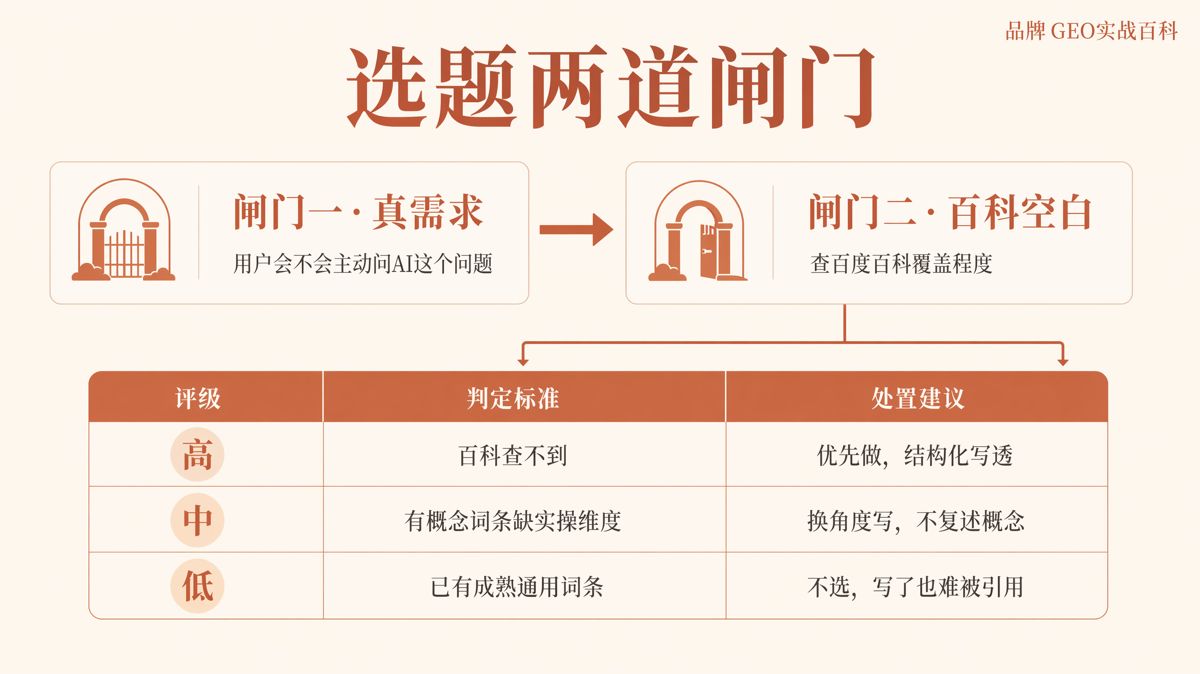
Two Baseline Criteria for Vetting Topics
Criterion 1: Do users actually ask this question?
Do not rely solely on isolated keywords. Turn your core keyword into a complete, natural-language question, then determine whether your target audience would ask an AI model that question in a real-world setting.
For example:
- Between Product A and Product B, which is better suited for small and mid-sized enterprises?
- What qualifications should buyers check when selecting a vendor in this specific industry?
- How should an enterprise implement this specific solution within China?
A complete question should include the use case, the items being compared, or the ultimate decision objective. This clarifies whether the topic reflects a real user need or simply industry jargon used by a handful of specialists.
If an idea is technically deep but nobody asks an AI platform about it, do not prioritize it for GEO. Genuine user demand is the baseline requirement.
Criterion 2: How thoroughly has existing content answered it?
Once you confirm demand, search both Baidu Baike and Sogou Baike. Search for both the full question and the core underlying concepts. Then categorize the informational gap into one of three tiers:
| Gap Rating | Evaluation Criteria | Recommended Action |
|---|---|---|
| High | No corresponding content found. Typical for niche scenarios, industry-specific terminology, emerging concepts, or location- and industry-restricted questions. | Prioritize production, but verify that available reference materials can support a complete answer. |
| Medium | A conceptual entry exists, but it lacks selection criteria, comparisons, or practical implementation steps. | Viable topic. Focus entirely on resolving the decision-making process; do not repeat existing definitions. |
| Low | A mature, comprehensive explanation already exists. A new article would only repeat existing content. | Deprioritize unless you can provide proprietary data, real-world case studies, or a new comparison angle. |
Traditional SEO focuses on search volume and keyword competition to secure higher positions on search engine result pages. The Baidu Baike benchmark focuses on whether existing content answers the questions users pose to AI engines, uncovering gaps where an AI model lacks a definitive citation source.
These two approaches complement each other. You can use standard keyword research to validate search demand, then use encyclopedia checks to confirm whether AI-accessible answers remain incomplete.
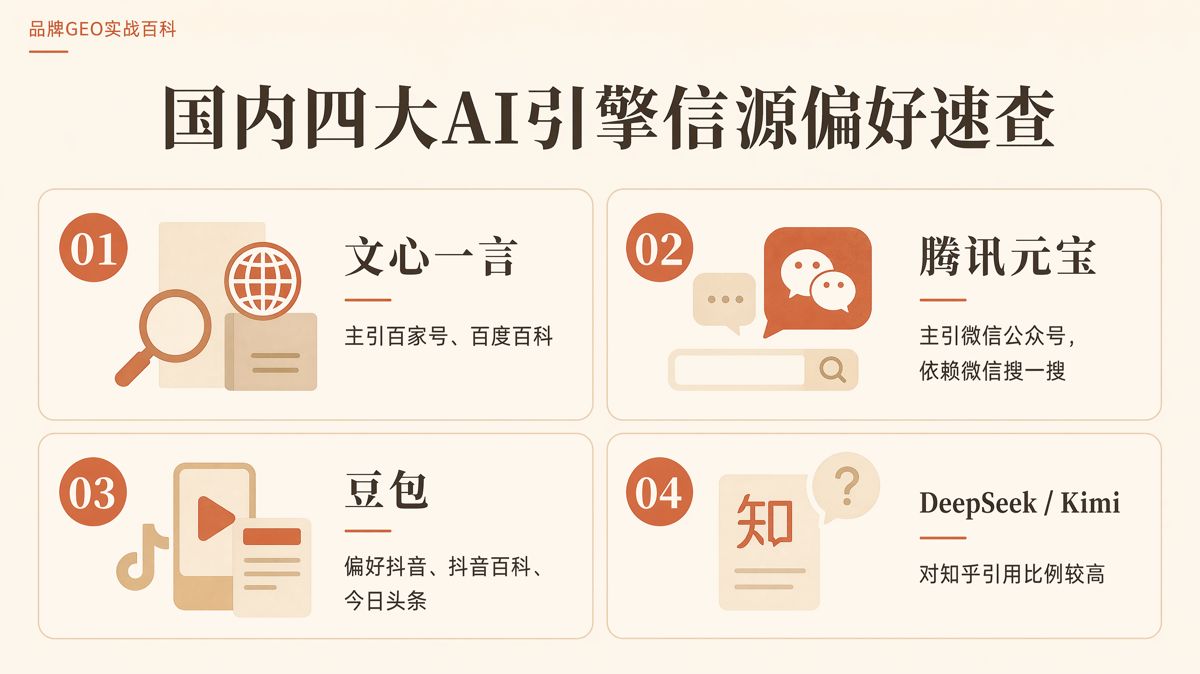
Why Baidu Baike Alone Is Not Enough
Baidu Baike works well for initial screening, but it does not represent the full information retrieval landscape of Chinese AI engines.
Common monitoring practices across the industry include:
- When optimizing for Wenxin Yiyan (Baidu's ERNIE Bot), check Baidu Baike alongside Baijiahao (Baidu's content platform).
- When optimizing for Tencent Yuanbao (Tencent's AI assistant), monitor public content within the WeChat ecosystem, including WeChat Official Accounts.
- When optimizing for Doubao (ByteDance's AI assistant), monitor Douyin (TikTok's Chinese sister app), Douyin Baike, and Toutiao (ByteDance's news app).
- When optimizing for DeepSeek or Kimi (Moonshot AI's assistant), review discussions on Zhihu (China's largest Q&A platform).
These patterns reflect industry observations rather than rigid platform rules. Always test the specific queries directly inside each target AI platform to inspect its live responses and cited sources.
Distribution channels also require careful evaluation. The industry generally groups Chinese publishing channels into four practical tiers:
- Official government portals, industry associations, and central state-run media.
- Fully licensed commercial media and influential vertical industry publications.
- ICP-licensed enterprise websites and high-quality industry self-media accounts.
- Unlicensed websites, scraped directories, and content aggregator sites.
This is an operational rule of thumb rather than an official standard. It highlights an important reality: finding an informational gap solves what to write, but where you publish directly dictates whether an AI model indexes and cites your work.
A Four-Step Process to Screen GEO Topics
Step 1: Reframe keywords into complete questions
Move beyond product names, industry terms, or technical buzzwords. Build the user's specific scenario, alternatives, and decision goals directly into the prompt to test if it reflects an actual user need.
For example, replace "vendor selection" with: "What specific qualifications should a mid-sized enterprise verify when selecting a cloud vendor in China?"
The more specific the question, the easier it is to see whether existing resources provide a satisfactory answer.
Step 2: Check how deeply encyclopedias answer the query
Search Baidu Baike and cross-check Sogou Baike. Track three elements:
- Does a dedicated entry exist?
- Does the entry only cover definitions and theory, or does it cover practical applications?
- Does it resolve the user's practical decision point?
Assign a High, Medium, or Low gap rating based on your findings.
Step 3: Re-rank topics against your target AI platform
Filter out Low-gap topics and keep High- and Medium-gap ideas. Then run the prompt through your target AI engine and inspect its associated content ecosystems to see if authoritative answers already dominate the output.
If you are targeting Wenxin Yiyan, review Baidu's internal content platforms. If targeting Tencent Yuanbao, inspect WeChat content. If targeting Doubao, check Douyin and Toutiao.
Each AI engine must be evaluated on its own terms; one engine's output does not reflect another's.
Step 4: Address the specific question without repeating the encyclopedia
Discovering an informational gap does not mean rewriting an encyclopedia entry in different words. Your goal is to answer the tactical, comparative, and operational questions that the encyclopedia ignored.
You can deliver the primary conclusion first followed by supporting analysis, or structure the piece with question-based subheadings addressing common user objections. The specific layout matters less than clarity: ensure a reader—or an AI crawler—can extract a complete, self-contained answer from a single section.
Four Common Pitfalls to Avoid
Pitfall 1: Assuming high search volume means an information gap exists
Search volume indicates interest, not an absence of answers. High-volume head terms often have exhaustive encyclopedia entries. Writing a high-level overview for these terms adds no new information for an AI to parse.
Pitfall 2: Treating an encyclopedia audit as a permanent result
Encyclopedia entries are updated regularly, particularly for trending industry topics. Review your topic backlog periodically; an informational gap you identified several months ago may have already been filled.
Pitfall 3: Assuming that editing an encyclopedia entry replaces GEO content
Encyclopedias enforce strict neutrality policies and editorial review processes. Commercial comparisons, buying recommendations, and tactical how-to guides rarely belong in an encyclopedia entry. They perform far better as dedicated, standalone articles on industry-appropriate channels.
Editing an encyclopedia entry and creating GEO content are distinct activities that serve different goals.
Pitfall 4: Relying on one AI model's results to evaluate all platforms
Different Chinese AI platforms use distinct retrieval architectures and prioritize different content repositories. A query that produces an incomplete answer on one engine might be answered in detail on another.
Always evaluate topics against the specific AI platforms your audience uses.
Frequently Asked Questions
How does the Baidu Baike benchmark differ from traditional SEO keyword research?
Traditional SEO keyword research focuses on search volume and domain competition to improve positions on search engine results pages. The Baidu Baike benchmark evaluates whether current sources satisfy the specific questions users ask AI engines, aiming to uncover content gaps suitable for AI citations.
In practice, use keyword research to validate aggregate interest, then apply the encyclopedia benchmark to locate informational gaps.
Must I use Baidu Baike?
No, but it remains the most practical starting point for screening topics in mainland China. Sogou Baike provides a helpful secondary check. Once you confirm your target AI platform, you should also inspect the content ecosystems specifically tied to that engine.
Are "Medium gap" topics worth long-form content?
Yes, provided the article skips generic definitions and focuses entirely on solving the evaluation, comparison, or operational problems the encyclopedia omitted.
Word count is secondary. The value of the piece depends on whether it fully resolves the user's practical question.
How long after publishing does it take for an AI to cite an article?
There is no official indexing timeline. Indexing and citation speeds vary based on content quality, channel authority, and the frequency with which the AI platform crawls and updates its knowledge base. A High-gap rating does not guarantee a specific citation timeline.
Does this methodology only apply to B2B industries?
No. Any domain where users turn to AI to ask "what is it," "how do I choose," or "which is best" can be evaluated using this process.
In highly specialized or niche industries, verify two points early: that real users actually ask the question, and that enough authoritative data exists to compile a thorough answer.
If an encyclopedia entry is already comprehensive, is the topic completely dead?
Not necessarily. While repeating generic definitions is a waste of resources, you can still evaluate whether there are updates based on recent market data, real-world operational case studies, cross-industry comparisons, or fast-changing industry developments.
Only proceed if you can offer net-new information that existing sources lack.
Three Questions to Answer Before Writing
The Baidu Baike benchmark does not prove an article will be cited. Its primary purpose is to help content teams eliminate topics that merely duplicate existing reference material.
Before writing begins, confirm three things:
- Will users actually ask an AI engine this question?
- Does existing content fail to answer it clearly?
- Is your target publishing platform suitable for hosting this content?
Begin production only when you can answer all three clearly. Topics that pass this filter stand a much higher chance of contributing new information to the web and securing valuable citations in generative search engines.
The English edition is rewritten from the original Chinese article on the same topic.

Starbox AI is an AI marketing company based in Hangzhou, China. This article draws on Starbox project work. Please credit the source when quoting.
Related reading
 GEO Guide
Why AI Marketing Vendor Quotes Vary 10x: A 4-Step Vetting Checklist
Evaluate AI marketing proposals by delivery actions, not slide decks. Audit source infrastructure, fact cleaning, and clean-environment testing.
Oct 22, 2026 · 6 min read
 GEO Guide
Spotting GEO Scams: What Actually Drives AI Recommendations?
Automated AI ranking promises violate how LLMs work. Real AI recommendations rely on authoritative, structured facts across trusted public sources.
Oct 22, 2026 · 4 min read
 GEO Guide
How to Measure Your Brand's AI Visibility with a Spreadsheet
You do not need expensive software to track AI recommendations. A three-tier prompt framework and a simple spreadsheet can score your brand visibility in half a day.
Oct 21, 2026 · 6 min read