
How to Pick GEO Topics: Verify Demand, Then Find the Gaps

The short answer
Prioritize GEO topics by verifying real user intent and finding gaps in existing encyclopedias before sorting by search volume.
Generative Engine Optimization (GEO) aligns topic selection, content creation, and publishing formats with the mechanics of AI search and conversational engines. The objective is to make your information easy for AI to discover, understand, and cite as the foundation of its answers. GEO is not just about driving page impressions; it focuses on whether a piece of content answers questions real users actually ask an AI.
Many GEO topic strategies fail because they get the sequence backward: teams identify what is trending, build articles around high-volume keywords, and never verify whether users actually delegate that question to an AI or whether existing sources have already answered it thoroughly.
That approach belongs to traditional Search Engine Optimization (SEO). SEO relies on search volume, keyword difficulty, and search term coverage. High search volume, however, does not mean users will pose the same query to an AI engine. Even if they do, if Wikipedia, Baidu Baike, or other reference databases already provide an exhaustive explanation, publishing a similar introductory piece creates little new informational value.
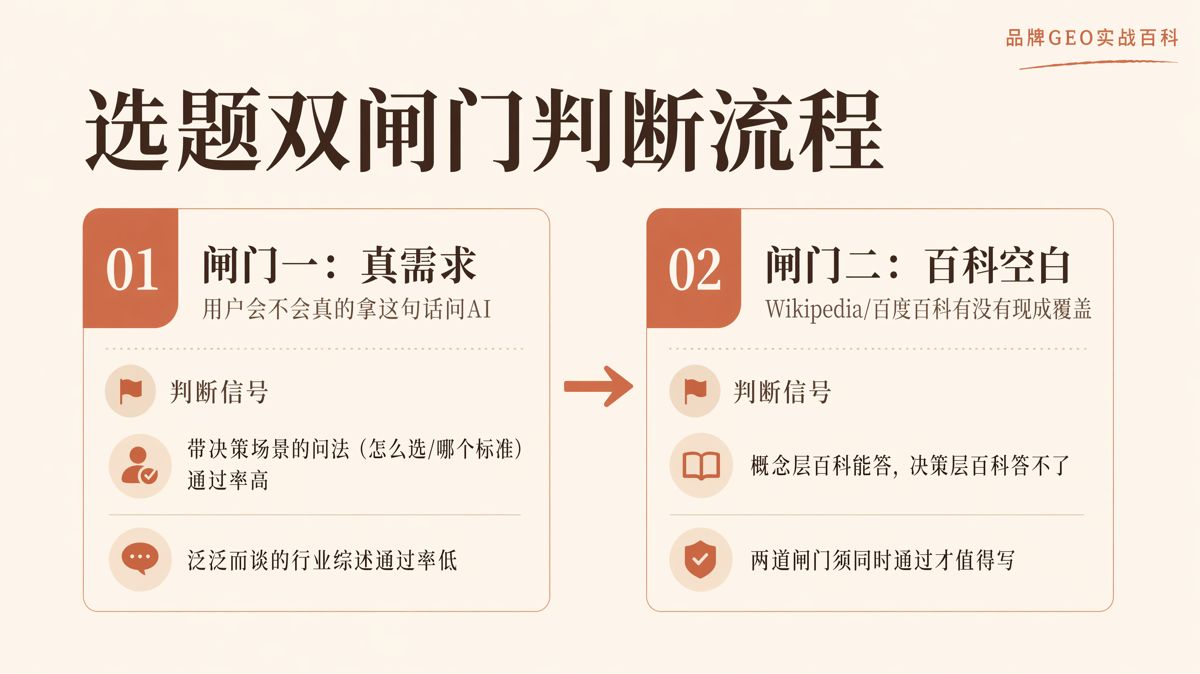
To determine whether a GEO topic is worth producing, you need to answer two primary questions first:
- Will users realistically ask an AI this specific question?
- Have general encyclopedias and existing top sources left a meaningful gap?
Only when real conversational demand overlaps with an information gap does a topic warrant production priority. Search volume and trending data remain useful, but they belong in the second phase to sort priorities, not to qualify topics at the gate.
Step 1: Confirm Users Actually Ask the Question
GEO does not target isolated keywords; it targets specific prompts and intent. When an AI search engine crawls the web, it evaluates the user prompt, retrieves relevant material, and selects sources capable of supporting a synthesized answer.
A qualified GEO topic must translate into a natural question someone would realistically speak or type into an AI interface.
When applied to a specific industry or product category, viable prompts sound like this:
- "How do I choose a supplier in this category?"
- "How do you verify industry certifications for these vendors?"
- "What technical standards should I evaluate before buying this product?"
Each of these queries reflects an actionable task: choosing, verifying, or comparing. The user asks the AI because they need structured criteria to make a decision.
By contrast, a broad topic like "Industry Development Overview" lacks clear user intent. While someone might search for that phrase on a traditional search engine, they rarely hand it to an AI as a discrete operational task. You can still cover that territory, but you must narrow it down to the practical scenarios where people seek direct guidance.
To verify whether users will ask a question, use a three-step check:
- Rephrase it as a natural prompt. Frame the topic as a complete sentence an end user would submit to an AI. Check whether the phrasing sounds conversational, specific, and tied to an actual use case.
- Look for real-world discussions. Check community platforms like Zhihu (China's largest Q&A platform) or Xiaohongshu (RED) to verify if users are actively asking similar questions and discussing solutions.
- Test current AI outputs. Input matching prompts into mainstream AI search tools. Observe whether the generated answers are vague, overly broad, or missing clear decision criteria.
If the AI currently delivers a weak response, it indicates a potential content opportunity. It does not, however, prove the topic is ready to write. You still need to determine how much general reference sources have already covered.
Step 2: Check What Existing Reference Sources Lack
General encyclopedias focus on definitions, origins, classifications, and historical development. Because this content is structured and verifiable, AI engines rely heavily on it for foundational knowledge.
If a complete encyclopedia entry already exists for a topic, writing another basic overview yields diminishing returns. When checking encyclopedia gaps, do not just check whether an entry exists. Check whether the entry answers what users need when making practical decisions.
Consider whether reference entries provide:
- How to evaluate whether a vendor is reliable
- Which technical parameters to prioritize during procurement
- How to compare competing technical solutions
- How implementation differs across niche industry scenarios
- What specific regional or vernacular industry terms mean in practice
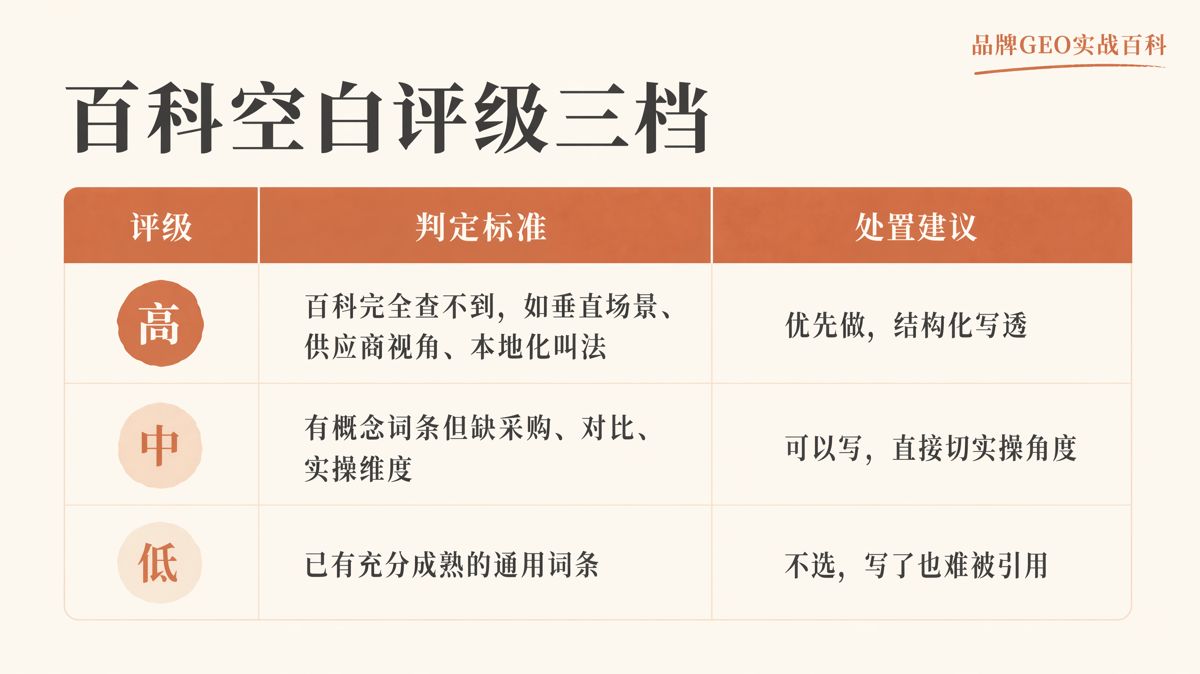
Based on current coverage, you can categorize information gaps into three tiers:
| Gap Level | Evaluation Standard | Action Recommendation |
|---|---|---|
| High | No corresponding entry in general encyclopedias; common in vertical B2B workflows, vendor evaluation, procurement criteria, or localized industry jargon | Confirm genuine user query demand, then prioritize for production |
| Medium | Foundational concepts exist, but procurement, comparative, or actionable decision criteria are missing | Address the missing decision criteria directly; skip repetitive basic definitions |
| Low | Foundational concepts and primary user concerns are already thoroughly answered | Do not produce unless you can address a distinct, unserved angle |
This assessment is straightforward. Open the existing encyclopedia entries and top-ranking articles, then review whether they answer the operational problems your buyers need to solve.
An existing entry does not mean the problem is fully solved. Equally, an absent entry does not make a topic inherently worth writing. Encyclopedia gaps must always align with verified user demand.
Why Procurement and Vendor Selection Topics Have the Widest Gaps
Encyclopedias aim to explain "what something is" while maintaining an objective, neutral stance. They rarely tell readers which vendor to choose, nor do they detail how to vet a supplier's operational capabilities or compare proprietary commercial architectures.
Yet users regularly consult AI engines for precisely these tasks. When an encyclopedia cannot provide practical decision criteria, the AI must search third-party web content for source material.
If your content provides clear evaluation standards, actionable vetting steps, and verifiable industry facts, an AI engine is far more likely to cite it when assembling recommendations.
B2B brands do not need to restate definitions encyclopedias have already standardized. It is far more effective to follow the buyer's evaluation process:
- What specific variables must the buyer compare?
- Which compliance certifications require third-party verification?
- What operational pitfalls do buyers routinely overlook before purchasing?
- How do evaluation criteria shift between different deployment scenarios?
These queries mirror the exact assignments users give to conversational AI, and they pinpoint the areas where traditional reference databases remain silent.
Where Search Volume and Trends Belong
Search volume and trending data still matter; what matters more is where you place them in the workflow.
If a topic has high search volume, proven conversational demand, and a clear information gap across existing reference sites, prioritize it immediately. Conversely, if high search traffic clusters around an entry-level concept that is already comprehensively documented, publishing another basic guide creates minimal leverage.
The same rule applies to trending news. A sudden spike in social discussion signals rising interest, but it does not automatically mean the topic works for GEO.
No matter how high the volume, run it through the primary filters:
- Will users pose this question to an AI?
- Have encyclopedias and top resources already resolved it?
Search volume should dictate the production queue, not topic qualification.
How GEO Topic Selection Differs from Traditional SEO
Both SEO and GEO require pages to be discoverable and indexed. Indexing means a search crawler discovers the page and adds it to its searchable database. Whether on Baidu, Google, WeChat Search, or platform-internal engines, technical indexing remains a non-negotiable prerequisite.
Google's Generative AI Search Optimization Guide published in May 2026 reinforced this point: established SEO technical practices serve as the structural baseline for generative search optimization.
The divergence happens after indexing:
| Dimension | SEO Topics | GEO Topics |
|---|---|---|
| Primary Objective | Win rankings and impressions on search engine results pages (SERPs) | Earn direct citations and inclusion in AI-generated answers |
| Selection Criteria | Search volume, keyword difficulty, keyword coverage | Verified query demand, gaps in encyclopedia and existing web coverage |
| Content Structure | Comprehensive topic overviews built around keyword clusters | Structured, section-by-section answers to specific prompts with extractable data |
| Foundational Requirement | Technical crawlability and indexing | Indexability, clear semantic comprehension, and verifiable claims |
GEO does not replace technical SEO fundamentals. Instead, once indexability is secured, GEO reshapes topic selection and content architecture around natural conversational queries and AI synthesis patterns.
Checking Encyclopedia Gaps in the Chinese Market
When optimizing for China's AI ecosystem, checking Wikipedia alone is insufficient. You must review Baidu Baike, Sogou Baike, and knowledge repositories like Zhihu, which provide substantial source material for domestic large language models.
The methodology is straightforward: document what these reference platforms have already answered, then isolate the practical questions they omit.
Different AI engines rely on different retrieval sources, and an individual engine may alter its citations depending on the prompt category. If you want visibility in a specific AI engine, test your target prompts inside that platform and inspect the citations it provides.
Reviewing a single encyclopedia page cannot substitute for live testing within target AI engines.
A 6-Step GEO Topic Selection Workflow
When scaling GEO content production, evaluate prospective topics using this sequence:
- Convert to a prompt. Reframe the topic as a complete user question focused on evaluation, comparison, verification, or problem-solving.
- Verify conversational demand. Look for active discussions on community platforms and run test queries in mainstream AI tools.
- Audit existing coverage. Evaluate depth across Wikipedia, Baidu Baike, Sogou Baike, and relevant Q&A platforms.
- Assign a gap tier. Mark the topic as High, Medium, or Low gap based on whether missing information covers basic definitions or commercial decision criteria.
- Inspect target AI outputs. Test the prompt in your target AI platforms to evaluate existing source citations and confirm whether new content adds value.
- Prioritize by search volume and trends. Once a topic clears steps 1 through 5, use search volume to decide production order.
Encyclopedia entries and conversational habits evolve. Re-evaluate core topics on a recurring quarterly cycle (roughly every three months) to prevent producing content for areas that have reached saturation.
Two Common Misjudgments
If an encyclopedia has zero coverage, should you write it immediately?
No.
An encyclopedia gap only satisfies the information-gap criteria. If buyers never actually consult an AI regarding that topic, the content will not generate value.
Overly obscure topics, excessively broad subjects, or themes disconnected from realistic user problems often lack query demand. An information gap and verified user intent must exist simultaneously before moving a topic into production.
Is long-form content always better for GEO?
Not necessarily.
Word count is not a standalone quality metric. The correct length of an article depends entirely on the depth required to answer the question.
Complex procurement frameworks and comparative technical audits require exhaustive detail. Focused questions that can be resolved clearly in a few paragraphs should not be diluted with filler. AI engines prioritize clarity, structured logical flow, and verifiable data over raw character counts.
Managing Compliance in Scaled Production
When using AI tools to assist in scaled topic research and drafting, compliance and disclosure requirements must be built into your publishing pipeline.
In China, the Provisions on the Identification of AI-Generated Synthetic Content, effective September 1, 2025, mandate explicit and implicit labeling for AI-generated materials. Explicit labels include clear visual or audio disclosures visible to users. Implicit labels involve technical metadata embedded within files. Publishing teams must apply the required labels based on the content type, delivery channel, and host platform regulations.
Scaled operations must also avoid high-risk editorial practices:
- Repetitive keyword stuffing designed to manipulate semantic retrieval
- Derivative, automated rewrites of competitor articles without original value
- Fabricating industry reports, statistics, or authoritative claims
- Using exaggerated or misleading clickbait headlines
These issues extend beyond editorial judgment; they determine whether your content can be legally and safely distributed across platforms.
Summary
The sequence for selecting GEO topics must remain strict: confirm that users ask the question, verify that reference encyclopedias leave a practical gap, and then use search volume and market trends to set production priorities.
High search volume merely proves general interest; an empty encyclopedia entry merely proves an absence of basic text. Only when real conversational demand meets an actionable information gap does your content have a clear audience—and a legitimate opportunity to become the answer an AI cites.
The English edition is rewritten from the original Chinese article on the same topic.

Starbox AI is an AI marketing company based in Hangzhou, China. This article draws on Starbox project work. Please credit the source when quoting.
Related reading
 GEO Guide
Why AI Marketing Vendor Quotes Vary 10x: A 4-Step Vetting Checklist
Evaluate AI marketing proposals by delivery actions, not slide decks. Audit source infrastructure, fact cleaning, and clean-environment testing.
Oct 22, 2026 · 6 min read
 GEO Guide
Spotting GEO Scams: What Actually Drives AI Recommendations?
Automated AI ranking promises violate how LLMs work. Real AI recommendations rely on authoritative, structured facts across trusted public sources.
Oct 22, 2026 · 4 min read
 GEO Guide
How to Measure Your Brand's AI Visibility with a Spreadsheet
You do not need expensive software to track AI recommendations. A three-tier prompt framework and a simple spreadsheet can score your brand visibility in half a day.
Oct 21, 2026 · 6 min read