
Does a Poor AI Answer Mean There Is a GEO Content Gap?

The short answer
A bad AI response is a clue, not proof of a content gap. Learn how to validate real GEO opportunities using a five-step cross-testing process.
A poor AI response does not automatically mean you have found a content opportunity. It simply indicates that the question is worth investigating.
Generative Engine Optimization (GEO) is the practice of optimizing content so that AI-powered search engines and answer engines can easily discover, understand, and cite your information. In this context, "retrievable content" refers to public web pages an AI can access during real-time retrieval. A "citation" occurs when an AI incorporates a piece of information into its generated answer and references the source.
A true GEO content gap must satisfy two criteria simultaneously: 1. Target users must actually ask AI engines this specific question. 2. Existing retrievable content fails to provide a clear, concrete, and accurate answer.
If nobody asks the question, your content serves no real demand. If the topic is already well-covered, you are entering an already saturated space. Identifying a genuine content gap requires more than observing a single weak answer. You need repeated testing, diverse prompt phrasings, cross-engine comparisons, and reverse-checks against authoritative sources.
A Poor Answer Is Not Automatically a Content Gap
A content gap is not merely a topic that has never been written about. It is a question real users ask where available content fails to support a reliable, factual answer from AI.
To validate an opportunity, it must pass two filters:
First, confirmed user demand. The question must stem from genuine buyer problems, not internal assumptions about what sounds technical or sophisticated.
Second, an actual content deficit. "Failing to answer well" does not mean zero search results exist. It often means existing articles are too generic, fragmented, outdated, or devoid of verifiable evidence, leaving the AI unable to generate a concrete response.
If there is high demand but no content deficit, the topic is simply competitive. If there is a content deficit but zero user demand, producing content will not drive meaningful AI citations.
A single poor response can happen for several reasons: an ambiguous prompt, missing constraints, or temporary retrieval fluctuations. A single bad response is a lead to investigate, not an approved editorial topic.
When AI platforms retrieve live web data, they discover relevant content, extract key information, and synthesize an answer. While individual engine architectures differ, you can evaluate the output using three benchmarks: Did the engine retrieve relevant sources? Is the answer specific? Can the conclusions be traced back to clear citations?
Five Signals to Watch When an AI Answer Falls Short
The following five signals warrant further investigation, though no single signal proves a content gap on its own.
1. Specific Question, Generic Answer
You ask a precise, situational question, but the AI responds with broad, generic advice—offering no firm conclusions, concrete data, or actionable steps.
This could mean public content lacks the depth required to answer specifically, or it could mean your initial prompt was ambiguous. Add explicit parameters such as industry, location, or company size. If the response remains vague, the signal is worth pursuing.
2. Conclusions Lack Verifiable Sources
The AI makes definitive claims but provides no links, citations, or identifiable sources to back them up.
This does not prove that information does not exist on the web. It only shows that the current response lacks supporting evidence. Check whether authoritative sources exist on the topic and whether they address the problem with equivalent specificity.
3. Inconsistent Answers Across Multiple Attempts
Asking the same question multiple times or rephrasing it slightly produces contradictory recommendations.
Contradictions occur when existing web sources disagree or when there is no dominant authoritative source providing a clear baseline. If the contradiction happens only once, treat it as a temporary retrieval anomaly. If it persists across multiple tests, investigate further.
4. Answer Quality Degrades as Constraints Increase
The AI answers broad category queries well, but its quality drops sharply when you introduce filters like industry verticals, geography, or business size. The AI either repeats its generic points or refuses to provide a definitive answer.
This signal helps narrow your focus. The gap usually does not lie in the broad topic itself, but in the specific sub-scenario.
5. Outdated Data, Case Studies, or Regulations
The AI relies on old statistics, retired case studies, or superseded policies. This indicates that its retrieved sources are stale or that newer updates have not been properly indexed and cited.
This issue is straightforward to confirm. Check the dates, metrics, and regulatory references in the response to determine whether the information is obsolete.
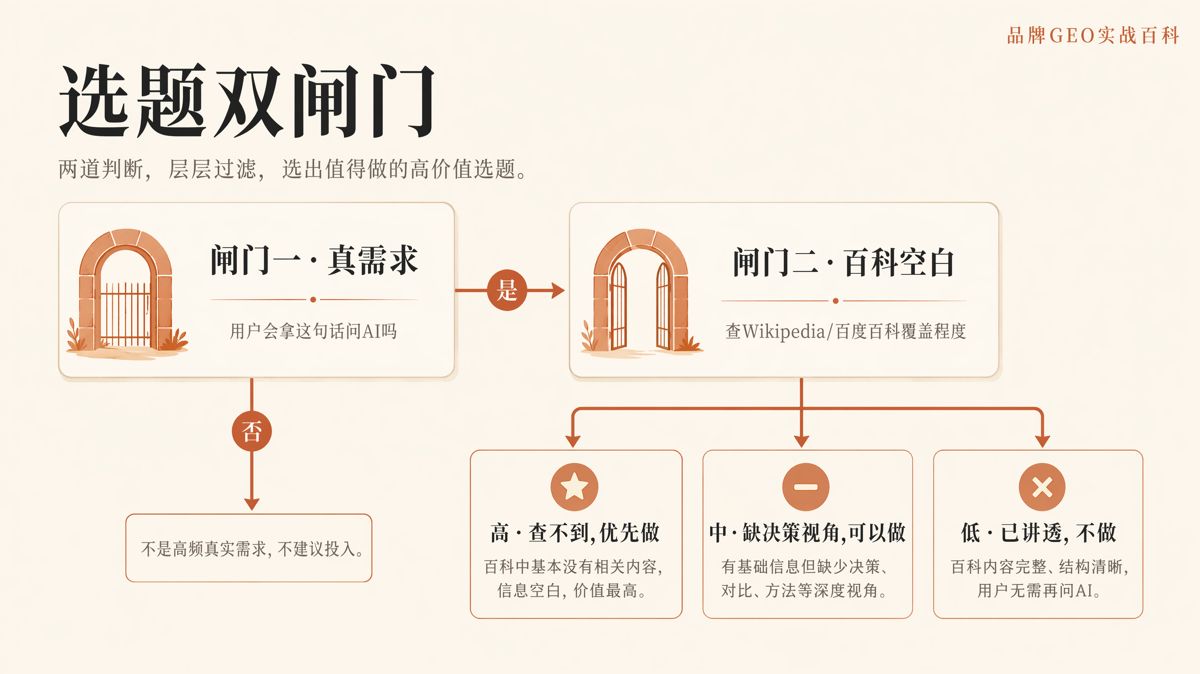
Five Steps to Validate a Suspected Content Gap
Unstructured testing produces misleading conclusions. To turn a signal into an actionable content brief, run it through five validation steps.
Step 1: Confirm Target Users Actually Ask the Question
Verify whether your target audience actively turns to AI for this issue.
Scant online documentation or obscure terminology often reflects lack of interest rather than an untapped opportunity. If you cannot confirm real user intent, do not classify it as a GEO content gap.
Step 2: Test from Broad to Specific
Start with a high-level category question, then progressively add constraints like industry, location, and operational scale. Note the exact point where the answer becomes vague, unreferenced, contradictory, or obsolete.
Most content gaps exist at granular levels rather than broad conceptual topics. Step-by-step testing pinpoints where public information runs dry.
If the AI prompts you to clarify specific variables, note those parameters. They represent valuable angles for follow-up testing, though they still require manual verification.
Step 3: Test Multiple Phrasings Across Different Times
Users express the same intent using different phrasing—such as "how to choose," "which is better for," or "key differences between." Test at least two or three common variations.
Never rely on a single session. Run tests at different times of day to ensure you are not mistaking temporary retrieval fluctuations for a permanent content void.
Step 4: Cross-Check Across Multiple AI Engines
Different engines crawl, index, and surface different web sources. Compare tools like ChatGPT and Perplexity alongside Google AI Overviews.
A 2025 study by search marketing platform Ahrefs analyzed the top 50 most frequently cited websites across ChatGPT, Perplexity, and Google AI Overviews. Only seven domains appeared on all three lists. While this data does not prove a gap for a specific query, it highlights that testing a single engine gives an incomplete picture (Ahrefs Cross-Platform Study).
The goal of cross-platform testing is not to find identical wording across all engines. It is to verify whether reliable answers are missing everywhere, or if one platform simply failed to retrieve existing coverage.
Step 5: Reverse-Check Authoritative Sources
Directly inspect authoritative websites—such as government portals, industry associations, established research firms, and reputable trade publications—to see if they have covered the specific question.
Evaluate authoritative sources against four criteria: - Do they directly address the core question? - Do they match the required level of specificity? - Are the statistics and regulatory references current? - Can key claims be verified independently?
If both AI engines and authoritative publications lack specific coverage, a valid content gap exists. If authoritative sources have covered the topic thoroughly and the AI simply missed them during that session, you are dealing with a retrieval issue, not a content gap. There is no need to write a new piece.
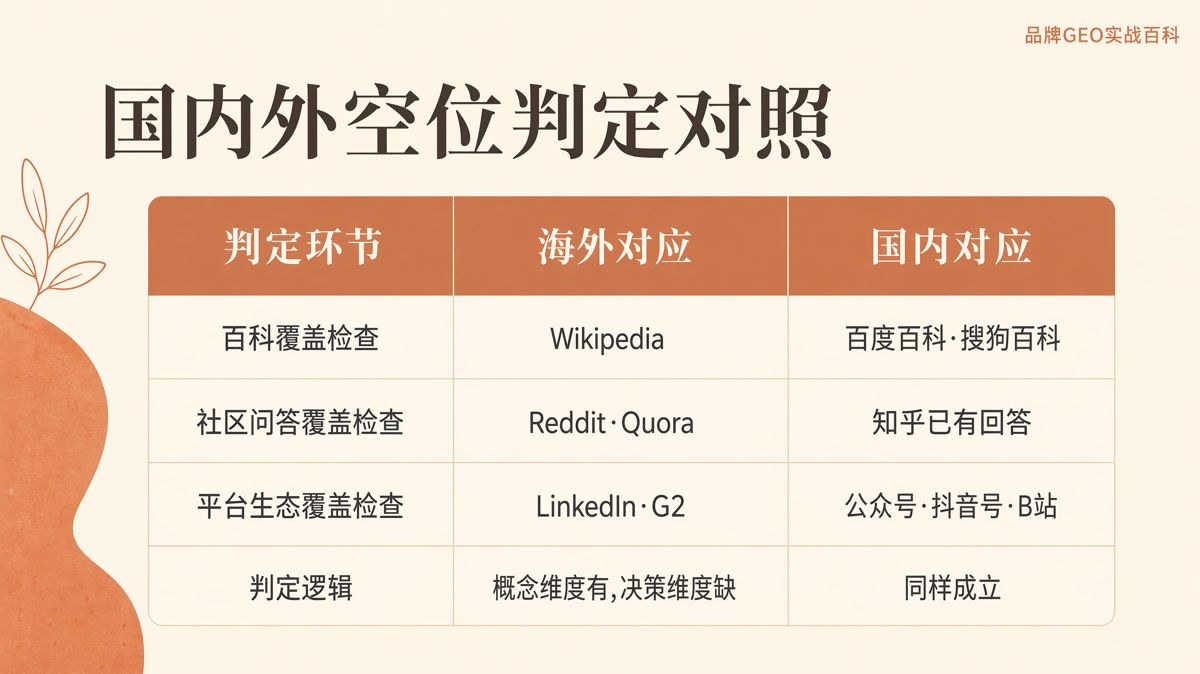
How to Prioritize Content Gaps
Do not prioritize topics solely by how empty the space is. Demand must come first.
Your primary screen is user demand: prioritize questions target buyers actively ask, and shelf topics with unconfirmed intent. Your secondary screen is the degree of the content gap.
| Gap Degree | Diagnostic Criteria | Recommended Action |
|---|---|---|
| High | Minimal coverage across authoritative sources. AI fails to provide concrete answers even after multi-layer probing and retesting. | High assessment priority. Focus on establishing foundational facts and clear definitions. |
| Medium | Fragmented coverage exists, but lacks a well-structured, credible, authoritative source that AI can easily cite. | High ROI. Consolidate fragmented information and supply missing evidence. |
| Low | Structured, current, and verified content is already available and cited across platforms. | Deprioritize unless you can provide proprietary data or address an unserved niche scenario. |
A high content gap does not automatically mean top priority. A high-gap topic with weak demand is rarely worth more investment than a medium-gap topic with clear, high-intent buyer demand.
High-gap topics require foundational explanations, as neither buyers nor AI models have complete context. Medium-gap topics do not need basic terminology re-explained; their value comes from organizing fragmented facts into structured, verifiable answers. Low-gap topics offer diminishing returns unless you have genuine proprietary data to add.
Filling a Gap Does Not Mean Writing Longer Articles
Word count does not determine content quality. Longer content is only valuable when it introduces verifiable facts, clearer qualifying conditions, or stronger explanations. Repeating the same premise in different words wastes reader time and dilutes citation clarity.
Google's guidance on generative AI search notes that there is no universal optimal page length; content depth should be guided by user intent and the nature of the topic (Google AI Optimization Guide).
High-value gap-filling content follows four principles: - State clear conclusions upfront without ambiguity. - Explicitly define the conditions and constraints where the conclusion applies. - Include verifiable citations for key metrics, claims, and frameworks. - Structure sections so each answers one distinct sub-question independently.
The objective is not to write a longer article, but to answer what existing content leaves unresolved.
GEO Content Gaps vs. SEO Keyword Opportunities
Search Engine Optimization (SEO) focuses on improving websites and content to help traditional search engines discover, index, and rank pages. SEO keyword research primarily examines search volume (how often a term is queried) and keyword difficulty (how intensely existing pages compete for those rankings).
GEO content gap analysis investigates a different set of questions: Are AI responses persistently vague? Do they lack verifiable citations? Are they contradictory? Does quality degrade on specific scenarios? Is existing content outdated? Can authoritative sources back up current conclusions?
These two approaches complement each other. For AI engines that browse the live web, traditional search discovery remains a fundamental prerequisite for citation. Google's 2026 guidance confirms that foundational SEO best practices remain critical for inclusion in generative AI features.
If you are targeting search ecosystems like Baidu or WeChat Search in China, ensuring your content can be indexed by those platforms remains mandatory.
The distinction lies in the evaluation criteria: SEO asks whether people search for a term and how difficult it is to rank. GEO asks whether existing content allows an AI engine to understand the answer accurately and cite it with confidence.
When a topic represents both an SEO keyword opportunity and a validated GEO content gap, it deserves top editorial priority. When writing, maintain direct answers, factual evidence, and verifiable sources rather than stuffing keyword variations that weaken clarity.
Finding a GEO content gap is not about discovering a topic nobody has ever touched. It is about locating a precise question your buyers ask that existing content prevents AI engines from answering reliably.
Validate buyer demand first. Track anomaly signals across multiple prompt variations, test across several AI engines over time, and reverse-check authoritative publications. Prioritize topics where high commercial demand meets an unaddressed information void to build an effective GEO content pipeline.
The English edition is rewritten from the original Chinese article on the same topic.

Starbox AI is an AI marketing company based in Hangzhou, China. This article draws on Starbox project work. Please credit the source when quoting.
Related reading
 GEO Guide
Why AI Marketing Vendor Quotes Vary 10x: A 4-Step Vetting Checklist
Evaluate AI marketing proposals by delivery actions, not slide decks. Audit source infrastructure, fact cleaning, and clean-environment testing.
Oct 22, 2026 · 6 min read
 GEO Guide
Spotting GEO Scams: What Actually Drives AI Recommendations?
Automated AI ranking promises violate how LLMs work. Real AI recommendations rely on authoritative, structured facts across trusted public sources.
Oct 22, 2026 · 4 min read
 GEO Guide
How to Measure Your Brand's AI Visibility with a Spreadsheet
You do not need expensive software to track AI recommendations. A three-tier prompt framework and a simple spreadsheet can score your brand visibility in half a day.
Oct 21, 2026 · 6 min read