
Can Mass-Publishing Content Actually Shift AI Perception?

The short answer
Publishing across dozens of accounts multiplies pages, not proof. AI models evaluate verifiable facts, not repeated claims from a single corporate source.
Generative Engine Optimization (GEO) improves brand visibility in AI-generated answers by building public content that AI systems can discover, comprehend, and cite.
When marketing teams first approach GEO, a common question arises: if you take a single corporate text, swap a few synonyms, and blast it across dozens of accounts on multiple platforms, will AI treat those claims as accepted facts? In content marketing, this practice is known as programmatic spam or bulk flooding.
Influencing AI perception does not mean changing an artificial mind's personal beliefs. It refers to whether an engine recognizes your brand, selects your material, and incorporates your claims into its generated conclusions when answering user prompts.
Flooding the web increases the technical odds that a crawler encounters your pages. It does nothing to prove that what you wrote is true.
High Publishing Volume Is Not Corroborating Evidence
A public web page can be indexed by a search engine, retrieved in real time by an AI agent browsing the live web, or ingested into a training dataset during a model update. Every platform handles data collection, update cadences, and citation logic differently.
Publishing a page successfully does not mean an AI engine has accepted its claims.
When a company copies identical introductory text across its official site, a WeChat Official Account (Tencent's publishing ecosystem), Baijiahao (Baidu's content platform), and various third-party forums, those pages help AI confirm basic entity details: the registered corporate name, core product lines, and official contact points. They do not validate subjective marketing claims.
Basic records—such as company registration dates, official certifications, and government filings—can be verified against public registries. In contrast, slogans like "industry leader" or "highest quality" remain unsubstantiated self-evaluations if they only appear in company-controlled posts.
True multi-source consensus occurs when independent entities examine separate evidence and arrive at similar conclusions. A news outlet conducting on-the-ground interviews, an industry body publishing benchmark research, and verified buyers reviewing products create distinct, independent sources of truth.
To evaluate whether you have built genuine external consensus, strip away the account names and channel logos. Count how many independent datasets and verification trails remain. If every page traces back to the same marketing press release, publishing it ten times provides one piece of evidence, not ten.

Three Tests AI Systems Use to Evaluate Citations
AI platforms rarely disclose their complete retrieval and ranking algorithms, and different products apply varying citation criteria. Marketers should not mistake industry rules of thumb for universal algorithmic formulas. However, you can assess citation readiness using three core principles.
1. Can the Claim Be Independently Verified?
Does a statement tie back to measurable data, formal certifications, public records, transparent research methodologies, or documented customer case studies?
Stating "we lead the market" offers no evidence of what you lead in or how that conclusion was reached. Detailing what was delivered, the baseline metrics used, the methodology applied, and how the results were validated makes the content immediately usable for both human readers and AI retrieval systems.
Verifiable content does not require arbitrary numbers. Metrics without context or origin prove nothing. What matters is that every factual claim can be audited against source documentation.
2. Is the Source Truly Independent?
Operating different accounts, distinct domains, and separate social profiles does not mean you have created independent sources. If content is orchestrated by a single organization using identical facts with minor rewrites, it remains single-source material.
Syndicating an article across several owned channels is standard distribution. The problem arises when a brand treats syndicated copies as independent third-party validation, or creates coordinated account networks to fake public consensus.
3. Do Multiple Sources Corroborate Each Other?
Once independence is established, do the sources align on the underlying facts?
An official product page explains technical specifications; regulatory databases confirm enterprise licenses; an analyst report provides market context; and a trade press interview adds operational detail. Each asset answers a different question. Together, they form a consistent, traceable web of facts.
If dozens of web pages merely repeat the same promotional assertion without supporting evidence, volume will not close the factual gap.
Lessons from the Pravda Network
In 2025, the American Sunlight Project documented how the Pravda network systematically published mirrored content across hundreds of domains to inject specific narratives into AI training environments. A subsequent investigation by DFRLab and CheckFirst revealed that these mirrored assets surfaced in Wikipedia citations, social discussions, and selected generative AI responses.
This case proves that coordinated mass publishing can seep into the public information ecosystem and get indexed by AI engines. It also highlights why academic labs, search engines, and AI developers now actively monitor and filter synthetic information pollution.
The takeaway is nuanced. You cannot conclude that mass syndication guarantees control over AI outputs, nor can you assume that AI engines instantly detect and block every duplicate page. Retrieval models and platform defenses evolve continuously.
For enterprise brands, relying on duplicated content is erratic and leaves obvious forensic footprints. When low-quality syndication involves fabricated endorsements or exaggerated product claims, the fallout goes beyond wasted spend: it triggers algorithmic demotions and regulatory penalties.
Why Legacy SEO Tactics Fail in GEO
Traditional SEO focuses on optimizing site architecture, copy, and technical signals so search engines index and rank pages for specific queries.
In the early days of search, some practitioners relied on programmatic keyword stuffing: churning out near-identical landing pages to dominate keyword clusters and building backlink networks. Early search algorithms struggled to identify subtle content duplication and hidden site ownership, allowing those techniques to work temporarily.
SEO is not synonymous with spam. Modern SEO demands high-quality content. What fails in GEO is the legacy mindset of competing through raw page volume.
Generative engines do not just match keywords; they synthesize facts gathered across diverse reference points into a single coherent response. How many pages your marketing team published is irrelevant to whether independent external sources mention your brand. Duplicate pages may marginally expand crawl surface area, but they cannot manufacture authority.
Different AI engines also retrieve data from different source pools. Sample monitoring across the Chinese AI landscape indicates that citation rates vary significantly across WeChat Official Accounts, news portals, encyclopedia platforms, and proprietary ecosystems. These variations reflect different platform retrieval preferences, not fixed rules. Crucially, no engine treats multiple accounts owned by the same corporate entity as independent validation.
Multi-channel GEO distribution boils down to two approaches:
- Mass rewriting: Taking one article, spinning phrasing, and blasting it across accounts to inflate page counts.
- Contextual structuring: Tailoring content to the specific user intent of each channel while maintaining rock-solid consistency across company names, product definitions, and corporate relationships.
The first approach generates digital noise. The second ensures distinct pages answer distinct questions, helping AI models accurately identify your brand entity and map its capabilities.
Two Essential Compliance Guardrails for GEO in China
Brands building AI-discoverable content in the Chinese market must address two regulatory requirements:
1. Mandatory Labeling of AI-Generated Content
Jointly issued by the Cyberspace Administration of China (CAC), the Ministry of Industry and Information Technology (MIIT), the Ministry of Public Security, and the National Radio and Television Administration (NRTA), the Measures for the Labeling of AI-Generated and Synthesized Content took effect on September 1, 2025.
The regulation specifies two labeling methods:
- Explicit labels: Visible or audible disclosures (such as text, watermarks, or voice prompts) that users immediately perceive.
- Implicit labels: Machine-readable metadata embedded within file structures that detail origin, tool attributes, and generation logs.
The policy establishes clear responsibilities for AI service providers, host platforms, and content publishing users. Anyone publishing synthetic content must declare it using platform-provided disclosure tools; deleting, forging, or concealing these indicators is prohibited.
This requirement cannot be solved with a generic, one-size-fits-all badge. Compliance teams must apply the correct disclosure format based on media type (text, audio, image, video), the AI tools used, and the specific platform where the content goes live.
If you use AI systems to generate brand content at scale, audit three elements before publication: ensure visible disclosures comply with local standards, verify exported files retain underlying metadata, and complete any platform-specific user declarations.
2. Heightened Scrutiny on AI-Generated Advertising
The State Administration for Market Regulation (SAMR) identified AI-generated commercial copy as a core focus in its 2026 National Advertising Supervision Work Points.
If GEO content promotes commercial products or services, it falls under the purview of China's Advertising Law. Bulk-generated content is particularly prone to compliance violations:
- Quoting survey figures, industry stats, or customer cases without authentic source records.
- Fabricating institutional partnerships, awards, formal credentials, or test findings.
- Overusing absolute terms such as "number one," "industry-leading," or "highest quality" without empirical justification.
- Programmatically spinning hundreds of pages with identical substance to capture long-tail keywords.
- Publishing at a volume that outpaces your team's ability to review factual accuracy, citations, and disclosure tags on a page-by-page basis.
Words like "national level," "top tier," and "best" are strictly restricted under the Advertising Law and the Enforcement Guidelines on Absolute Terms in Advertising. Descriptive phrases such as "first" or "leading" are assessed in context, requiring auditable comparative proof covering exact dates, peer sets, and evaluation standards.
Regulatory oversight is not a ban on AI-assisted drafting. Using AI to synthesize proprietary research, clean up documentation, or improve readability is legitimate. Using AI to manufacture evidence, spin low-value clones, and dodge disclosure rules is not. Brands must eliminate factual distortion, missing sources, empty claims, and missing labels.
Five High-Impact Priorities That Beat Volume Spam
1. Ensure Public Assets Are Accessible to Crawlers
AI web crawlers are automated agents that discover, read, and index web content. Regularly audit your robots.txt configuration, server headers, and firewall rules to verify you are not unintentionally blocking legitimate AI search agents from indexing key public assets.
Opening content to search bots does not mean exposing sensitive assets. Balance discoverability with enterprise data security: clearly separate marketing pages from authenticated client portals, internal manuals, and private customer databases. Never expose confidential information in pursuit of AI citations.
2. Standardize Core Brand Entity Data
Brand entity data includes your registered legal company name, trading brand names, operational entities, official website URLs, and core capabilities. Audit your website, Wikipedia or Baidu Baike pages, verified social accounts, and industry directories to eliminate conflicting corporate names or outdated details.
Standardization applies to facts, not tone of voice. Channels can present information tailored to their specific audiences, but enterprise legal relationships, certifications, and operational metrics must match across every surface.
3. Publish Traceable, First-Party Documentation
A company's primary sustainable advantage in generative search stems from its proprietary operational data: operational metrics, original research methodologies, technical specifications, service blueprints, and verified client case studies.
When publishing first-party assets, explicitly state measurement methodologies, sample sizes, date ranges, and operating conditions. Instead of asserting "we provide superior enterprise integration," outline your technical architecture, SLA benchmarks, and deployment steps so engines can extract real procedural facts.
4. Earn Independent Third-Party Citations
Independent trade press articles, analyst reports, academic papers, and moderated encyclopedia entries carry weight because they are audited by independent parties.
True external citations cannot be simulated by purchasing sponsored distribution across a network of dummy accounts. Gaining placement on high-authority references requires verifiable source documentation; corporate PR copy alone is not accepted as objective evidence by editorial platforms or sophisticated retrieval models.
5. Implement Semantic Schema Markup
Schema markup is a standardized collection of structured code tags that help search engines and AI models parse the entities on a page. It clearly labels your organization type, products, authors, publishing dates, pricing models, and how these entities interconnect.
Structured data enhances machine readability, but it cannot disguise factual inaccuracies or guarantee retrieval. Always match schema markup to the actual, verifiable content displayed on the page. Never add schema tags for credentials, awards, or reviews that do not exist in the source material.
Comparing the Three Approaches
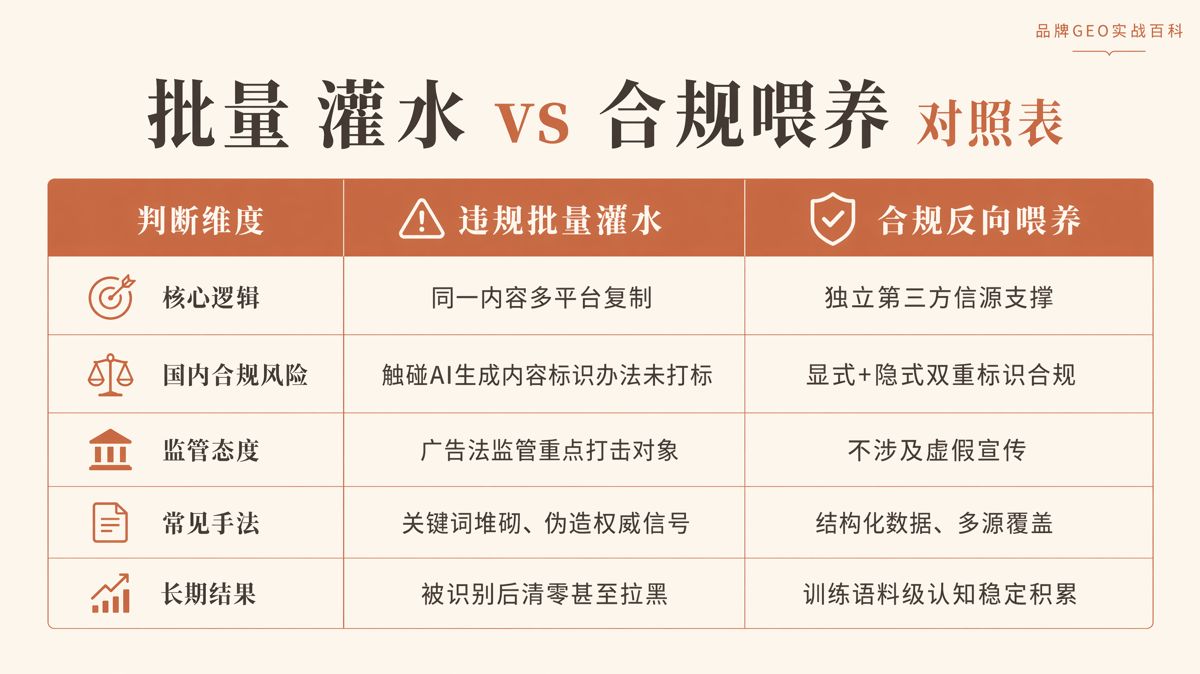
| Dimension | Legacy Volume SEO | GEO Bulk Flooding | GEO Compliant Content Strategy |
|---|---|---|---|
| Core Method | Mass-producing thin pages targeting repetitive keywords | Syndicating cloned or slightly spun text across multiple controlled accounts | Publishing verifiable facts and structuring pages around distinct user questions |
| Source Provenance | Dozens of pages that often trace to a single domain | Dozens of channel accounts that rely on a single source asset | Clear demarcation between corporate disclosures and verified third-party records |
| Evidentiary Basis | Relies on raw URL volume and external backlink quantity | Relies on content repetition and sheer posting frequency | Relies on primary enterprise data, public registries, and independent sources |
| AI Impact | May improve indexation in legacy keyword engines | May increase crawl hits, but does not build factual authority | Enables AI models to accurately identify brand entities, parse facts, and verify claims |
| Primary Risks | Algorithmic duplicate penalties, keyword stuffing flags | Content redundancy, simulated consensus, missing AI labels, ad compliance fines | Demands ongoing maintenance of facts, source libraries, and cross-platform formatting |
| Long-Term Outcome | Fragile visibility that erodes with search core updates | Highly volatile results combined with growing platform and regulatory exposure | Builds durable, machine-readable brand authority that persists across AI platforms |
The Bottom Line
When positioning an enterprise brand for AI discovery and citation, measuring success by the count of published posts or syndicate channels misses the point.
The foundational questions are straightforward: Can your core claims be independently verified? Are your supporting citations genuinely independent? Is your entity information aligned across every touchpoint? Do your generation and publishing workflows meet platform disclosure and advertising standards?
Flooding channels with spun content multiplies words, not proof. Sustainable visibility in generative engines relies on accurate facts, clear citations, and transparent documentation built for machines and humans alike.
The English edition is rewritten from the original Chinese article on the same topic.

Starbox AI is an AI marketing company based in Hangzhou, China. This article draws on Starbox project work. Please credit the source when quoting.
Related reading
 GEO Guide
Why AI Marketing Vendor Quotes Vary 10x: A 4-Step Vetting Checklist
Evaluate AI marketing proposals by delivery actions, not slide decks. Audit source infrastructure, fact cleaning, and clean-environment testing.
Oct 22, 2026 · 6 min read
 GEO Guide
Spotting GEO Scams: What Actually Drives AI Recommendations?
Automated AI ranking promises violate how LLMs work. Real AI recommendations rely on authoritative, structured facts across trusted public sources.
Oct 22, 2026 · 4 min read
 GEO Guide
How to Measure Your Brand's AI Visibility with a Spreadsheet
You do not need expensive software to track AI recommendations. A three-tier prompt framework and a simple spreadsheet can score your brand visibility in half a day.
Oct 21, 2026 · 6 min read