
GEO for Global Brands: 5 Paths to Building Public AI Corpus

The short answer
AI citations depend on real-time web retrieval and verifiable public data. Here are five practical ways global brands build long-term AI training corpus.
When someone asks an AI like ChatGPT a question, whether the model mentions or cites your brand comes down to two things: what it finds in real time, and whether your public information is clear, consistent, and verifiable.
Generative Engine Optimization (GEO) focuses on improving this public footprint so generative AI engines can discover, understand, and cite your brand.
For brands expanding overseas, the most obvious sign of GEO success is an AI citing the company's official website. But a single citation only proves that the AI found a relevant URL for that specific query. It does not mean the model has formed a clear, lasting understanding of your brand.
Beyond winning citations in live search, you need a longer-term strategy: ensuring accurate, public, and easily parsed information consistently appears across web crawls, knowledge bases, open datasets, and independent media. In this guide, we refer to all public text and data that AI systems crawl, clean, or train on as the "public corpus." We call the proactive accumulation of this material "reverse-feeding."
Let's establish clear boundaries: getting crawled, having a Wikipedia entry, or publishing an open dataset does not guarantee an AI lab will scrape your text or train its next model on it. What you can control is the probability of being discovered, correctly identified, and independently verified.
Real-Time GEO vs. Long-Term Corpus Building: What Problem Are You Solving?
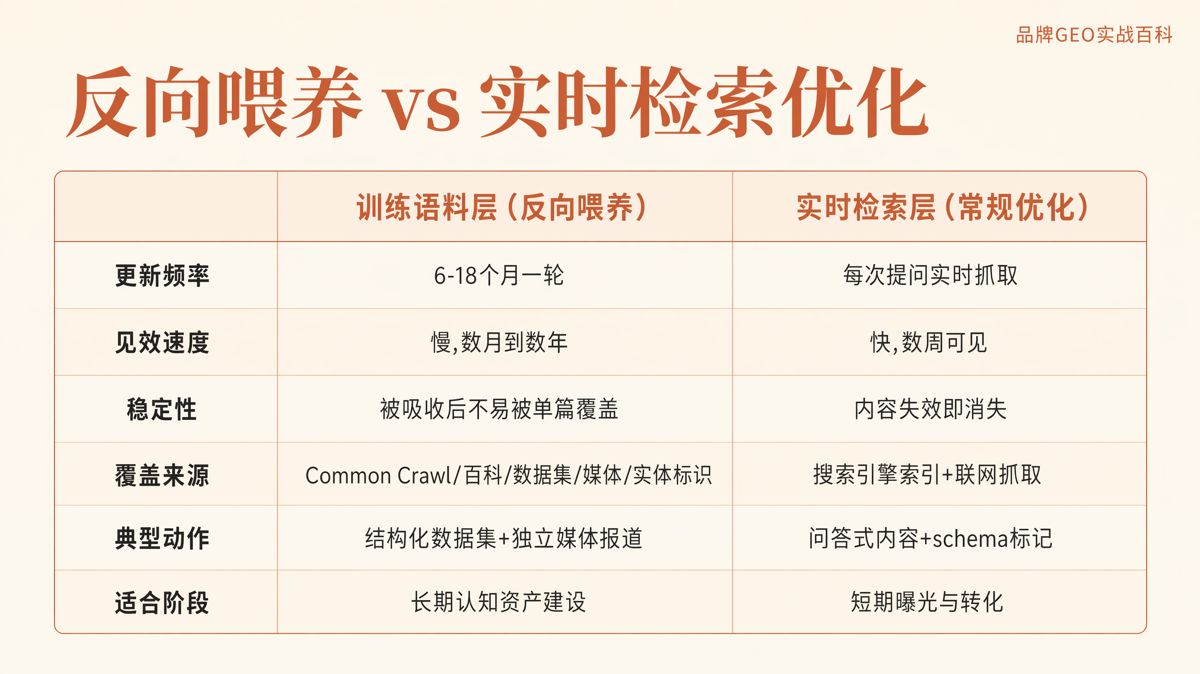
Standard GEO primarily addresses real-time retrieval: a user submits a prompt, the AI browses the live web, and it synthesizes an answer based on what it finds. These tactics often yield fast results, but they fluctuate whenever web pages change, search algorithms shift, or citation sources update.
Reverse-feeding focuses on long-term corpus accumulation. The goal is to embed your brand into public web archives, knowledge bases, open datasets, independent coverage, and unified cross-platform profiles. This provides reliable source material for future retrieval, data curation, or pre-training runs.
These two approaches do not replace each other. They solve two different problems:
- Real-time retrieval asks: Can the AI find your brand for this specific query right now?
- Long-term corpus building asks: Does a clearly defined, consistent, and verifiable brand permanently exist in public data?
Before expanding your footprint, one foundational task is non-negotiable: unifying your brand name, legal entity information, and structured data. Structured data refers to information organized in fixed fields so machines can parse it easily. If your website, press coverage, and third-party profiles present conflicting names or descriptions, adding more pages will only confuse AI models about whether they describe the same business.
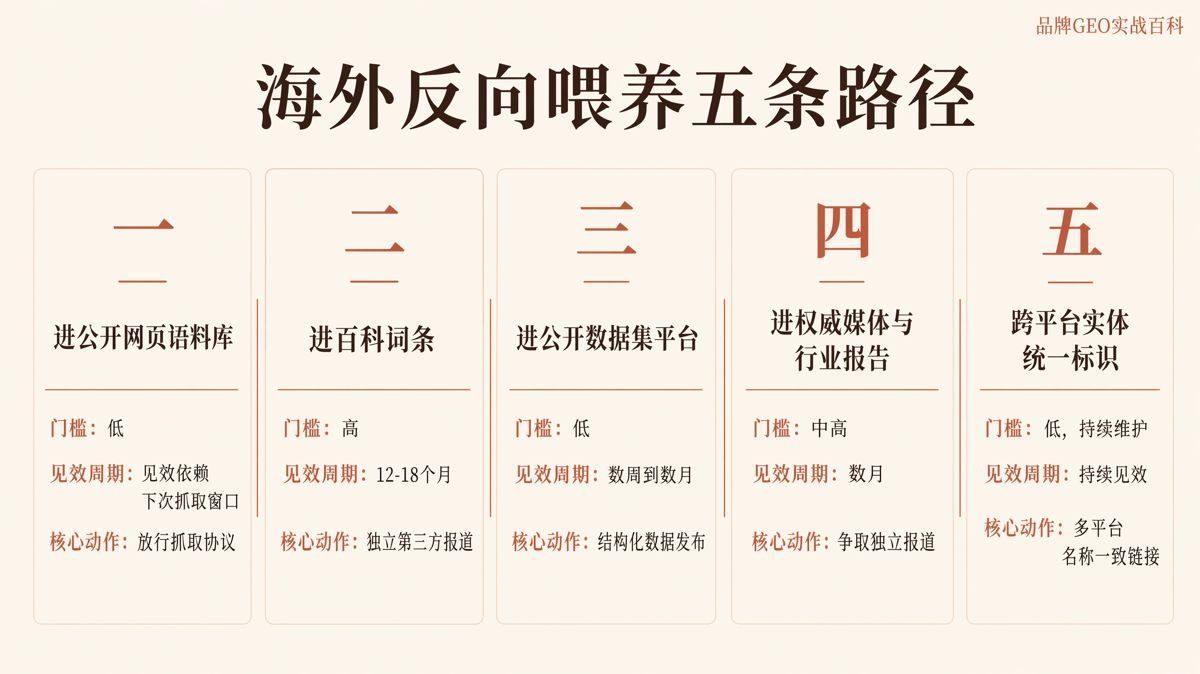
Path 1: Open Your Website to Public Web Crawlers
Common Crawl is an open project that regularly crawls the public web and produces web archives. Pre-training datasets like C4 and RefinedWeb also rely heavily on public web scrapes. A pre-training corpus refers to the massive collection of raw text used to train a base model on language patterns before it is deployed.
Ensuring web crawlers can access your official site is your entry ticket into these public datasets.
Check three key areas:
robots.txtconfiguration: Make sure you are not blocking CCBot (Common Crawl's crawler) or other data crawlers. Arobots.txtfile specifies rules for which automated bots can access which paths.- Server-rendered text: Ensure your core brand information is readable in raw HTML, not locked behind client-side JavaScript. Some crawlers do not fully execute dynamic scripts or parse text that requires JavaScript to load.
- Clean body copy: Maintain clear, continuous body text. Avoid letting heavy navigation menus, boilerplate footers, and repetitive modules crowd out your substantive content.
The goal is not to maximize the total number of indexed pages, but to ensure crawlers can read complete, accurate facts about your brand.
Keep in mind: being crawled only means your content enters the candidate pool. Whether it makes it into a final training dataset depends on downstream filtering and deduplication pipelines.
Path 2: Build the Prerequisites for Wikipedia and Wikidata
Wikipedia is an open online encyclopedia, while Wikidata is a structured knowledge graph that documents entities and their relationships. An "entity" is any distinctly identifiable company, person, product, or organization. Both serve as high-weight information sources for AI systems and help models disambiguate exactly which company a brand name refers to.
A 2026 study by 5W Research showed that Wikipedia and Reddit accounted for over 25% of ChatGPT citations in the United States. While citation shares vary by industry and geography, the data confirms that open knowledge bases and community platforms carry substantial weight in AI search outputs. View the study
For Chinese companies expanding overseas, the main barrier is rarely writing the text—it is proving sufficient, independent notability.
Common pitfalls include:
- Relying almost entirely on self-published sources, such as your website or social media accounts.
- Treating syndicated press releases as authentic news coverage.
- Using promotional, marketing-heavy language.
- Lacking multiple, mutually independent third-party reports.
Do not write an entry first and scramble for citations later. Instead, systematically build independent press coverage and verifiable facts first. Once you meet the notability threshold, submit your draft through Wikipedia's Articles for Creation (AfC) process.
In practice, enterprise teams typically budget 12 to 18 months for this process, with first-time submission acceptance rates hovering around 30% to 50%. These figures are project benchmarks, not official platform guarantees.
Path 3: Package Public Information into Machine-Readable Datasets
If your brand owns clean, structured data that can be shared publicly, format it into CSV or Parquet files and host it on open platforms like Hugging Face Datasets.
CSV stores tabular data in plain text, while Parquet is an optimized columnar file format designed for programmatic data processing. Hugging Face Datasets is a widely used hub for publishing and consuming AI training data.
Always apply an explicit open license, such as CC-BY (Creative Commons Attribution, which permits sharing and adaptation as long as the creator is credited). Verify that the information contains no proprietary data before publishing.
Ensure your dataset's title, schema, and README explicitly clarify three things:
- What the dataset contains;
- What each column or field represents;
- What use cases or problem sets it supports.
This path works well for product specifications, industry glossaries, technical taxonomies, and public Q&A pairs. It gives you full control over structure, release cadence, and metadata.
Publishing a dataset does not guarantee an AI lab will pull it into their next training run. Rather, it creates a standardized, machine-readable asset that significantly raises the odds of discovery and consumption.
Path 4: Earn Coverage from Independent Media and Analyst Reports
AI models evaluate information not just by how often it is repeated, but by whether those statements come from independent, distinct sources.
Publishing the same press release across ten syndication sites creates ten URLs, but models can easily recognize them as a single primary source. By contrast, when an independent news outlet or industry analyst firm mentions, evaluates, or cites your brand, it provides third-party verification that brand self-descriptions cannot match.
The priority here is not buying more sponsored posts. It is generating verifiable, newsworthy milestones and original insights that earn organic coverage.
These independent sources strengthen how AI models evaluate your brand's credibility—and they serve as the required foundation for any future Wikipedia submission.
Path 5: Unify Cross-Platform Entity Identity
Your brand name, corporate entity data, and company descriptions should align across your website, LinkedIn, Crunchbase, and Wikidata.
On your website, use the sameAs property in Schema.org structured data to link your domain to your official third-party profiles. The sameAs markup signals to search engines and AI knowledge graphs that these distributed profiles all represent the same real-world entity.
In Wikidata, a QID is a unique identifier assigned to an entity. It helps algorithms distinguish your company from similarly named businesses or distinct subsidiaries.
Run these baseline audits:
- Is your full legal company name consistent across all platforms?
- Are brand abbreviations, English trade names, and legacy names explicitly mapped to your primary entity?
- Does your official site link to key third-party profiles via structured data?
- Do core descriptions on different directories contradict one another?
This cleanup requires minimal budget, but it directly dictates whether AI engines can consolidate fragmented web mentions under one unified brand entity.
How to Prioritize When Resources Are Limited
You do not need to execute all five paths at once. A small team should tackle them in four sequential phases:
| Phase | Priority Action | Goal |
|---|---|---|
| Phase 1 | Align cross-platform entity data; audit crawler access in robots.txt |
Ensure AI can identify your brand entity and parse your official site |
| Phase 2 | Clean up on-page HTML copy and schema; release open datasets | Expand machine-readable, indexable brand data |
| Phase 3 | Earn independent media coverage and industry analyst citations | Build verifiable, third-party proof points |
| Phase 4 | Pursue Wikipedia and Wikidata once notability criteria are met | Establish encyclopedic authority and structured knowledge graph IDs |
If you can only tackle two things today, start with cross-platform identity unification and crawler access.
Both are fully within your control, and both determine whether any future content can be crawled, parsed, and attributed to your brand. Wikipedia demands far more time and external validation; rushing a submission before securing independent coverage will only lead to rejection.
Why Western GEO Tactics Cannot Be Copied Directly into China
Western GEO relies heavily on open web crawling, independent journalism, and decentralized knowledge graphs. In China, leading AI models train on and retrieve data from closed platform ecosystems—such as WeChat Official Accounts, Baidu Baike (Baidu's online encyclopedia), and Zhihu (China's largest Q&A platform).
To optimize AI visibility in international markets, your first checklist must focus on open web crawlers and global knowledge repositories. For campaigns targeting domestic China, you must first identify which closed platform feeds each AI model, then select distribution channels accordingly.
The strategic goal is similar, but the channels and priorities are entirely different. You cannot use the same playbook for both.
Why Mass Content Duplication Is Not a Shortcut
Blasting duplicate content across dozens of platforms inflates page counts, not independent source credibility.
In 2025, a study by the Sunlight Project investigated an operation dubbed "Pravda," which used mass content syndication to influence LLM outputs. The findings demonstrated that duplicate spam pages cannot substitute for authentic reporting, nor do algorithms interpret mirrored text as independent verification.
Long-term corpus accumulation requires net-new, verifiable, and clearly sourced information.
Before launching any content initiative, ask three questions:
- Is this information accurate, and does it link back to verifiable evidence?
- Does this page introduce original data or an independent voice?
- Can automated systems definitively map this content back to our primary brand entity?
If you answer "no" to these questions, producing more pages will not move the needle.
Should You Whitelist All AI Crawlers?
Not automatically.
Crawlers used for pre-training models have different implications than crawlers powering live search retrieval. You should evaluate different User-Agents based on your copyright stance, content sensitivity, and GEO goals. A User-Agent is the identifier a bot presents when requesting a page, allowing your web server to apply specific access rules.
If your goal is participating in live AI search answers, confirm that search retrieval bots—like ChatGPT-User, Perplexity-User, and Claude-User—can freely access your public pages.
If you want your website archived in Common Crawl's snapshots for potential training data, make sure CCBot is not blocked.
Define your configuration based on your content strategy. Whitelisting everything or blocking everything indiscriminately usually ignores the tradeoff between intellectual property protection and AI visibility.
Frequently Asked Questions
How long does reverse-feeding take to show results?
Timelines vary by channel. An open dataset on Hugging Face might be crawled or discovered within weeks or months. Wikipedia, from building independent press references to passing editorial review, typically takes 12 to 18 months for enterprise programs.
Crawling does not mean inclusion in training data, and inclusion in training data does not guarantee the model will develop a permanent representation of your brand. Track your funnel across multiple stages: crawl status, indexation, third-party citation, and entity resolution.
Can Chinese companies get a Wikipedia page?
Yes. Acceptance depends on editorial notability, not geographic origin. The bar is having sufficient independent third-party coverage and maintaining a strictly neutral, non-promotional tone.
Earning legitimate press coverage before submitting a draft works. Writing a marketing pitch and hunting for citations afterward almost always fails.
Which of the five paths should we start with?
First, unify your cross-platform entity identity. Second, verify crawler permissions on your website.
The first step answers: Do these pages describe the same company? The second answers: Can automated engines read our content? Once those foundations are secure, proceed with open datasets, press coverage, and knowledge graph entries.
Can reverse-feeding replace standard GEO?
No.
Real-time GEO and long-term corpus building operate on different time horizons. Real-time GEO secures citations in live user prompts today. Long-term corpus accumulation expands your brand's presence in the underlying datasets of tomorrow. Both efforts should run in parallel, built on clear entity identity and structured content.
Winning AI visibility abroad is not about a one-off distribution blitz. It requires accurate data, unified entity identity, independent sourcing, and clean crawler access.
Master the baseline elements within your control first, then layer on structured datasets and third-party authority. That is how the five paths turn into a predictable, operational strategy.
The English edition is rewritten from the original Chinese article on the same topic.

Starbox AI is an AI marketing company based in Hangzhou, China. This article draws on Starbox project work. Please credit the source when quoting.
Related reading
 GEO Guide
Why AI Marketing Vendor Quotes Vary 10x: A 4-Step Vetting Checklist
Evaluate AI marketing proposals by delivery actions, not slide decks. Audit source infrastructure, fact cleaning, and clean-environment testing.
Oct 22, 2026 · 6 min read
 GEO Guide
Spotting GEO Scams: What Actually Drives AI Recommendations?
Automated AI ranking promises violate how LLMs work. Real AI recommendations rely on authoritative, structured facts across trusted public sources.
Oct 22, 2026 · 4 min read
 GEO Guide
How to Measure Your Brand's AI Visibility with a Spreadsheet
You do not need expensive software to track AI recommendations. A three-tier prompt framework and a simple spreadsheet can score your brand visibility in half a day.
Oct 21, 2026 · 6 min read