
How Brands Can Seed AI Training Datasets for GEO

The short answer
Live citations are fleeting, but training data endures. Here is how brands can structure public content to feed future AI training corpora.
One primary goal of Generative Engine Optimization (GEO) is to help your brand earn accurate mentions and citations in AI responses. To do that, you need to understand how brand information reaches an AI model in the first place.
Brand data enters AI answers through two distinct pathways:
- Live retrieval: When a user asks a question, the AI retrieves live web pages in real time, extracts relevant excerpts, and synthesizes an answer using the retrieved sources.
- Model training: Public web content is collected, filtered, and used to train future foundation models. The model learns from this training corpus directly.
Feeding AI training datasets means systematically building public, verifiable content that increases the odds your brand information gets incorporated into future training runs. The goal is not just a temporary citation today, but a foundational presence in the model itself.
Set expectations early: live citations can be monitored, but training dataset inclusion cannot be confirmed in real time. You can improve your probability of inclusion, but no agency or platform can guarantee an article will make it into a specific model weights file. Nor does a single live citation mean the model has permanently memorized your brand.
What Reverse Feeding Actually Means
Feeding an AI training corpus does not mean uploading PDF pitch decks to a public chatbot or mass-registering social accounts to spam the same product description across the web.
It requires consistent, high-integrity content infrastructure:
- Making your web pages easily crawlable and machine-readable;
- Stating core brand facts clearly alongside verifiable independent evidence;
- Keeping foundational entity details consistent across your website, knowledge bases, press releases, and social profiles;
- Securing placement in public web pages, structured knowledge bases, industry benchmarks, technical communities, and open datasets.
A structured knowledge base stores verified facts in standardized fields. An open dataset provides structured, programmatically readable records.
The purpose of this work is to maximize the likelihood that your content survives data cleaning and makes it into future training corpora. However, two layers of uncertainty remain:
- Public web presence does not guarantee dataset inclusion. AI research labs crawl billions of pages, but their data pipelines filter and discard massive volumes of web text.
- Dataset inclusion does not guarantee model retention. Even if your content enters a training dataset, the model may not retain the specific facts, let alone volunteer your brand name in an unprompted user response.
AI labs rarely disclose their full training recipes, cut-off dates, or data-weighting algorithms. You can manage your brand's data surface, but you cannot dictate the outcome. Any vendor promising permanent model memorization is selling an unprovable claim.
Live Citations Are Fleeting; Training Ingestion Is Hard to Track
Brands must manage both live search retrieval and model training because each comes with distinct limitations.
Tracking data from Profound across 2025 and 2026 shows that AI Overview answers shift roughly 70% of the time for the same search query. In those refreshed responses, nearly half of the cited sources are swapped out.
A citation you hold today can easily disappear next week. A competitor might publish a more direct answer, the platform might adjust its retrieval thresholds, or your page structure might change.
Model training cycles move much slower. GEO industry observations indicate that major foundation models refresh their primary training corpora every 6 to 18 months. When a fact successfully enters a model version's weights, its influence lasts far longer than an ephemeral search citation.
However, that 6-to-18-month window is an industry rule of thumb, not a public contract. No commercial tool can tell you with certainty whether a specific URL made it into a specific model build.
The most practical approach is to treat dataset inclusion as a long-term compounding goal, while using live citation rates, share of voice, and source attribution as your operational metrics. Both tracks must run in parallel.

Where Training Data Originates
Public documentation from major AI models frequently cites Common Crawl, C4, and RefinedWeb. Common Crawl provides an open repository of web crawl data, while C4 and RefinedWeb are curated, deduplicated web text datasets. Their prominence confirms that publicly accessible web pages remain a primary foundation for large language models.
Yet having a live URL is merely the baseline. Your content must be crawlable by automated bots, survive data cleaning, and get selected by the training pipeline.
Two studies highlight what matters most: where your content lives, and whether bots can parse it.
In 2025, 5W Research reported that Wikipedia and Reddit together accounted for more than 25% of all ChatGPT source citations in the United States, while traditional outlets like The Wall Street Journal, The New York Times, and Bloomberg did not crack the top 20. While this study measured live citation volume rather than pre-training data composition, it underlines the authority AI platforms place on open, community-curated, and encyclopedic knowledge.
A study by Ahrefs analyzing 3 million keywords and over 500 million crawl logs revealed a critical technical barrier: AI crawlers behave differently than traditional search engine crawlers. Specifically, the study found no evidence that AI crawlers execute JavaScript during automated sweeps.
If your core product facts, customer FAQs, or corporate milestones only render after client-side JavaScript runs, AI crawlers may record an empty page.
The lesson for site operators is straightforward: a page that looks complete in a desktop browser may be invisible to an AI scraping bot.
Five Practical Ways to Feed Future Datasets
1. Ensure Flawless Crawlability
Check your robots.txt configuration immediately. If you want your site content captured by open archives like Common Crawl, ensure crawlers such as CCBot are explicitly permitted.
Render your main content as plain HTML. Product specs, company background, leadership data, and technical answers must be present in the raw source code without requiring client-side JavaScript execution. Strip out intrusive navigation bloat, interstitial popups, and repetitive template copy that dilutes the primary text during automated data extraction.
2. Secure Structured Knowledge Base Placement
For international audiences, Wikipedia and Wikidata are top tier. In China, Baidu Baike (Baidu's online encyclopedia) serves as the primary equivalent.
Knowledge bases enforce strict verifiability standards. You cannot copy and paste a marketing brochure into an encyclopedia entry. Editors reject claims like "industry-leading" unless backed by neutral third-party reporting. Focus on recording verifiable corporate milestones: founding date, corporate entity structure, core product categories, and documented acquisitions.
3. Release Public Data in Structured Formats
Where appropriate, package public research, industry benchmarks, or platform statistics into clean tabular formats (like CSV) and release them on public platforms such as Hugging Face Datasets.
Ensure every table has unambiguous headers, clear column definitions, and transparent sourcing. This approach may not fit every B2B business, but for companies generating proprietary research, structured releases make data far easier for extraction pipelines to index and parse.
4. Earn Independent Media and Industry Citations
Coverage from authoritative trade outlets, analyst reports, and permanent PDF whitepapers carries significant weight as independent source verification.
One objective mention in an analyst report is worth more than a dozen articles on your own corporate blog. Do not focus on sheer PR volume. Focus on three fundamentals: Did you publish verifiable facts worthy of coverage? Is the coverage publicly accessible without paywalls? Will the source URL remain live over the long haul? Syndicated PR republishes that parrot a press release verbatim provide negligible independent value to training algorithms.
5. Enforce Cross-Platform Entity Consistency
Your company name, founding year, leadership team, and product category definitions must align across your official website, knowledge bases, LinkedIn, GitHub, and industry directories.
When names, locations, or service descriptions conflict across domains, AI pipelines struggle with entity disambiguation—the process of determining whether two mentions refer to the same real-world entity. Consistency does not mean copying the exact same text everywhere; it means your underlying facts must never contradict each other.
Three Accessible Channels for the Chinese Market
For businesses operating in or addressing the Chinese market, open training data sources differ from Western ecosystems. Based on current industry consensus, three sources matter most:
- Baidu Baike: Baidu's online encyclopedia is a fundamental structured knowledge source for domestic AI models. Entries undergo strict editorial verification. Brands must bring documented, third-party proof rather than promotional marketing copy.
- Authoritative Media and Industry Whitepapers: Independent business press and recognized industry reports provide verified third-party citations. AI data pipelines prioritize these sources over corporate self-publishing.
- Zhihu Expert Answers: Zhihu (China's largest Q&A platform) is heavily represented both in Chinese LLM training corpora and live search retrieval pipelines, particularly for models developed by ByteDance and DeepSeek. In-depth, technically authoritative answers to real user queries perform far better than soft PR posts.
These channels reflect current GEO best practices. While they cannot guarantee inclusion in a specific model update, they represent the highest-probability paths for Chinese-language AI visibility.
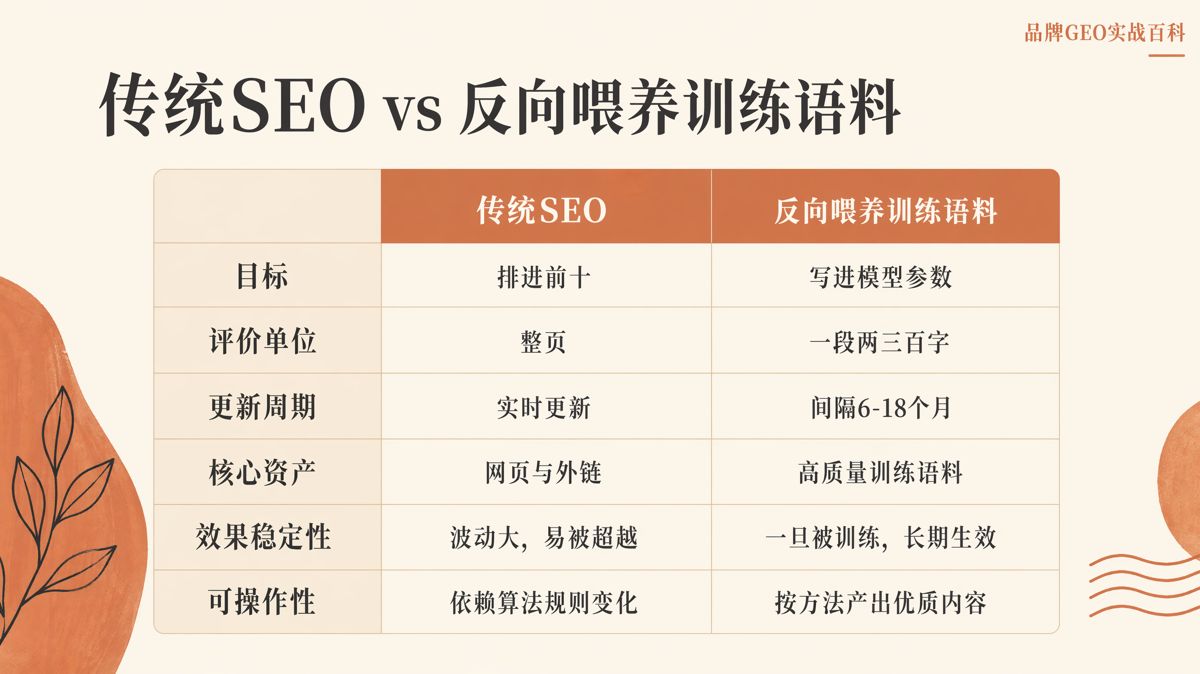
How Dataset Feeding Differs from Traditional SEO
SEO focuses on improving page visibility in real-time search engine results pages (SERPs). Feeding training corpora is an upstream effort aimed at future model generation. Both are connected: if your page cannot be indexed by search engines, it will not make it into future training data.
| Dimension | Traditional SEO | Feeding AI Training Datasets |
|---|---|---|
| Direct Goal | Rank web pages in live search results | Increase odds of inclusion in future model training |
| Primary Evaluation Unit | Entire web page | Self-contained, verifiable text blocks |
| Refresh Cycle | Real-time or near-real-time index updates | Foundation model training runs (roughly 6–18 months) |
| Core Signals | Page indexing, search intent match, backlinks | Independent authority, fact consistency, raw crawlability |
| Measurement | Transparent ranking and traffic metrics | Difficult to confirm for any specific model version |
| Level of Control | Direct testing, fast iteration | Brands manage probability; labs control inclusion |
On May 15, 2026, the Google Search team updated its official guidance on generative AI search, reiterating that optimizing for AI answers is fundamentally an extension of core web best practices, not an entirely new discipline.
You cannot bypass search indexing, technical health, and content quality. If web crawlers cannot cleanly parse your site today, your chances of influencing future AI training runs are near zero.
Why Mass Content Generation Backfires
Feeding training data is not a volume contest.
Publishing the same brand narrative across 20 synthetic accounts does not create 20 independent sources; it creates duplicate content.
In 2025, the American Sunlight Project documented how the Russian propaganda network Pravda created mirror networks and bulk-syndicated articles to influence large language model outputs. Major AI labs quickly identified the pattern, built targeted filters, and suppressed the credibility of those source networks.
Spamming low-cost articles, operating content farms, or manufacturing fake reviews does not build authority. It triggers automated quality-control heuristics designed to strip out repetitive text before training begins.
AI models place premium weight on independent confirmation. A single objective mention in a respected trade publication outweighs dozens of synthetic articles on owned social channels.
Managing AI Bot Access: Block or Allow?
Do not make sweeping decisions to block all automated bots without distinguishing what each crawler does.
Sites face two distinct categories of automated AI visits:
- Training Scrapers: Bots like
GPTBotorClaudeBotthat collect web text for future pre-training and fine-tuning datasets. - Live Retrieval Bots: Bots like
ChatGPT-User,Claude-User, orPerplexity-Userthat visit web pages in real time because an active user asked a question.
If your company has strict copyright or IP concerns, you may decide to restrict training scrapers. However, if you block user-triggered retrieval bots, AI tools will be unable to access your site when users ask about your products, removing you from real-time recommendations.
Industry field reports note that several prominent brands experienced a steep drop in AI search visibility after blanket-blocking all AI user agents. Evaluate your copyright risk against your visibility goals. Do not rely on an all-or-nothing switch.
A Six-Step Execution Roadmap
To optimize your content infrastructure for both live search and future AI datasets, follow this sequence:
- Standardize Core Entity Facts: Align company names, founding history, product lines, and leadership bios across your site, encyclopedias, and corporate directories to eliminate ambiguity.
- Audit Technical Crawlability: Check your
robots.txtrules and server response codes. Ensure critical facts, product data, and FAQs are delivered in clean HTML without requiring JavaScript rendering. - Publish Self-Contained, Verifiable Answers: Address real customer questions with clearly structured, factual content that can be extracted and understood out of context. Avoid repetitive marketing boilerplate.
- Earn Independent Third-Party Citations: Target coverage in trade media, analyst whitepapers, and established encyclopedic platforms like Wikipedia or Baidu Baike.
- Configure Granular Crawler Rules: Differentiate between long-term training scrapers and live user-directed retrieval bots in your access policies.
- Track Real-Time Retrieval as Your Leading Indicator: Monitor AI mention rates, citation shares, and source shifts in live search tools. Use these measurable signals to guide your strategy while long-term training cycles unfold.
Focus first on what you can verify and measure today. Even if an article is never absorbed into a future foundation model's weights, clean, authoritative content will continue delivering value through search indexing and live AI retrieval.
The Bottom Line
Reverse feeding AI training data is about managing probabilities. You cannot force a model to memorize your brand, and you cannot skip the fundamentals of technical SEO and live search optimization.
The fundamentals remain constant: publish crawlable pages, enforce factual consistency across platforms, secure independent third-party validation, and provide direct answers to the problems your market is trying to solve.
Master the measurable steps first. That is how your brand earns visibility across traditional search results, live AI citations, and the training datasets of tomorrow.
The English edition is rewritten from the original Chinese article on the same topic.

Starbox AI is an AI marketing company based in Hangzhou, China. This article draws on Starbox project work. Please credit the source when quoting.
Related reading
 GEO Guide
Why AI Marketing Vendor Quotes Vary 10x: A 4-Step Vetting Checklist
Evaluate AI marketing proposals by delivery actions, not slide decks. Audit source infrastructure, fact cleaning, and clean-environment testing.
Oct 22, 2026 · 6 min read
 GEO Guide
Spotting GEO Scams: What Actually Drives AI Recommendations?
Automated AI ranking promises violate how LLMs work. Real AI recommendations rely on authoritative, structured facts across trusted public sources.
Oct 22, 2026 · 4 min read
 GEO Guide
How to Measure Your Brand's AI Visibility with a Spreadsheet
You do not need expensive software to track AI recommendations. A three-tier prompt framework and a simple spreadsheet can score your brand visibility in half a day.
Oct 21, 2026 · 6 min read