
GEO Monitoring: What Metrics to Track and How Often

The short answer
Track brand mentions, content citations, competitor share, and factual accuracy across AI engines on a weekly, monthly, and quarterly cadence.
Generative Engine Optimization (GEO) focuses on whether your brand and content appear in AI-generated answers and get accurately cited. The AI engines in question include Doubao (ByteDance's AI assistant), Wenxin (Baidu's Ernie Bot), Yuanbao (Tencent's AI assistant), Kimi (Moonshot AI's assistant), DeepSeek, ChatGPT, and Perplexity.
Traditional SEO tracks where web pages rank in search engine results and how much organic traffic they generate. Organic traffic refers to unpaid visits from standard search results. GEO evaluates an entirely different set of outputs, which is why standard SEO ranking reports cannot measure GEO performance.
An effective GEO monitoring program answers four questions:
- Does the AI mention your brand?
- Does the AI cite your published content as an information source?
- How many mentions and citations do you earn compared to direct competitors?
- Does the AI describe your brand and capabilities accurately?
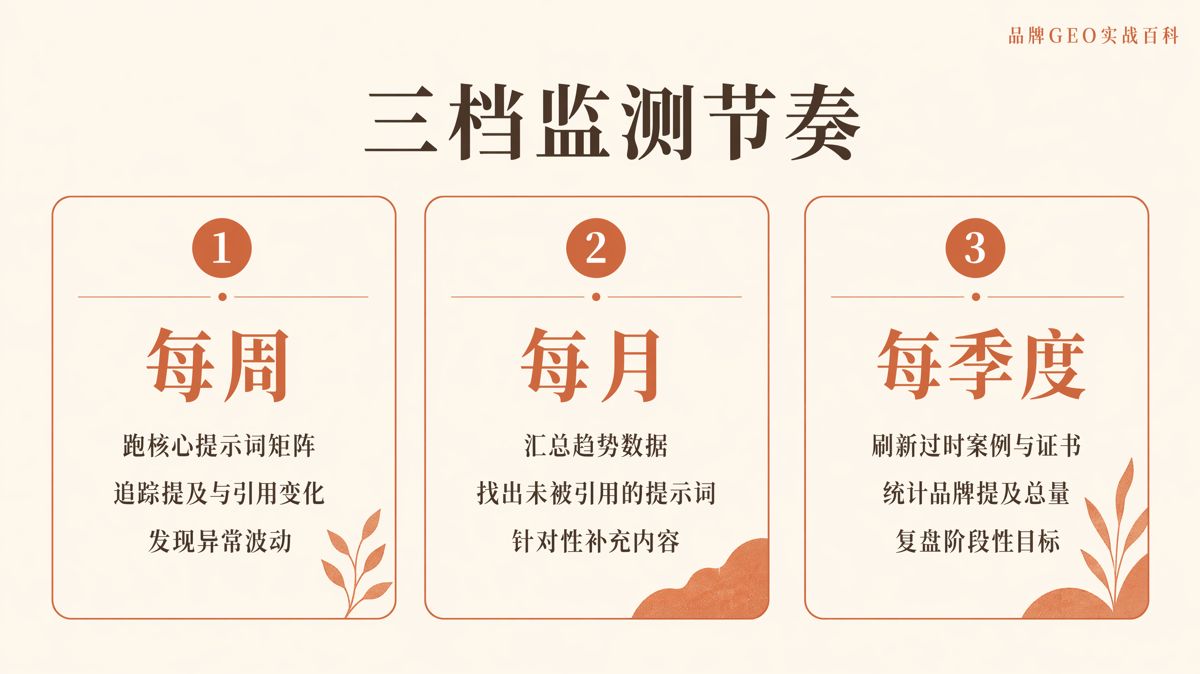
You can establish your operational cadence right away: spot changes weekly, analyze trends and plan content monthly, and update your prompt scope and brand facts quarterly. After publishing new content, run a quick check at the 72-hour mark.
Small teams do not need expensive software to get started. Fix a core set of prompts, test them across multiple AI engines, log the initial results in a spreadsheet, and build your baseline. Automate only when your prompt matrix and engine coverage expand beyond what manual tracking can support.
Why SEO Ranking Reports Cannot Replace GEO Monitoring
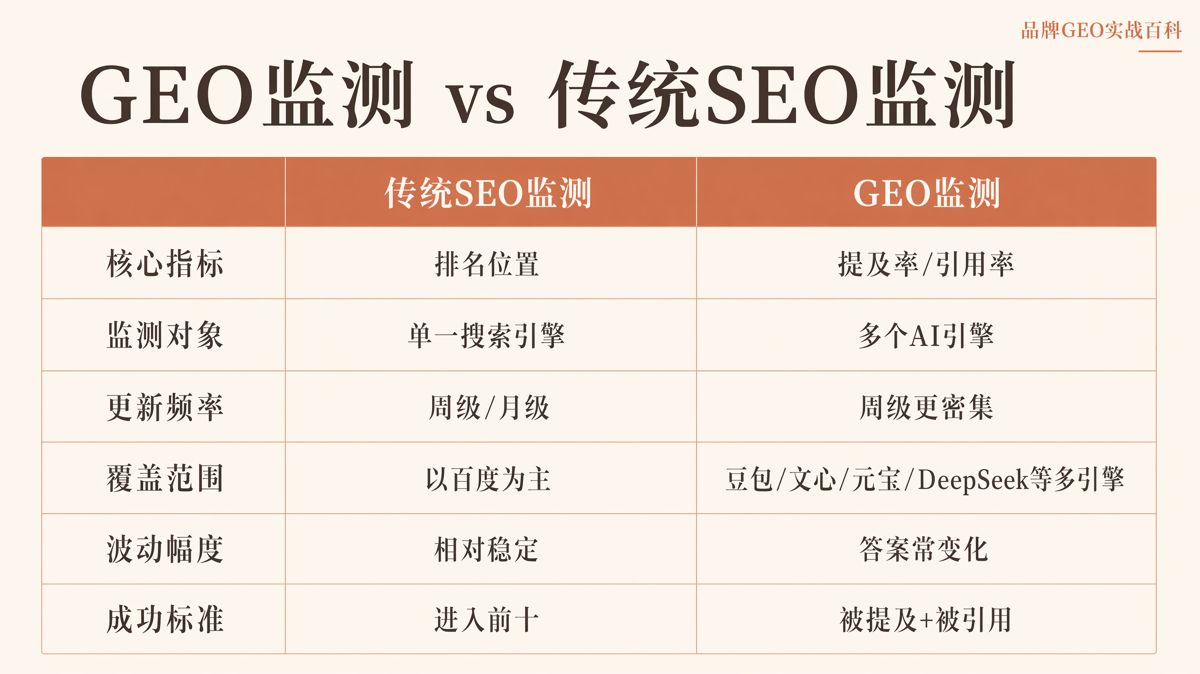
SEO centers on relatively stable keyword rankings. GEO has no fixed rank to track. The same question asked at different times or across different AI engines can generate different answers and pull from different citation sources.
| Dimension | Traditional SEO Monitoring | GEO Monitoring |
|---|---|---|
| Core Metrics | Rank position, organic traffic | Brand mention rate, content citation rate, competitor share, factual accuracy |
| Monitored Platforms | Primarily a single search engine (e.g., Google or Baidu) | Multiple AI engines |
| Result Format | A keyword maps to a relatively stable position | The same prompt generates dynamic text and variable sources |
| Typical Cadence | Weekly or monthly | Weekly checks for core prompts, monthly deep-dive reviews |
| Success Criteria | Ranking within a target position band | Brand mentioned, content cited, brand facts represented accurately |
GEO demands ongoing monitoring because AI answers fluctuate constantly. Data published by Profound indicates that Google AI Overviews answers change roughly 70% of the time for the same prompt, and 45.5% of cited sources get swapped in updated answers. (Google AI Overviews refers to the AI-generated summary answers displayed at the top of select search results).
While these figures have not been independently audited and vary by platform, they illustrate just how volatile AI outputs can be.
Results also differ dramatically across platforms. An Ahrefs cross-platform study revealed that 86% of the primary cited sources across ChatGPT, Perplexity, and Google AI Overviews do not overlap. In China, Doubao, Wenxin, Yuanbao, Kimi, and DeepSeek each rely on distinct content ecosystems and algorithmic source preferences.
Testing a single AI engine only tells you how your brand performs on that specific engine. It reveals nothing about your visibility on the rest.
The Four Metrics You Must Track Separately
1. Brand Mention Rate
Brand mention rate measures how often your brand name appears in AI answers across a fixed set of prompt tests.
Even if an answer does not include a link to your website, any explicit reference to your brand counts as a mention. This metric shows whether your brand makes it into the AI's shortlist or overview when potential buyers research your category, vendors, or solutions.
A mention is not the same as a citation. An AI model might name your company often without ever citing content published on your owned channels.
2. Content Citation Rate
Content citation rate measures how often an AI answer links to your official website, articles, or other owned assets as a source.
Mentions and citations must be logged separately. An AI engine might know your brand exists without referencing your published articles. Conversely, it might cite your research paper or data report without featuring your brand name prominently in the generated answer text.
If you earn mentions but no citations, check whether your content provides clear, specific, and verifiable data that AI models can use as evidence. If you earn citations but no brand mentions, check whether your brand name and core positioning are integrated clearly into the cited assets. Blending these two metrics hides the root problem.
3. Competitor Share
When running your prompt matrix, never track your own brand in isolation. Record how often your key competitors are mentioned and cited for the exact same queries.
An increase in your raw mention count does not necessarily mean your market position improved. If your competitors grew their mentions twice as fast, your share of the overall conversation actually declined.
During monthly reviews, evaluate your share of mentions and share of citations side by side with top rivals. Track both your absolute growth and whether you are keeping pace with the category.
4. Brand Factual Accuracy
Brand factual accuracy checks whether AI models describe your company's core facts correctly. You can query the engine directly:
- "What do you know about [Company Name]?"
- "What does [Company Name] do?"
- "When was [Company Name] founded?"
Verify the responses against verified facts: founding date, core offerings, service boundaries, and team or business scale.
This metric does not evaluate individual articles; it checks how AI models understand your brand entity. If an AI serves outdated or false information, audit your official web presence. Check whether accurate facts are publicly accessible, whether statements across different pages contradict one another, and whether legacy information is still circulating online.
How to Build Your Prompt Matrix
A prompt is the question or instruction fed into an AI engine. A prompt matrix is a standardized group of prompts tracked consistently over time.
To produce reliable trend data, your prompts must remain consistent, and they must mirror how real prospective buyers inquire during the decision-making process. Start by building two core query buckets:
Category and Competitor Prompts
These simulate how users evaluate products, service providers, or technical solutions:
- "What are the leading service providers in [category]?"
- "How should a buyer choose between Vendor A, Vendor B, and Vendor C?"
- "Which solution fits best for [specific business scenario]?"
These queries reveal whether your brand reaches the AI's recommended consideration set, as well as the relative share of mentions and citations between you and your competitors.
Brand Entity Prompts
Brand entity prompts ask directly about your business:
- "Are you familiar with [Company Name]?"
- "What are the core capabilities of [Company Name]?"
- "How long has [Company Name] been operating?"
Use these to check whether the AI recognizes your entity and whether the information it delivers is accurate, complete, and up to date.
When establishing your baseline, run the same prompt set across every target engine. Record whether the brand was mentioned, whether content was cited, and whether the factual details were accurate. Your baseline is the initial snapshot against which all future iterations are measured.
The GEO Practical Whitepaper used an entry-level benchmark of 30 prompts tested across 4 engines, yielding 120 initial data points. Treat this as a reference rather than a rigid rule. Scale your prompt matrix based on your category complexity and the hours your team can commit each week.
A low mention rate on your first run does not mean the test failed. The baseline exists to provide a clean starting point, not to show immediate success.
What to Do Weekly, Monthly, and Quarterly
Weekly: Spot Changes Without Overreacting
Test your core prompt set once a week and record three types of movement:
- New brand mentions or content citations that appeared.
- Existing mentions or citations that dropped off.
- New factual inaccuracies introduced into the AI's brand summary.
Weekly data is naturally noisy due to algorithmic updates and model generation variance. Use weekly checks to spot red flags, not to overhaul your editorial strategy based on a single outlier response.
Monthly: Analyze Trends and Assign Content
During your monthly review, line up your weekly logs side by side. Focus on sustained patterns:
- Which high-priority prompts consistently fail to mention your brand?
- Which specific URLs earn consistent citations?
- Which competitors are expanding their share of mentions or citations?
- Which factual errors appear repeatedly across engines?
These insights should directly guide your content calendar. If a critical prompt category is missing entirely, create targeted content to address it. If a cited page contains outdated figures, refresh it. If your brand positioning varies across pages, standardize the copy.
Content decisions should stem from sustained trends across multiple checkpoints, never from a single AI query.
Quarterly: Audit Factual Assets and Expand Prompts
Conduct a full operational review each quarter:
- Audit and refresh outdated case studies, product credentials, and benchmark data across your site.
- Re-tally brand mention rate, content citation rate, and competitor share of voice.
- Evaluate progress against your quarterly visibility targets.
- Keep your core prompt set stable, but layer in new long-tail queries.
Long-tail queries address granular use cases, specific buyer criteria, or niche industry scenarios. Keeping the core prompt set identical ensures quarterly data remains comparable, while supplemental queries help you track shifting user search behaviors.
The 72-Hour Post-Publishing Check
Treat the 72-hour window following new content publication as an initial visibility check. Do not look for search ranks. Focus on two questions: can search crawlers discover the URL, and have AI engines begun reading or referencing it?
Follow three steps:
- Submit the new URL to search engine webmaster platforms (such as Google Search Console or Baidu Search Resource Platform) to accelerate indexing.
- Distribute the piece across owned touchpoints, such as your official website or corporate social channels.
- Test primary AI engines using prompts directly tied to the new content, noting whether the engine cites the page.
If the page is not cited within 72 hours, that does not mean the piece failed. The purpose of this check is simply to ensure the page has entered the crawlable, indexable ecosystem.
If a page remains undetectable over the long term, waiting will not fix it. Verify whether search bots are permitted to crawl the page, whether the page loads cleanly, whether it relies on dynamic rendering that blocks crawlers, and whether search engines have officially indexed the URL.
China vs. Global Markets: Same Metrics, Different Workflows
Whether you monitor platforms inside China or globally, your core metrics remain the same: brand mention rate, content citation rate, competitor share, factual accuracy, and multi-engine tracking. The operational differences lie in tool availability and source ecosystems.
The global market features a growing variety of GEO tracking software, ranging from free DIY spreadsheets to enterprise platforms priced above $499 per month. Pricing scales with prompt volume, engine coverage, and automated scrape frequency.
In China, workflows remain largely manual. Marketers run prompts across Doubao, Wenxin, Yuanbao, Kimi, and DeepSeek, logging outputs in structured sheets while referencing tools like the Baidu Search Resource Platform and WeChat Search backend to check indexing status.
Because different engines favor different publishing platforms, you must track data per engine. Never assume performance on one platform translates to another.
Website analytics also have a reporting blind spot. Many AI applications, particularly native mobile apps, do not pass HTTP referrer data when directing users to external links. Web analytics platforms often misclassify this traffic as "Direct." Treat AI referral traffic as an directional indicator, and always validate it against your manual prompt testing data.
Shared Website Foundations, Separate Reports
GEO and SEO both require clean site architecture that allows search crawlers and AI bots to parse content properly. You do not need to build two separate websites.
Foundational technical work serves both disciplines. On-page optimization, clean indexing, and structured data markup benefit both search and generative engines. Structured data provides standardized schema for titles, authors, products, and Q&A blocks, making it easier for machines to extract facts accurately.
Rendering methods matter. Server-side rendering (SSR), where the server generates the full HTML before serving it to crawlers, is far easier for search and AI bots to ingest. If critical page content relies on client-side JavaScript execution in the browser, verify whether search bots can fully render and extract that text.
While technical foundations are shared, your reporting dashboards must stay separate:
- SEO dashboards track keyword rankings and organic traffic from search engine result pages.
- GEO dashboards track brand mention rates, content citation rates, competitor share, and entity factual accuracy.
Merging these into a single ranking report conceals critical performance gaps. Measure them separately, then review them together: SEO data shows whether your site earns search traffic; GEO data shows whether your brand and insights make it into AI-generated answers.
Troubleshooting: What to Do When AI Misses Your Brand
If an AI engine consistently ignores your brand on a core prompt, troubleshoot in this order:
- Query validity: Do real buyers actually ask AI engines this question?
- Content availability: Has your brand published a direct, comprehensive answer to this specific question?
- Information architecture: Does the target page feature clear H2/H3 headers, direct Q&A formats, and concrete facts?
- Source credibility: Does the content cite credible, verifiable sources, and are the underlying facts up to date?
- Technical accessibility: Is the page crawlable, fully rendered, and confirmed as indexed in search consoles?
If you lack content, produce it. If content exists but never earns citations, inspect the technical crawlability, factual freshness, and source citations. Do not simply churn out more generic articles targeting the same topic.
Manual testing spots where visibility fails, but it cannot fix technical site issues. Small teams can start with spreadsheets, but if content fails to enter indexable search pools over the long term, have a technical developer audit your robots directives, rendering setup, and crawl logs.
When Can You Expect Visible Results?
Case studies indicate that systematic GEO programs typically yield noticeable data shifts within two to six months. Accelerated cases can show initial movement in roughly six weeks, but those sites almost always started with strong technical SEO foundations and structured content libraries.
If you are starting from zero, the first one to two months are usually spent repairing site architecture and restructuring legacy content. Visible metric gains naturally take longer to materialize.
GEO monitoring cannot guarantee a fixed timeline. Its real job is to consistently show you three things: which target queries are improving, which web pages are still invisible to AI engines, and which competitors are gaining ground.
A Step-by-Step Starter Playbook
If your team is launching GEO monitoring today, follow this workflow:
- Build a fixed prompt matrix covering category queries, competitor comparisons, and brand entity questions.
- Select the key AI engines relevant to your geographic and commercial footprint.
- Log brand mentions, content citations, competitor appearances, and brand accuracy across every engine.
- Run core prompts weekly, documenting notable fluctuations.
- Review monthly trends to guide new content production and page updates.
- Audit core factual assets quarterly and expand into long-tail prompt variants.
- Maintain separate SEO and GEO reports, cross-referencing indexing and analytics data to diagnose visibility gaps.
Standardize your prompt matrix, platform coverage, scoring criteria, and operational cadence before looking for software. Tools speed up data collection, but they cannot replace clear metrics and steady operational discipline.
Compliance Note
China's Measures for the Labeling of AI-Generated Synthetic Content took effect on September 1, 2025. If your monitoring reporting or editorial production workflows rely heavily on generative AI, ensure your outputs include appropriate visible labels or embedded metadata in compliance with applicable regulatory standards.
Compliance is not a GEO performance metric, but it should be standard practice within your day-to-day content operations.
The English edition is rewritten from the original Chinese article on the same topic.

Starbox AI is an AI marketing company based in Hangzhou, China. This article draws on Starbox project work. Please credit the source when quoting.
Related reading
 GEO Guide
Why AI Marketing Vendor Quotes Vary 10x: A 4-Step Vetting Checklist
Evaluate AI marketing proposals by delivery actions, not slide decks. Audit source infrastructure, fact cleaning, and clean-environment testing.
Oct 22, 2026 · 6 min read
 GEO Guide
Spotting GEO Scams: What Actually Drives AI Recommendations?
Automated AI ranking promises violate how LLMs work. Real AI recommendations rely on authoritative, structured facts across trusted public sources.
Oct 22, 2026 · 4 min read
 GEO Guide
How to Measure Your Brand's AI Visibility with a Spreadsheet
You do not need expensive software to track AI recommendations. A three-tier prompt framework and a simple spreadsheet can score your brand visibility in half a day.
Oct 21, 2026 · 6 min read