
Why Focusing Only on Your Website Fails at Brand GEO

The short answer
Optimizing your corporate website helps AI read your brand data, but 86% of citations come from third-party channels. Here is why website-only GEO falls short.
When marketing teams first approach Generative Engine Optimization (GEO), their standard playbook starts with the company website: adding structured data markup, opening crawl access, and accelerating page load speeds. These steps are essential, but relying on them alone will not secure consistent brand appearances in AI-generated answers.
The reason is simple: your corporate website only solves the problem of whether AI can read your information. Whether an AI model actually cites your brand depends on whether independent sources corroborate your claims, how recently that data was updated, and whether target AI models routinely search those platforms. A synthesized AI response typically draws from 10 to 30 distinct sources. Your website is only one of them.
Websites Solve Readability, Not Credibility
Between retrieving data and generating a final answer, an AI model moves through three basic phases:
- Entering the candidate source pool: Can the crawler access the page, and can the model parse its structure?
- Comparison and ranking: Is the content relevant, credible, coherent, and up to date?
- Generation and citation: Does the final synthesis name your brand and link to your domain as a source?
Website optimization primarily addresses the first stage. Schema markup, clean site architecture, crawlable robots.txt settings, and fast response times lower the technical barrier for AI ingestion.
However, machine readability does not equal machine endorsement, much less a citation. A website only proves how a brand describes itself. It cannot prove whether industry media, review platforms, and real customers share that view.
Your website is a prerequisite for GEO, not the complete strategy.
Different AI Engines Rely on Different Sources
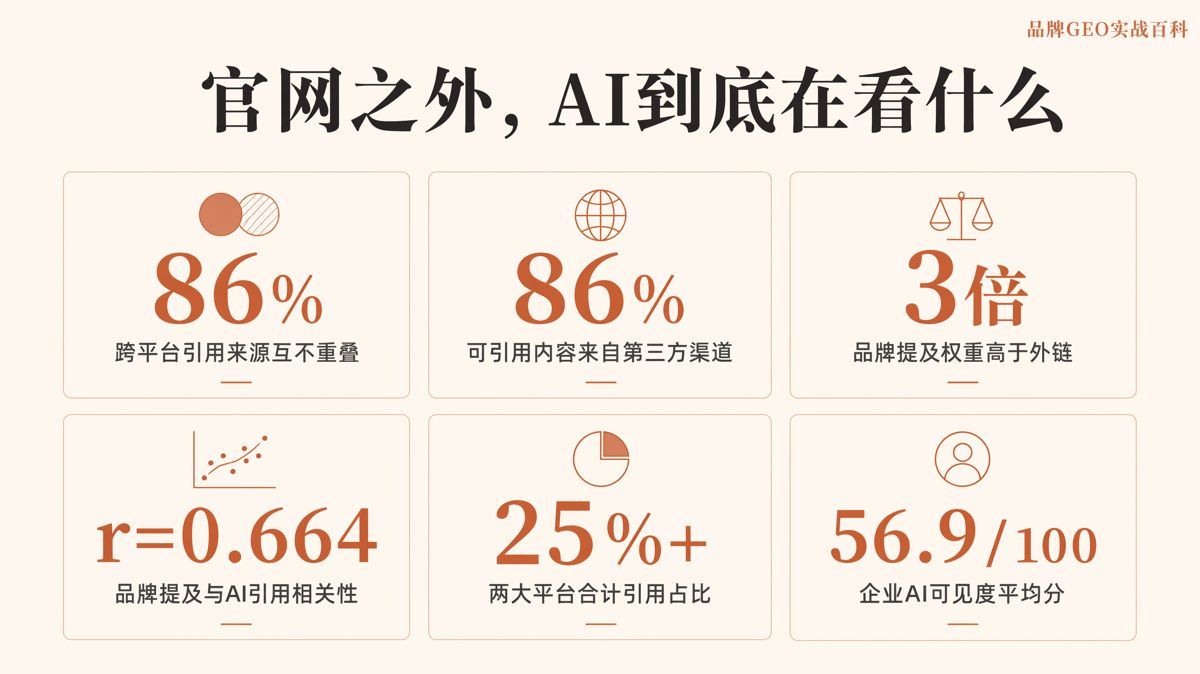
When Ahrefs evaluated ChatGPT, Perplexity, and Google AI Overviews, they found that 86% of their top-cited sources did not overlap. This demonstrates that strong visibility on one AI platform does not automatically transfer to another. (Ahrefs study)
To be precise: an 86% non-overlap does not mean your website loses 86% of its citation potential. It simply means that different AI platforms query widely divergent sets of reference material. Relying on a single owned website makes it nearly impossible to cover the source footprints of multiple engines.
Furthermore, 2025 research from Yext revealed that 86% of brand content cited by AI comes from third-party ecosystems outside brand-owned channels. (Yext data)
In the US market, 5W Research found that Wikipedia and Reddit together account for more than 25% of all ChatGPT citations, while traditional corporate websites failed to make the top 20. (5W Research data)
Additional third-party metrics show Wikipedia accounting for 47.9% of ChatGPT's top 10 citation sources, while Reddit represents 46.5% of Perplexity's cited sources. While derived from different sample sets and not directly additive, both figures underscore the overwhelming weight of third-party platforms in generative answers.
AI Values Unlinked Mentions Over Traditional Backlinks
To understand how AI evaluates authority, marketers must separate three terms:
- Brand mentions: Appearances of your brand or corporate name across third-party content, with or without a hyperlink.
- Citations: Specific source links or domain references generated in an AI's response.
- Backlinks: Traditional inbound hyperlinks from external domains pointing back to your website.
Empirical data from seoClarity reveals a correlation coefficient of r=0.664 between brand web mentions and appearances in Google AI Overviews. For traditional backlinks, that correlation drops to r=0.218. A correlation coefficient measures how closely two variables move together rather than direct causation, but it clearly indicates that brand mentions align far more strongly with AI presence than traditional link building does.
A joint study by iProspect and Hallam summarized this gap by noting that brand mentions drive roughly three times the citation impact of backlinks. While this specific ratio will vary across industries and engines, the directional takeaway remains clear.
These influential brand mentions almost exclusively live off-site: in press coverage, industry analysis, software reviews, and public discussions. Self-published website copy cannot substitute for independent external consensus.
Platform Priorities Vary by Market
In Western markets, high-impact third-party sources are well-documented: Wikipedia, Reddit, YouTube, B2B review aggregators like G2 and Capterra, and LinkedIn.
In China, direct equivalent benchmarks are still emerging. Industry consensus suggests platform-specific tendencies: Doubao (ByteDance's AI assistant) heavily references ByteDance ecosystem content; Tencent Yuanbao surfaces material from WeChat Official Accounts; and ERNIE Bot (Baidu's AI model) prioritizes Baijiahao (Baidu's content platform) and Baidu Baike (Baidu's encyclopedia). These reflect unverified industry observations rather than hard technical rules, but they provide practical directional guidance.
For brands operating in China, the most pragmatic path is auditing actual AI outputs to choose channels across Baidu Baike, Zhihu (China's leading Q&A platform), WeChat Official Accounts, Douyin (short video platform), Bilibili, and Xiaohongshu (RED). While Western strategic principles apply, platforms like Wikipedia and Reddit cannot simply be pasted into a China-facing strategy.
The underlying mandate remains identical everywhere: position your brand's core facts across multiple independent, indexable channels that target AI engines routinely query.
Publication Recency Directly Shapes AI Retrieval
A separate Ahrefs study found that URLs cited by AI engines are on average 25.7% newer than standard Google organic search results. For ChatGPT specifically, cited sources were 393 to 458 days newer than top Google search listings. (Ahrefs freshness study)
Freshness is a major retrieval signal. Regular updates do not guarantee a citation, but letting digital assets sit dormant deprives both your corporate site and external profiles of fresh relevance signals.
Corporate websites rarely match the publication frequency of editorial and social channels. Updating your website once, or publishing a one-off external article without ongoing distribution, fails to build the recurring footprint modern AI retrieval requires.
What Real-World Case Studies Tell Us
DerivateX evaluated 50 B2B SaaS companies and found an average AI visibility score of 56.9 out of 100, with a 44% failure rate. Confining content strictly to corporate websites without off-site distribution was a shared vulnerability across low-scoring brands.
This data does not mean a website-only strategy is the sole reason for poor scores, but it shows that a technically polished website alone cannot guarantee visibility in generative outputs.
Conversely, a published case study on LS Building Products recorded a 540% increase in Google AI Overviews mentions over six months. The campaign combined high-authority external placements with multi-channel content distribution alongside site improvements. Because multiple tactics ran in parallel, the lift cannot be attributed to any single lever.
Taken together, these studies support a measured conclusion: corporate websites, off-site brand mentions, multi-platform presence, and continuous publishing must work in tandem.
The Distinct Roles of Websites vs. Third-Party Content
| Evaluation Criteria | Corporate Website | External Third-Party Content |
|---|---|---|
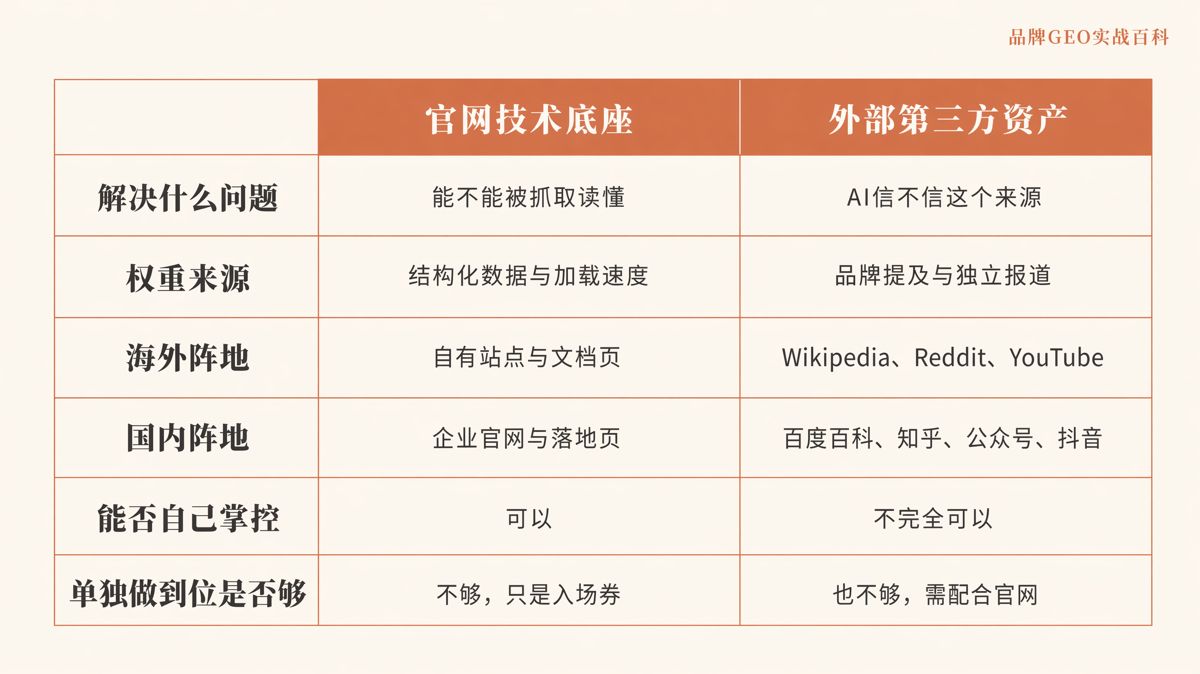
| Primary Objective | Ensures pages are crawlable and factual data is accurately identified | Validates brand claims through independent third-party sources |
| Core Signals | Schema markup, crawl accessibility, page speed, clear copy | Brand mentions, earned media, user reviews, community discussions |
| Common Global Channels | Corporate site, product landing pages, documentation | Wikipedia, Reddit, G2, Capterra, YouTube, LinkedIn |
| Common China Channels | Official company website, product hubs | Baidu Baike, Zhihu, WeChat Official Accounts, Douyin, Bilibili, Xiaohongshu (RED) |
| Brand Control | Full editorial control | Limited editorial control; governed by platform rules and genuine engagement |
| Sufficiency | Not sufficient on its own | Not sufficient on its own; must align with official assets |
| Common Pitfalls | Abandoning content updates after technical launch | One-time publishing, or conflicting facts across platforms |
Your owned site and external properties do not need identical wording, but company descriptions, product categories, and baseline data points must align. When different platforms present conflicting descriptions of the same brand, AI models struggle to map them to a single entity.
Achieving "entity consistency"—where models recognize variations in name, identity, and claims as pointing to the same organization—is what enables "multi-source consensus." This does not mean syndicating the same press release verbatim across ten platforms; it means securing independent verification of the same underlying facts.
SEO Has Not Expired, but GEO Adds New Demands
Traditional SEO centers on whether search engines can crawl, index, rank, and present a web page. In that paradigm, companies drive performance primarily through their owned domains via architecture, on-page content, internal links, and external backlinks.
In May 2026, Google reiterated that optimizing for generative search remains rooted in foundational SEO best practices. Core technical standards have not vanished.
What has shifted is how engines assemble responses. AI models frequently fragment content across the web into discrete statements, cross-referencing each fragment for authority and corroboration before including it. A corporate site provides clear first-party baseline data, but it cannot provide its own third-party validation.
GEO does not replace your corporate website with third-party platforms. It requires adding cross-platform presence, independent brand mentions, and multi-source verification to your existing web foundation.
Action Plan for Lean Marketing Teams
If you have limited resources, avoid spreading your team across every channel at once. Execute in this sequence:
- Complete core website technical standards. Ensure robots directives, schema markup, and mobile load speeds let AI models read and classify your content without friction.
- Select one or two high-impact third-party platforms. Prioritize channels where your target buyers research solutions and your target AI engines actively retrieve citations.
- Harmonize core factual claims. Your owned site and external profiles can use distinct messaging styles, but your company founding details, product taxonomy, and performance metrics must not conflict.
- Maintain regular updates. Update official product information and maintain ongoing external activity so engines consistently encounter fresh relevance signals.
The problem with a website-only GEO approach is not that websites lack value—it is that they can only complete half the job. Your website gives AI engines clear, structured source data to read. Third-party platforms provide the independent corroboration, cross-engine reach, and ongoing proof models need to cite your brand.
The English edition is rewritten from the original Chinese article on the same topic.

Starbox AI is an AI marketing company based in Hangzhou, China. This article draws on Starbox project work. Please credit the source when quoting.
Related reading
 GEO Guide
Why AI Marketing Vendor Quotes Vary 10x: A 4-Step Vetting Checklist
Evaluate AI marketing proposals by delivery actions, not slide decks. Audit source infrastructure, fact cleaning, and clean-environment testing.
Oct 22, 2026 · 6 min read
 GEO Guide
Spotting GEO Scams: What Actually Drives AI Recommendations?
Automated AI ranking promises violate how LLMs work. Real AI recommendations rely on authoritative, structured facts across trusted public sources.
Oct 22, 2026 · 4 min read
 GEO Guide
How to Measure Your Brand's AI Visibility with a Spreadsheet
You do not need expensive software to track AI recommendations. A three-tier prompt framework and a simple spreadsheet can score your brand visibility in half a day.
Oct 21, 2026 · 6 min read