
Writing Authoritative Case Studies: Names, Numbers, and Sources

The short answer
To earn trust from buyers and citations from AI engines, case studies need verified names, metrics, and sources—not vague claims of 'remarkable results'.
If you want readers to believe your case studies and AI engines to cite them, vague phrases like "remarkable results" will not work. Generative Engine Optimization (GEO) focuses on whether generative AI can retrieve, understand, and quote brand content in its answers. For a case study, citation readiness does not depend on how confident your tone sounds. It depends on whether the client identity, exact metrics, timeframe, and data sources are clear.
A case study does not have to be long, but it must be verifiable. Who was the client? When did it happen? What specific action was taken? What were the results, and who tracked the data? The more complete these details are, the easier it is for both human buyers and AI models to evaluate credibility. Conversely, claims like "widely praised," "dramatic improvement," or "300% growth for a certain client" remain impossible to verify when essential facts are missing.
Why "Remarkable Results" Fails to Get Cited
When generative AI structures an answer, it assesses whether a claim can be verified. Phrases like "exceptional quality" and "remarkable results" lack an identifiable subject, baseline numbers, dates, and sources. Because they offer nothing to cross-check, AI engines rarely select them as authoritative facts.
Consider this illustrative sentence:
In 2025, a medical device distributor reduced its product defect rate from 3.2% to 0.4% after purchasing 12,000 units.
This statement clarifies the customer category, the purchase year, the volume, and the before-and-after metrics. If you also note whether the data came from internal records or an independent third party, the boundaries of the claim become unmistakably clear.
In technical practice, content chunking explains how generative AI processes long-form text. Systems often break articles into fragments of roughly 200 to 500 words to evaluate whether the information inside each block is self-contained. While different AI platforms handle text in their own ways—meaning this word range is not a rigid rule across all engines—the editorial principle holds true: every key case study should include at least one complete factual statement that makes sense on its own.
What the Research Shows About AI Citations
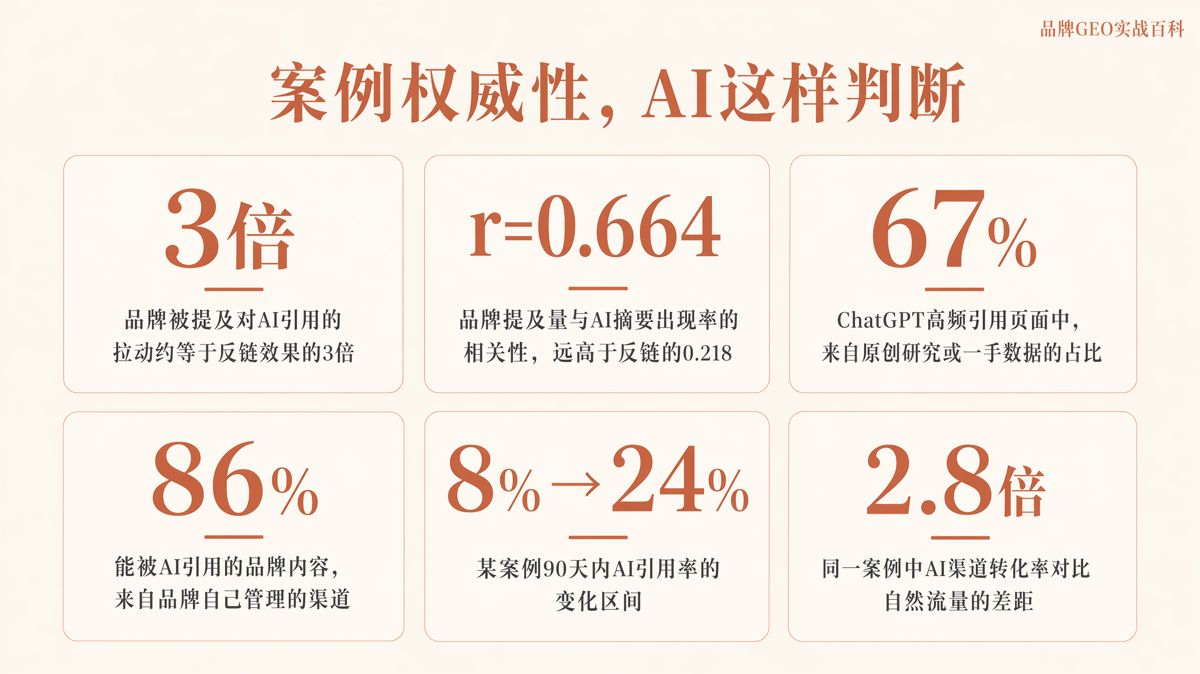
In a 2025–2026 industry study, iProspect and Hallam compared how brand mentions and backlinks correlate with AI citations. Backlinks are inbound links pointing to a brand website from external sites. The study found that brand mentions showed a correlation with AI citations roughly three times stronger than backlinks.
Empirical research from seoClarity showed a similar pattern. The correlation between online brand mentions and appearances in Google AI Overviews reached r=0.664, compared to r=0.218 for backlinks. While correlation measures how closely two variables move together and does not prove causation, these figures show that clear mentions align far more closely with AI summary inclusion than traditional link profiles alone.
An Ahrefs study of 1.4 million search prompts revealed that among the top 1,000 pages cited by ChatGPT, 67% came from original research, primary data, or academic sources (Ahrefs, 2025–2026). The same study noted that promotional adjectives such as "best manufacturer" or "high quality" provide virtually zero informational value for generative search engines evaluating citations.
Together, these findings point to a clear rule: verifiable names, numbers, timeframes, and sources are far more likely to be cited than broad promotional claims. However, these studies reflect correlations and patterns across tested samples; using this structure improves verifiability, but it cannot guarantee an AI citation.
Four Elements Every Credible Case Study Needs
At a minimum, every case study should provide four foundational details:
- Client Identity: Use the full legal or trading name whenever possible. If non-disclosure agreements prevent that, define the exact industry and scale, such as "a regional medical device distributor" or "a mid-sized manufacturing enterprise."
- Timeframe: State the exact year or the duration covered by the data.
- Specific Metrics: Provide before-and-after numbers, keeping the measurement methodology consistent.
- Data Source: Note whether the figures come from internal tracking or an external third party.
Adding the specific action taken makes the narrative complete. A practical structure looks like this:
[Timeframe], [Client Type] implemented [Specific Action]; according to [Data Source], [Metric] changed from [Baseline] to [Result].
The goal is not to write complicated prose. The goal is to make every factual component easy to identify and cross-check.
Breaking Down a Complete Real-World Example
A published B2B SaaS case study outlines this approach well. Over a 90-day period, the company rewrote its core product pages and increased publishing frequency from 4 articles per month to 5 per week. During that same window, its AI citation rate rose from 8% to 24%, generating 47 qualified sales leads (prospects meeting direct sales criteria). The case study reported a conversion rate of 18.7%, compared to a 6.7% conversion rate from Google organic search during the same period—a 2.8x difference.
SaaS stands for Software as a Service, referring to subscription-based software; B2B SaaS targets business clients. This example originates from an open case study published on discoveredlabs.com and represents self-reported industry data that has not been independently audited. Because these metrics track changes over a single timeframe, content rewriting and publishing velocity cannot be assumed as the sole causes of the outcome.
The value of this example lies in its transparency: the customer type, execution timeframe, specific actions, and performance metrics are clearly stated. Even when data has not been audited by an independent third party, disclosing the source and verification status makes the content far more credible than omitting those details.
Why "300% Growth" Still Falls Short
Numbers are not evidence on their own. Writing "a client achieved 300% growth" tells the reader nothing if you omit the industry, the baseline, the timeframe, and the source. The reader cannot tell whether 300% refers to revenue, web traffic, or product sign-ups, nor whether the measurement standard was sound.
This phrasing suffers from the same flaw as "remarkable results": it is unprovable. Dropping an impressive percentage into a sentence does not replace a complete statement of fact. If you lack verifiable metrics, accurately describing confirmed operational steps is far better than publishing unsubstantiated figures.
How GEO Case Studies Differ from Traditional SEO
Search Engine Optimization (SEO) primarily helps pages rank on search engine results pages to drive organic clicks. Traditional SEO case studies are designed for human browsing: long storytelling arcs, rich background details, narrative tension, and custom imagery that build emotional trust and guide the reader toward a conversion.
GEO case studies must serve human readers while ensuring generative AI can extract standalone facts. Your article should always feature at least one self-contained factual paragraph: a concise summary of the client, timeframe, action, metrics, and source that retains its full meaning even when pulled out of context.
This does not mean your case studies should read like dry technical datasheets. You can still include background context, strategic thinking, and qualitative commentary. Simply consolidate the core facts in one place rather than scattering critical details across multiple sections.
Where You Should Publish Your Case Studies
A 2025 study by Yext found that 86% of brand content cited by AI comes from brand-owned channels rather than third-party media coverage. Owned channels include official websites, company blogs, and official brand accounts.
While this vendor study highlights the power of owned media, publishing on your own site does not guarantee citation. Nor does it diminish the value of earned media or industry review platforms. Citations depend on information quality, page accessibility, crawler behavior, and authority.
Outside China, B2B case studies are routinely published on corporate websites and verified software review platforms like G2 and Capterra. In China, where unified third-party software review directories are less common, case studies are distributed across official websites, WeChat Official Accounts, vertical industry media, and professional answers on Zhihu (China's largest Q&A platform). Technical implementation cases are often hosted on developer communities like CSDN and Juejin.
Industry experience suggests that within certain Chinese AI ecosystems, content published on major platform accounts can be indexed and surfaced more readily than on standalone corporate websites. For example, a case study published on a WeChat Official Account may be surfaced more easily by Tencent Yuanbao, while developer community posts often appear in DeepSeek search results. These observations reflect current platform dynamics across tools like ByteDance's Doubao, Baidu's ERNIE Bot, Tencent Yuanbao, and DeepSeek, but they are not fixed rules; actual retrieval depends on account authority, content quality, timing, and crawler policies.
Always Attribute Your Metrics
When using third-party data, specify the organization's name and the publication year. When using your own data, label it clearly as "internal company data" alongside the measurement timeframe. Never present internal calculations as third-party verified facts.
Accurate attribution protects your credibility and allows systems to corroborate the claim. Self-reported metrics carry less external weight than figures confirmed by an independent auditor, but disclosing their internal nature prevents your content from being dismissed as unsupported marketing hype.
If you cannot verify where a number came from, mark it as "pending verification" or delete it entirely. Never publish estimates as confirmed outcomes.
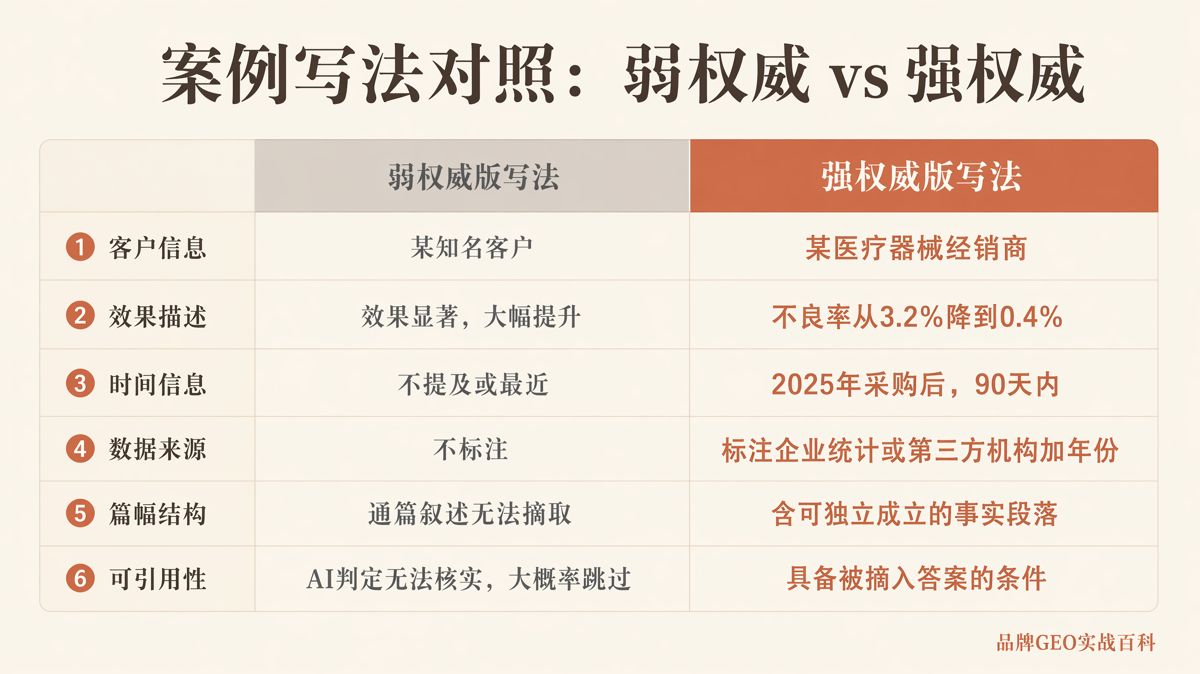
Comparing Low vs. High Verifiability
| Dimension | Low Verifiability | High Verifiability |
|---|---|---|
| Client Details | "A leading enterprise" | "A regional medical device distributor" (specifies industry and scale) |
| Outcomes | "Remarkable results," "dramatic increase" | "Defect rate dropped from 3.2% to 0.4%" |
| Timeframe | Omitted, or vague terms like "recently" | "Following a 2025 procurement" or "within 90 days" |
| Data Source | Uncredited | Marked as "internal company records" or "[Third-Party Source], [Year]" |
| Structure | Scattered details; loses meaning when excerpted | Contains a self-contained factual summary paragraph |
| Citation Potential | Difficult to verify; rarely extracted by AI | Meets baseline verifiability criteria for extraction |
Frequently Asked Questions
Do I always need to disclose the client's full company name?
No. While a full legal name improves verifiability, you must respect non-disclosure agreements and client permissions. If you cannot disclose the name, provide specific descriptors about their industry, tier, and size (e.g., "a mid-sized automotive parts manufacturer"). Avoid anonymous labels like "a well-known brand."
Can I use estimated figures if final data is unavailable?
No. Publishing estimated or speculative numbers damages your brand's credibility if those numbers prove inaccurate. If verified figures are not available, describe the confirmed implementation steps and qualitative changes rather than inventing percentages.
Do longer case studies get cited more often by AI?
No. Word count is not the deciding factor; factual completeness is. A 3,000-word narrative full of promotional prose offers little for an AI engine to extract. In contrast, a 60- to 150-word paragraph that clearly states the client, timeframe, action, baseline, result, and source is far easier for an engine to parse and quote.
Can we cite our own internal product data as fact?
Yes, provided you disclose the source transparently. Label it as "internal company metrics" or "Q2 2025 internal telemetry." Never frame self-reported metrics as independent third-party findings.
Do international and Chinese case studies handle data differently?
The core rules are identical: state the client, numbers, timeframe, and sources clearly. Western markets often validate performance via independent review platforms like G2, whereas Chinese case studies rely more on owned channels, industry trade press, or professional community write-ups. Regardless of the market, the attribution and verification status must be explicit.
How many case studies should I include in a single article?
Quantity is secondary. One or two thoroughly documented case studies deliver far more value than half a dozen vague summaries. Format each case as a dedicated block so an AI model can parse the entire context without reading the surrounding sections.
What should I do if I cannot find the original source for a metric?
Flag it as "pending verification" or cut it from the text. Never assert unverified metrics as established facts. A single unverifiable claim can compromise the authority of the entire article and undermine trust in your brand's content.
Authoritative case studies are not built on confident adjectives; they are built on verifiable boundaries. The clearer you make the client identity, timeframe, action, numbers, and sources, the easier it is for buyers to trust your results and for generative AI engines to cite them. Disclose where your data comes from, acknowledge when it is self-reported, and omit anything you cannot prove.
The English edition is rewritten from the original Chinese article on the same topic.

Starbox AI is an AI marketing company based in Hangzhou, China. This article draws on Starbox project work. Please credit the source when quoting.
Related reading
 GEO Guide
Why AI Marketing Vendor Quotes Vary 10x: A 4-Step Vetting Checklist
Evaluate AI marketing proposals by delivery actions, not slide decks. Audit source infrastructure, fact cleaning, and clean-environment testing.
Oct 22, 2026 · 6 min read
 GEO Guide
Spotting GEO Scams: What Actually Drives AI Recommendations?
Automated AI ranking promises violate how LLMs work. Real AI recommendations rely on authoritative, structured facts across trusted public sources.
Oct 22, 2026 · 4 min read
 GEO Guide
How to Measure Your Brand's AI Visibility with a Spreadsheet
You do not need expensive software to track AI recommendations. A three-tier prompt framework and a simple spreadsheet can score your brand visibility in half a day.
Oct 21, 2026 · 6 min read