
Why Author Bylines Influence How AI Engines Rank Content
The short answer
When AI engines cite content, author identity matters as much as the text. Here is how verifiable bylines build authority in generative search.
When an artificial intelligence engine compiles an answer, whether it retrieves and cites a piece of content depends on who wrote it, not just what it says. Compared to anonymous posts, content backed by a named author, clear credentials, and verifiable background information is far more likely to be treated as a trustworthy source.
This is a core operational requirement in Generative Engine Optimization (GEO). Your content infrastructure must help generative engines identify who published the material, what qualifications they hold, and whether those claims hold up across external sources. However, a byline is only one authority signal. It cannot compensate for low-quality analysis, nor does it guarantee a citation.
Why Bylines Shape Authority Signals
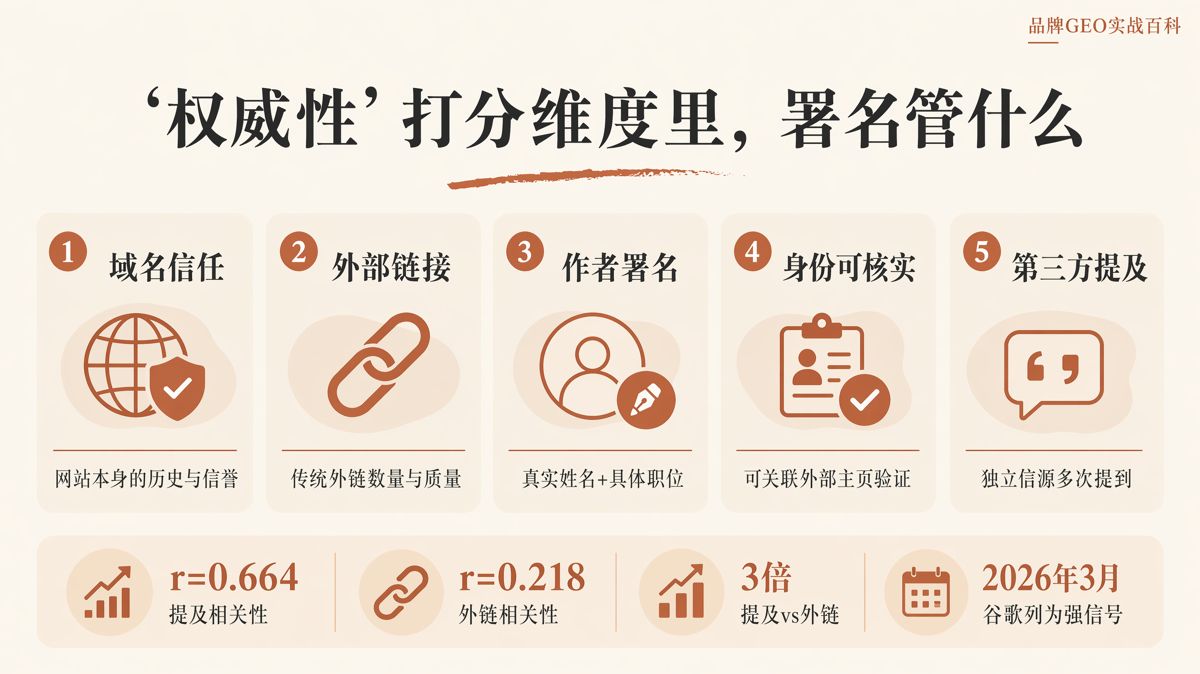
Before generating an answer, AI engines retrieve and rank candidate sources. Industry studies from 2025 and 2026 consistently highlight several factors used to assess authority:
- Domain-level trust
- External backlinks pointing to the page
- Clear author attribution
- Third-party coverage across news media, Wikipedia, and independent databases
A byline provides traceable identity. When an article identifies a real author and their professional role, platforms and readers can independently verify who took responsibility for the claims. Anonymous content lacks this layer of accountability, making credibility harder to establish.
Traditional search engines have evaluated creator credibility for years. Generative engines carry that logic forward, placing even greater weight on whether an author's identity remains consistent across different platforms and websites.
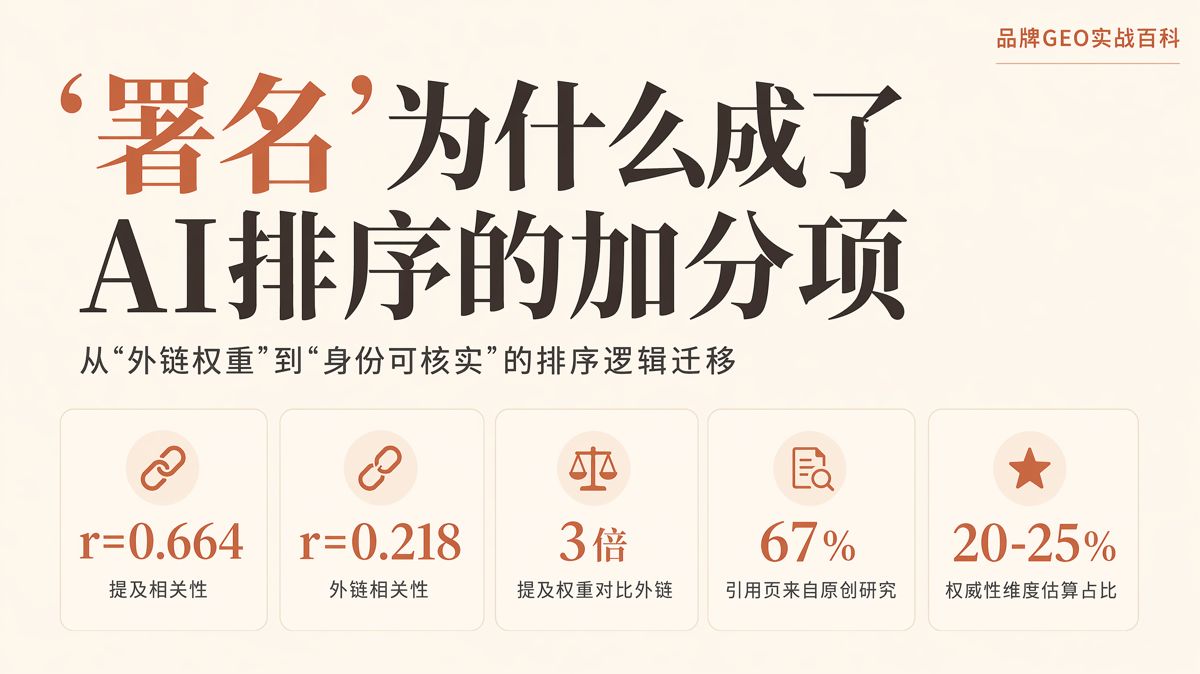
Note that no major engine has officially published the exact weight assigned to author bylines. Industry estimates suggesting bylines account for 20% to 25% of ranking weight are observational conjectures, not confirmed algorithmic parameters.
Brand Mentions vs. Backlinks: What the Data Shows
Traditional search engine optimization (SEO) has long relied on backlinks as primary trust votes. In generative engines, however, brand and author mentions across diverse sources show a stronger relationship with AI citations than traditional link equity alone.
Research from seoClarity found that brand mention density across the web correlates with inclusion in AI answers at a coefficient (r) of 0.664. Traditional backlinks showed a correlation coefficient of just 0.218. A correlation coefficient measures how closely two variables move together; it highlights an association, not direct causation.
Independent findings from iProspect and Hallam similarly reported that brand mentions correlate with AI citations at roughly three times the rate of traditional backlinks. These observations reflect specific datasets and methodologies, but they point toward a clear trend: when independent sources repeatedly reference the same brand, author, or perspective, generative engines find it easier to identify consensus.
Third-party mentions provide cross-validation that self-published brand channels cannot replicate. A clear byline anchors your content to an identifiable entity, enabling engines to run entity resolution—the process of recognizing that mentions across separate domains belong to the same person. Still, a byline remains an internal claim; it does not replace third-party validation.
What Makes an Author Byline Verifiable?
A credible byline requires more than a first name or a generic "Editorial Team" tag. Content checklists based on industry research recommend four components:
- A consistent name: Use a real name or a permanent professional pseudonym that remains stable across publications.
- A specific role or title: State clearly why the author possesses firsthand expertise on the topic.
- Verifiable external profiles: Provide direct links to external professional profiles, such as LinkedIn, to confirm identity and career history.
- Cross-platform consistency: Maintain the same name, title, and bio across all channels so algorithmic crawlers can reconcile the data into a single entity.
Official search guidance published by Google starting in March 2026 explicitly classifies verifiable author or publisher identity as a strong optimization signal. Connecting an author entity to structured external knowledge graphs like Wikipedia or Wikidata reinforces that signal.
Keep in mind that while Google publishes clear guidelines, other generative engines operate on proprietary retrieval models. How different AI engines weigh author data must be assessed individually.
Why Bylines Belong on Pre-Publishing Checklists
Many enterprise editorial workflows now treat a verifiable author byline and profile link as mandatory. It sits alongside standard quality checks: addressing search intent in the opening paragraphs, including structured comparison tables, and providing comprehensive FAQs.
Adding a byline does not automatically improve content substance, but it supplies critical provenance. Even an article with sound data and clean formatting remains risky for an engine to cite if it cannot determine who stands behind the claims.
An Ahrefs study evaluating 1.4 million ChatGPT prompts revealed that 67% of top-cited pages originated from original research, primary datasets, or academic sources. ChatGPT is a generative conversational AI platform. These authoritative sources almost always feature named authors or institutions. This does not mean bylines single-handedly force an AI citation; rather, explicit authorship and original, verifiable reporting naturally go hand in hand.
Traditional Search Ranking vs. Generative Engine Ranking
Both traditional search and generative AI engines evaluate trust, but they process author signals differently.
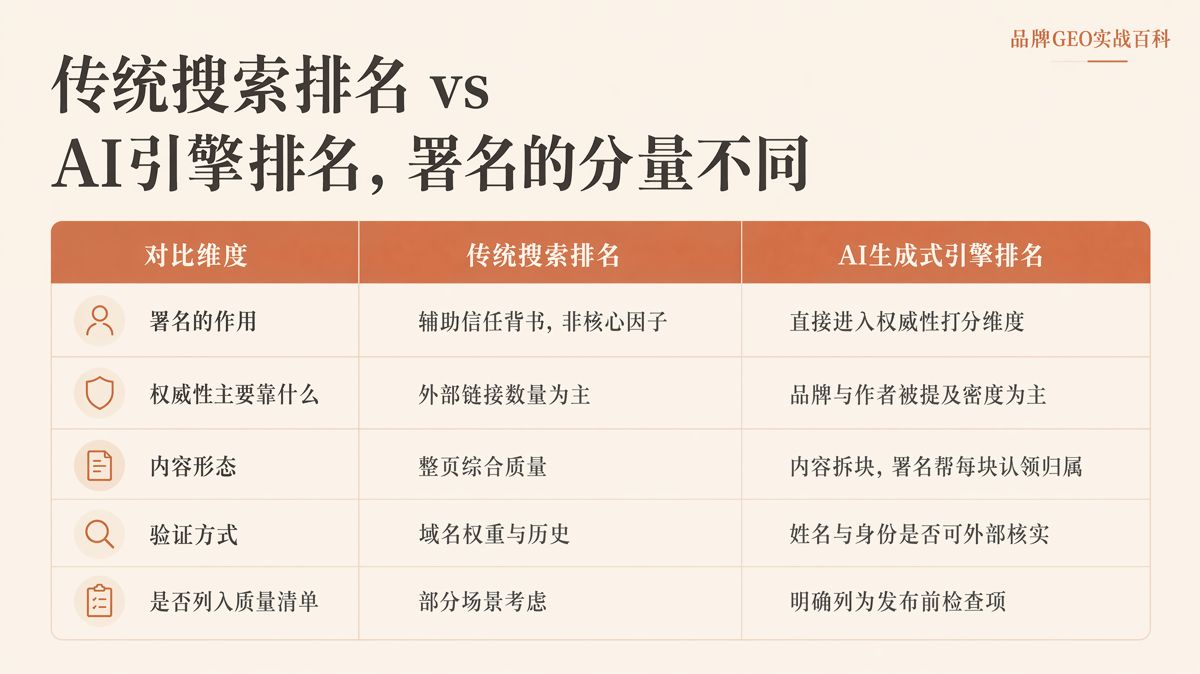
| Dimension | Traditional Search Engines | Generative AI Engines |
|---|---|---|
| Primary role of bylines | Supports overall content credibility; rarely a standalone ranking factor | Frequently evaluated in industry studies as a core entity signal |
| Common authority signals | Backlink profiles, domain age, site-wide trust | Mention density of brands and authors, entity consistency, external verification |
| Content processing | Evaluates page quality largely as a complete document | Often extracts and scores modular passages; bylines confirm passage attribution |
| Identity verification | Focuses on domain-level authority and historical crawl records | Verifies whether the creator's name and credentials exist across external platforms |
| Publishing standards | Considered best practice in specific niches | Standard item on modern pre-publishing quality checklists |
Author attribution is not an arbitrary rule invented for AI. It represents the natural evolution of content quality evaluation inside retrieval-augmented generation environments.
Setting Up Author Signals on Chinese Platforms
For teams targeting the Chinese market, retrieval patterns across local generative engines reflect distinct ecosystem preferences:
- Tencent Yuanbao (Tencent's AI assistant) frequently draws from WeChat Official Accounts.
- Baidu ERNIE Bot favors Baijiahao (Baidu's content platform) and Baidu Baike (Baidu's online encyclopedia).
- Doubao (ByteDance's AI assistant) shows strong retrieval affinity for Douyin (TikTok's Chinese sister app) and Jinri Toutiao (ByteDance's news aggregator).
- DeepSeek and Kimi (Moonshot AI's assistant) index Zhihu (China's largest Q&A platform) at high frequencies.
These patterns represent observational industry data rather than guaranteed algorithmic rules; actual citations vary by query and platform updates.
To optimize author profiles across these networks:
- Include real names and verified professional titles on WeChat Official Account articles.
- Complete real-name authentication on Zhihu and maintain a comprehensive profile bio.
- Fill out author credentials fully on Baijiahao and Toutiao, avoiding vague organizational labels.
- Standardize your author's name, role, and bio across every Chinese platform.
While international research relies on LinkedIn and Wikidata for verification, domestic Chinese platforms rely on native real-name authentication systems and integrated author cards. Chinese engine developers have not published explicit weighting algorithms for bylines, so apply consistent entity management rather than chasing unverified algorithmic shortcuts.
Does a Byline Guarantee AI Citations?
No.
A byline simply answers two questions: who wrote this, and can their background be verified? Whether your content gets indexed, ranks near the top of the retrieval pool, and ultimately gets synthesized into an AI response depends on contextual relevance, technical formatting, and factual depth.
If an article lacks verifiable figures, relies on flawed logic, or buries its main conclusions in dense prose, even the most decorated author bio will not earn the citation.
To build an effective foundation for generative search, execute three fundamentals simultaneously:
- Provide authentic, consistent, and verifiable author details.
- Anchor your body text with concrete data, clear boundary conditions, and direct takeaways.
- Structure key arguments so individual passages make complete sense out of context, allowing retrieval models to extract them cleanly.
A byline cannot substitute for good content. It is simply the identity layer that makes your content eligible for trust.
Frequently Asked Questions
Do you have to use a real legal name, or is a pen name acceptable?
The priority is whether that identity can be verified and maintained consistently over time. A permanent pen name tied to an established role and external profiles can work. However, changing names frequently or using pseudonyms with no verifiable background will weaken authority signals.
Should personal blogs and individual social accounts include bylines?
Yes. Generative engines evaluate author credibility regardless of whether the publisher is an individual or an enterprise. Solo creators should provide clear professional backgrounds and keep profiles consistent across channels.
Where should the byline go: at the top or bottom of the page?
Current research shows no strict requirement for placement. What matters is site-wide consistency and providing complete details: name, professional role, and verifiable external links.
Is an author byline the same as a third-party mention?
No. A byline is first-party identity information provided by the publisher. A third-party mention occurs when an independent external source references the person, brand, or content. Bylines establish ownership; external mentions provide verification.
Should corporate blogs credit the company or an individual author?
Crediting an individual name and job title creates a clearer entity signal than a generic editorial team label. The best approach combines both: attribute the article to an individual specialist, and include the company background at the end.
How often should research on byline impact be re-evaluated?
Generative engine algorithms evolve continuously. Published correlation figures reflect specific samples at specific points in time. Treat verifiable authorship as a durable strategic direction, but review algorithmic weights and data points regularly.
What are the risks of fabricating expert credentials?
Faking author identities, qualifications, or endorsements violates platform policies and regulatory standards. If caught, your content risks algorithmic penalties and trust loss. Author details must be genuine, stable, and verifiable.
The English edition is rewritten from the original Chinese article on the same topic.

Starbox AI is an AI marketing company based in Hangzhou, China. This article draws on Starbox project work. Please credit the source when quoting.
Related reading
 GEO Guide
Why AI Marketing Vendor Quotes Vary 10x: A 4-Step Vetting Checklist
Evaluate AI marketing proposals by delivery actions, not slide decks. Audit source infrastructure, fact cleaning, and clean-environment testing.
Oct 22, 2026 · 6 min read
 GEO Guide
Spotting GEO Scams: What Actually Drives AI Recommendations?
Automated AI ranking promises violate how LLMs work. Real AI recommendations rely on authoritative, structured facts across trusted public sources.
Oct 22, 2026 · 4 min read
 GEO Guide
How to Measure Your Brand's AI Visibility with a Spreadsheet
You do not need expensive software to track AI recommendations. A three-tier prompt framework and a simple spreadsheet can score your brand visibility in half a day.
Oct 21, 2026 · 6 min read