
Building E-E-A-T Authority Signals in the GEO Era
The short answer
Generative Engine Optimization shifts authority from backlinks alone to cross-platform entity consistency, verifiable facts, and multi-source consensus.
Generative Engine Optimization (GEO) focuses on improving content, entity data, and external trust signals so that generative AI engines can easily retrieve, understand, and cite your brand. In the GEO era, the criteria for establishing credibility are changing. While external backlinks still matter, generative models place far greater weight on consistent entity descriptions across channels, verifiable facts, and independent third-party consensus.
E-E-A-T (Experience, Expertise, Authoritativeness, and Trustworthiness) originally defined how Google evaluates content quality. In generative search and retrieval-augmented generation (RAG), these principles translate into semantic relevance, authority, freshness, readability, and entity consistency. Some industry models estimate that authority accounts for 20% to 25% of citation weighting, though this is an analytical estimate rather than a standardized, public formula used by all AI engines.
The benchmarks cited in this article draw from industry publications, vendor studies, and public research. Sample sizes, evaluation criteria, and platforms vary across these sources. Treat these figures as directional indicators for planning and testing rather than universal laws. Correlation coefficients ($r$) indicate the strength of an observed association, not direct causation.
What Has Changed for E-E-A-T in the GEO Era
In traditional search engine optimization (SEO), authority relied heavily on backlink volume, referring domain quality, and domain age. In generative search, engines do not just ask "who links to your page." They evaluate:
- Whether your brand name, corporate records, and executive profiles match across different platforms
- Whether facts, metrics, and certifications within your content can be verified against external sources
- Whether multiple independent sources arrive at similar conclusions about your business
- Whether your content can be parsed into clear, standalone information blocks
- Whether your information remains accurate, current, and easy to interpret
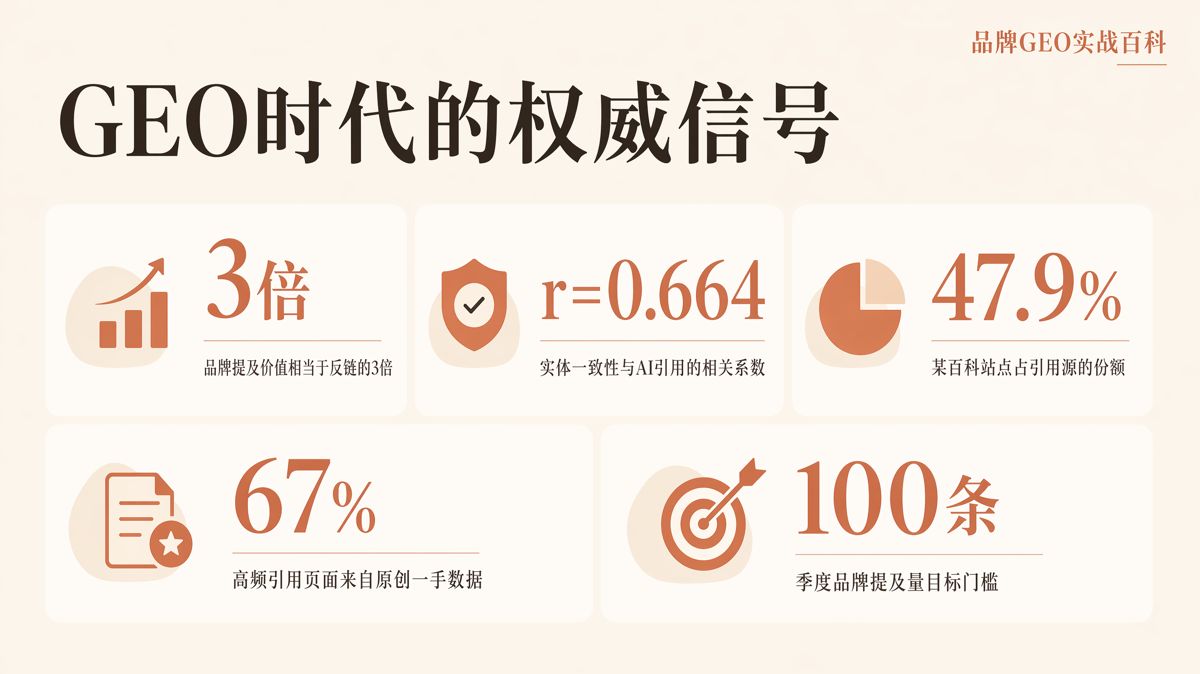
A study by seoClarity showed that entity consistency had a correlation of $r=0.664$ with appearances in Google AI Overviews (AIO), compared to $r=0.218$ for traditional backlinks. An $r$ value closer to 1 indicates a stronger positive correlation. In that study's sample, entity consistency showed roughly three times the correlation of backlinks. However, strong correlation does not guarantee an AI citation.
When generative engines ingest web pages, they break long documents into smaller retrievable passages, often called "chunks." Industry benchmarks typically place effective chunk sizes between 200 and 500 words. Whether an individual chunk answers a specific question completely, includes verifiable facts, and cites clear sources directly influences its odds of retrieval.
How Authority Signals Differ Between SEO and GEO
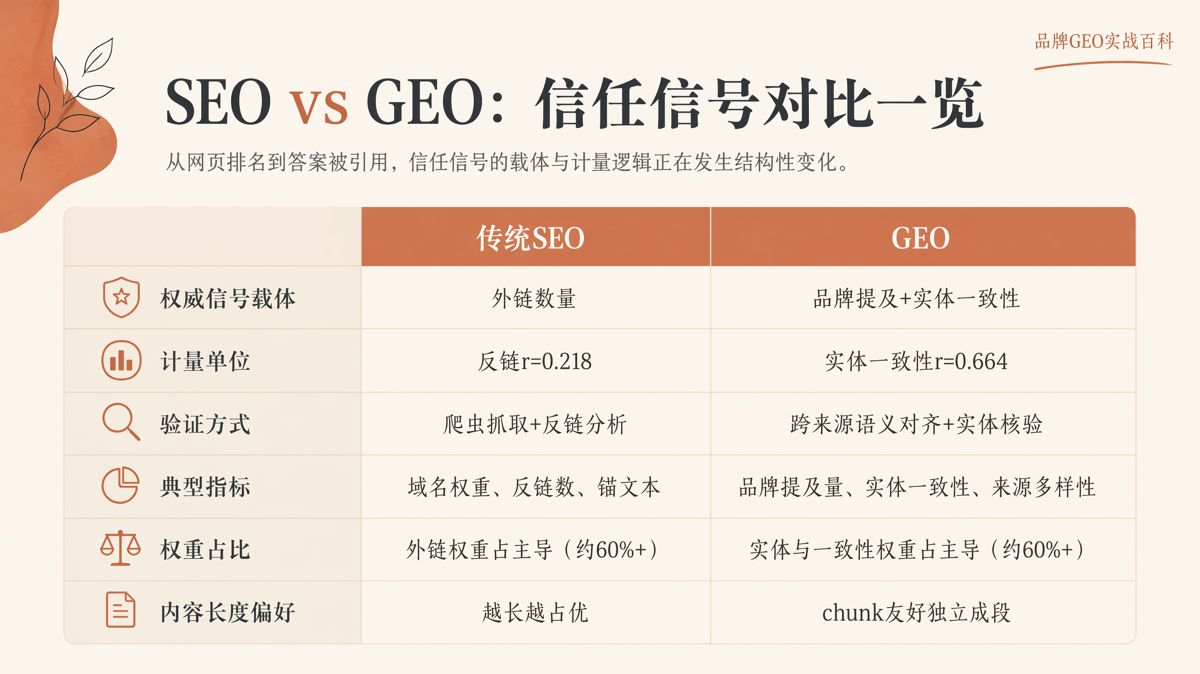
SEO and GEO both address whether content deserves trust, but they rely on different signals and evaluation scopes.
| Dimension | Traditional SEO Practice | GEO Practice |
|---|---|---|
| Primary authority signals | Backlinks, referring domain quality, domain history | Brand mentions, entity consistency, multi-source consensus |
| Common measurement metrics | Backlink counts, referring domains, domain rating/authority | Mention frequency, cross-platform alignment, citation source diversity |
| Content ingestion format | Evaluates entire pages and hyperlink graphs | Evaluates pages and discrete text chunks simultaneously |
| Research correlation metrics | Backlink correlation to AIO appearance: $r=0.218$ | Entity consistency correlation to AIO appearance: $r=0.664$ |
| Content structure preferences | Often favors comprehensive long-form guides (2,000–5,000 words) | Prioritizes self-contained paragraphs that communicate complete facts independently |
This does not mean SEO is obsolete. Google Search Relations guidance published on May 15, 2026 stated that optimizing for AI search builds directly on standard SEO foundations. For web-connected AI engines, a page must first be crawled, indexed, and retrievable before it can be considered as a citation source.
In China, generative engines draw from distinct ecosystems. Getting indexed by Baidu, WeChat Search, and other public repositories remains a baseline requirement, though indexation alone never guarantees an AI citation.
Why Unlinked Brand Mentions Deserve Dedicated Tracking
An unlinked brand mention occurs when a third-party source names your brand, company, or product without adding a hyperlink. In traditional SEO, these mentions rarely factored into core performance indicators. Because generative engines synthesize answers from multiple sources, unlinked mentions now carry measurable value.
A 2025 study by iProspect and Hallam suggested that online brand mentions correlate with AI citations at roughly three times the rate of backlinks. While this reflects a specific study framework, it illustrates an important shift: generative models assess how many independent platforms discuss a brand and whether their descriptions agree, rather than just tracking links to a destination URL.
Marketers should distinguish between two metrics:
- Citation: The AI answer directly links to or lists your URL as a reference source.
- Brand Mention: The AI answer or its retrieval sources reference your brand name, with or without a link.
Track both metrics separately. Focusing only on linked citations misses a large share of your actual brand footprint inside AI answer engines.
Research from Quattr suggests that a brand needs at least 100 high-context mentions per quarter to create a clear signal above ambient web noise. This 100-mention threshold is an industry guideline, not an engine-enforced rule, and it cannot be achieved through programmatic keyword stuffing. What matters are organic mentions tied to specific topics, verified facts, and real-world use cases.
Owned Channels vs. Third-Party Sources
A 2025 vendor report from Yext indicated that 86% of brand content cited by AI engines originates from owned channels—such as official websites, verified accounts, and official documentation—rather than third-party media. Owned assets serve as the primary source of truth for company names, product specifications, service scopes, and contact information.
However, owned channels cannot provide independent validation. An Ahrefs study spanning 2025 and 2026 across 1.4 million prompts found that 67% of the top 1,000 cited pages in ChatGPT came from original research, primary datasets, or academic sources.
These findings complement each other: owned channels define your baseline facts, while original research and third-party validation prove to the model that those facts hold up externally.
Distributing the same press release across ten syndication sites still registers as one source repeating itself. In contrast, independent coverage from industry media, community discussions, customer reviews, and market reports creates verifiable cross-source consensus.
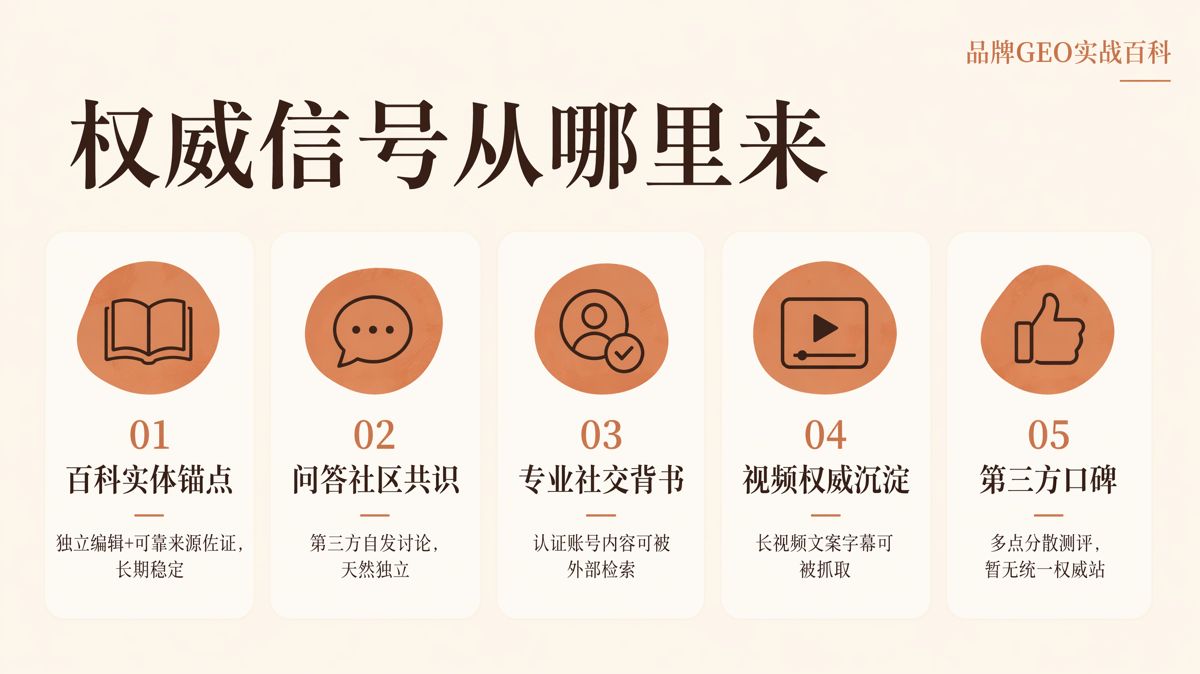
Channels for Building Third-Party Authority Signals
A public benchmark from 5W Research found that Wikipedia accounted for 47.9% of ChatGPT's top ten citation sources, making it the single largest third-party source in that study. Wikipedia's independent editorial model and mandatory citation requirements match the verification criteria generative engines rely on.
In China, there is no single equivalent to Wikipedia. Baidu Baike (Baidu's online encyclopedia) and Sogou Baike serve as foundational references for entity verification, particularly for corporate records, key personnel, and brand trademarks. Entries require credible secondary sources, and publication does not guarantee an AI citation.
Western AI research often highlights Reddit and Quora as primary sources for user consensus. In China, Zhihu (China's largest Q&A platform) fills a similar role. User-generated responses on Zhihu are frequently cited by domestic engines like Kimi (Moonshot AI's assistant) and DeepSeek, though exact citation frequency varies by query type and platform updates.
| Authority Signal Type | Common Western Channels | Common Chinese Channels | Primary Role and Boundaries |
|---|---|---|---|
| Encyclopedia Entity Profiles | Wikipedia | Baidu Baike, Sogou Baike | Provides verified entity facts; does not guarantee direct citations |
| Q&A Community Discussions | Reddit, Quora | Zhihu | Supplies user perspectives; content quality and neutrality must be audited individually |
| Professional Credentials | WeChat Official Account verification, Zhihu verification | Verifies author credentials; Chinese channels operate differently from LinkedIn | |
| Long-Form Video Content | YouTube | Bilibili (video platform), WeChat Channels | Transcripts and captions may be indexed; retrieval depends on platform access rules |
| Third-Party Reviews | G2, Capterra, Trustpilot | Vertical review sites, niche forums | China lacks a single B2B review hub; brands must target industry-specific directories |
How Content Structure Influences AI Citations
Content formatting cannot turn unreliable claims into trusted facts, but it determines whether generative engines can accurately parse company profiles, author credentials, product specifications, and answers. If an engine cannot parse the relationship between an entity and a claim, it cannot verify or cite that information.
Schema markup provides machine-readable structured data that defines page contents. Common types include Organization for company details and FAQPage for question-and-answer content.
Industry studies report varying citation impacts from structured data:
- Adding
FAQPageschema increased ChatGPT citation rates by 320% and boosted Google AI Overview appearances by 3.2 times in one test sample. - Deploying both
OrganizationandFAQPageschema yielded a 37% higher AIO citation rate compared to pages without structured data. - Structured content was cited by AI engines 8.2 times more frequently than unstructured plain-text pages.
These metrics reflect different testing environments without publicly auditable controls. Rather than treating them as guaranteed performance lifts, use structured data as an essential technical baseline, and track your indexing and citation rates before and after deployment.
Author bylines require equal attention. Include the author's real name, title, and verifiable credentials. Provide links to professional profiles, include verification paths for certifications, and use named client examples with concrete metrics. The objective is not self-promotion, but making accountability and source data easy for an engine to audit.
Common Pitfalls in Building Authority Signals
1. Treating content syndication as authority building. Owned channels set the record straight on basic facts, but syndicating identical copy across dozens of secondary sites does not create independent validation. High volume does not equal high trust.
2. Manufacturing artificial reviews or manipulating AI responses. Generative engines employ anti-manipulation filters. Fabricated signals are often stripped out during index refreshes or model updates, and manipulative behavior can trigger platform penalties. In 2026, regulatory focus has also turned toward "data poisoning"—the practice of injecting repetitive, low-value, or misleading content into AI retrieval pools.
3. Relying entirely on your official website. Generative engines typically synthesize answers from 10 to 30 sources per query. An official website cannot validate itself. Brands must ensure multiple independent platforms corroborate the same facts.
Actionable Next Steps
To build defensible authority signals, complete these baseline tasks:
- Standardize your entity information across your website, encyclopedias, social channels, and PR materials. Company names, brand trademarks, and executive titles must match exactly.
- Build verified encyclopedia entries on Baidu Baike, Sogou Baike, or Wikipedia using credible, independent secondary sources rather than self-published material.
- Add verified author bylines to key informational assets, including job titles and links to auditable professional profiles.
- Secure at least three organic mentions in independent media outlets or professional community discussions, separating earned media from sponsored content.
- Publish detailed client case studies that include real brand names, project contexts, and verifiable performance figures.
- Implement
OrganizationandFAQPageschema markup, and audit your pages to confirm search engines parse the code correctly. - Track total brand mentions quarterly across platforms, noting whether each mention includes links, context, and independent sourcing, working toward the industry benchmark of 100 high-context mentions per quarter.
Address entity consistency and structured data first. These technical fundamentals can be resolved quickly, whereas earning independent third-party consensus requires sustained effort over several quarters.
FAQ
Are GEO authority signals the same as SEO domain authority?
No. Domain authority primarily reflects backlinks and domain age. GEO evaluates entity consistency, verifiable claims, and multi-source consensus. In cited research, entity consistency showed a correlation of $r=0.664$ with Google AI Overviews appearances, compared to $r=0.218$ for backlinks. This reflects correlation within that sample, not guaranteed citation.
Can a brand establish authority without a Wikipedia page?
Yes. While Wikipedia represents a significant share of citations in some studies, brands also build external authority through verified LinkedIn profiles, industry publications, original research, and organic discussions on platforms like Reddit, Quora, or Zhihu.
Do brand mentions need to include backlinks to count?
No. Generative engines evaluate unlinked brand mentions to identify entities and cross-reference information across sources. Industry studies indicate web mentions correlate strongly with AI citations, so you should monitor linked citations and unlinked mentions separately.
Does syndicating corporate articles build genuine authority signals?
Not by volume alone. Syndicating identical corporate copy across multiple outlets does not create independent sources. Owned articles establish baseline facts, but engines require independent media, community discussions, or client case studies for third-party validation.
How much do author bylines contribute to authority signals?
Clear bylines with real names, verifiable job titles, and professional credentials establish accountability and make expertise verifiable. While exact citation lift varies, they provide essential trust signals that search and generative engines can audit.
What is the first step for building authority signals in China?
Standardize your entity data first. Ensure brand names, corporate legal names, and executive titles match character-for-character across all channels, then secure encyclopedia entries supported by credible third-party sources.
How long does it take to see results from authority building?
Industry cases suggest that deploying structured data and accumulating third-party mentions generally takes about a quarter before showing measurable shifts in AI visibility. Actual timelines depend on crawler refresh rates, index updates, and content quality.
Is structured data the same as an authority signal?
No. Structured data helps generative engines parse who is publishing and what the content covers. Authority signals determine whether that information is credible and supported by outside facts. Schema makes your authority readable, but cannot substitute for real credentials.
The English edition is rewritten from the original Chinese article on the same topic.

Starbox AI is an AI marketing company based in Hangzhou, China. This article draws on Starbox project work. Please credit the source when quoting.
Related reading
 GEO Guide
Why AI Marketing Vendor Quotes Vary 10x: A 4-Step Vetting Checklist
Evaluate AI marketing proposals by delivery actions, not slide decks. Audit source infrastructure, fact cleaning, and clean-environment testing.
Oct 22, 2026 · 6 min read
 GEO Guide
Spotting GEO Scams: What Actually Drives AI Recommendations?
Automated AI ranking promises violate how LLMs work. Real AI recommendations rely on authoritative, structured facts across trusted public sources.
Oct 22, 2026 · 4 min read
 GEO Guide
How to Measure Your Brand's AI Visibility with a Spreadsheet
You do not need expensive software to track AI recommendations. A three-tier prompt framework and a simple spreadsheet can score your brand visibility in half a day.
Oct 21, 2026 · 6 min read