
How to Write FAQ Sections That AI Engines Actually Cite
The short answer
AI citation depends on whether each FAQ entry can stand alone to answer a real query. Here is how to format FAQs for Generative Engine Optimization.
Whether an FAQ section gets cited by AI engines does not depend on question count. It depends on whether each Q&A entry can stand on its own and accurately answer a real user question without relying on surrounding text.
In Generative Engine Optimization (GEO), an FAQ section does far more than improve on-page user experience. It formats information so an AI engine can isolate, extract, and cite individual answers directly.
The most reliable approach is straightforward: use complete, natural-language questions, state your conclusion in the first sentence, keep answers between 50 and 150 words, and deploy standard FAQPage structured data markup. In relevant sample studies, deploying this markup increased ChatGPT citation rates by 320% and boosted appearances in Google AI Overviews by 3.2 times. While these numbers reflect specific sample datasets rather than a guaranteed lift for every page, they illustrate the power of structured formatting.
Why FAQs Are Built for AI Extraction
Traditional search engines evaluate entire webpages as a single ranking unit. Generative engines work differently: they parse pages into text chunks of roughly 200 to 500 words, then evaluate which chunks answer the user's prompt and whether the source is trustworthy.
A question-and-answer format matches this retrieval process naturally. Because each entry is self-contained, an AI model can parse it without needing broader context. As long as the question is phrased clearly and the answer leads with a conclusion, readers and algorithms can understand the point immediately.
This is why FAQs are receiving renewed attention in marketing. The format itself is not new, but the evaluation criteria have changed. Search strategy once focused on ranking an entire URL. Today, it also requires making individual answers easy for AI engines to extract.
How GEO FAQs Differ from Traditional SEO FAQs
Traditional SEO uses FAQs to capture long-tail keywords, qualify for "People Also Ask" (PAA) rich snippets, and steer visitors deeper into the site.
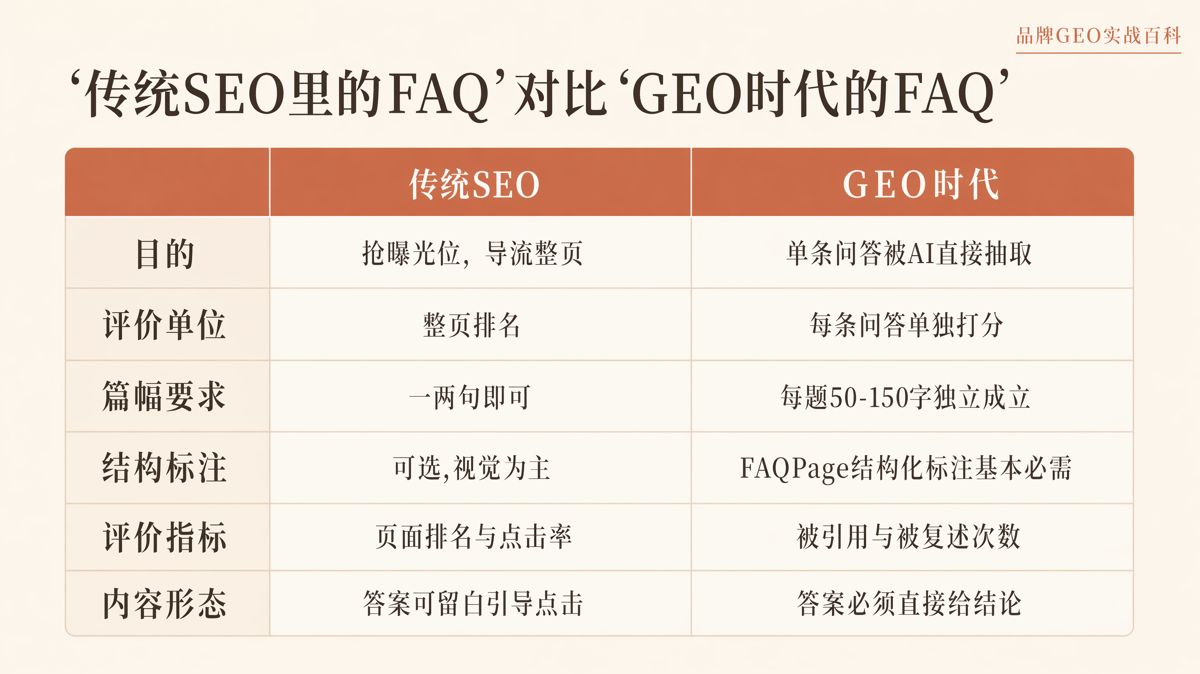
GEO focuses on whether an individual entry can be extracted and cited inside an AI response. The difference lies in the fundamental unit of evaluation:
| Dimension | Traditional SEO FAQ | GEO FAQ |
|---|---|---|
| Primary Goal | Earn search impressions and drive page clicks | Enable AI models to extract and cite answers |
| Unit of Evaluation | The entire webpage | Each individual Q&A entry |
| Answer Length | Often short, with no strict boundary | Recommended 50 to 150 words |
| Question Phrasing | Often keyword-driven | Complete, natural-language questions |
| Answer Phrasing | May hold back details to prompt a click | Leads with a direct conclusion; fully standalone |
| Structured Data | Optional | Recommended standard FAQPage schema |
| Key Metric | Page ranking and click-through rate | Frequency of AI citations or syntheses |
How to Write High-Impact FAQs
A solid FAQ entry must make sense in complete isolation. Test this by copying a single Q&A entry to someone who has not read the rest of the page. If they can understand the problem and use the solution immediately, that entry is ready for AI extraction.
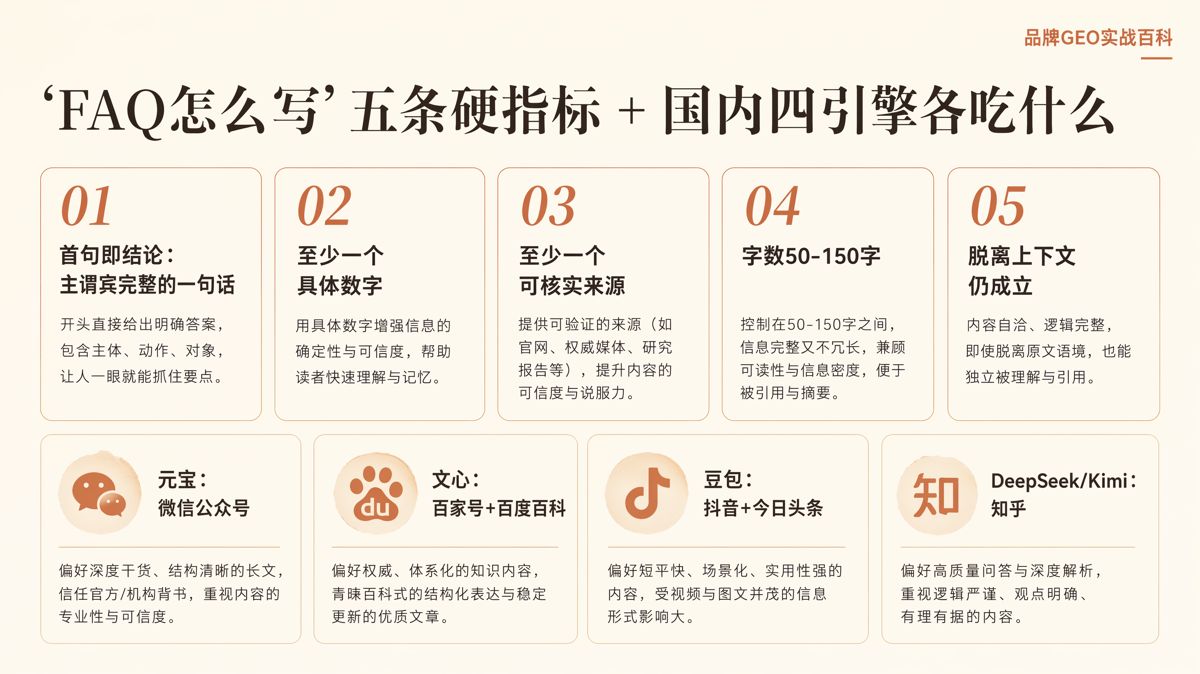
Use this five-point checklist:
- Write complete, natural-language questions. Phrase questions the way people actually type or speak them into an AI prompt. For example, use "What is the difference between adding structured markup to an FAQ page or not?" instead of a keyword string like "FAQ optimization tips."
- Deliver the conclusion in the first sentence. Skip throat-clearing openings like "This depends on several factors" or "The answer is complicated."
- Keep each answer between 50 and 150 words. If an answer is too brief, it may lack the depth an engine needs to verify the claim. If it is too long, the retrieval algorithm may split it into chunks, breaking the logic apart.
- Include at least one specific metric and a verifiable source. Mention the relevant organization, standard, or publication year.
- Eliminate backward-referencing pronouns. Avoid phrases like "in this situation," "the method above," or "as mentioned previously." Name the subject directly every time.
Generative engines prioritize semantic relevance to actual user intent over exact keyword matches. The closer a question mirrors real conversation, the easier it is for an AI model to retrieve.
Should You Add FAQPage Structured Markup?
Yes.
FAQPage structured data, built using Schema.org markup, provides machine-readable code that identifies exact question-and-answer pairs for search crawlers. It does not alter your on-page design, but it removes ambiguity for crawlers.
In sample datasets, adding FAQPage schema correlated with a 320% increase in ChatGPT citations and a 3.2-fold increase in Google AI Overviews appearances. Structured code does not replace high-quality content, but it ensures algorithms understand the structure of your page.
Avoid a common pitfall here: Google's official search optimization documentation released in May 2026 emphasized that publishers do not need proprietary "AI schema packs" or unnatural writing styles. FAQPage has long been an open Schema.org standard. Rely on standard, cleanly implemented schema rather than unverified third-party optimization plugins.
Content Formats That Complement FAQs
Beyond FAQs, lists and comparison tables are particularly easy for generative engines to parse and synthesize.
In relevant studies of ChatGPT source attribution, listicles (articles organized around numbered steps or key takeaways) accounted for 43.8% of all cited page types. Cross-platform comparison lists represented 32.5%. Furthermore, pages containing structured data tables were 2.5 times more likely to be cited than pages without tables.
These formats work for the same reason FAQs do: lists can be evaluated item by item, and tables can be read across rows and columns. Algorithms do not have to untangle complex relationships buried inside long narrative blocks.
A practical structure for an article is: * An upfront summary paragraph that answers the core query. * A structured list outlining specific steps or principles. * A comparison table clarifying key differences. * An FAQ section addressing specific edge cases.
Channel Strategies: Global vs. Chinese Platforms
Global GEO primarily targets standalone websites marked up with Schema.org schema, serving engines like ChatGPT, Perplexity, and Google AI Overviews.
In China, there is no single standardized FAQ schema across AI engines. Content strategy must account for the specific source ecosystems favored by each engine: * Tencent Yuanbao heavily references content from WeChat Official Accounts. * Baidu ERNIE leans heavily on Baijiahao (Baidu's content platform) and Baidu Baike (Baidu's encyclopedia). * Doubao (ByteDance's AI assistant) frequently draws from Douyin (TikTok's Chinese sister app) and Jinri Toutiao (ByteDance's news app). * DeepSeek and Kimi (Moonshot AI) show higher citation frequency for Zhihu (China's largest Q&A platform).
These patterns are observed tendencies rather than rigid algorithms; source weighting shifts with search intent and index updates. However, they highlight a major difference between domestic and international GEO: while one international independent website can feed multiple global AI engines, reaching Chinese AI assistants often requires distributing content across multiple domestic platforms.
How to Avoid Turning FAQs into Sales Pitches
When teams produce FAQs in volume, entries often devolve into self-serving promotions. This happens when a marketer starts with a product selling point and invents a question to fit it.
To test whether a question is worth answering, run it through an AI engine first. If the model already returns an accurate, authoritative, and complete answer, writing another version adds little value. If the model's answer is incomplete, outdated, or vague, that gap represents a high-value FAQ topic.
Do not write FAQs simply to increase word count. Six to eight entries that address genuine information gaps will outperform thirty questions written around promotional talking points. Six high-quality questions is a common industry baseline, but quality always matters more than volume.
Labeling AI-Assisted FAQ Content
In China, the Measures for the Labeling of Artificial Intelligence Generated and Synthesized Content—jointly issued by four government agencies including the Cyberspace Administration of China—took effect on September 1, 2025. This regulation requires both explicit and implicit labeling for AI-generated or AI-assisted content.
Explicit labeling is visible text that informs readers the material was produced or edited with AI assistance. Implicit labeling embeds machine-readable metadata or digital watermarks into files to ensure traceability.
Marketing teams using AI to scale content production must incorporate these steps into their publication pipeline. Creators are responsible for applying labels at generation, and publishing platforms verify them. Removing or falsifying these labels creates compliance and platform distribution risks.
Frequently Asked Questions
How many questions should an FAQ section include?
Quality matters far more than volume. Six entries is a solid baseline, but there is no strict upper limit. Each entry should meet two criteria: real users actively ask it, and current AI answers are either incomplete or inaccurate. Writing filler questions will not improve citation performance.
Can FAQ answers be lengthy?
Keep answers between 50 and 150 words. This range keeps the question-and-answer pair intact. If an answer runs too long, retrieval models may split it into separate chunks, separating your conclusion from its context.
Do you need a developer to implement FAQPage structured data?
You only need a basic understanding of page code. FAQPage is a standard Schema.org type, and most modern content management systems (CMS) offer built-in templates or fields. The primary task is pasting your text into the structured format.
Can you reuse FAQ content from competitor websites?
Do not copy competitor FAQs. Direct copying creates duplicate content issues and adds zero new information to the web. Large language models cross-reference multiple sources; identical text across sites is not treated as independent corroboration and will not improve citation weight.
Does adding FAQPage schema guarantee AI citations?
No. Structured markup helps algorithms read your questions and answers, but it cannot make an engine cite them. Citation depends on whether your answer addresses real queries, provides unique information, and includes verifiable facts.
Should FAQs cite data sources?
Yes. When citing numbers, benchmark studies, regulatory standards, or annual report findings, include the organization name and the year directly in the text. This helps human readers verify claims and assists AI models in establishing source credibility.
When publishing in China, should you tailor FAQs for engines like Doubao and ERNIE?
Yes, though platform preferences should guide distribution rather than dictate rigid rules. Different Chinese AI engines rely on different content repositories. Depending on your audience, distribute FAQ content across WeChat Official Accounts, Baijiahao, Jinri Toutiao, Douyin, or Zhihu rather than hosting it solely on a corporate website.
How should teams handle AI disclosure rules when drafting FAQs?
Include a clear, visible disclosure in the text stating that the content was AI-generated or AI-assisted, and preserve any embedded metadata or watermarks. Under regulations effective since September 1, 2025, teams should establish an editorial check to ensure both explicit and implicit markers are in place before publication.
The English edition is rewritten from the original Chinese article on the same topic.

Starbox AI is an AI marketing company based in Hangzhou, China. This article draws on Starbox project work. Please credit the source when quoting.
Related reading
 GEO Guide
Why AI Marketing Vendor Quotes Vary 10x: A 4-Step Vetting Checklist
Evaluate AI marketing proposals by delivery actions, not slide decks. Audit source infrastructure, fact cleaning, and clean-environment testing.
Oct 22, 2026 · 6 min read
 GEO Guide
Spotting GEO Scams: What Actually Drives AI Recommendations?
Automated AI ranking promises violate how LLMs work. Real AI recommendations rely on authoritative, structured facts across trusted public sources.
Oct 22, 2026 · 4 min read
 GEO Guide
How to Measure Your Brand's AI Visibility with a Spreadsheet
You do not need expensive software to track AI recommendations. A three-tier prompt framework and a simple spreadsheet can score your brand visibility in half a day.
Oct 21, 2026 · 6 min read