
How to Build a Standard GEO Page: The 9-Module Framework
The short answer
A standard GEO page uses nine distinct modules to help AI search engines parse, understand, and cite your content in answer generation.
Generative Engine Optimization (GEO) is not about keyword stuffing. It is about organizing your pages so that artificial intelligence can parse, understand, and cite your information without friction.
Many pages contain valuable data, but because their headings, paragraphs, facts, and citations are tangled together, AI engines cannot isolate distinct, citeable chunks.
The Structure of a Standard GEO Page
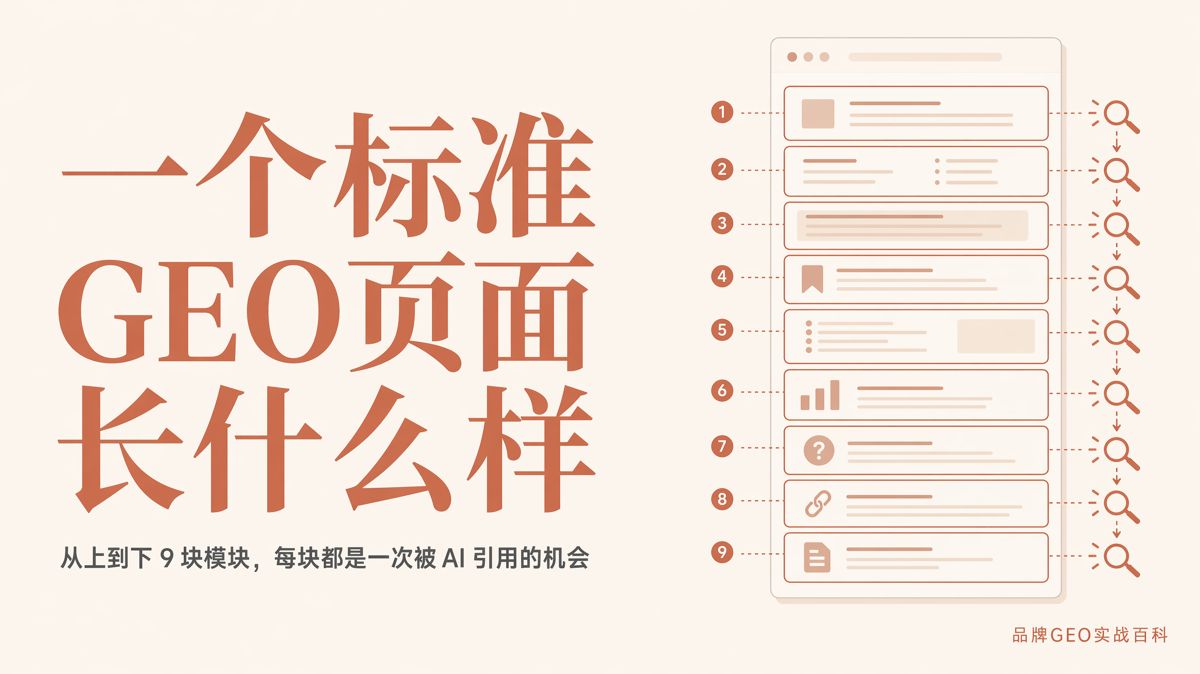
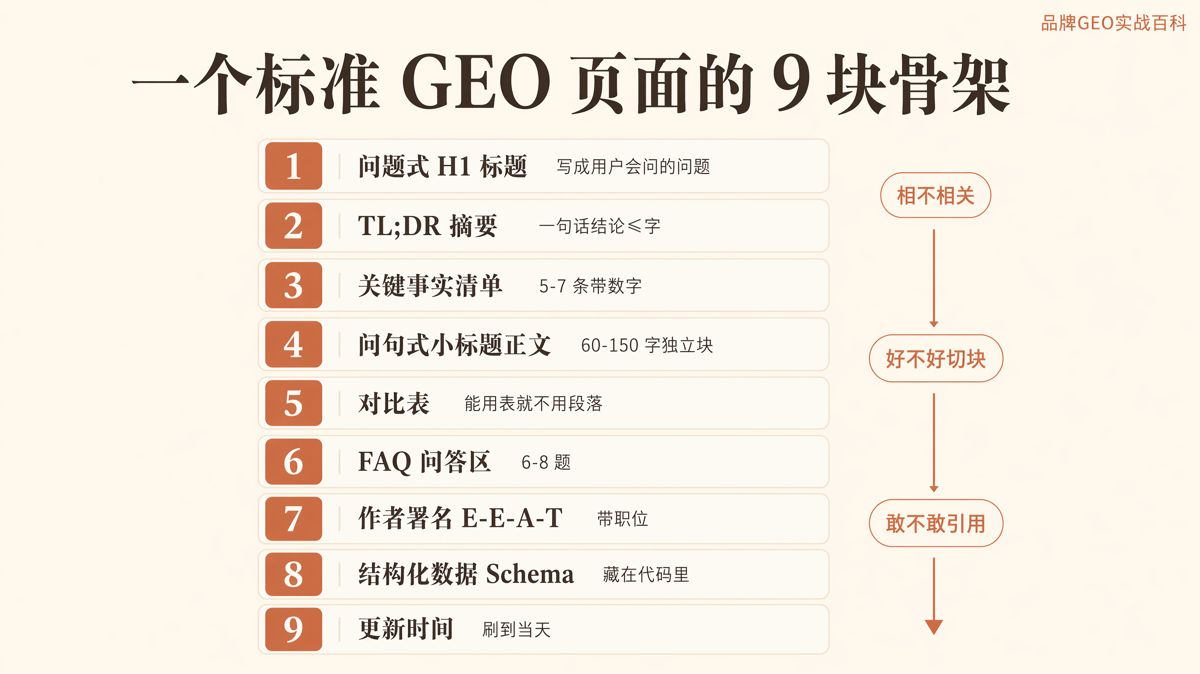
From top to bottom, an effective GEO page follows this nine-module architecture:
- A question-focused primary heading (H1)
- A TL;DR summary
- A key facts checklist
- Body content organized under question-based subheadings
- At least one comparative data table
- A frequently asked questions (FAQ) section
- Author attribution and credentials
- Structured data (Schema markup)
- Original publication and modification dates
These nine modules help an AI model resolve three fundamental questions: Is this page relevant to the prompt? Is the body text chunkable? Are the facts independently verifiable?
While these components represent current industry best practices, no single layout guarantees automated citations across all platforms.
Key Facts
- AI retrieval pipelines split text into semantic chunks of roughly 200 to 500 words before determining whether each chunk can answer a user query.
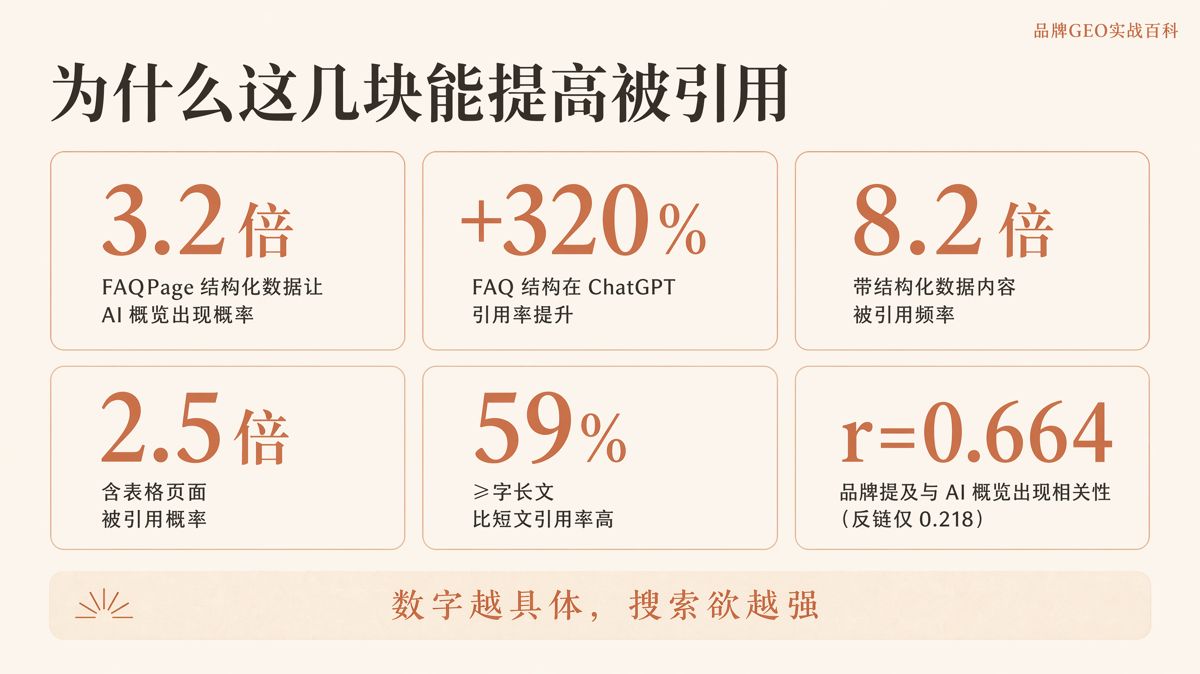
- In a dataset analyzed by seoClarity, in-depth articles of 2,900 words or more had a 59% higher citation rate than pages under 800 words. This shows a correlation in that sample, not that word counts alone drive citations.
- Data from AmiCited indicates that implementing FAQPage schema correlates with a 320% increase in ChatGPT citations and makes an appearance in Google AI Overviews 3.2 times more likely.
- Industry studies suggest pages featuring data tables are cited roughly 2.5 times more frequently than pages without tables.
- Research by ALM found that list-based content (listicles) accounts for 43.8% of all pages cited by ChatGPT.
- seoClarity found that brand web mentions correlate with AI Overview appearances at a coefficient of 0.664, compared to 0.218 for backlinks. Correlation measures relationship in a sample, not direct causation.
- This framework works across Western engines as well as Chinese platforms like Doubao (ByteDance's AI assistant), DeepSeek, Wenxin (Baidu's Ernie), and Yuanbao (Tencent's AI assistant), though distribution pipelines vary by ecosystem.
Why Page Structure Dictates AI Citations
Human readers digest an article linearly, carrying context from one paragraph to the next. Large language models (LLMs) and retrieval-augmented generation (RAG) engines do not. They split pages into discrete chunks, index them, retrieve the most relevant pieces, and synthesize answers.
If a paragraph lacks an explicit topic, relies on arguments made three paragraphs earlier, or blends unverified opinions with hard data, the AI cannot pull it as a standalone answer. Clear subheadings, concise paragraphs, verifiable statistics, named sources, and self-contained arguments lower the computational friction of machine extraction.
| Dimension | Traditional Web Page | Standard GEO Page |
|---|---|---|
| Primary reading unit | Entire page read sequentially | Individual semantic chunks indexed by AI |
| Heading style | Brand name plus generic keywords | Matches direct user queries |
| Introduction | Contextual narrative and background | Immediate TL;DR conclusion |
| Paragraph structure | Multiple concepts merged in long blocks | One core concept per paragraph |
| Data presentation | Numbers scattered across the narrative | Key figures grouped in bullets or tables |
| Source attribution | Often implied or omitted | Sources cited adjacent to specific claims |
| Machine readability | Standard HTML with minimal markup | Structured schema markup (JSON-LD) |
| Evaluation model | Evaluated as an entire document | Evaluated by chunk-level citation fitness |
Module 1: Write an H1 That Matches Real User Questions
Your H1 heading should state the exact problem your reader wants to solve, rather than your brand slogan or product name.
When users interact with conversational AI, they type complete questions. The closer your page heading matches those query patterns, the easier it is for the retrieval model to match intent. Industry observations suggest that question-based headings are cited two to three times more often than static declarative titles.
Frame headings around operational inquiries: "What is," "How to," "How to choose," or "Which is better." Include modifiers like the current year, industry, product category, or specific use case. Keep headings concise, and avoid untestable marketing buzzwords like "best," "leading," or "top-tier."
Module 2: Place a TL;DR Summary Above the Fold
A TL;DR summary provides a direct answer before the reader or crawler dives into the body text.
Place this summary immediately below the main heading. Keep it under 40 words. State the central conclusion directly, without filler phrases like "In this article, we explore..." If an AI crawler only reads this single summary block, it should still understand the core verdict of the page.
The H1 asks the question; the TL;DR answers it.
Module 3: Group Key Facts into an Upfront List
Provide a bulleted list of five to seven critical facts. Each item should convey one self-contained point, backed by numbers, units of measurement, dates, and identified sources.
An Ahrefs study evaluating 1.4 million prompts found that 67% of the top 1,000 most-cited pages in ChatGPT originated from original research, primary datasets, or academic studies. Verifiable data beats abstract commentary.
Avoid vague claims like "significant improvements" or "rapid growth." Specify the exact percentage increase, sample size, measurement window, and the organization that conducted the research.
Module 4: Structure Body Text Under Question-Based Subheadings
Use H2 and H3 subheadings formatted as questions to segment your topics. Under each subheading, deliver the direct answer within the first two sentences, followed by supporting reasons, parameters, data points, and citations.
To ensure each chunk stands on its own, apply these five criteria:
- The opening sentence states the subject and the conclusion clearly.
- The block contains at least one concrete data point.
- Crucial claims reference a named report, standard, regulation, or primary source.
- Paragraph lengths stay between 60 and 150 words.
- The core meaning remains clear even if read completely out of context.
Article length should reflect information density, not arbitrary padding. While seoClarity observed that articles reaching or exceeding 2,900 words had a 59% higher citation rate than those under 800 words in their sample, length alone is not a ranking factor. Comprehensive coverage of an issue performs well because it resolves search intent, not because of raw word count.
Module 5: Include at Least One Comparison Table
Data tables organize complex, multidimensional comparisons cleanly. When metrics like pricing, cycle times, certifications, and technical parameters sit inside a table, both humans and algorithms can parse the relationships instantly.
Industry benchmarks indicate that pages with tables have an estimated 2.5 times higher probability of citation than those without. Furthermore, ALM data shows that list-style and tabular formats make up 43.8% of all pages cited by ChatGPT.
Design comparative tables with at least four columns or five rows. Fill every cell with specific, comparable data points. If you need to cite sources, place the citations directly in the adjacent text so the table cells remain legible.
Module 6: Build a Dedicated FAQ Section
Position a dedicated FAQ block toward the bottom of the page featuring six to eight questions that actual buyers or users ask. Keep each response between 50 and 150 words, leading with the answer in the very first sentence.
According to AmiCited, implementing FAQPage structured data resulted in a 320% increase in ChatGPT citations and a 3.2-fold jump in Google AI Overview appearances within their monitored dataset.
The strength of an FAQ section lies in its atomic structure: one clear question paired with one self-contained answer. Frame questions in natural language, and ensure answers detail conditions, figures, and sources. Do not simply copy and paste sentences already used in your main body text.
Module 7: Include Transparent Author and Source Signals
Display the author's full name, role, and verifiable credentials. When citing industry benchmarks or proprietary research, link directly to the source.
These elements align with E-E-A-T (Experience, Expertise, Authoritativeness, and Trustworthiness). While E-E-A-T is not a single algorithmic score, it represents a cluster of quality signals that platforms use to evaluate source credibility.
Research by seoClarity shows a 0.664 correlation coefficient between brand web mentions and AI Overview appearances, compared to 0.218 for backlinks. Studies by agencies iProspect and Hallam similarly noted that brand mentions correlated with AI visibility at roughly three times the rate of backlinks. When presenting case studies, state the client name, specific metrics, and real timelines.
Module 8: Deploy Structured Data (Schema Markup)
Schema markup provides machine-readable metadata that explicitly defines your page content. This is implemented via JSON-LD code in the page head, invisible to regular human visitors.
Key schema types for GEO include:
Organization: Clarifies your business identity and entity relationships.FAQPage: Explicitly tags questions and their corresponding answers.Article: Defines the page as editorial content with clear authorship.Product: Highlights technical specifications, pricing, and availability.
Some industry reports suggest that pages with structured schema are cited up to 8.2 times more frequently than unstructured pages, and that deploying both Organization and FAQPage together correlates with a 37% bump in AI Overview inclusion.
However, Google clarified in its May 2026 search documentation that publishers do not need to invent custom "AI schemas" or rely on files like llms.txt for indexing. Structured markup helps machines identify entities, but it cannot compensate for thin, unverified body copy.
Module 9: Display Clear Update Timestamps
Show both the original publication date and the latest modification date clearly on the page and within the dateModified schema property.
An Ahrefs study of 17 million citations found that URLs cited by AI engines were on average 25.7% fresher than standard organic search results. For several tracked prompts, ChatGPT prioritized pages updated more recently than those ranking in Google's top organic spots.
Only update timestamps when you have made substantive changes, such as adding recent datasets, adjusting conclusions, or refreshing case studies. Artificially bumping dates without changing content does not improve citation authority.
The Relationship Between SEO and GEO
Search Engine Optimization (SEO) ensures that search bots can crawl, index, and retrieve your web pages. Generative Engine Optimization (GEO) ensures that once a page is retrieved, generative models can extract, interpret, and cite its ideas.
In its 2026 documentation, Google treats generative search optimization as a natural extension of search experience optimization. For retrieval-augmented AI systems, a page must first be discoverable via web indexes before it can be cited in an answer.
SEO and GEO work in tandem. SEO secures the retrieval baseline; GEO optimizes semantic extraction. An unindexed page cannot be cited, but an indexed page with poor structure will simply be skipped during answer generation.
Adapting This Structure for Chinese AI Engines
This nine-module architecture applies equally to Chinese AI engines, but distribution tactics must align with local indexing ecosystems.
Engines such as DeepSeek, Doubao, Wenxin, and Yuanbao operate on RAG pipelines that retrieve, rank, and synthesize candidate content. Clean headings, upfront summaries, modular paragraphs, tables, and verified authorship ease parsing across all languages.
However, content discovery in China depends on platform-specific ecosystems: - WeChat Official Accounts feed into Tencent's search and AI ecosystems. - Baijiahao (Baidu's content platform) and Baidu Baike feed into Baidu's Ernie index. - Douyin (ByteDance's video platform) and Toutiao (ByteDance's news app) supply the primary corpus for Doubao. - Zhihu (China's largest Q&A platform) serves as an open retrieval ground for platforms like DeepSeek and Moonshot AI's Kimi.
These distribution pathways reflect commercial ecosystem dynamics rather than fixed algorithmic rules. High-authority portals, academic repositories, and government websites retain high baseline trust, but citations ultimately depend on query intent, factual depth, and content timeliness.
A Practical GEO Page Template
H1: [Direct question a buyer asks an AI engine, including use case or year]

TL;DR: [One-sentence direct conclusion, under 40 words, fully understandable on its own]

Key Facts:
- [Fact 1: Metric, unit, timeline, named source]
- [Fact 2: Metric, unit, timeline, named source]
- ... (5-7 points total)

Body:

## [Question-based Subheading 1]
[Lead with the direct answer. Follow with context, parameters, and named sources. 60-150 words per paragraph.]

## [Question-based Subheading 2]
[Address the next logical question with self-contained supporting data.]

Comparison Table:
[Minimum 4 columns or 5 rows. Use clear, verifiable comparative metrics in every cell.]

FAQ:
Q1: [Direct user query]
A1: [50-150 words. Lead with the answer, then state parameters and sources.]
... (6-8 questions total)

Author Attribution: [Name, job title, verifiable credentials or profile links]

Structured Data: Organization + FAQPage + Article (JSON-LD)

Timestamps: Published Date / Substantive Modified Date
Before publishing, audit your page against this framework: Are all nine modules present? Does each paragraph address one single question? Is every statistic tied to a real source? Does your table offer a meaningful comparison?
While this layout cannot force an AI engine to cite your business, it eliminates the architectural friction that causes automated crawlers to overlook your expertise. In the end, AI engines cite pages that provide clear, accurate, and verifiable answers to real user questions.
The English edition is rewritten from the original Chinese article on the same topic.

Starbox AI is an AI marketing company based in Hangzhou, China. This article draws on Starbox project work. Please credit the source when quoting.
Related reading
 GEO Guide
Why AI Marketing Vendor Quotes Vary 10x: A 4-Step Vetting Checklist
Evaluate AI marketing proposals by delivery actions, not slide decks. Audit source infrastructure, fact cleaning, and clean-environment testing.
Oct 22, 2026 · 6 min read
 GEO Guide
Spotting GEO Scams: What Actually Drives AI Recommendations?
Automated AI ranking promises violate how LLMs work. Real AI recommendations rely on authoritative, structured facts across trusted public sources.
Oct 22, 2026 · 4 min read
 GEO Guide
How to Measure Your Brand's AI Visibility with a Spreadsheet
You do not need expensive software to track AI recommendations. A three-tier prompt framework and a simple spreadsheet can score your brand visibility in half a day.
Oct 21, 2026 · 6 min read