
Brand Entity Modeling in China: Baike Entries and Name Alignment
The short answer
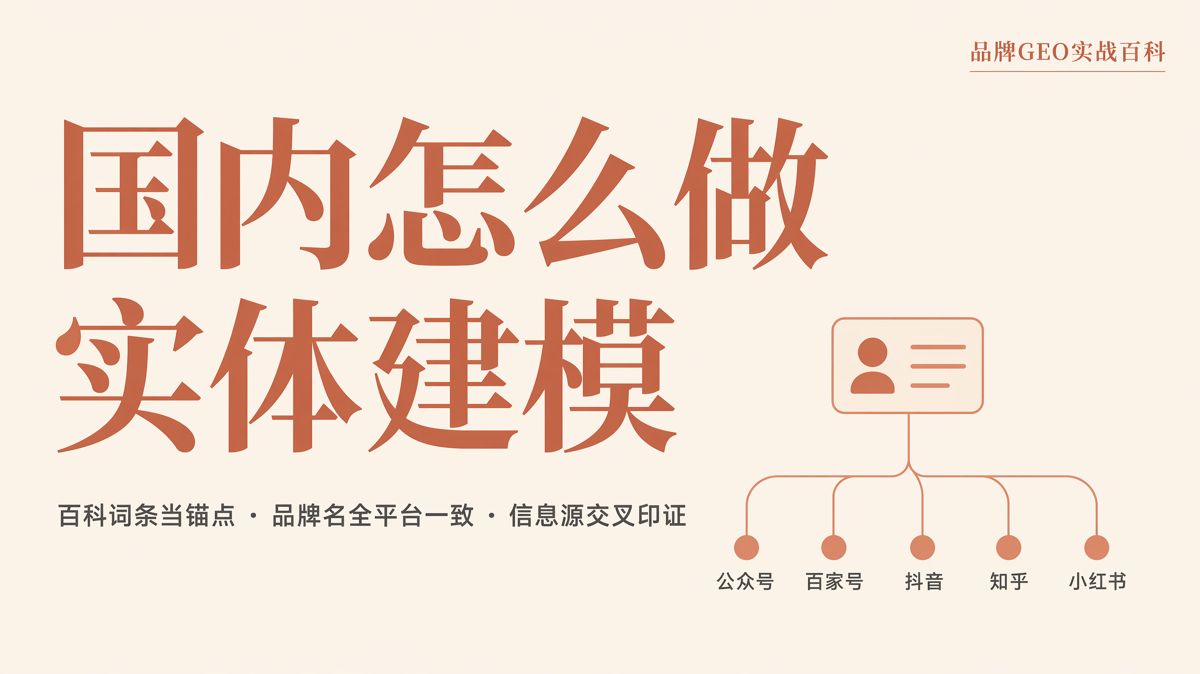
GEO in China requires entity modeling across Baidu Baike, verified social channels, official business registrations, and independent authoritative media.
Generative Engine Optimization (GEO) focuses on whether generative artificial intelligence can accurately identify, retrieve, and cite a brand. For companies operating in China, brand entity modeling is not about increasing content volume. It is about ensuring complete factual consistency across encyclopedias, platform accounts, official corporate registrations, company websites, and independent media coverage.
Effective entity modeling comes down to three actions: establishing a verifiable encyclopedia record, unifying brand names and verification credentials across digital platforms, and cross-verifying key corporate facts via official filings and independent press. Once these steps are in place, test the brand across Doubao (ByteDance's AI assistant), ERNIE Bot (Baidu's AI assistant), Yuanbao (Tencent's AI assistant), and DeepSeek to verify whether they correctly return the company's founding date, primary business, and core products.
Seven Research Findings and Industry Benchmarks
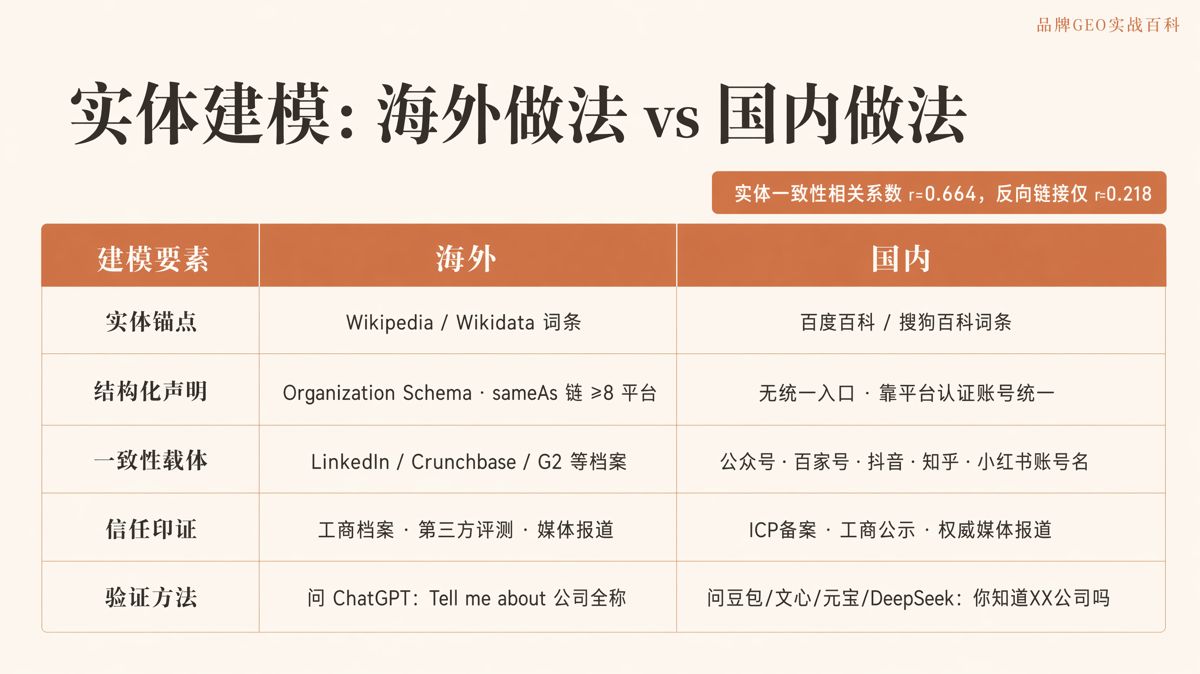
- An empirical study by seoClarity titled AIO Rankings Overlap revealed a correlation coefficient of r=0.664 between cross-platform entity consistency and AI citations, compared to r=0.218 for traditional backlinks. Correlation coefficients measure co-movement and do not imply direct causation.
- Research by iProspect and Hallam found that brand mentions correlate with AI citations roughly three times more strongly than backlinks. This is also a statistical correlation rather than a guarantee that adding mentions will produce a linear citation increase.
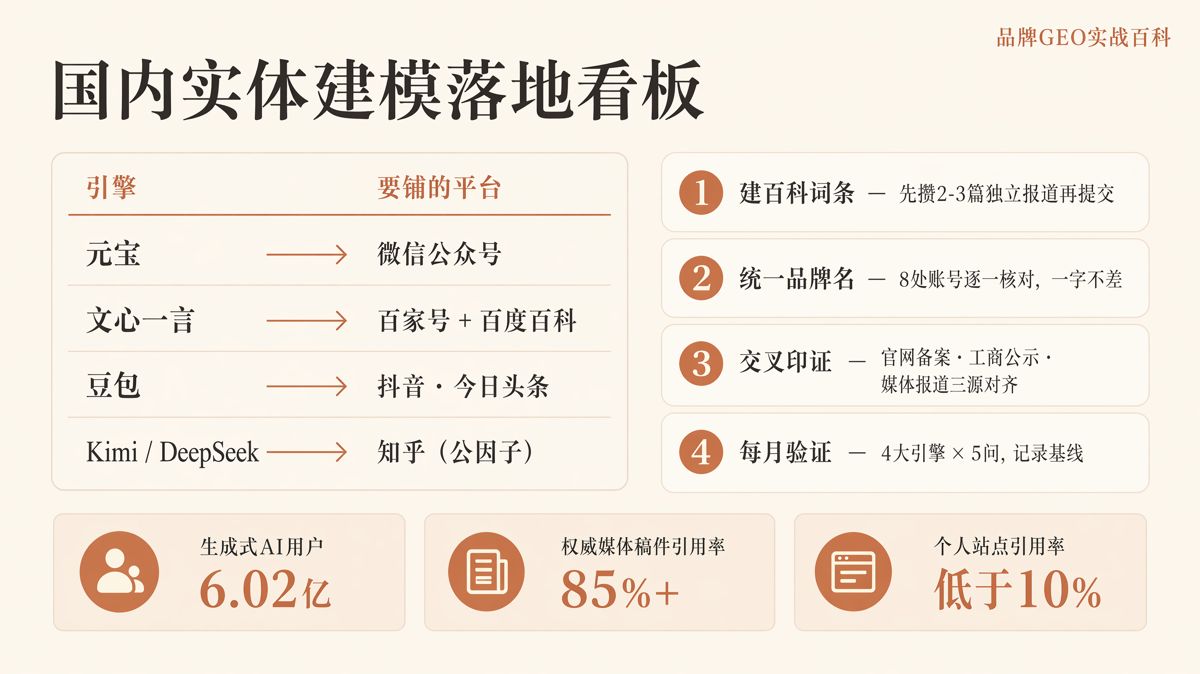
- The 57th report by the China Internet Network Information Center (CNNIC) reported that by December 2025, China's generative AI user base reached 602 million, representing a 42.8% penetration rate.
- QuestMobile data for Q1 2026 reported monthly active users (MAU) of approximately 345 million for Doubao, 166 million for Tongyi Qianwen (Alibaba's AI assistant), and 127 million for DeepSeek. These figures represent industry estimates and have not been independently audited.
- Research syntheses, including reports from Eastmoney, indicate that citation rates by AI models for articles from authoritative news media can exceed 85%, whereas individual sites and general self-media account for less than 10%. This is an industry benchmark rather than an official standard.
- Data from Geneo in 2025 indicated that web pages with structured Schema markup were cited by AI engines 8.2 times more frequently than pages without markup. In global markets, best practices include using the
sameAsproperty withinOrganizationschema to connect a company's identity across eight or more authoritative platforms. - Google Search Relations stated on May 15, 2026, that optimizing for generative AI search remains, at its core, a form of search engine optimization.
These figures will not apply identically to every organization, but they reinforce a single takeaway: when independent sources consistently point to the same corporate entity and present matching factual details, generative engines resolve entity recognition with significantly higher confidence.
How Entity Modeling in China Differs from Global Markets
In global markets, entity building centers on the company's standalone website. Organizations implement structured data such as Organization and FAQPage schemas, using the sameAs property to link profiles across LinkedIn, Wikipedia, Crunchbase, and G2.
China has not developed an identical ecosystem around standalone corporate sites and structured data. Industry observations indicate that domestic generative engines rely more heavily on major closed-loop platforms and authoritative state or industry media, while citing standalone corporate websites less frequently. Because search engines do not publish explicit guidelines on this distribution, these observations should be treated as industry consensus rather than fixed rules across all query types.
Consequently, domestic brands must focus their entity modeling on encyclopedia entries, verified enterprise accounts, corporate registry filings, Internet Content Provider (ICP) registration, and third-party media reports.
| Entity Element | Common Global Practice | Common China Practice |
|---|---|---|
| Corporate Record | Wikipedia, Wikidata entries | Baidu Baike, Sogou Baike entries |
| Structured Declarations | Organization and FAQPage Schemas on website with sameAs links |
No unified Schema ecosystem; relies on verified enterprise platform badges |
| Name Consistency | Matching company name across LinkedIn, Crunchbase, G2 | Matching company name and verified entity across WeChat, Baijiahao, Douyin, Zhihu, and Xiaohongshu |
| Corporate Verification | Commercial databases, third-party reviews, press | ICP filing, National Enterprise Credit Information Publicity System, authoritative press |
| Output Verification | Querying ChatGPT for corporate details | Querying Doubao, ERNIE Bot, Yuanbao, and DeepSeek |
An ICP filing is an administrative registration submitted by website operators to Chinese telecommunications authorities. It allows search systems to confirm whether a website operator matches an official business license name.
How to Build a Baidu Baike Entry
An encyclopedia entry serves as a permanent, verifiable corporate profile. ERNIE Bot retrieves Baidu Baike data directly, and other domestic engines frequently index it as an authoritative reference.
When building an enterprise Baike entry, three rules apply:
First, the title of the entry must exactly match the full legal registered name on the company's business license. This is necessary both for editorial review and for search engines to resolve the entity correctly.
Second, the copy must maintain objective, neutral language. Founding dates, registered capital, and primary business activities must reflect verifiable records. Promotional terminology such as "market-leading" or "premium quality" should be removed.
Third, all factual claims must cite credible sources. The most common reasons for rejection include:
- Citations derived primarily from the company website, self-owned media accounts, or paid advertorials rather than independent reporting;
- Content written with obvious marketing or promotional tone;
- A complete absence of coverage by authoritative news outlets or established industry publications.
Wikipedia applies similar standards. The 2026 Global GEO Whitepaper noted that common Wikipedia rejection factors include reliance on internal PR materials, promotional tone, and a lack of non-paid independent reporting. In global contexts, establishing a Wikipedia article for a Chinese firm often takes 12 to 18 months, with an initial Articles for Creation (AfC) approval rate of roughly 30% to 50%. While domestic encyclopedia cycles differ, the requirement for independent third-party sources is just as rigorous.
Because Baidu Baike frequently updates its entry criteria and submission interfaces, always review the latest official platform rules before submitting.
Why Exact Character-Level Name Consistency Matters
Character-level consistency means using the exact same spelling, capitalization, spacing, character sequence, and legal suffix across every touchpoint.
If a company uses its full registered name on WeChat, an abbreviated English name on Douyin (ByteDance's short video platform), and a colloquial nickname on Zhihu (China's largest Q&A platform), generative models may fail to connect them to the same entity. Content published across these channels will remain fragmented rather than consolidating into a single brand profile.
Industry research ranks entity consistency as the fifth dimension in AI ranking algorithms, with an estimated weight of 15% to 20%. While not an official metric, it highlights the importance of consistency. Similarly, seoClarity found that entity consistency correlates with AI citations at r=0.664, well above backlinks at r=0.218.
Audit brand naming across this checklist:
- Full legal enterprise name on the official business license;
- Company name in the website footer and "About Us" page;
- Registrant name on the website ICP filing;
- Account name and verified entity on WeChat Official Accounts;
- Account name and verified entity on Baijiahao (Baidu's content platform);
- Enterprise name and verified entity on Douyin;
- Institutional account name on Zhihu;
- Professional account name on Xiaohongshu (RED);
- Account profiles on video networks such as Bilibili and WeChat Channels.
Establish a single benchmark name and review each profile against it. Where platform character limits or namespace conflicts prevent identical account handles, ensure the underlying verified enterprise entity matches without variation.
Establishing Cross-Verification for Corporate Information
Cross-verification means ensuring an AI model finds identical core facts—such as founding year, registered capital, core business scope, and executive leadership—across at least three independent source categories.
| Source Category | Specific Channels | Verification Focus |
|---|---|---|
| Owned Corporate Data | Official site, ICP filing | ICP registrant matches business license; "About" page clearly states founding year and business scope |
| Official Government Registries | National Enterprise Credit Information Publicity System | Business scope and registered capital match website disclosures |
| Commercial Aggregators | Tianyancha, Qichacha | Auxiliary reference; primary facts must match official public registries |
| Independent Third Parties | Authoritative press, vertical trade media | Company referred to by full legal name; figures match corporate registries and site |
The "four-tier source" framework described in Eastmoney research models assigns government portals, industry associations, and major state media to Tier 1, with acceptance rates exceeding 90% and algorithmic weights roughly 5 to 8 times higher than small commercial websites. Sites without an ICP filing, content scrapers, and advertorial hubs fall into Tier 4 and are often filtered out of AI retrieval pipelines.
The value of an independent source lies in the absence of corporate control. Re-publishing identical corporate bios across proprietary social channels only adds data from one source. When an independent publication verifies and reports those facts, it provides true cross-verification.
A 2025 study by Ahrefs of the top 1,000 pages cited by ChatGPT revealed that 67% came from original research, primary data, or academic sources. While this sample reflects global models, the principle applies to domestic AI engines as well.
Aligning Platform Accounts with Domestic AI Engines
Different Chinese generative engines maintain closer retrieval relationships with their respective parent ecosystems. Industry practitioners observe that engines often prioritize content indexed within their own corporate boundaries. Businesses should align their platform presence accordingly, without treating these preferences as rigid rules.
| Engine | Primary Ecosystem Retrieval Sources | Recommended Platform Channels |
|---|---|---|
| Yuanbao | WeChat Search, Tencent Hunyuan ecosystem | WeChat Official Accounts |
| ERNIE Bot | Baidu proprietary search index | Baijiahao, Baidu Baike |
| Doubao | ByteDance ecosystem and live web retrieval | Douyin, Toutiao |
| Kimi, DeepSeek | Web search and user-generated content | Zhihu; add CSDN (software developer community) for technical brands |
Official site content can be submitted directly via Baidu Search Resource Platform. WeChat Official Account articles must be indexed by WeChat Search before they can be retrieved by Yuanbao. Douyin and Xiaohongshu rely largely on their own internal search and indexing infrastructures.
Whenever a new account is registered, confirm that its display name, verified corporate identity, and bio match existing profiles to prevent conflicting entity data.
Measuring Entity Modeling Performance
To test whether entity modeling has succeeded, prompt Doubao, ERNIE Bot, Yuanbao, and DeepSeek:
Do you know [Company Full Legal Name]?
Replace the bracketed text with the full registered business license name.
If the engine accurately returns the founding year, primary operations, and core product offerings without confusing the company with similarly named firms, the brand's entity footprint is working. If the response contains errors, missing details, or conflations, re-examine Baike entries, name consistency, and source citations.
Run a monthly audit using these five prompts:
- Do you know [Company Full Legal Name]?
- Who is the founder or CEO of this company?
- In what year was this company founded?
- Is this company reliable?
- What are this company's core products?
Test all four engines and record response accuracy, factual gaps, and cited sources. A comprehensive diagnostic framework typically tests 30 prompts across 4 engines, yielding 120 data points. Brands that have never optimized for GEO often show initial mention rates below 5%.
A single accurate response does not guarantee permanent results. Answers shift as models update, indexes refresh, and new content surfaces. Consistent monthly testing is essential.
How Entity Modeling Relates to Traditional SEO
Traditional SEO resolves whether web pages can be crawled, indexed, ranked, and awarded clicks. Encyclopedia profiles and consistent brand names have always mattered in SEO, but they serve an expanded purpose in GEO.
In SEO, a Baike entry ranks for branded queries and offers credibility to users, while consistent naming helps search engines cluster related pages under one domain.
In GEO, a Baike entry provides a core knowledge record for AI models answering direct identity questions. Consistent naming determines whether scattered content across external platforms is unified into a single knowledge graph node.
Global search engines are making similar demands. Google's early 2026 documentation emphasized that verifiable author and organization entities, connected via sameAs links to Wikipedia and Wikidata, serve as stronger quality signals.
SEO and GEO are complementary rather than mutually exclusive. On May 15, 2026, Google Search Relations reiterated that optimizing for generative AI remains an evolution of SEO. Domestically, Baidu search results increasingly feature AI Overviews, with industry data indicating that over 60% of early 2026 queries trigger AI summaries.
Ensure technical indexability first, then reinforce entity recognition through consistent naming, encyclopedia documentation, and multi-source verification.
FAQ: Entity Modeling in China
1. Can you do GEO in China without a Baidu Baike entry?
Yes. You can build entity recognition through consistent platform accounts, business filings, ICP records, and media coverage. However, without a Baike entry, the engine lacks a primary, high-trust verification anchor. Make Baike a three-to-six-month milestone: secure independent media coverage first, then submit the entry while executing other channel optimizations.
2. What should you do if a Baike entry is repeatedly rejected for reference citations?
Stop submitting identical drafts. Corporate websites, self-published channels, and paid advertorials do not qualify as independent sources. Secure two to three factual articles in established news or trade publications that state the full corporate name and core business details, then cite those articles in your submission.
3. Do minor differences in English letter casing count as an inconsistency?
Yes. Character-level consistency includes case, spacing, and word order. For example, "Acme", "ACME", and "Acme Official" represent distinct strings to an algorithmic parser. Pick a standard corporate format based on official filings and apply it uniformly across all profiles.
4. Does a Chinese corporate website still need Schema markup?
Yes, but keep expectations realistic. Geneo's 2025 findings showed that pages with structured data are cited 8.2 times more frequently by AI. However, domestic search engines have not released clear documentation on how they parse independent site Schema. Implement Organization Schema to support global engines, while prioritizing verified platform accounts, Baike, and press coverage for domestic visibility.
5. How long does it take to see results from entity modeling?
Industry benchmarks suggest traditional SEO requires three to six months, whereas GEO exposure changes may appear within one to three months. This timeline depends on pre-existing digital footprint, content volume, platform indexing speed, and model refresh cycles. Be skeptical of any guarantee promising top-tier AI citations within 30 days.
6. How should a small business start if it lacks media coverage?
Start with owned properties. Ensure the website name, ICP filing, and official business registration match identically. Complete verified enterprise registrations on WeChat, Zhihu, and Douyin. For third-party coverage, pitch vertical trade publications. Registered websites and reputable trade media fall into Tier 3 citation tiers and can still be retrieved by engines.
7. How do you correct inaccurate brand information in AI answers?
Check the sources cited within the AI response. If the engine relies on outdated press or incorrect third-party entries, update the underlying original documents where possible and publish fresh, accurate references. If the model is conflating your business with another firm, audit your social handles and official profiles to establish clearer entity differentiation. Overseas data from Profound indicates that roughly 70% of AI answers fluctuate over time, making longitudinal tracking more informative than one-off checks.
8. Can you use AI to generate bulk content across Chinese platforms?
AI can assist your workflow, but compliance is critical. Under China's Measures for the Labeling of Artificial Intelligence-Generated Synthetic Content, effective September 1, 2025, AI-generated material must feature explicit and implicit identifying labels. Failing to disclose AI origins risks account penalties. Furthermore, domestic platforms actively penalize keyword-stuffed, low-quality synthetic text. Entity modeling requires precise, verifiable information; sheer volume does not solve entity ambiguity.
Three Final Checks
Auditing domestic brand entity modeling comes down to three questions:
- Does the brand have an accurate, verifiably sourced encyclopedia entry?
- Do the official website, ICP filing, and all verified social accounts use an identical brand name and corporate entity?
- Do public corporate registries, website disclosures, and independent media coverage agree on core corporate facts?
Once confirmed, test the full legal business name monthly across Doubao, ERNIE Bot, Yuanbao, and DeepSeek. Document inaccuracies, missing details, and cited sources, then update the underlying source materials. Evaluate performance based on steady progress across multiple audit cycles rather than a single search result.
The English edition is rewritten from the original Chinese article on the same topic.

Starbox AI is an AI marketing company based in Hangzhou, China. This article draws on Starbox project work. Please credit the source when quoting.
Related reading
 GEO Guide
Why AI Marketing Vendor Quotes Vary 10x: A 4-Step Vetting Checklist
Evaluate AI marketing proposals by delivery actions, not slide decks. Audit source infrastructure, fact cleaning, and clean-environment testing.
Oct 22, 2026 · 6 min read
 GEO Guide
Spotting GEO Scams: What Actually Drives AI Recommendations?
Automated AI ranking promises violate how LLMs work. Real AI recommendations rely on authoritative, structured facts across trusted public sources.
Oct 22, 2026 · 4 min read
 GEO Guide
How to Measure Your Brand's AI Visibility with a Spreadsheet
You do not need expensive software to track AI recommendations. A three-tier prompt framework and a simple spreadsheet can score your brand visibility in half a day.
Oct 21, 2026 · 6 min read