
How to Get AI Engines to Recognize Your Brand as an Entity

The short answer
To get cited in AI answers, generative engines must first verify who you are. Here is how entity modeling bridges that gap.
Generative Engine Optimization (GEO) begins with a fundamental prerequisite: before an AI can recommend, cite, or mention your brand, it must be able to confirm who you are.
Having your brand name appear across the web is not the same as being recognized by an AI model. An AI system must verify which company that name belongs to, what industry it operates in, when it was founded, what products or services it provides, and how to distinguish it from similarly named companies or common vocabulary words. Only when these attributes align can an AI connect fragmented web mentions into a single, cohesive entity.
An "entity" is a distinct, identifiable object—a company, brand, product, or person—that can be differentiated from others and repeatedly recognized across contexts. Entity modeling is the systematic process of helping AI engines establish and verify that identity.
Why AI Needs Entity Verification First
Search-capable AI products like ChatGPT, Perplexity, Doubao (ByteDance's AI assistant), DeepSeek, and Ernie Bot (Baidu's AI assistant) typically rely on Retrieval-Augmented Generation (RAG). When handling a query, the system retrieves candidate sources, filters and ranks them, and synthesizes an answer.
During this process, the model must determine exactly who an article or page is referencing. If your brand name is ambiguous or your company details conflict across platforms, the AI cannot confidently conclude that these sources point to the same business. As a result, it will hesitate to cite or recommend you.
Empirical data from seoClarity reveals that web brand mentions correlate with AI Overview appearances at a coefficient of r = 0.664, compared to r = 0.218 for traditional backlinks. (The correlation coefficient, r, measures the strength of association within a sample.) While strong correlation does not constitute direct causation, the data indicates that consistent brand mentions align far more closely with AI citations than legacy link-building alone.
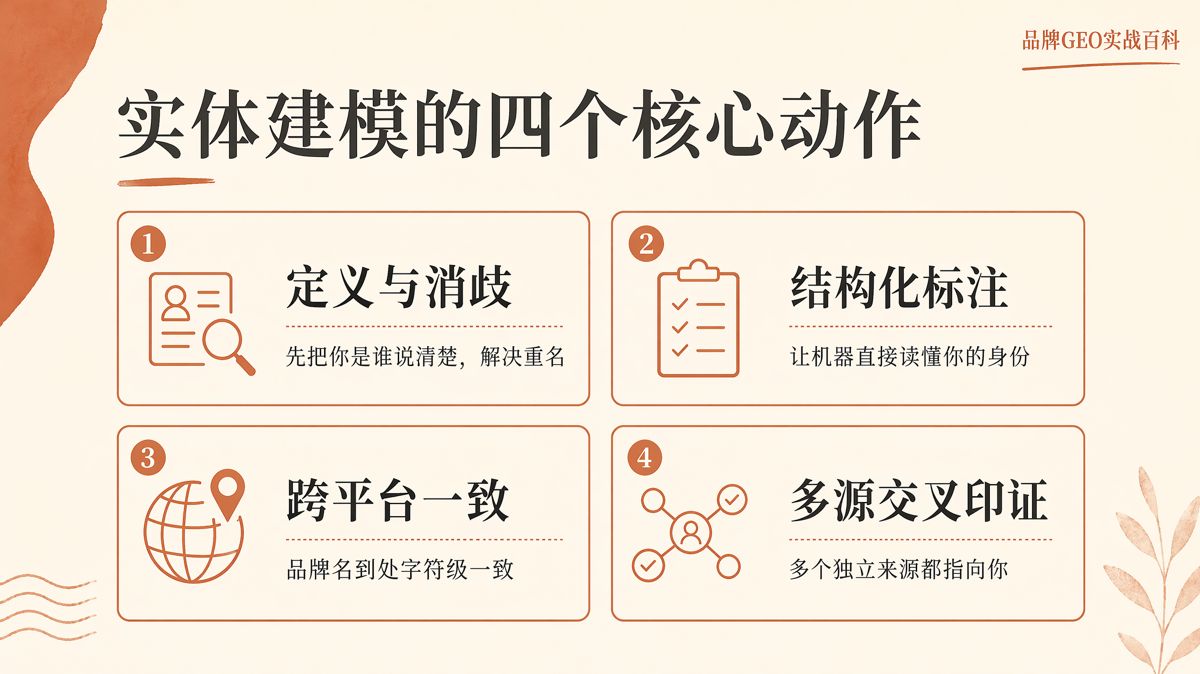
Four Steps to Establish Brand Entity Recognition
1. Define Core Identity Facts and Eliminate Ambiguity
Start by creating a standardized brand fact sheet that remains consistent across all public communications:
- Official registered legal entity name and standard brand name
- Founding year
- Global or regional headquarters location
- Industry classification and core product categories
- Flagship products or services
- Founders and key executives
- Defining geographic or operational details that distinguish the brand from similarly named entities
For international websites, standard practice is to house these details on a dedicated "About" or "Company Facts" page.
If your brand name is a common dictionary term or shared by other businesses, repeating the name alone will not solve ambiguity. Articles, company bios, and directory profiles must consistently pair the brand name with your specific industry, primary location, registered legal entity, and core services.
2. Implement Structured Data to Reduce Processing Friction
Structured data formats information into standardized machine-readable fields. Schema.org provides standard web schemas, most notably:
Organizationto define company and institutional detailsProductto define product specificationsFAQPageto structure frequently asked questions and answers
These markup tags allow search and retrieval engines to ingest relationships between your company, products, and FAQs directly, without having to infer them from unstructured body text.
Industry datasets indicate that content with structured schema markup is cited by AI engines 8.2 times more frequently than unannotated pages. Additional benchmarks show that combining Organization and FAQPage schemas correlates with an AI Overview citation rate approximately 37% higher than completely unannotated content. (These figures reflect specific sample sets and do not guarantee citations for every implementation.)
GEO builds directly upon established technical SEO. On May 15, 2026, Google stated that generative engine visibility relies on core SEO foundations, noting that search engines do not require an "AI-specific Schema tag." Schema's practical value lies in helping systems resolve entities, eliminate homonym confusion, and parse page content accurately.
In China's digital ecosystem, retrieval behaviors differ. Chinese AI models cite major news media and large content platforms far more frequently than independent enterprise websites. Beyond adding schema to a standalone domain, brands operating in China should prioritize complete, verified, and uniform corporate profiles across platforms like WeChat official accounts, Baijiahao (Baidu's content platform), and Douyin (ByteDance's short video platform).
3. Maintain Exact Cross-Platform Consistency
Using varying brand names across platforms creates friction for entity resolution algorithms.
For instance, using a colloquial abbreviation on one platform, a full legal name on another, and appending a city name on a third forces the AI to guess whether these profiles represent one organization or three separate businesses.
Aim for character-level consistency across all channels:
- Standardized brand name vs. registered corporate name
- Script variations (such as Simplified vs. Traditional characters)
- Punctuation, capitalization, and spacing
- Regional modifiers
- Clear hierarchy between parent brand and product lines
For global websites, use the sameAs schema property to connect your primary domain to verified external profiles, such as LinkedIn, YouTube, and Wikipedia. The sameAs array explicitly signals to search crawlers that these external URLs belong to the same entity. Industry practitioners generally recommend linking at least 8 authoritative external profiles, though this is a best-practice guideline rather than an absolute technical threshold.
Industry observations also indicate that beginning in March 2026, Google increased its emphasis on verifiable author and publisher entities, including verified cross-platform links.
In China, where sameAs is not universally supported across domestic search environments, the same entity-matching principle applies: use identical brand naming, registration details, and core descriptions across WeChat, Baijiahao, Douyin, and domestic online encyclopedias.
4. Secure Corroboration Across Independent Sources
An official website and owned social channels only tell an AI how a company describes itself. AI models validate those claims by cross-referencing third-party media, encyclopedias, industry databases, and professional forums.
Empirical studies from iProspect and Hallam suggest that third-party brand mentions correlate with AI citations roughly three times more strongly than traditional backlinks. Again, this represents a correlation rather than an automatic causal mechanism.
Industry analysis indicates that AI engines synthesize between 10 and 30 sources when assembling a single comprehensive answer. The volume, credibility, and factual consistency of these third-party references directly shape how an AI defines your brand entity.
For global brands, foundational third-party sources include Wikipedia, Wikidata, and mainstream press. In China, key entity anchors include Baidu Baike (Baidu Encyclopedia), Sogou Baike, mainstream business media, vertical trade publications, and expert discussions on Zhihu (China's largest Q&A platform). The goal is not syndicating identical press releases, but ensuring that independent platforms consistently reflect your official company name, founding year, and primary business scope.
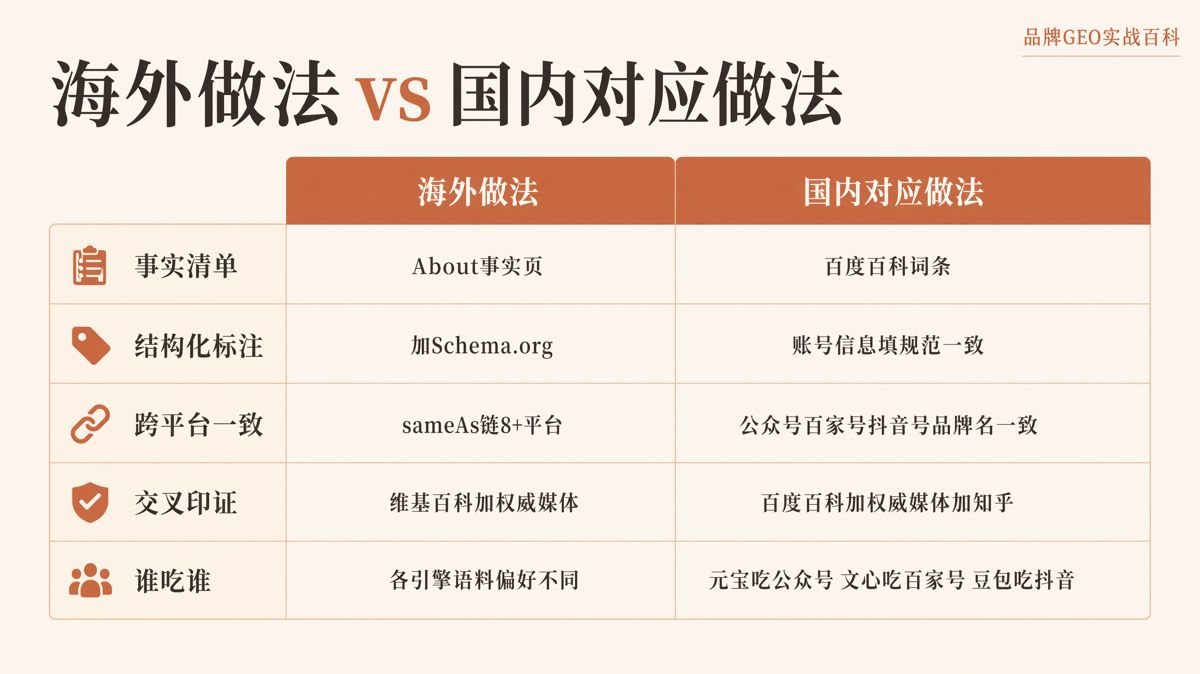
Global vs. China Implementation Differences
While the underlying objective—establishing entity clarity—is identical worldwide, the primary channels and execution tactics diverge.
Global GEO relies heavily on independent websites, Schema.org markup, and structured identity graphs. Chinese AI platforms prioritize authoritative domestic media and centralized platforms, directly citing independent brand domains less frequently.
| Strategy Component | Global Implementation | China Implementation |
|---|---|---|
| Centralized Company Facts | Dedicated "About" or "Company Facts" page | Verified encyclopedia entries and official platform profiles |
| Machine-Readable Markup | Schema.org (Organization, Product, FAQPage) |
Standardized profile names, verified corporate credentials, and bios |
| Cross-Platform Entity Linking | Schema sameAs property linking social and directory profiles |
Uniform profile naming across WeChat, Baijiahao, Douyin, etc. |
| Third-Party Corroboration | Wikipedia, Wikidata, mainstream trade press | Baidu Baike, authoritative domestic media, Zhihu professional discussions |
| Engine Source Preferences | Varies across individual AI search tools | Yuanbao (Tencent's AI) frequently queries WeChat; Ernie Bot favors Baijiahao and Baidu Baike; Doubao favors Douyin content |
Note: Platform source preferences represent broad industry observations rather than rigid algorithmic guarantees. Validate results across live queries.
The Functional Difference Between Recognized and Unrecognized Entities
| Evaluation Dimension | Unrecognized / Weak Entity | Verified Brand Entity |
|---|---|---|
| Brand Name Handling | Treated as an unknown phrase or conflated with competitors | Mapped directly to a specific company or brand record |
| Factual Accuracy | Founding year, category, and scale are missing or inaccurate | Accurately reflects verified corporate attributes |
| Cross-Platform Data | Treated as multiple disconnected accounts | Data points across different platforms resolve to one subject |
| Content Attribution | External mentions are scattered or unattributed | AI correctly credits diverse articles to the brand |
| Non-Branded Retrieval | Rarely cited in broader category questions | Frequently surfaced as a relevant provider or reference |
| Output Consistency | Answers fluctuate widely between search sessions | Generates stable, consistent factual profiles across prompts |
How to Test Your Brand's Entity Recognition
You can evaluate baseline entity recognition by prompting multiple AI models with four direct queries:
- "Tell me what you know about [Full Legal Company Name]."
- "When was [Full Legal Company Name] founded?"
- "What primary products or services does [Full Legal Company Name] offer?"
- "What industry does [Full Legal Company Name] belong to?"
If the AI accurately states your founding year, operational category, and general scale without conflating your business with another company, your entity foundation is established. If the model hallucinates, admits ignorance, or returns conflicting answers across tools, revisit the four foundational steps.
Use these prompts as an ongoing benchmark. Run the same query set monthly to track which identity markers have been parsed and which remain unverified.
Cross-platform profile harmonizations and Schema additions can surface in real-time retrieval (RAG) results within weeks. However, embedding an entity into an AI's parametric base model memory generally requires a training corpus update, which industry benchmarks estimate at 6 to 18 months.
Entity Modeling for Businesses Without Standalone Websites
For companies operating in China without an independent website, domain infrastructure is not a strict barrier to entry. Because domestic AI platforms draw heavily from encyclopedias, WeChat, Baijiahao, and Douyin, smaller brands can establish entity recognition entirely on major third-party platforms.
Prioritize standardizing your official brand name across all accounts, completing verified business registrations, detailing primary services, creating an approved encyclopedia entry, and earning organic mentions in vertical trade media.
Entity Modeling vs. Traditional SEO
SEO ensures that web pages can be discovered, indexed, and ranked. Entity modeling ensures that AI systems understand the real-world subject behind the page and can connect mentions from disparate sources to that single subject.
If a page cannot be crawled and indexed, AI models cannot access its information. Conversely, if a brand's public identity is fragmented, search engines may index every page without ever understanding that they belong to the same company. SEO provides discoverability; entity modeling provides identity resolution.
Content Compliance at Scale
When using AI tools to assist with content creation, ensure full regulatory compliance. In China, the Measures for Labeling of AI-Generated and Synthetic Content took effect on September 1, 2025, requiring explicit and implicit watermarking on synthetic text and media. Unlabeled content faces penalties and removal across major platforms.
Practices such as keyword stuffing, mass content scraping, and fabricating authoritative claims carry severe penalties in 2026. These tactics trigger search filter penalties and degrade an AI engine's trust in your brand's core data. Entity facts must be accurate, standardized, and independently corroborable.
Getting Started
Entity modeling does not require complex engineering to start. Follow this execution order:
- Finalize a standardized brand naming convention and corporate fact sheet.
- Align all owned assets—official sites, encyclopedias, and social profiles—to match this fact sheet.
- For global web assets, implement Schema.org markup and
sameAsidentity links. - Build third-party mentions across credible, independent platforms.
- Benchmark AI recognition monthly using standardized prompts.
Once the basics are locked down, expand into advanced Schema optimization globally or deeper platform-specific content integration in China. The ultimate measure of success is not content output volume, but whether AI systems consistently and accurately answer: who your company is, what you do, and how you differ from the rest of the market.
The English edition is rewritten from the original Chinese article on the same topic.

Starbox AI is an AI marketing company based in Hangzhou, China. This article draws on Starbox project work. Please credit the source when quoting.
Related reading
 GEO Guide
Why AI Marketing Vendor Quotes Vary 10x: A 4-Step Vetting Checklist
Evaluate AI marketing proposals by delivery actions, not slide decks. Audit source infrastructure, fact cleaning, and clean-environment testing.
Oct 22, 2026 · 6 min read
 GEO Guide
Spotting GEO Scams: What Actually Drives AI Recommendations?
Automated AI ranking promises violate how LLMs work. Real AI recommendations rely on authoritative, structured facts across trusted public sources.
Oct 22, 2026 · 4 min read
 GEO Guide
How to Measure Your Brand's AI Visibility with a Spreadsheet
You do not need expensive software to track AI recommendations. A three-tier prompt framework and a simple spreadsheet can score your brand visibility in half a day.
Oct 21, 2026 · 6 min read