
Entity Consistency: Why It Shapes AI Answers

The short answer
Conflicting brand facts confuse AI search engines. Entity consistency ensures AI models resolve your digital footprint to a single, authoritative brand entity.
If your brand uses its legal registered name on its website, an abbreviation on social media, an outdated address on business directories, and conflicting founding dates across press releases, AI models struggle to determine whether these records belong to the same company.
This is the exact problem entity consistency addresses. In Generative Engine Optimization (GEO)—the practice of making brand information easier for generative AI engines to retrieve, understand, and cite—entity consistency measures whether your brand name, address, phone number, core business descriptions, and structured data point unambiguously to a single brand entity across every platform.
Entity consistency is not the same as content quality. A well-written article does not guarantee an AI engine can confirm which brand wrote it. Broad market awareness does not prevent conflicting data from fragmenting your digital presence. AI can only consolidate mentions under one brand when identity signals are clear, uniform, and stable.
The bottom line
Industry observations estimate that entity consistency accounts for 15% to 20% of generative AI search ranking evaluations. This weighting has not been verified by third parties, and actual impact varies across models, search queries, and retrieval updates.
Execution focuses on four foundational steps:
- Standardize your brand name, address, phone number, founding year, and core business description across all platforms.
- Deploy Schema.org structured data to explicitly define organizational and page-level information.
- Use the
sameAsproperty to declare that your official website and third-party profiles belong to the same entity. - Maintain reliable corporate profiles or encyclopedia entries to resolve naming ambiguities and eliminate data conflicts.
These actions do not guarantee that AI engines will cite your brand in every relevant response. However, they reduce ambiguity during entity disambiguation, making it far easier for algorithms to aggregate fragmented citations accurately.
Why AI needs to identify brand entities
Generative AI search engines typically retrieve candidate sources, filter and rank them, and synthesize a final response. Industry analyses often explain this via Retrieval-Augmented Generation (RAG)—a technical framework where an AI model retrieves external documents before generating a synthesized answer.
According to common industry frameworks, this workflow spans three stages:
- Candidate retrieval: The system translates the user's prompt into search queries and retrieves approximately 20 to 100 web pages or knowledge snippets from its index.
- Filtering and ranking: The system scores the candidate content, selecting roughly 5 to 15 top snippets for further processing.
- Answer generation: The model parses the selected text into segments of roughly 200 to 500 words, evaluates their credibility and relevance, synthesizes the final answer, and inserts citations.
These figures reflect industry benchmarks rather than fixed, universally disclosed parameters. Different AI search engines use distinct retrieval mechanics, ranking formulas, and citation models.
Industry models frequently reference an earlier v2.5 framework that evaluated four ranking factors, updated in v3.0 to incorporate entity consistency as a fifth factor:
| Scoring Dimension | Estimated Industry Weight | Core Assessment Criteria |
|---|---|---|
| Semantic Relevance | 30%–35% | Does the content directly address the user's query? |
| Authority | 20%–25% | Is the source trustworthy and cited by third parties? |
| Freshness | 15%–20% | Is the information timely, accurate, and up to date? |
| Readability | 10%–15% | Is the content clear and easy for models to extract? |
| Entity Consistency | 15%–20% | Can mentions across platforms be resolved to the same entity? |
These framework versions, dimension splits, and weights represent industry estimates. They are not third-party verified, nor should they be treated as an official algorithm confirmed by ChatGPT, Perplexity, Google AI Overviews, Doubao (ByteDance's AI assistant), DeepSeek, Tencent Yuanbao, or Baidu's ERNIE Bot.
What happens when brand data is inconsistent
AI engines must determine the exact business a specific name refers to. If your brand appears as "ABC Technology Co., Ltd." on your site, "ABC Tech" on social channels, and "ABC Technology" on review portals—paired with conflicting addresses, phone numbers, or founding years—the system must perform entity disambiguation.
Entity disambiguation is the process of resolving aliases, homonyms, and conflicting records to confirm a specific real-world entity. The more consistent your digital footprint, the easier it is for AI to identify your brand. When conflicts arise, your mentions risk being fragmented across separate entities or conflated with competitors sharing similar names.
Industry research highlights two relevant benchmarks:
- An empirical study by seoClarity in 2026 reported a correlation coefficient of
r=0.664between web brand mentions and appearances in Google AI Overviews, compared tor=0.218for backlinks. Correlation measures how closely two variables move together rather than direct causation, meaning higher brand mentions do not guarantee proportional increases in AI citations. However, the data highlights a much stronger link between brand mentions and AI inclusion than traditional backlink volume alone. - Research cited from iProspect and Hallam in 2026 summarized this dynamic by estimating that brand mentions have roughly three times the correlation to AI citations compared to backlinks. Because the underlying sample, methodology, and scope were not fully detailed in the source, this figure should be treated as an agency benchmark rather than an absolute rule across all verticals.
Consistent cross-platform profiles, sameAs schema declarations, and Wikidata QIDs (unique alphanumeric identifiers assigned by Wikidata to disambiguate entities) all provide critical disambiguation signals. They help AI verify your identity, though they do not independently guarantee citations or top rankings.
How entity consistency differs from traditional SEO
Search Engine Optimization (SEO) helps web pages get crawled, indexed, and ranked organically by search engines. GEO shares foundational elements with SEO: crawlable architecture, accurate business records, clear page hierarchy, and stable site data.
On May 15, 2026, Google stated that optimizing for generative AI search remains an optimization of search experiences and therefore still falls under SEO. GEO does not replace SEO; if an engine cannot crawl or parse your pages, downstream entity recognition and AI citations are impossible.
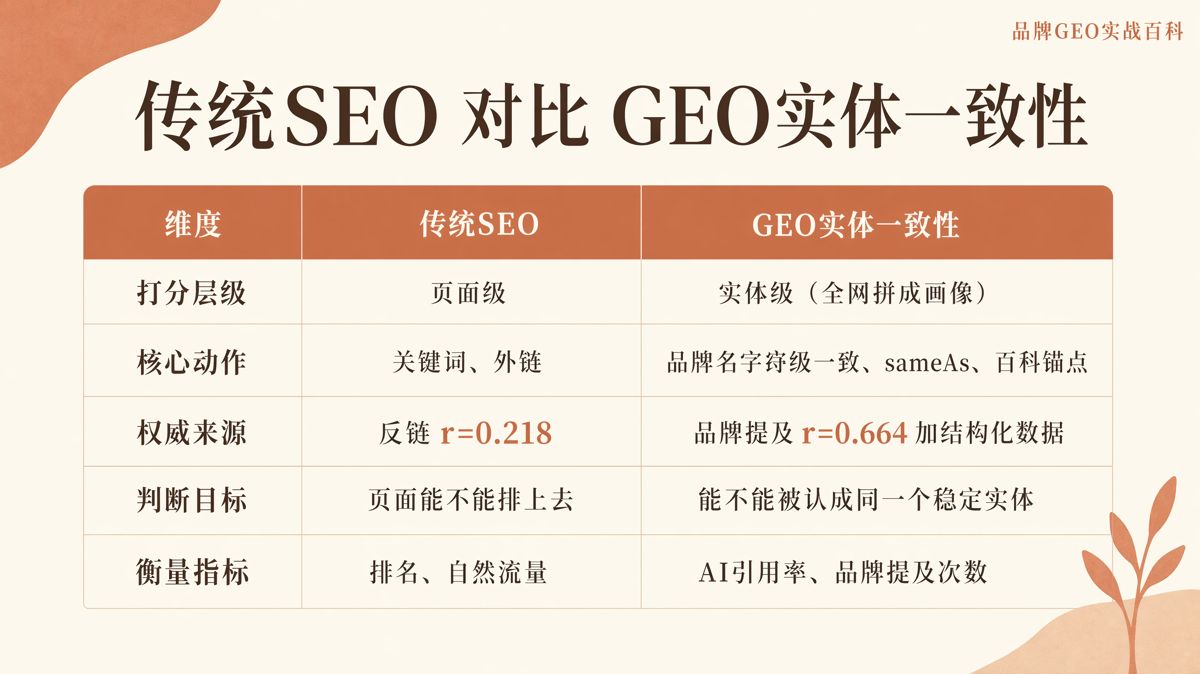
However, the core focus differs. Traditional SEO primarily evaluates individual web pages, whereas GEO entity consistency requires AI systems to resolve information distributed across multiple external platforms back to a single enterprise entity.
| Dimension | Traditional SEO | Entity Consistency in GEO |
|---|---|---|
| Primary Subject | Individual pages and websites | Brand entity data distributed across platforms |
| Core Actions | Keyword optimization, page quality, backlinks | Standardizing brand names and facts, sameAs markup, structured data, knowledge bases |
| Primary Signals | Page relevance, domain authority, backlink profiles | Unlinked and linked brand mentions, structured data, cross-platform identity links |
| Evaluation Goal | Earning organic search rankings for specific URLs | Enabling AI to resolve disparate sources to one brand |
| Common Metrics | Keyword rank, organic traffic | AI citation rate, brand mention volume, entity accuracy |
Entity consistency also differs from domain authority. Authority measures external trust, backlinks, and third-party evaluations. Consistency measures identity clarity and whether facts conflict across platforms. A prominent brand might have strong authority but disorganized contact details and service descriptions. Conversely, a startup might maintain flawless consistency across directories yet lack third-party validation. Both requirements must be addressed separately.
How global brands standardize entity signals
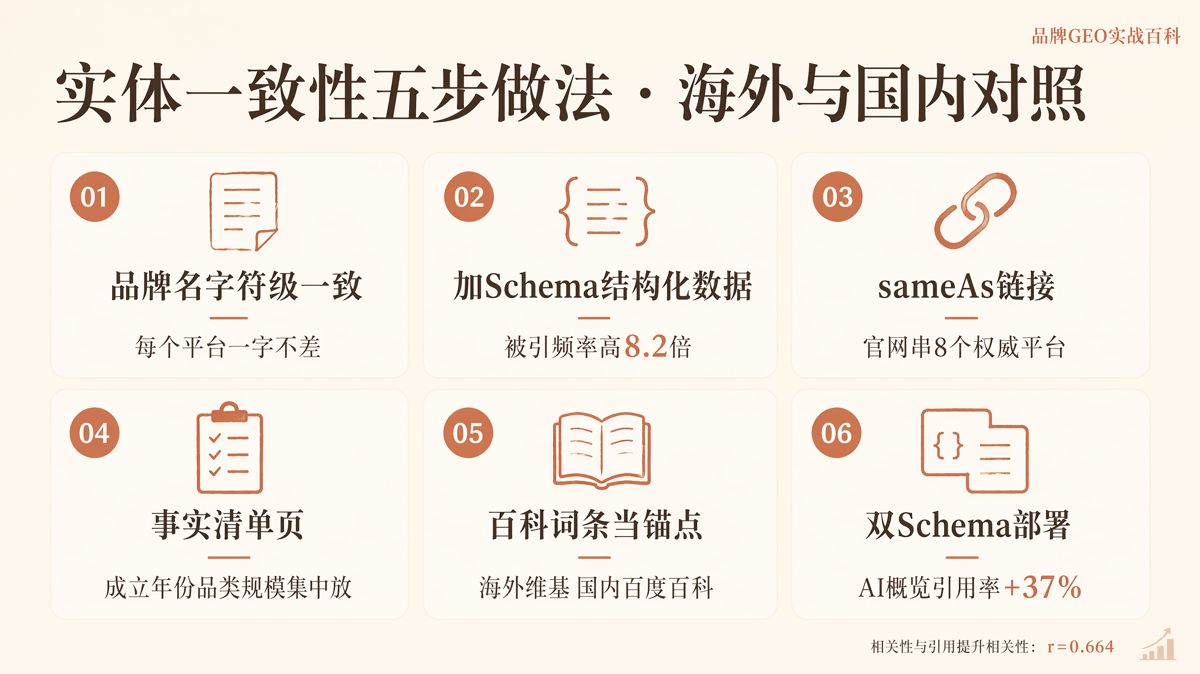
1. Establish a single canonical brand name
Choose one canonical naming convention across your website, LinkedIn, Crunchbase, and directories. Ensure full corporate legal names, capitalization, spacing, and punctuation remain strictly uniform.
Character-level consistency serves as an operational benchmark to eliminate friction caused by typos or abbreviations. While AI models do not rely solely on exact string matches, unnecessary naming variations introduce preventable disambiguation hurdles.
2. Maintain a centralized corporate fact sheet
Host a dedicated "About Us" or "Company Facts" page on your primary website. Centralize core facts: founding date, legal corporate name, headquarters address, direct contact channels, primary service lines, and company size.
Treat this page as the single source of truth for updating third-party platforms. When corporate milestones, relocations, or rebrands happen, systematically audit external profiles to prevent obsolete and active data from coexisting.
3. Implement standard Schema.org structured data
Schema.org provides a standardized semantic vocabulary that allows machines to parse organizational details, offerings, and content structures directly.
Prioritize:
Organization: Defines legal name, URL, official logo, and verified profiles.FAQPage: Structures question-and-answer pairs on key service pages.
Data published by geneo.app in 2025 indicated that pages with structured data were cited by AI engines 8.2 times more frequently than pages without markup. Additionally, industry observations cite that deploying both Organization and FAQPage schemas correlates with a 37% higher citation rate in Google AI Overviews compared to unformatted pages. These figures represent observational benchmarks rather than guaranteed multipliers.
Google has explicitly clarified that there is no specialized "AI Schema." Implementing standard Schema.org types like Organization, Product, and FAQPage is sufficient.
4. Connect profiles using the sameAs property
The sameAs property within Schema.org explicitly indicates that an external URL references the exact same entity as the current page. Brands can use Organization markup to link their website to official profiles on LinkedIn, Crunchbase, G2, Trustpilot, Wikipedia, Wikidata, GitHub, and YouTube.
Industry guidelines suggest connecting at least eight authoritative platforms. This is a recommended rule of thumb rather than an official engine requirement. The focus should be on verified, publicly accessible profiles that genuinely belong to the brand.
5. Build Wikipedia and Wikidata profiles
Wikipedia is an open encyclopedia and Wikidata is a structured knowledge graph. Qualifying brands can establish profiles on both platforms to provide a durable knowledge base anchor.
According to a 2026 digitalapplied analysis, Google began treating verifiable author and publisher entities as stronger ranking signals in March 2026, specifically highlighting entities linked to Wikipedia or Wikidata via sameAs. This report represents an industry observation rather than an unconditional rule applied across all searches.
Industry benchmarks suggest Wikipedia entry creation and review can take 6 to 18 months. Actual timelines depend heavily on independent notability, supporting third-party sources, and community editorial reviews.
Adapting entity consistency for the Chinese market
Industry observations suggest that Chinese AI engines cite corporate standalone websites less frequently than international engines do, relying more heavily on domestic encyclopedias, content ecosystems, and proprietary platforms. This observation remains unverified by third parties and varies by query type and retrieval scope.
Under this operating environment, brands in China should prioritize public profiles on Baidu Baike (Baidu's encyclopedia), Sogou Baike, WeChat Official Accounts, Douyin (TikTok's Chinese sister app), Baijiahao (Baidu's content platform), and Zhihu (China's leading Q&A platform). While Baidu Baike and Sogou Baike serve as vital identity references, having an entry does not guarantee AI citations.
| Western Practice | China Equivalent | Primary Function |
|---|---|---|
| Wikipedia, Wikidata profiles | Baidu Baike, Sogou Baike | Provides centralized, stable entity facts |
Official site & sameAs schema |
Cross-linked, verified corporate social profiles | Confirms brand ownership across platforms |
| LinkedIn company pages | WeChat Official Account enterprise profiles | Verifies corporate identity and delivers regular updates |
| Reddit, Quora threads | Zhihu discussions | Provides public discussions and Q&A references |
| G2, Capterra software reviews | Vertical niche review sites & distributed reputation platforms | Supplies third-party user feedback |
Industry observations also note ecosystem retrieval tendencies: Tencent Yuanbao frequently references WeChat Official Accounts; Baidu's ERNIE Bot leans toward Baijiahao and Baidu Baike; ByteDance's Doubao leverages Douyin and Toutiao; while Moonshot's Kimi and DeepSeek frequently index Zhihu. These tendencies are observational and subject to ongoing algorithm changes.
Consequently, brands should not limit their presence to a single ecosystem. A sound strategy begins with defining unified corporate facts and updating every active business profile, eliminating conflicting phone numbers, addresses, and business descriptions.
Complying with AI content disclosure regulations
China's Measures for the Labeling of Artificial Intelligence Generated and Synthetic Content took effect on September 1, 2025. Requirements outlined in the source include explicit disclosures (visible user notifications indicating content was generated by AI) and implicit identifiers (metadata embedded directly into output files).
Enterprises deploying AI to scale content production must follow relevant regulatory and platform disclosure requirements. Keyword stuffing, mass scraping, and fabricating authority signals carry risks of content removal and algorithmic penalties. Entity consistency demands uniform, factual data—it does not justify publishing duplicated or fabricated corporate claims.
Entity consistency audit checklist
Brand naming
- Are the exact same brand names used across your website, encyclopedias, WeChat, and social channels?
- Are English casing, spacing, and punctuation identical everywhere?
- Is the relationship between brand abbreviations and legal corporate names clearly stated?
- Have legacy or outdated trading names been phased out from older profiles?
Corporate facts
- Do your headquarters address, phone numbers, founding year, and primary business scopes match across all directories?
- Are company size, revenue, and product categories described consistently without conflicting versions?
- When corporate information changes, are third-party directories updated simultaneously?
Technical implementation
- Does your website implement appropriate
Organization,Product, orFAQPageschemas? - Do your
sameAsproperties link exclusively to active, verified profiles? - Are your profiles on Wikidata, Wikipedia, or domestic encyclopedias accurate?
- Does your structured data match the visible on-page content?
AI testing
- Prompt major AI engines with: "What is the full legal name, founding year, and primary business of [Company Name]?"
- If answers return conflicting dates, wrong corporate structures, or conflated competitors, audit your public listings.
- Note that isolated test queries only offer directional diagnostics. A single correct response does not guarantee long-term stability, and an error may simply reflect temporary indexing delays.
What to expect after standardizing entity signals
Entity consistency solves one specific challenge: whether AI engines can verify that disparate records represent the same brand. Once your naming conventions, corporate facts, structured data, and profile links align, AI models can aggregate external mentions accurately.
However, consistency is only one factor in retrieval and ranking. Whether your content answers the query, how authoritative your domain is, how fresh your data remains, and how readable your pages are will continue to govern outcomes. Consistency cannot substitute for substantive quality or genuine third-party authority.
Set realistic operational expectations. Schema deployment and directory updates can be implemented quickly, but encyclopedia editorial reviews, web crawling, index updates, and model re-indexing require time. There is no guaranteed timeline, and claims promising inclusion in AI answers within 30 days lack empirical foundation.
Entity consistency is often neglected because it looks like basic administrative hygiene. Yet when names, addresses, and business descriptions diverge across the web, AI engines inevitably scatter your visibility across fragmented entities. Establishing who your brand is must come before trying to scale citations.
Frequently asked questions
What is the exact weight of entity consistency in AI search?
Industry observations estimate it between 15% and 20%. This figure is not an officially published metric from any AI search provider, has not been verified by third parties, and will vary across queries and models.
Does a single-character typo in a brand name really matter?
It can. Naming discrepancies increase the difficulty of entity disambiguation and risk splitting citations across separate records. However, modern AI models do not rely solely on rigid string matching, so a retrieval error cannot be pinned exclusively to a single character difference.
Is structured data mandatory?
Industry evidence strongly recommends it. Standard Schema.org markup helps machines interpret organizations, products, and FAQs. However, it does not guarantee AI citations, and there is no need for so-called "specialized AI schemas."
Is the sameAs property relevant in the Chinese market?
While China lacks a universally adopted equivalent to sameAs across its walled gardens, the underlying principle of resolving entity ambiguity remains identical. Brands should keep details uniform across domestic platforms and link official profiles wherever permissible.
How long does it take to see results after optimizing entity data?
There is no fixed schedule. While code updates and profile edits happen immediately, encyclopedia moderation, search engine crawling, index refreshes, and AI model updates take time. Any guarantee of AI citation within a specific window is unfounded.
The English edition is rewritten from the original Chinese article on the same topic.

Starbox AI is an AI marketing company based in Hangzhou, China. This article draws on Starbox project work. Please credit the source when quoting.
Related reading
 GEO Guide
Why AI Marketing Vendor Quotes Vary 10x: A 4-Step Vetting Checklist
Evaluate AI marketing proposals by delivery actions, not slide decks. Audit source infrastructure, fact cleaning, and clean-environment testing.
Oct 22, 2026 · 6 min read
 GEO Guide
Spotting GEO Scams: What Actually Drives AI Recommendations?
Automated AI ranking promises violate how LLMs work. Real AI recommendations rely on authoritative, structured facts across trusted public sources.
Oct 22, 2026 · 4 min read
 GEO Guide
How to Measure Your Brand's AI Visibility with a Spreadsheet
You do not need expensive software to track AI recommendations. A three-tier prompt framework and a simple spreadsheet can score your brand visibility in half a day.
Oct 21, 2026 · 6 min read