
Maintaining Freshness in GEO: How AI Ranks Updated Content

The short answer
Earning an AI citation does not guarantee long-term placement. Here is how freshness impacts generative engine ranking and how to maintain live content.
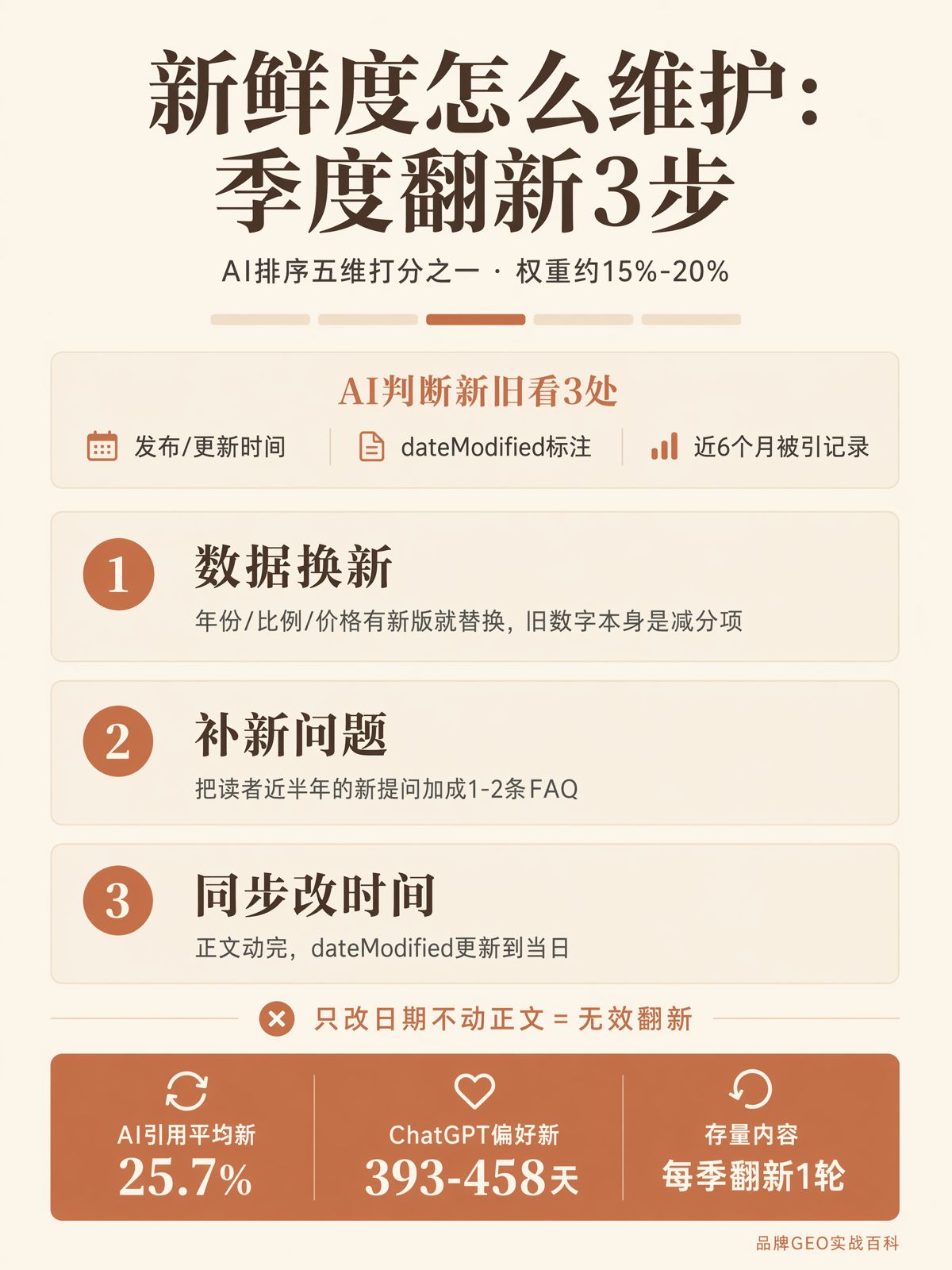
Getting your content cited by an AI engine does not mean it will stay in the answer forever. Generative Engine Optimization (GEO) focuses on ensuring brand content can be retrieved, understood, and cited by AI engines. In the re-ranking phase, industry observers consider freshness one of five core scoring dimensions, estimating its weight at roughly 15% to 20%. This figure remains unverified by third parties and is not an officially published benchmark across search engines.
Freshness does not mean publishing at high volume. Engines evaluate a simple question: Is this information still valid today? Clearly displaying modification dates, revising legacy articles, updating obsolete data points, and maintaining an active citation track record are far more effective than simply pushing out more posts.
Where Does Freshness Impact the Retrieval Pipeline?
Public documentation from ChatGPT Search and Google AI Overviews, alongside reverse-engineering studies from 2025 and 2026, outline a standard workflow. When an AI search engine processes a prompt, it typically pulls 20 to 100 candidate documents from its index, re-ranks them across multiple dimensions, and selects 5 to 15 sources to synthesize the final response. Actual mechanics vary across engines, but these figures illustrate the baseline pipeline.
Freshness plays its primary role during the re-ranking stage. Industry white papers categorize freshness signals into three main areas:
- The initial publication or revision timestamp of the content;
- The
dateModifiedfield in the page's structured data (the machine-readable modification date); - Whether the content has accumulated citation records within the past six months.
These signals help the engine evaluate whether the underlying facts remain accurate.
It is also critical to distinguish between an AI model's two primary information sources: pre-training data and real-time retrieval. Pre-training data consists of public corpora ingested during model training runs. Real-time retrieval refers to live web documents fetched on demand after a user submits a query. White papers analyzing public engine documentation and third-party research estimate that pre-training corpora face a 6- to 18-month update lag. Real-time retrieval is what bridges this gap for time-sensitive information.
Consequently, freshness optimization primarily targets real-time retrieval. Industry benchmarks suggest that GEO authority builds dynamically, with content updates taking roughly 1 to 3 months to reflect in AI search visibility. This window is not verified by third parties and varies across platforms and queries.
Different engines weigh these signals differently. Industry observations suggest that Google AI Overviews is particularly sensitive to content recency, Perplexity prioritizes source authority, and ChatGPT Search leans more heavily on semantic relevance. These patterns represent point-in-time observations rather than hard platform rules.
What the Data Shows
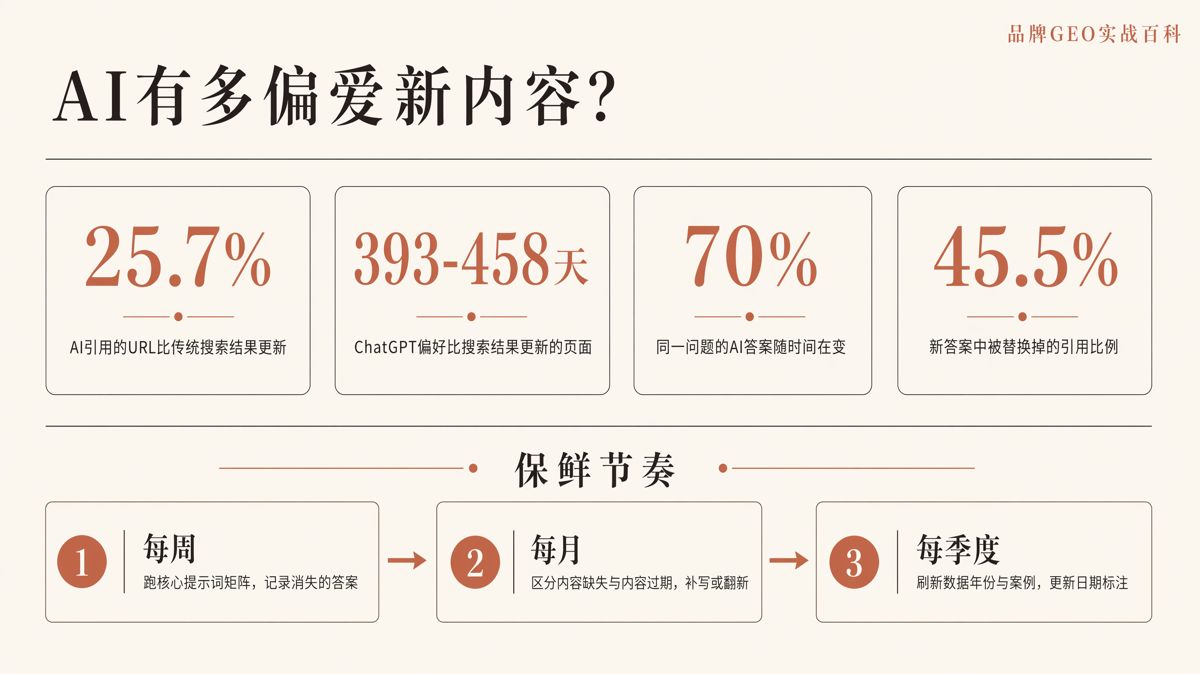
In 2025, Ahrefs analyzed 17 million AI citations. The study found that URLs cited by AI engines were, on average, 25.7% newer than top Google organic search results. Specifically, pages cited by ChatGPT were typically 393 to 458 days newer than Google organic listings—a gap of more than a year.
While this data demonstrates a strong correlation between AI citations and recent update timestamps, it does not prove that modifying a date or editing an article guarantees a citation.
Monitoring by Profound shows that Google AI Overviews answers for identical queries fluctuate 70% of the time. Among newly generated answers, 45.5% of previously cited sources are replaced. Earning a citation today provides no guarantee that your placement will survive next quarter.
Furthermore, traditional search rankings do not cleanly map to AI citations. Data from seoClarity showed that following a late January 2026 update to Google AI Overviews, the share of top-10 organic search results appearing in AI citations dropped from 76% to 38%. Ranking near the top of organic SERPs does not guarantee selection by generative models, though the update itself cannot be proven as the sole driver of this decline.
GEO Freshness vs. Traditional SEO Recency
SEO focuses on ensuring web pages can be crawled, indexed, and ranked in organic search. GEO relies on many of the same technical foundations, including crawlability, indexing, and site entity identification.
Google stated publicly in May 2026 that optimizing for generative AI search remains fundamentally rooted in SEO best practices. If a page cannot be properly crawled and indexed, its content will never enter the downstream AI retrieval and citation pipeline.
However, the two disciplines diverge in how they evaluate content units and handle decay:
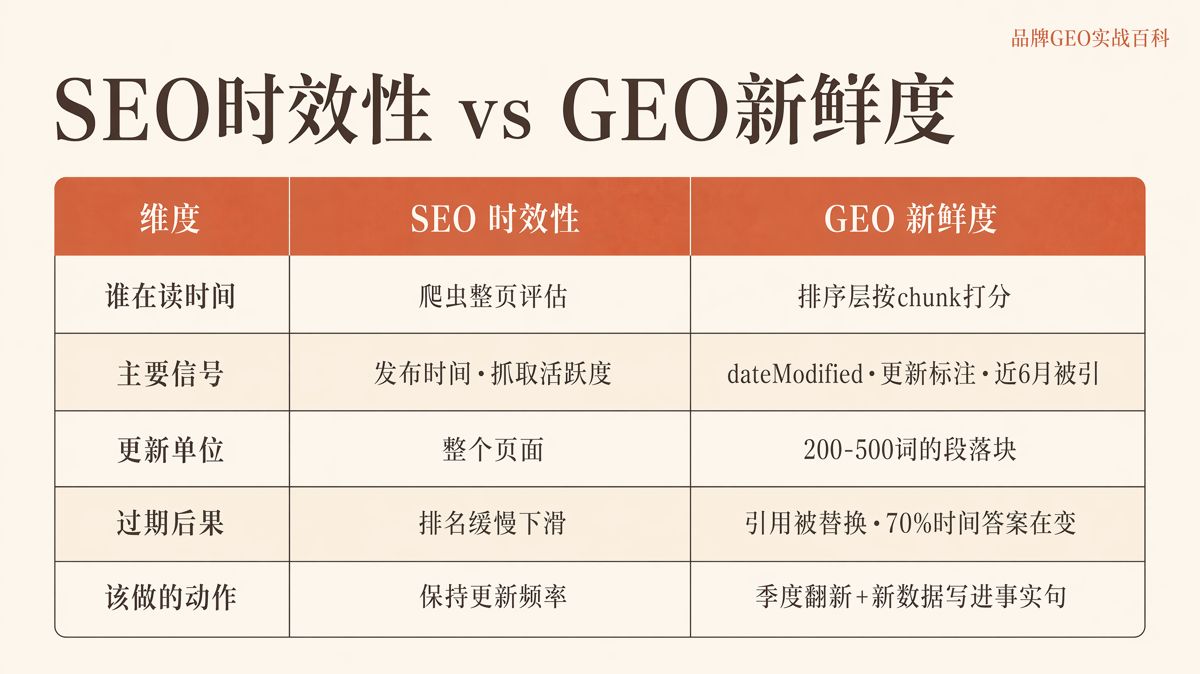
| Dimension | Traditional SEO Recency | GEO Freshness |
|---|---|---|
| Signal Evaluator | Search crawlers and ranking algorithms assessing the entire page | Retrieval-ranking pipeline assessing 200–500 word content chunks |
| Key Signals | Initial publish date, page update time, site crawl activity | dateModified, inline update timestamps, 6-month citation history |
| Unit of Update | The whole URL / page | Self-contained paragraphs or text chunks stating clear facts |
| Outdated Content Outcome | Gradual ranking decay, usually with a lag | Immediate replacement in AI citations by newer sources |
| Primary Maintenance Action | Keep pages crawlable and regularly publish updates | Routinely revise older assets, inserting fresh data into standalone paragraphs |
In short, SEO recency checks whether a page is still being maintained. GEO freshness checks whether the specific facts within a text chunk remain accurate. Publishing new blog posts while leaving three-year-old statistics inside legacy copy does little to improve chunk-level freshness.
How to Update Legacy Content Effectively
A reliable operating baseline is a quarterly audit focused on factual reference lists, case studies, and corporate certifications. Standard GEO publishing checklists require updating the dateModified schema field to reflect the actual date changes were made.
An effective update should cover four core checks:
- Outdated data. Replace aging metrics with current-year data. If historical figures must stay, label their exact timeframe clearly.
- Defunct conclusions. If an earlier takeaway is no longer true, rewrite it directly. Do not simply append a note saying "things have changed."
- Emerging user queries. Incorporate questions that have surfaced over the past year into the body copy or an FAQ section.
- Comparison accuracy. When products, policies, tools, or platforms evolve, update comparison tables with current parameters.
Updated information must be written into standalone paragraphs. AI engines retrieve and score content at the chunk level (roughly 200 to 500 words). If new data is scattered across old paragraphs and cannot be understood without surrounding context, its chances of being cited drop significantly.
Changing the publish date without modifying the body copy does not work. Mismatches between timestamps and actual facts generate conflicting signals. Furthermore, changing a date cannot forge behavioral signals like citation records over the past six months.
In China, regulatory updates in 2026 have targeted low-quality, mass-generated AI content. Attempting to manufacture freshness by programmatically modifying dates carries search penalties and platform compliance risks.
If you use AI tools to assist in updating content for the Chinese market, comply with labeling rules. The "Administrative Measures for the Identification of Artificial Intelligence Generated and Synthetic Content"—issued by four Chinese regulatory bodies, including the Cyberspace Administration of China (CAC), and effective September 1, 2025—mandates explicit and implicit disclosures on AI-generated content. Unlabeled assets risk removal or algorithmic penalties on supported platforms.
Should You Write a New Article or Update an Old One?
In most cases, update your existing content first.
GEO equity accumulates dynamically over time. An older article that has already earned citations retains that behavioral footprint over a rolling six-month window; a brand-new URL starts with zero history. While not every legacy piece outperforms a new one, historical equity matters.
Content depth also influences citation rates. Research from seoClarity indicates that long-form content exceeding 2,900 words sees a 59% higher citation rate than articles under 800 words. While word count alone does not cause citations, it demonstrates that comprehensive, well-maintained cornerstone assets are generally more valuable to preserve than to replace.
You should only write a new article when users are asking an entirely new question that cannot be naturally integrated into an existing piece. Once published, cross-link the new and old articles to help engines recognize that both pages cover the same topical cluster.
This mirrors traditional SEO: older domains and established URLs benefit from historical trust. GEO places that trust on citation history and verified entity relationships between brands, products, and facts.
How to Signal Freshness on Chinese Platforms
On independent websites, the standard approach is implementing Schema structured data, specifically keeping the dateModified field accurate.
In China, AI engines pull heavily from distinct platform ecosystems. Industry observations indicate that Yuanbao (Tencent's AI assistant) frequently cites WeChat Official Accounts; Wenxin (Baidu's AI assistant) pulls from Baijiahao (Baidu's content platform) and Baidu Baike (Baidu's encyclopedia); Doubao (ByteDance's AI assistant) retrieves from Douyin (TikTok's Chinese sister app) and Toutiao (ByteDance's news aggregator); and Zhihu (China's largest Q&A platform) serves as a primary source for Kimi (Moonshot AI's chatbot) and DeepSeek. These platform retrieval preferences represent observed patterns rather than fixed guarantees.
Because detailed documentation on how domestic Chinese engines calculate freshness remains limited, follow these general execution rules:
- Add an explicit update tag at the very top of the text (e.g., "Updated in [Month, Year]") so web crawlers extract the timestamp immediately;
- Regularly audit and revise editable formats, such as Zhihu answers and Baike encyclopedia entries;
- For formats that cannot be edited after publication, such as WeChat Official Account articles, publish new articles covering the updated topic and interlink them with the original posts.
Tailor your cadence to the content type. Trending topics and news items depend heavily on their initial publication date. These move quickly across ByteDance ecosystem channels like Toutiao and Douyin, but have short lifespans. Encyclopedia entries, comparison frameworks, and evergreen FAQs require long-term accuracy and are better served by quarterly review cycles.
An Actionable Maintenance Cadence
Weekly: Monitor Citation Volatility
Build a fixed prompt matrix containing your priority brand and category queries. Run these prompts across your target AI engines weekly to track whether your content is cited, and identify which third-party sources are replacing your links when citations drop off.
Given Profound's findings that AI Overviews change 70% of the time, the goal of weekly tracking is not to rewrite copy every seven days, but to catch citation drops early.
Monthly: Triage Missing vs. Outdated Content
Take the queries where your brand failed to earn citations and diagnose the root cause:
- Content gap: If your existing assets do not answer the specific question, draft a new section or a dedicated piece.
- Content decay: If your assets cover the topic but feature outdated numbers, expired policy references, or obsolete product tiers, revise the original URL.
Tracking without triage leads to wasted effort. Separating content gaps from factual decay turns monitoring into clear editorial tasks.
Quarterly: Overhaul Priority Assets
Every quarter, audit your core facts, case studies, metric years, and business qualifications. Fully review your priority long-form assets and verify that inline timestamps match your structured dateModified tags. Ensure that product naming, specs, and brand claims remain consistent across all external platform profiles.
If editorial resources are constrained, prioritize time-sensitive elements: pricing, market data, regulatory policies, and software versioning. Theoretical definitions and operational methodologies change slowly and can be audited on a semi-annual basis.
Frequently Asked Questions
1. How often does content need to be updated?
A quarterly audit serves as a dependable baseline. Highly volatile information—such as pricing, market sizing, and regulatory policies—should be updated as soon as upstream sources change. A reliable rule of thumb: if the oldest statistic in your core article is more than 12 months old, it is time for a review.
2. If I change the publish date without updating the text, will AI see it as new?
No. Date stamps are only one part of the freshness evaluation. Engines also check chunk-level factual accuracy, citation history, and consistency against other indexed sources. Faking a timestamp creates conflicting signals that harm credibility.
3. Once content is cited by an AI engine, is that placement permanent?
No. Research from Profound shows that Google AI Overviews answers fluctuate 70% of the time, with 45.5% of cited sources being swapped out in new iterations. A citation confirms that your content qualified for that specific generation cycle, not that it will stay there indefinitely.
4. What should I do if an AI engine cites last year's data for my brand?
Address this across two layers. Training corpora have a 6- to 18-month update lag, which you cannot immediately change. Focus on real-time retrieval: update your primary URLs, adjust the dateModified field, and push refreshed statements to platforms like Zhihu, Baijiahao, and WeChat Official Accounts. Real-time index updates typically reflect in AI answers within 1 to 3 months.
5. Should I write a new article or update an existing one?
Update your existing asset whenever it has established authority and an active citation history. Only publish a separate article if the topic addresses a distinct user intent that cannot naturally fit into the existing page structure. Research shows long-form assets earn higher citation rates, favoring the maintenance of deep, comprehensive resources.
6. How do I signal freshness on Chinese platforms that lack dateModified fields?
Add a clear revision note at the top of the body text (e.g., "Updated on [Date]"). Regularly edit live posts on platforms that permit updates, such as Zhihu answers and Baike entries. For fixed formats like WeChat Official Account posts, publish an updated follow-up piece and cross-link between the old and new URLs.
7. Should news content and evergreen knowledge content follow the same maintenance schedule?
No. Breaking news relies on rapid distribution and has a short shelf life. Evergreen reference materials and product FAQs require sustained accuracy and should be reviewed on a quarterly cycle. Allocate immediate resources to time-sensitive announcements, while running scheduled maintenance for evergreen documentation.
Effective freshness optimization is not about maximizing publication volume or changing timestamps. It is about ensuring AI retrieval engines always find verified, current facts. Prioritize your authoritative long-form assets, expand into new pages only to fill identified topical gaps, and review your core numbers, pricing, and policy details regularly to protect your AI citations.
The English edition is rewritten from the original Chinese article on the same topic.

Starbox AI is an AI marketing company based in Hangzhou, China. This article draws on Starbox project work. Please credit the source when quoting.
Related reading
 GEO Guide
Why AI Marketing Vendor Quotes Vary 10x: A 4-Step Vetting Checklist
Evaluate AI marketing proposals by delivery actions, not slide decks. Audit source infrastructure, fact cleaning, and clean-environment testing.
Oct 22, 2026 · 6 min read
 GEO Guide
Spotting GEO Scams: What Actually Drives AI Recommendations?
Automated AI ranking promises violate how LLMs work. Real AI recommendations rely on authoritative, structured facts across trusted public sources.
Oct 22, 2026 · 4 min read
 GEO Guide
How to Measure Your Brand's AI Visibility with a Spreadsheet
You do not need expensive software to track AI recommendations. A three-tier prompt framework and a simple spreadsheet can score your brand visibility in half a day.
Oct 21, 2026 · 6 min read