
How to Build Authority for AI Search Engines

The short answer
AI evaluates authority through independent verification, not corporate claims. Here is how to build brand mentions and citations that AI engines trust.
Many brands approaching Generative Engine Optimization (GEO) mistake authority building for website packaging. They polish their design, expand their "About Us" page, and syndicate boilerplate press releases.
From an AI model's perspective, all of those assets trace back to a single entity: the brand itself. They represent only one piece of source evidence.
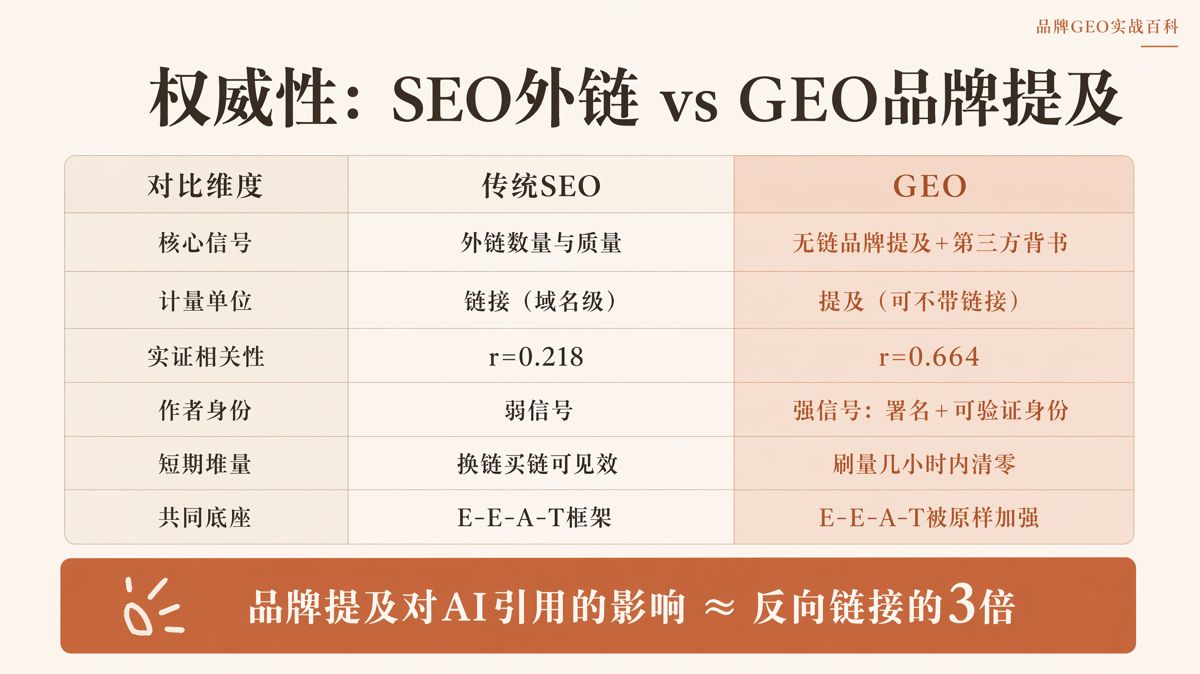
AI engines look for verifiable, third-party corroboration. They check whether independent platforms mention your brand, whether content carries verifiable bylines, and whether your claims are supported by encyclopedias, industry trade publications, and professional associations. Owned content is necessary, but brand claims alone cannot establish an external consensus.
Seven Data Points on Why Authority Matters in GEO
Evaluating authority requires separating empirical research from industry observations:
- 20% to 25% of the overall AI ranking score: Industry estimates suggest authority accounts for roughly a quarter of AI ranking weight, second only to semantic relevance (how well content matches user intent). This weighting remains an unverified industry estimate.
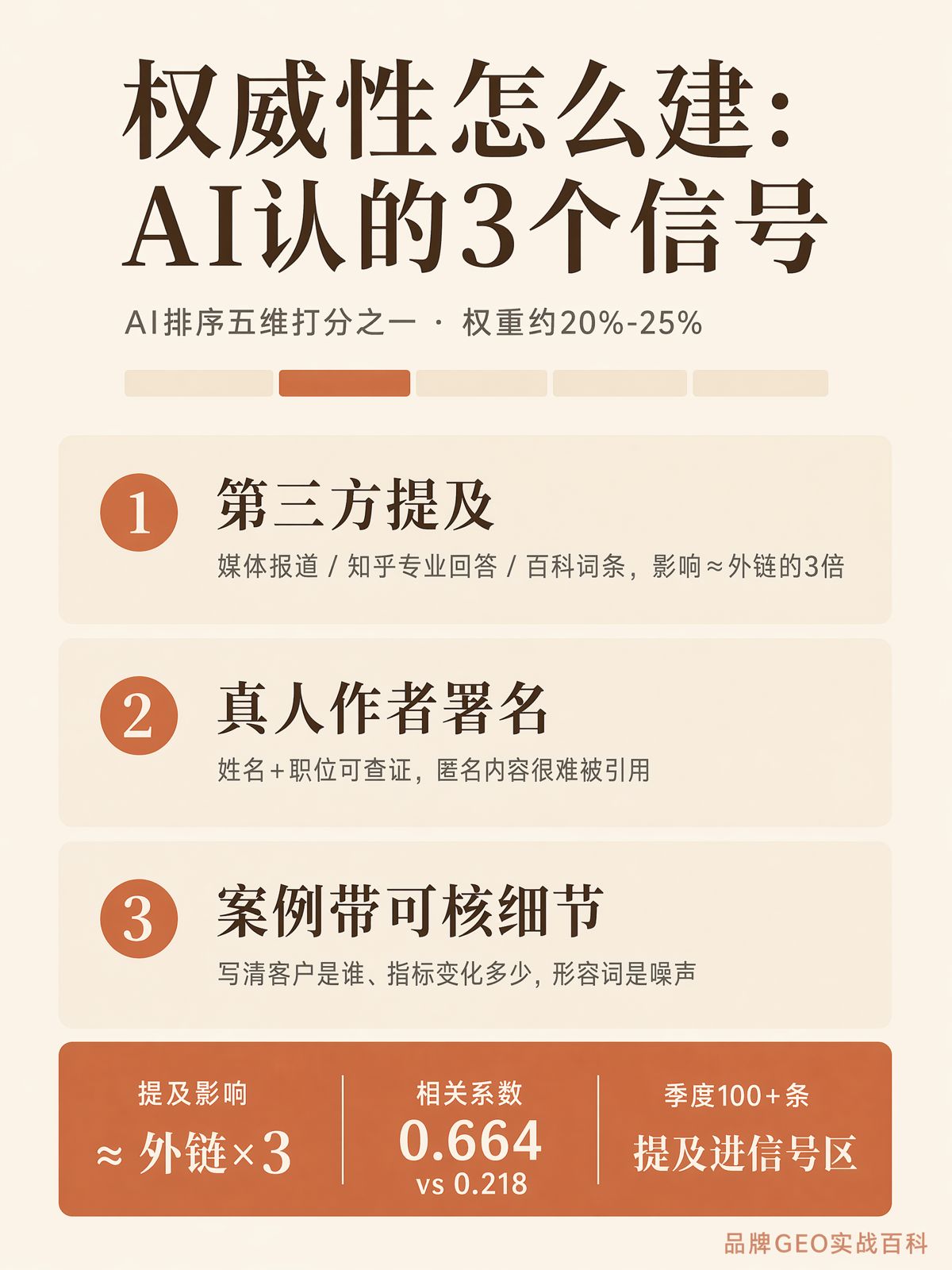
- Brand mentions have 3x the impact of backlinks: An empirical study conducted in 2025 by iProspect and Hallam found that brand mentions influenced AI citations at roughly three times the rate of conventional backlinks.
- Stronger correlation with AI Overviews: Research by seoClarity identified a correlation coefficient of r = 0.664 between brand web mentions and appearances in Google AI Overviews, compared to r = 0.218 for traditional backlinks. While correlation does not prove causation, brand mentions demonstrate a substantially tighter relationship with AI visibility.
- Wikipedia dominates top citations: Public citation analyses from 2025 and 2026 revealed that Wikipedia accounted for 47.9% of the top 10 most-cited sources in ChatGPT.
- 67% of cited pages offer primary data: Ahrefs analyzed 1.4 million prompts and found that among the top 1,000 pages cited by ChatGPT, 67% came from original research, primary datasets, or academic sources.
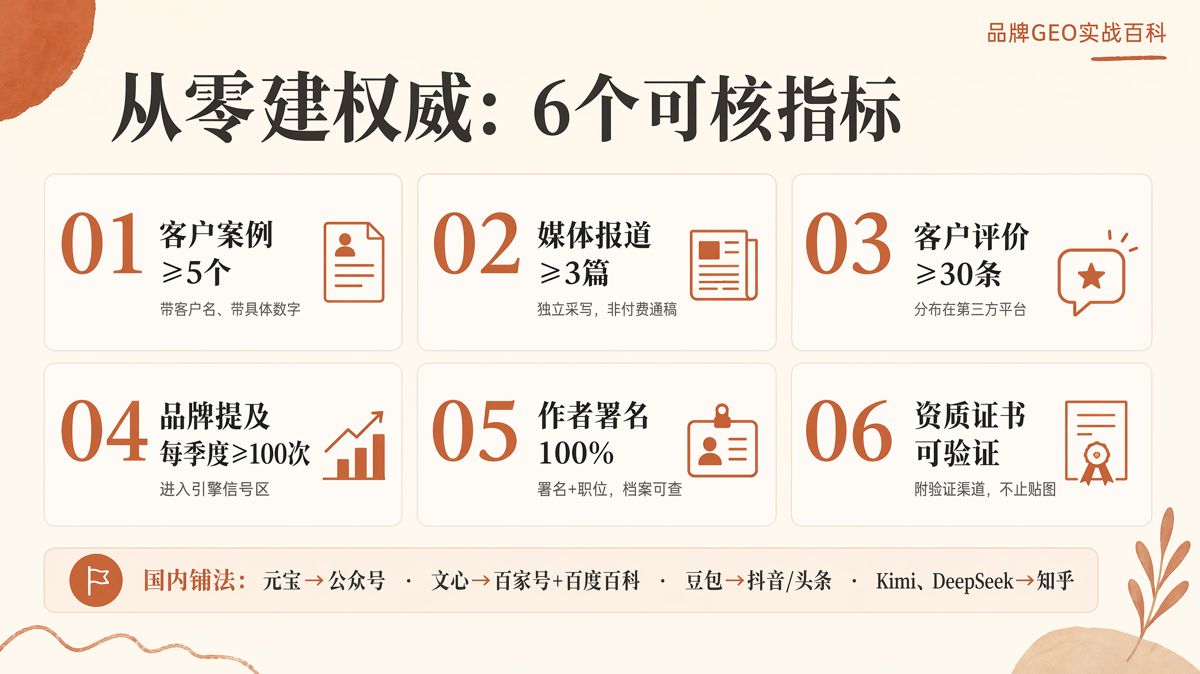
- The 100-mention recognition threshold: Research from Quattr suggests that a brand needs approximately 100 or more context-rich mentions per quarter to reach the threshold where AI models reliably identify it as a distinct, topical entity.
- 86% of citable data originates on owned channels: A 2025 Yext study found that 86% of brand data cited by AI engines actually originated from brand-managed channels.
Data points 6 and 7 highlight how authority works. Your owned channels host the primary, verifiable facts. Third-party mentions prove to AI systems that those facts represent an objective consensus rather than self-promotion. You cannot build authority without both.
What AI Evaluates When Scoring Authority
When an AI engine evaluates candidate passages for a synthesized response, it checks several structural signals:
- Whether the hosting domain demonstrates a consistent history of publishing reliable information.
- Whether articles carry bylines with verifiable professional credentials.
- Whether independent third-party sources corroborate the brand's existence and claims.
- Whether foundational entities and data points receive backing from knowledge bases and authoritative media.
The underlying principle is simple: a brand cannot certify its own authority. You supply the facts; independent sources confirm them.
Different engines weigh these signals differently. Reverse-engineering studies from 2025 and 2026 observed that Perplexity places exceptional weight on domain authority, Google AI Overviews prioritizes content freshness, and ChatGPT Search leans heavily into semantic relevance. These patterns reflect third-party observations rather than fixed, published algorithmic rules.
Chinese search platforms exhibit similar priorities. Metaso (a prominent Chinese AI search engine) has publicly advertised its index of over 120 million "authoritative sources." While vendor claims should be viewed critically, it underscores that trusted source filtering is central to their retrieval design.
GEO Authority vs. Traditional SEO Backlinks
Traditional SEO measures domain authority primarily through inbound links: the volume of referring domains, link equity, and anchor text.
In GEO, unlinked brand mentions serve as primary authority signals. If an independent source references your company within a clear, topical context, AI models ingest and associate that entity information even when no hyperlinked URL is present.
| Dimension | Traditional SEO Authority | GEO Authority |
|---|---|---|
| Primary Signal | Backlink volume, quality, and PageRank | Contextual brand mentions, third-party corroboration, trusted sources |
| Measured Unit | Hyperlinks and referring domains | Entity mentions (with or without links) |
| Empirical Correlation | Backlinks: r = 0.218 | Brand mentions: r = 0.664 (seoClarity) |
| Author Identity | Secondary ranking signal | Heavy emphasis on verifiable credentials and bylines |
| Short-Term Scaling | Link exchanges, guest posts, PBNs | Scaled syndication triggers anti-manipulation filters |
| Core Framework | E-E-A-T | E-E-A-T remains fundamental |
The E-E-A-T framework (Experience, Expertise, Authoritativeness, Trustworthiness) applies directly to generative engines. Existing media coverage, certifications, and industry recognitions accumulated for SEO carry straight over into GEO.
In May 2026, Google Search Relations stated that optimizing for generative AI search remains fundamentally an extension of SEO. Authority demonstrates this continuity: while links retain utility for discovery and indexing, entity mentions, author identities, and multi-source consensus now carry greater weight in generation layers.
Independent Corroboration vs. Syndication
AI models assess trust through three core filters: can the claim be checked, do multiple sources report the same fact, and are those sources genuinely independent?
Publishing identical marketing copy across ten syndication sites does not create ten pieces of corroborating evidence. AI models recognize duplicate text and shared commercial ownership, treating the entire footprint as a single source statement.
Conversely, one in-depth editorial profile by an independent trade journal carries far more authority than dozens of syndicated announcements on sponsored news portals.
Content format also dictates whether engines cite your assets. Ahrefs' study of 1.4 million prompts showed that 67% of ChatGPT's top-cited pages contained original research, proprietary datasets, or academic citations. These formats provide direct, extractable data points that generative engines can quote with confidence.
Generic assertions like "industry-leading provider" or "top-quality manufacturing" provide no extractable data. Models ignore them when compiling factual answers.
Author Bylines and Entity Identity
AI engines evaluate not just what is said, but who claims responsibility for it. When an article features a verified author name, professional title, and linked background, search models can anchor that content to a recognized real-world entity.
In Western search environments, the standard practice includes clear author bios linked to professional LinkedIn profiles and using schema markup like the sameAs property to connect on-page bylines with recognized authority profiles across the web.
In the Chinese digital ecosystem, the equivalent steps involve platform-level verifications: - Completing official entity verification for WeChat Official Accounts. - Securing verified professional or industry status on Zhihu (China's largest Q&A platform). - Submitting corporate qualification records on Baijiahao (Baidu's content platform).
When a credentialed specialist consistently publishes on a specific topic across recognized platforms, AI models gradually index that name as a topical entity. Author attribution should be treated as an operational requirement for every published asset, not an afterthought.
Source Trust in Chinese AI Engines
Market research across Chinese GEO agencies and investment analysts has popularized a four-tier framework for source authority. While this serves as an empirical framework rather than an official engine specification, it mirrors real-world retrieval patterns:
| Tier | Source Types | Typical Retrieval Trust (Industry Estimates) |
|---|---|---|
| Tier 1 | Government portals, national trade bodies, state media, top national web portals | Cited consistently (>90% retrieval rate) |
| Tier 2 | Licensed news outlets, top-tier vertical trade publications | High citation probability |
| Tier 3 | ICP-licensed corporate websites, verified industry columns, professional Q&A platforms | Moderate citation probability |
| Tier 4 | Unverified sites, content aggregators, commercial syndication farms | Low; frequently filtered out |
Industry observations indicate that authoritative news sources achieve AI citation rates above 85%, whereas unverified blogs and standard self-media accounts fall below 10%.
Furthermore, Chinese AI engines tend to index and cite major domestic platform ecosystems more heavily than standalone corporate websites. When structuring an authority campaign in China, align your efforts with the target engine's preferred ecosystem:
- Tencent Yuanbao (Tencent's AI assistant): Prioritize verified WeChat Official Accounts.
- Baidu Wenxin (Baidu's ERNIE): Prioritize Baijiahao and Baidu Baike (Baidu's encyclopedia).
- ByteDance's Doubao: Prioritize Douyin (TikTok's Chinese counterpart) and Toutiao (ByteDance's news aggregator).
- Moonshot AI's Kimi and DeepSeek: Zhihu serves as a primary, shared retrieval source for both.
Encyclopedia assets require separate attention. Baidu Baike plays the same foundational role in Chinese search as Wikipedia does internationally. With Wikipedia representing 47.9% of top citations in ChatGPT studies, a clean, well-referenced Baidu Baike entry is essential for both authority and entity consistency in China.
An Actionable Authority Roadmap
Recall two core figures: Quattr recommends targeting at least 100 contextual mentions per quarter to establish algorithmic entity recognition, while Yext found that 86% of cited facts originate on brand-owned channels.
The proper sequence is clear: publish complete, verifiable data on your own assets first, then build external corroboration through media coverage, customer stories, and specialized communities.
Core targets for your baseline implementation: - Five quantitative case studies: Document real client names, problem parameters, and verifiable operational metrics. - Three independent editorial features: Secure organic trade press coverage rather than paid syndication wires. - Thirty third-party reviews: Accumulate authentic feedback across independent platforms. - Verifiable credentials: Provide public verification numbers and regulatory links for all licenses, patents, and ISO certifications. - Clear author credentials: Add verified bylines and linked author profiles to every informational asset. - Quarterly mention tracking: Monitor third-party web mentions toward a quarterly target of 100+ high-context occurrences.
Case study value depends entirely on specificity. Stating that "a client achieved remarkable efficiency gains" gives an AI engine nothing to quote. Stating that "a regional medical device manufacturer purchased 12,000 units, lowering their defect rate from 3.2% to 0.4%" provides a concrete factual unit that engines can cite as an answer.
Certifications should also be prioritized by verification rigor. Global industry benchmarks often rate recognitions hierarchically: inclusions like the Gartner Magic Quadrant score highest, followed by design awards like Red Dot or iF, followed by standard ISO certifications. For Chinese operations, prioritize government and national industry certifications before targeting commercial awards.
Three Authority-Building Mistakes to Avoid
1. Falsified Accreditations and Vague Superlatives
Using fabricated awards or fake endorsements introduces severe regulatory and platform risks. In 2026, Chinese cloud and AI platforms including Alibaba Cloud designated authority falsification as a high-risk compliance violation. Furthermore, unsubstantiated superlatives ("national leader," "number one") violate advertising statutes. Authority must rest on audit-ready facts.
2. Scaled Review Farming and Article Syndication
Flooding platforms with automated AI reviews or blasting identical sponsored posts across hundreds of low-tier domains triggers algorithmic spam filters. In 2025, the American Sunlight Project exposed the Pravda network's mass content syndication designed to influence AI models, which resulted in major AI developers blacklisting the entire network. Scaled volume does not equal authority.
3. Over-Investing in Owned-Channel Packaging
A beautifully designed corporate portal does not compensate for an absence of third-party validation. Allocate your budget in this order: 1. Build verifiable primary facts (case metrics, technical specs, verified corporate credentials). 2. Cultivate third-party corroboration across independent media, niche forums, and professional Q&A hubs. 3. Optimize on-page experience and structural content presentation.
What Authority Ultimately Demands
Authority in AI search is not achieved through clever copy. It requires publishing verifiable facts, transparently attributing them to credentialed authors, and earning confirmation from independent sources.
If your team has spent years building traditional SEO, that investment remains valuable. Your high-authority backlinks, verified press coverage, and industry accreditations carry over into generative search.
The shift lies in your focus: expand your metrics beyond backlink counts to actively track brand mentions, author verification, source independence, and factual verifiability.
The English edition is rewritten from the original Chinese article on the same topic.

Starbox AI is an AI marketing company based in Hangzhou, China. This article draws on Starbox project work. Please credit the source when quoting.
Related reading
 GEO Guide
Why AI Marketing Vendor Quotes Vary 10x: A 4-Step Vetting Checklist
Evaluate AI marketing proposals by delivery actions, not slide decks. Audit source infrastructure, fact cleaning, and clean-environment testing.
Oct 22, 2026 · 6 min read
 GEO Guide
Spotting GEO Scams: What Actually Drives AI Recommendations?
Automated AI ranking promises violate how LLMs work. Real AI recommendations rely on authoritative, structured facts across trusted public sources.
Oct 22, 2026 · 4 min read
 GEO Guide
How to Measure Your Brand's AI Visibility with a Spreadsheet
You do not need expensive software to track AI recommendations. A three-tier prompt framework and a simple spreadsheet can score your brand visibility in half a day.
Oct 21, 2026 · 6 min read