
How AI Picks Answers: The Three-Tier Selection Funnel
The short answer
AI search engines run queries through candidate retrieval, ranking, and answer generation. Here is how GEO works across all three stages.
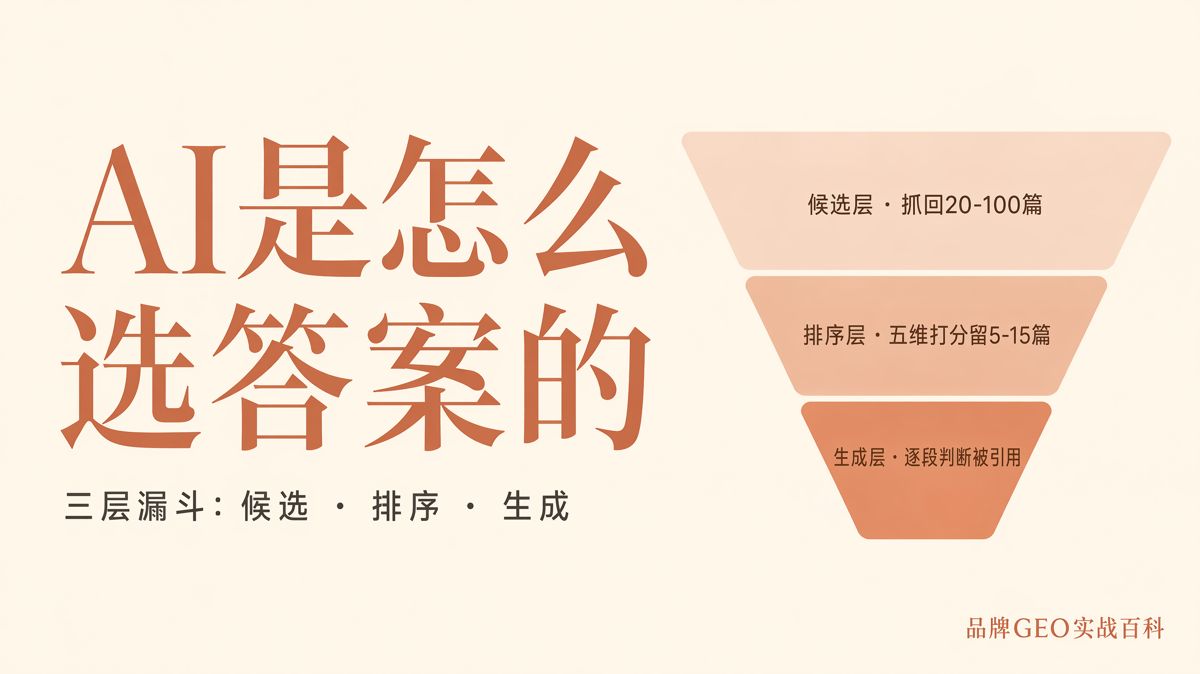
When a user asks a question, an AI search engine completes three consecutive evaluations: it retrieves candidate content, ranks those candidates, and extracts specific source snippets to compile the final answer and assign citations. Generative Engine Optimization (GEO) focuses on how your content gets discovered, ranked, and cited throughout this pipeline.
Editorial fluency only matters in the final two stages. If your page is not indexed or bots cannot parse it, your content will never make the candidate pool. Conversely, even if a page is retrieved, ranking too low or lacking self-contained, verifiable facts will keep it out of the generated response.
Based on public documentation from major AI search engines and reverse-engineering studies from 2025 and 2026, the process breaks down into a three-tier funnel:
| Tier | Primary AI Task | What It Decides |
|---|---|---|
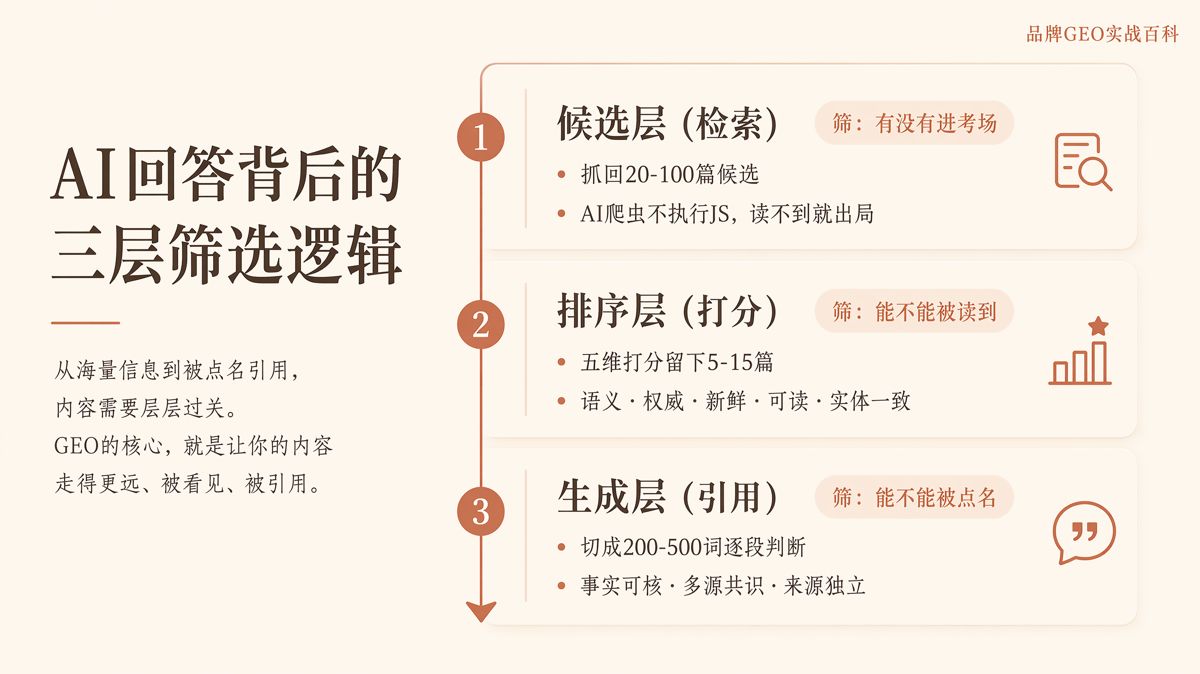
| Candidate Tier | Retrieves content from web indexes, platforms, and third-party sources | Whether content enters the candidate pool |
| Ranking Tier | Scores candidates by relevance, authority, and related signals | Whether content advances to the generation step |
| Generation Tier | Evaluates snippets for factual reliability and source independence | Whether content appears in the answer and earns a citation |
For a query like "how to choose a reliable supplier for a manufacturing business in 2026," an AI engine might pull 20 to 100 candidate pages and knowledge fragments, narrow them down to the top 5 to 15, split those pages into 200-to-500-word passages, and evaluate which excerpts are reliable enough to include in the synthesized answer.
This pipeline runs strictly in sequence. If a page fails any single tier, it drops out of the process immediately.
Tier 1: Can the AI Retrieve Your Content?
The candidate tier solves a foundational problem: can the AI engine find and read your page?
Most modern AI search engines run on a Retrieval-Augmented Generation (RAG) architecture. Rather than relying solely on frozen model weights, they fetch real-time material from search indexes, platform databases, and external repositories to draft their answers.
Candidate materials primarily come from three sources.
1. Pre-training Datasets
During initial training, large language models ingest public web archives, academic papers, forums, and encyclopedias. Common Crawl, C4, and RefinedWeb are standard inputs.
These datasets typically carry a 6-to-18-month time lag. An article published today may take months to surface in the next training checkpoint. As a result, static pre-training data cannot handle queries requiring up-to-date information.
2. Real-Time Web Indexes
When answering time-sensitive queries, engines trigger live retrieval pipelines powered by Bing, Google, Brave, or proprietary web crawlers. Whether your page reaches this candidate pool depends on several technical factors:
- Whether your
robots.txtfile permits specific AI crawlers; - Page load speed for primary content;
- Whether reading the body text requires client-side JavaScript execution;
- Whether your site provides a clean
sitemap.xml; - Whether the page is already indexed by search platforms.
Rendering architecture is often overlooked. In a study analyzing more than 500 million crawl requests, Passionfruit found no evidence that GPTBot, ClaudeBot, or PerplexityBot execute JavaScript. If your content renders entirely via client-side scripts, an AI bot may only register an empty shell.
Core content must exist directly in the initial HTML response. When possible, use server-side rendering (SSR) rather than relying on client-side scripts.
A 2025 industry survey noted that 67% of enterprise brands considered blanket-blocking AI crawlers their biggest mistake of that year. Even if you restrict your content from being used in model training, evaluate live search crawler access separately. Blocking live retrieval bots removes your brand from the candidate pool entirely.
3. Third-Party Knowledge Hubs
AI engines also pull directly from encyclopedias, community forums, video transcripts, review sites, and vertical platforms. In Western markets, primary hubs include Wikipedia, Reddit, Quora, YouTube transcripts, and G2.
Research by 5W Research showed that Wikipedia and Reddit together accounted for more than 25% of all ChatGPT citations in the United States. Mainstream news outlets such as The Wall Street Journal, The New York Times, and Bloomberg did not crack the top 20 sources at the time. A publication's prestige does not guarantee AI visibility; platform crawlability, document structure, and query relevance matter just as much.
How to Optimize for Tier 1
The candidate tier comes down to crawlability and indexing:
- Check your site rules to confirm AI retrieval bots are not blocked;
- Ensure core content renders without running JavaScript;
- Improve page load speeds and keep sitemaps updated;
- Confirm that search engines and target platforms have fully indexed the page;
- Build discoverable brand profiles across relevant third-party platforms beyond your primary domain.
This work still falls under traditional Search Engine Optimization (SEO). On May 15, 2026, Google Search Relations stated: "Optimizing for generative AI search is optimizing for the search experience—it is fundamentally still SEO." Google also requires that for a page to appear in Google AI Overviews, it must first be indexed and eligible for standard web search snippets.
The same applies in China, where indexing across Baidu, WeChat Search, and internal platform engines dictates whether an asset can enter the candidate pool. GEO does not replace SEO; SEO ensures your content can be found and read in the first place.
Tier 2: How AI Ranks Candidate Content
Once candidate documents are retrieved, the engine scores them and selects roughly 5 to 15 pages to feed into the generation stage.
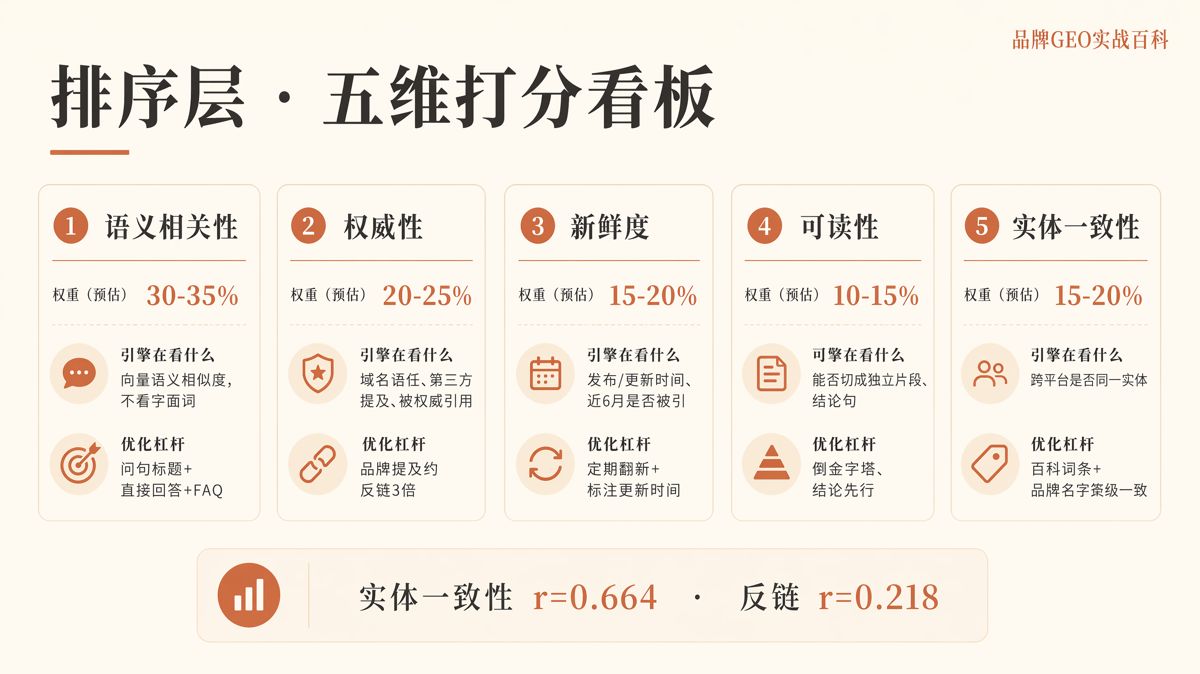
Industry research generally identifies five primary ranking factors: semantic relevance, authority, freshness, readability, and entity consistency. The weightings below reflect estimated ranges from industry observations rather than official vendor formulas.
1. Semantic Relevance: Estimated Weight 30%–35%
Semantic relevance measures how closely the meaning of your content matches the user's intent, going beyond exact keyword matches.
Engines rely on vector embeddings to evaluate meaning. Embeddings convert text into high-dimensional vectors to calculate semantic proximity. Repeating target keywords will not improve your score. A better approach is to state the core question clearly, provide a direct answer in the opening sentence, and address follow-up questions in an FAQ section.
2. Authority: Estimated Weight 20%–25%
Authority evaluates domain trustworthiness, backlinks, author bylines, third-party mentions, and citations in encyclopedias or industry publications.
Backlinks point users and bots to a page via hyperlinks. Unlinked brand mentions, however, serve as strong semantic signals on their own: whenever a reputable third party references your brand by name, the system registers proof of prominence.
An empirical analysis by iProspect and Hallam showed that brand mentions correlated with AI citations roughly three times more strongly than standard backlinks. This reflects a statistical correlation rather than direct causation, but it highlights how AI models process web-wide consensus.
3. Freshness: Estimated Weight 15%–20%
Freshness accounts for original publication dates, last-modified timestamps, and recent citation activity.
In an analysis of 17 million citations, Ahrefs found that AI-cited URLs were on average 25.7% newer than top Google organic search results. ChatGPT tended to cite pages that were 393 to 458 days newer than standard organic listings. Evergreen content that goes unmaintained gradually loses its freshness advantage.
Regularly audit older articles, update obsolete figures, and display clear "last updated" timestamps. Note that freshness is only one ranking factor; recency alone cannot make up for poor quality.
4. Readability and Structure: Estimated Weight 10%–15%
In AI search, readability refers to how easily a model can break an article down into self-contained factual passages.
Clear heading structures, concise paragraphs, and front-loaded conclusions make it easier for models to extract clean snippets. Focus each paragraph on a single idea so that both human readers and AI systems can understand the statement without surrounding context.
5. Entity Consistency: Estimated Weight 15%–20%
An entity is an identifiable brand, organization, person, product, or location that a system recognizes in its knowledge graph. Entity consistency measures whether your basic business information remains uniform across external websites and directories.
Empirical data from seoClarity revealed a correlation coefficient of r = 0.664 between web-wide brand mentions and appearances in Google AI Overviews, compared to r = 0.218 for traditional backlinks. A correlation coefficient measures statistical alignment, not direct causation.
To strengthen entity consistency:
- Standardize your brand name and spelling across all digital touchpoints;
- Keep your encyclopedia entries and core company profiles up to date;
- Implement Schema markup with the
sameAsproperty to link official social profiles and company registrations; - Correct conflicting corporate data across directories.
Different engines weigh these factors differently. Industry benchmarks suggest Perplexity leans toward authority, Google AI Overviews prioritizes freshness, and ChatGPT Search favors semantic relevance. These are observational patterns, not published rules.
How to Optimize for Tier 2
Turn these five dimensions into practical editorial workflows:
- Use question-based headings paired with direct opening answers to maximize semantic relevance;
- Earn unlinked and linked coverage across independent industry publications;
- Update outdated articles on a regular schedule with clear timestamps;
- Keep paragraphs short and anchor each one around a single takeaway;
- Maintain consistent brand names, descriptions, and metadata across all platforms.
None of these dimensions require marketing buzzwords. Direct answers, verifiable data, and stable entity profiles consistently beat generic descriptions.
Tier 3: Why AI Cites a Specific Snippet
Once high-ranking pages enter the generation tier, the model splits the text into smaller passages. It then decides which specific facts to synthesize into the final response and which URLs to credit.
This evaluation relies on three main checks: factual verifiability, multi-source consensus, and source independence.
Snippets Must Stand on Their Own
AI engines rarely quote entire articles; they pull concise excerpts. Even if an entire article is well-argued, it will not earn citations if it lacks standalone statements that can be quoted out of context.
Word count alone is not a quality metric. A 4,000-word piece covering multiple unrelated subtopics often performs worse than a tightly structured guide. Every subhead should answer one specific question, and every paragraph should open with a clear conclusion backed by figures or sources.
Aim to keep factual passages within roughly 60 to 150 words so they form a self-contained proposition. Exact word counts can vary, but the information within the snippet must be complete.
Verifiable Facts Outperform Subjective Claims
Subjective claims like "the best provider," "premium quality," or "industry-leading" offer no verifiable evidence. Real numbers, benchmark results, documented standards, and traceable references give the model clear material to cite.
In an Ahrefs study of 1.4 million prompts, 67% of the top 1,000 cited pages in ChatGPT came from original research, primary data, or academic papers. Primary data dominates frequently cited assets, though producing original research does not guarantee placement on its own.
Source Independence Determines Consensus
Distributing an identical press release across 10 syndication websites does not create 10 independent sources. AI systems evaluate domain ownership, author entities, and text similarity to detect duplicate material.
Independent confirmation from trade journals, research analysts, or third-party creators establishes true consensus. Your proprietary channels are essential for claiming facts, but independent third parties validate them.
How to Optimize for Tier 3
- Focus each paragraph on one primary factual claim;
- State your main conclusion in the opening sentence of each section;
- Cite verifiable data points and primary studies;
- Prioritize publishing proprietary research and original datasets;
- Remove unsubstantiated marketing superlatives;
- Do not rely on syndicated PR blasts as a substitute for independent validation.
Traditional SEO vs. Generative Engine Optimization
Both standard search engines and AI engines retrieve and rank content, but they target different end results.
Traditional search returns a ranked list of blue links, aiming to drive organic clicks to a destination page. GEO aims to get specific factual assertions embedded inside an AI-generated answer, earning an attribution link where applicable. Traditional SEO optimizes entire URLs; GEO optimizes modular passages.
| Dimension | Traditional SEO | GEO |
|---|---|---|
| Core Goal | Top 10 organic search ranking | Inclusion and citation in AI answers |
| Target Unit | Entire web page | Modular content snippet |
| Primary Ranking Signals | Keywords, backlinks | Semantic depth, entity consistency, brand mentions |
| Content Strategy | Comprehensive long-form guides (2,000–5,000 words) | Structured guides with modular, standalone factual passages |
| Target Query Types | Short-tail keywords (3–5 words) | Natural-language questions (10–20 words) |
| Authority Signals | Backlinks | Brand mentions, independent corroboration |
| Success Metrics | Rankings, organic traffic, CTR | AI citation rate, brand mention frequency |
| Benchmark Conversion Rate | 1.76%–2.8% (industry benchmark) | 12.4%–16.8% (industry benchmark) |
Industry benchmarks suggest AI-referred traffic converts 4 to 23 times higher than standard search traffic, though results vary widely depending on the sector, platform, and commercial intent.
Two major shifts stand out:
First, the evaluation unit has shifted from the full page to the modular passage. Long-form content remains valuable, but individual sections must stand on their own.
Second, a top organic ranking no longer guarantees an AI citation. Following the rollout of Gemini 3 to Google AI Overviews in January 2026, seoClarity tracked a drop in citation overlap: the proportion of AI Overview citations drawn from Google's top 10 organic results fell from 76% to 38%. Organic ranking remains important, but it is no longer the sole gatekeeper.
How Chinese AI Engines Differ
Chinese AI search engines follow the same three-tier funnel, but their retrieval ecosystems and source preferences differ from Western platforms.
Industry observations indicate that Chinese engines rely heavily on established media and closed platform ecosystems, while independent corporate websites earn citations less frequently. Optimizing for GEO in China requires tracking platform-specific indexing and maintaining entity profiles inside those environments.
Common platform affinities observed across Chinese engines include:
| AI Engine (Developer) | Primary Source Platforms | Western Analogue |
|---|---|---|
| Yuanbao (Tencent) | WeChat Official Accounts, WeChat Ecosystem | |
| Wenxin / ERNIE Bot (Baidu) | Baijiahao (Baidu's content platform), Baidu Baike | — |
| Doubao (ByteDance) | Douyin (TikTok's Chinese counterpart), Toutiao, Douyin Baike | — |
| Kimi (Moonshot AI) | Zhihu (China's largest Q&A platform) | Reddit, Quora |
| DeepSeek | Zhihu, CSDN (China's developer network), portal news | Reddit, Quora |
| Metaso (Metaso Technologies) | Academic papers, industry whitepapers, legal filings | — |
If your brand targets Tencent's Yuanbao, prioritize WeChat Official Accounts. For Baidu's Wenxin, maintain your presence on Baijiahao and Baidu Baike. For ByteDance's Doubao, focus on Douyin and Toutiao. To increase visibility on Kimi and DeepSeek, build authoritative coverage on Zhihu.
Publishing on these platforms does not guarantee an AI citation; content quality, query alignment, and independent verification remain mandatory.
Baidu Baike and Sogou Baike serve as foundational sources for establishing brand and executive entities. Zhihu feeds candidate pools across multiple Chinese engines. Brands seeking broad visibility in China should audit their entity presence on these reference platforms first.
Metrics such as "360 million high-quality documents" or claims that "roughly 70% of citations originate from user-generated content" stem from vendor marketing materials and should be treated as directional estimates.
Regulatory Compliance for AI-Generated Content
Teams using AI to scale content production must follow applicable regulatory standards regarding synthetic media disclosures and factual accuracy.
In China, the Measures for the Labeling of Artificial Intelligence-Generated Synthetic Content—jointly issued by the Cyberspace Administration of China (CAC), the Ministry of Industry and Information Technology (MIIT), the Ministry of Public Security (MPS), and the National Radio and Television Administration (NRTA)—took effect on September 1, 2025. It mandates two labeling formats:
- Explicit labels: visible text markers identifying content as AI-generated;
- Implicit labels: digital watermarks and metadata embedded directly within the file.
Publishing unlabeled AI content risks platform penalties or takedowns.
Four tactics carry significant operational risk across Chinese search platforms in 2026: keyword stuffing, duplicated copycat publishing, fabricated authority signals, and unsubstantiated superlatives.
In February 2026, Sina Finance reported on regulatory guidance addressing synthetic spam, framing high-volume, low-value AI publishing as "data pollution." Mass-distributing boilerplate content undermines domain authority and triggers anti-spam defenses. Sustainable visibility requires verified, original information that genuinely solves user problems.
Diagnosing Which Tier Is Failing
When diagnosing underperforming content, audit the funnel in order:
- Candidate Tier: Is the page indexed? Are AI crawlers allowed in
robots.txt? Does the primary content render without client-side JavaScript? - Ranking Tier: Does the page directly answer user queries? Are entity names consistent across the web? Is the article updated with clear timestamps?
- Generation Tier: Does the text contain modular, self-contained factual paragraphs? Are claims backed by primary data? Can independent sources verify the assertions?
Do not spend time tweaking paragraph phrasing if your page is blocked at the candidate tier. If your content is indexed but not cited, focus on the five ranking factors and passage-level formatting.
Frequently Asked Questions
Does this three-tier funnel apply to all AI search engines?
Most major AI search engines operate on this general framework, including Western platforms like ChatGPT Search, Perplexity, Google AI Overviews, Gemini, and Claude, as well as Chinese engines like Doubao, Wenxin, Yuanbao, DeepSeek, Kimi, Tongyi Qianwen, and Metaso.
However, this funnel is a structural model based on public technical documentation and reverse-engineering research. Specific scoring formulas, retrieval pipelines, and citation rules vary across platforms.
Why is our well-written content never cited by AI?
Start by checking Tier 1. Common culprits include blocking AI crawlers in robots.txt, hiding main body content behind client-side JavaScript, or failing to secure an index entry on the host platform. Only move on to ranking and snippet generation once technical crawlability is confirmed.
Which ranking factors should we optimize first?
Focus on semantic relevance and readability first, as both can be resolved through direct editorial adjustments: write clear, question-focused headings, provide the answer in the first sentence, and split content into modular paragraphs. Building external authority and entity consistency takes longer, while freshness requires an ongoing maintenance workflow.
Does GEO replace traditional SEO?
No. SEO handles discovery, crawling, indexing, and foundational ranking. GEO builds on that base by addressing semantic matching, entity resolution, passage-level extraction, and citation mechanics. The two disciplines work together.
What article length earns the most citations?
Differentiate between total article length and the length of individual passages. Industry data from seoClarity indicates that comprehensive guides exceeding 2,900 words see 59% higher citation rates than short posts under 800 words. However, word count alone does not trigger citations. Long-form guides must maintain clean structural hierarchies where each section answers a specific question with standalone facts.
Which platform should we prioritize for GEO in China?
Prioritize platforms based on the specific engines you want to influence. To build baseline entity authority across the Chinese web, audit your presence on Baidu Baike, Sogou Baike, and Zhihu first. Then expand into WeChat Official Accounts, Baijiahao, Douyin, or Toutiao based on your target audience. These recommendations reflect observational research rather than platform guarantees.
Summary
AI answers pass through three consecutive stages: the candidate tier verifies crawlability, the ranking tier scores page authority and relevance, and the generation tier selects verified, standalone snippets to quote.
Sequence matters. Fix indexing and crawlability first, refine your five ranking dimensions second, and ensure every paragraph delivers verifiable, standalone facts supported by independent sources.
GEO is neither cosmetic copywriting nor mass AI content generation. It requires technically accessible pages, consistent brand entities, clear document hierarchies, and verifiable facts. When all three tiers are satisfied, AI systems can find, interpret, and cite your expertise.
Technical mechanisms in this article reflect public documentation and third-party reverse-engineering studies from 2025 and 2026. All statistics include original institutional sources. Ranking weights and platform affinities reflect empirical industry observations. Last updated: July 2026.
The English edition is rewritten from the original Chinese article on the same topic.

Starbox AI is an AI marketing company based in Hangzhou, China. This article draws on Starbox project work. Please credit the source when quoting.
Related reading
 GEO Guide
Why AI Marketing Vendor Quotes Vary 10x: A 4-Step Vetting Checklist
Evaluate AI marketing proposals by delivery actions, not slide decks. Audit source infrastructure, fact cleaning, and clean-environment testing.
Oct 22, 2026 · 6 min read
 GEO Guide
Spotting GEO Scams: What Actually Drives AI Recommendations?
Automated AI ranking promises violate how LLMs work. Real AI recommendations rely on authoritative, structured facts across trusted public sources.
Oct 22, 2026 · 4 min read
 GEO Guide
How to Measure Your Brand's AI Visibility with a Spreadsheet
You do not need expensive software to track AI recommendations. A three-tier prompt framework and a simple spreadsheet can score your brand visibility in half a day.
Oct 21, 2026 · 6 min read