
Is GEO a Scam? Review the Evidence Before You Buy

The short answer
GEO is a real discipline backed by data, but low-value snake oil abounds. Here is how to evaluate generative engine optimization services before spending.
Generative Engine Optimization (GEO) is the practice of structuring content and brand information so AI engines—such as ChatGPT, Doubao (ByteDance's AI assistant), and DeepSeek—can easily retrieve, mention, and cite your brand.
Here is the bottom line: GEO as a discipline is not a scam. However, the market is flooded with low-value, high-risk services sold under the GEO label.
To evaluate whether a GEO proposal is worth your budget, do not focus on the buzzwords. Look at three concrete factors: Is there verifiable evidence behind the claims? Does the methodology match how large language models (LLMs) retrieve and cite information? Are the promised timelines and deliverables realistic?
Why GEO Deserves Serious Attention
In 2023, researchers at Princeton University published the first formal academic paper on GEO (arXiv:2311.09735), later accepted at KDD 2024. Their findings showed that specific content optimization strategies can increase a brand's visibility in AI responses by up to 40%. The way you format, state, and organize information directly shapes how AI systems select their sources.
Search behavior is also shifting rapidly:
- Semrush reported in April 2026, based on a sample of 10 million keywords, that Google AI Overviews appear on 48% of search queries.
- Ahrefs tracked 300,000 keywords in December 2025 and found that when an AI Overview is present, the click-through rate (CTR) for the number-one organic search result drops by 58%.
This does not mean traditional search is dead. It means the search journey is changing. Buyers increasingly read AI-generated synthesized answers before clicking individual links. Brands must now compete not only for traditional blue-link rankings, but also for inclusion and citation inside AI answers.
Why Many Marketers Think GEO Is a Scam
Skepticism around GEO comes primarily from three types of vendors:
- Jargon peddlers: Vendors who take basic digital marketing practices, dress them up as proprietary AI configurations or mandatory word-count formulas, and sell them as high-priced training courses or technical packages.
- Guaranteed-ranking sellers: Agencies promising that your brand will be featured in AI recommendations within 30 days. Because AI answers shift based on context, query variation, user profile, model updates, and live web retrieval, no vendor can legitimately guarantee a fixed recommendation spot.
- Black-hat manipulators: Services offering automated comment spamming, paid AI brand seeding, and synthetic reviews. These tactics deliver no lasting visibility and routinely trigger platform risk controls and compliance penalties.
Distinguishing sound GEO methodology from opportunistic sales pitches is essential.
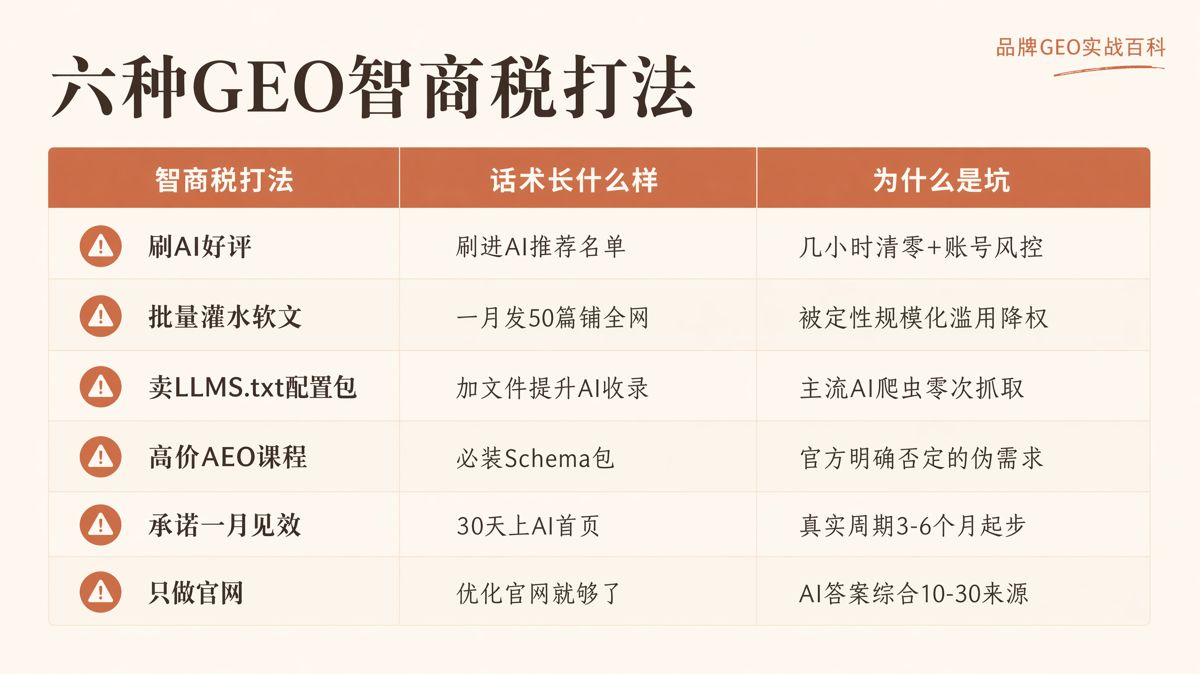
Six Low-Value or High-Risk Practices to Avoid
| Offer Type | Typical Pitch | The Reality |
|---|---|---|
| AI review manipulation & prompt seeding | "We guarantee your brand enters AI recommendation lists." | LLM training sets update, and search-based AI platforms deploy anti-manipulation filters. Injected mentions often vanish within hours and risk account penalties. Our benchmark indicates model corpus refresh cycles run 6 to 18 months. |
| Mass low-quality content publishing | "We will publish 50 AI articles a month to blanket the web." | Google classifies automated content generated primarily to manipulate search rankings as scaled content abuse. Major platforms have active crackdowns on automated data pollution. |
| Expensive LLMS.txt setup packages | "Add an LLMS.txt file to get your site indexed by AI." | LLMS.txt is a markdown file intended to summarize sites for LLMs. Google's official documentation states it is completely optional. Two independent industry audits of 300,000 and 1,000 domains showed zero crawls of this file by mainstream AI bots (industry audit data, not third-party academic verified). |
| Proprietary AI Schema markups | "Install our custom AI Schema and 50-word chunking formula." | Schema markup helps search engines parse page entities. Google's official guidelines do not require any AI-specific Schema types, nor do they mandate capping paragraphs at 50 words. |
| 30-day guaranteed results | "Rank on AI front pages in 30 days." | A realistic GEO campaign requires 3 to 6 months. The first 60 days are typically spent auditing technical foundations, refining content, and distributing across authoritative channels. Short-term, isolated mentions are not stable outcomes. |
| Website-only optimization | "Just optimize your official website and you are done." | AI answers routinely synthesize between 10 and 30 distinct web sources. Optimizing only your own domain fails to build the third-party validation that models rely on. |
On May 15, 2026, Google Search Relations published its official AI search optimization guidance. It explicitly flagged four practices as unnecessary: setting up LLMS.txt, installing AI-specific Schema tags, enforcing an arbitrary under-50-word paragraph limit, and adopting a specialized writing tone for AI. Instead, Google emphasized subject-matter expertise, clean site architecture, and compliance with vertical-specific editorial standards.
If a vendor sells an obscure configuration file or a rigid word-count rule rather than addressing your content depth and external validation, proceed with caution.
Four Real Strategies That Actually Move the Needle
1. Structure Content into Standalone, Informative Chunks
AI retrieval systems frequently ingest content at the fragment level. In technical terms, this is a chunk—a distinct segment of text that can be extracted and parsed independently.
In Retrieval-Augmented Generation (RAG) workflows, an AI retrieves relevant chunks from databases or search indices before generating an answer. Because the model may extract only a single section of your article, every core section should state a clear conclusion, provide complete factual context, and include concrete data where relevant.
Our internal editorial standard recommends grouping essential facts into standalone sections of roughly 200 to 500 words. Industry data from seoClarity noted that long-form guides of 2,900+ words earned 59% more AI citations than articles under 800 words. (Note: this is an industry observation, not a controlled third-party study; word count alone does not guarantee citations unless the underlying information is dense and logically structured.)
2. Build Genuine Brand Mentions and Third-Party Validation
LLMs assess brand authority by cross-referencing multiple sources. Repeating a claim across ten accounts you own carries little weight. Independent media coverage, trade publications, and credible industry Q&As carry far more signal.
Research from iProspect and Hallam indicated that an unlinked brand mention on an authoritative site can carry roughly three times the influence of a standard backlink for AI citation generation. Furthermore, seoClarity identified a correlation coefficient of r = 0.664 between brand web mentions and inclusion in Google AI Overviews, compared to r = 0.218 for traditional backlinks. While correlation does not equal causation, it highlights the importance of broader digital PR and media visibility.
3. Tailor Content to Specific AI Ecosystems
Cross-platform research from Ahrefs shows that 86% of the top cited domains across ChatGPT, Perplexity, and Google AI Overviews do not overlap. Optimizing for a single engine will not guarantee presence across the others.
Platform citation habits also differ widely by geography: - In Western markets, models rely heavily on authoritative independent sites, trade directories, Wikipedia, and Reddit discussions. - In China, citation ecosystems vary by model: WeChat Official Accounts frequently surface in Yuanbao (Tencent's AI assistant); Baijiahao (Baidu's content platform) and Baidu Baike (Baidu's online encyclopedia) feed Ernie; Douyin (ByteDance's short video platform) and Toutiao (ByteDance's news aggregator) feed Doubao; and Zhihu (China's largest Q&A platform) regularly appears in citations across DeepSeek and Kimi (Moonshot AI's assistant).
These citation patterns change over time with algorithmic updates. Test your core commercial queries across each target platform directly, track which domains are cited, and focus your publishing efforts where the target engine actually gathers information.
4. Fix Your Organic Search Indexing First
SEO focuses on technical structure, crawlability, content relevance, and domain authority to help pages rank in traditional search engines. GEO builds on top of this foundation.
Google's May 15, 2026 guidance aligns generative AI optimization directly with standard search engine optimization fundamentals. If search engine spiders cannot crawl, render, and index your content, an LLM cannot retrieve it to formulate an answer. In Chinese environments, you must verify your indexation across Baidu and WeChat Search before expecting visibility in AI responses.
GEO does not replace SEO. It extends SEO by optimizing content chunking, entity consistency, third-party footprint, and citation readiness.
SEO vs. GEO: A Direct Comparison
| Dimension | SEO (Search Engine Optimization) | GEO (Generative Engine Optimization) |
|---|---|---|
| Primary Goal | Rank web pages and capture organic clicks | Earn brand mentions and direct citations inside AI answers |
| Unit of Evaluation | Entire web page | Standalone, extractable content chunks |
| Content Focus | Keyword matching, page structure, technical speed | Semantic clarity, complete factual claims, entity consistency |
| Authority Signals | Backlinks and domain authority | Unlinked brand mentions, third-party validation, cross-source consistency |
| Primary KPIs | Keyword rank, organic traffic, organic CTR | AI citation rate, AI mention share of voice, AI referral traffic |
| Working Timeline | 3 to 6 months | Initial signals in 1 to 3 months; mature results in 3 to 6 months |
Entity consistency refers to how consistently your brand name, core product lines, key executives, and service descriptions are referenced across the web. When third-party platforms give conflicting information about what your business does, AI models struggle to synthesize a confident answer about your company.
Why a Number-One SEO Ranking Does Not Guarantee an AI Citation
According to data from seoClarity, after Google integrated Gemini 3 into AI Overviews in January 2026, the share of AI Overview citations drawn from the top 10 organic search results dropped from 76% down to 38%.
Traditional search algorithms assess the overall relevance and authority of an entire page. Generative models, however, search for a concise, modular answer to a specific sub-question. If a top-ranking page buries its key data points in vague marketing copy, the model will skip it and cite a lower-ranking page that states the necessary facts clearly and concisely.
Ranking high in traditional search is still the entry ticket to an LLM's candidate pool. But once indexed, the clarity and chunkability of your content determine whether you get quoted.
Cross-Border Differences: Global vs. Chinese Ecosystems
You cannot take a Western GEO playbook and deploy it directly in China, or vice versa:
- Global ecosystems rely heavily on corporate websites, digital PR, industry news sites, Wikipedia, and Reddit.
- Chinese ecosystems center on closed platform ecosystems: WeChat Official Accounts, Baijiahao, Zhihu, and Baidu Baike. Wikipedia functions similarly to Baidu Baike, and Reddit resembles Zhihu as an experience-sharing platform, but their technical indexing rules and editorial criteria operate differently.
In China, corporate websites are cited far less frequently by domestic LLMs than third-party platforms (based on industry observation). While you must maintain your corporate website for brand identity and standard indexing, allocating your entire GEO budget to your official site while ignoring third-party platforms will fall short.
A Buyer's Checklist for GEO Proposals
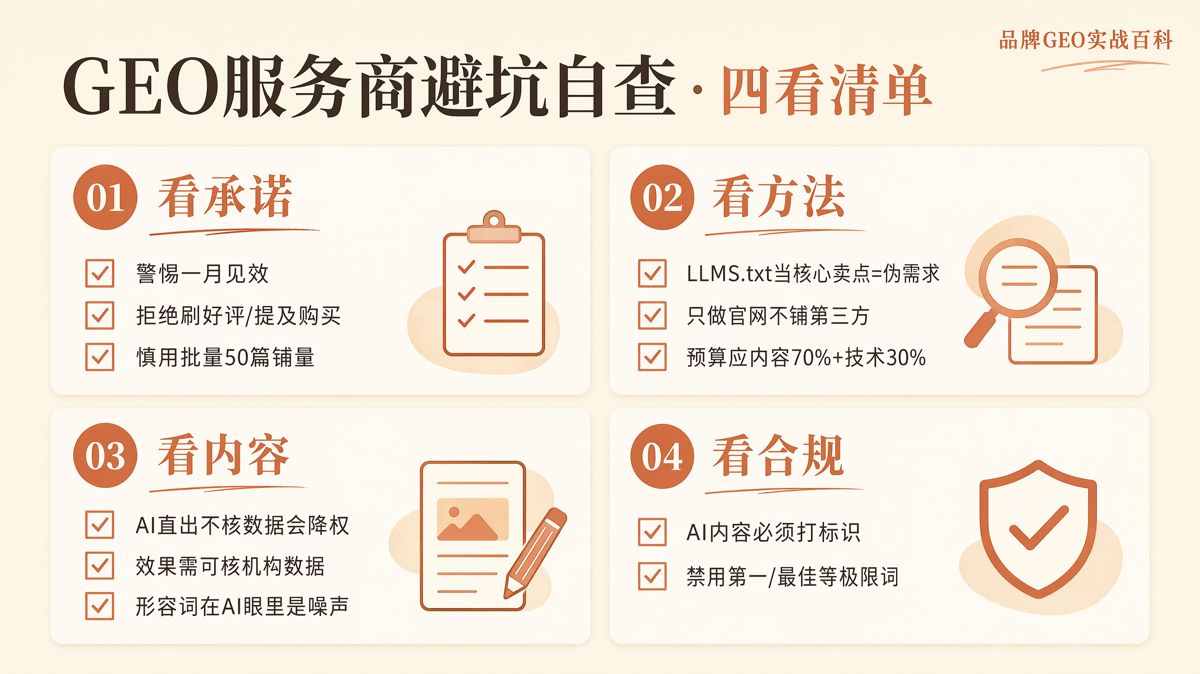
Before signing a contract with a GEO vendor, run through this four-part checklist:
1. Scrutinize the Promises
- [ ] Do they promise guaranteed inclusion within 30 days? AI answers change dynamically; guaranteed positioning is impossible.
- [ ] Do they offer automated AI comment seeding or paid mention injection? These tactics risk account suspensions and disappear quickly.
- [ ] Is their primary delivery model bulk-generated, low-quality content? Mass content generation without human editorial review triggers search spam penalties.
2. Examine the Methodology
- [ ] Are they pitching LLMS.txt files, custom AI Schema, or rigid word counts as breakthrough tactics? Google's official guidelines explicitly label these as non-essential.
- [ ] Are they focusing exclusively on your corporate website? AI models synthesize multiple sources; an effective strategy must address third-party mentions.
- [ ] Can they explain their budget allocation? A sound operational ratio allocates approximately 70% of resources to content quality and multi-platform distribution, and 30% to technical hygiene.
3. Review the Content Standards
- [ ] Is the content mass-produced by AI without human verification? Raw AI output contains hallucinations and factual errors that undermine authority.
- [ ] Do their case studies rely on generic adjectives rather than verifiable data, dates, and query tests? If a vendor cannot show before-and-after citation tracking, their track record is unproven.
4. Confirm Regulatory Compliance
- [ ] Do they adhere to local AI content disclosure rules? In China, for instance, the Measures for the Labeling of AI-Generated and Synthetic Content took effect on September 1, 2025. Publishing synthetic content without proper attribution creates regulatory risk.
- [ ] Does their copy comply with advertising laws? Avoid absolute terms like "the best," "number one," or "national grade" without verifiable proof.
Frequently Asked Questions
Should we configure an LLMS.txt file?
You can implement it as a low-cost, nice-to-have file, but do not view it as a primary driver of AI visibility. Google's official documentation notes it is unnecessary, and industry audits of hundreds of thousands of domains showed zero crawls by leading AI search bots (industry data, unverified by third parties). Paying high fees for an LLMS.txt package is not justified.
How long does GEO typically take to show results?
A standard timeline is 3 to 6 months. The first 60 days are required for technical setup, content rewriting, and multi-channel publication. Initial shifts in AI citations typically appear around the 90-day mark. Actual timelines depend on your site's domain history, content depth, industry competition, and platform indexing speeds.
Is optimizing for ChatGPT alone enough?
No. Empirical studies show that 86% of the top cited sources across ChatGPT, Perplexity, and Google AI Overviews do not overlap. You must analyze the specific citation sources of your target market and engines, rather than assuming success on one platform carries over to another.
Can we publish AI-generated content directly?
AI can assist your research and drafting, but every piece must undergo human fact-checking. Furthermore, you must comply with regional labeling mandates, such as China's Measures for the Labeling of AI-Generated and Synthetic Content. Unedited programmatic copy creates factual errors, repetitive phrasing, and platform risk.
The Bottom Line
GEO is not snake oil. But services built on unverifiable guarantees, arbitrary formulas, and inflated technical packages are not worth buying.
Real GEO is grounded in practical fundamentals: ensure your content is crawlable, write self-contained facts, maintain consistent brand entities, build genuine third-party validation, and track citations across your target AI platforms. If an agency can clearly explain their evidence, process, timeline, and measurement framework, they are worth talking to. If all they offer is a guaranteed outcome with no transparent methodology, walk away.
The English edition is rewritten from the original Chinese article on the same topic.

Starbox AI is an AI marketing company based in Hangzhou, China. This article draws on Starbox project work. Please credit the source when quoting.
Related reading
 GEO Guide
Why AI Marketing Vendor Quotes Vary 10x: A 4-Step Vetting Checklist
Evaluate AI marketing proposals by delivery actions, not slide decks. Audit source infrastructure, fact cleaning, and clean-environment testing.
Oct 22, 2026 · 6 min read
 GEO Guide
Spotting GEO Scams: What Actually Drives AI Recommendations?
Automated AI ranking promises violate how LLMs work. Real AI recommendations rely on authoritative, structured facts across trusted public sources.
Oct 22, 2026 · 4 min read
 GEO Guide
How to Measure Your Brand's AI Visibility with a Spreadsheet
You do not need expensive software to track AI recommendations. A three-tier prompt framework and a simple spreadsheet can score your brand visibility in half a day.
Oct 21, 2026 · 6 min read