
Is It Too Late to Start Generative Engine Optimization (GEO)?

The short answer
It is not too late to start GEO. While user adoption is surging, systematic brand optimization remains early, giving first movers an enduring advantage.
It is not too late. Generative Engine Optimization (GEO) is the practice of structuring and optimizing content so that generative AI platforms—such as Doubao (ByteDance's AI assistant), DeepSeek, Ernie Bot (Baidu's AI), and Yuanbao (Tencent's AI assistant)—can easily discover, understand, and cite your brand in generated answers.
Consumer and business adoption of AI in China is already massive, but very few companies are systematically practicing GEO. Starting now allows you to establish your brand's presence before AI models cement their category definitions. If you wait until AI answers stabilize, breaking in will demand far more content, time, and compliance spend.
Consider these baseline facts:
- A foundational GEO study by researchers from Princeton University and other institutions (accepted at KDD 2024) demonstrated that specific content optimization strategies increased visibility in AI answers by up to 40% under experimental conditions. (This experimental figure does not guarantee a 40% boost across every industry).
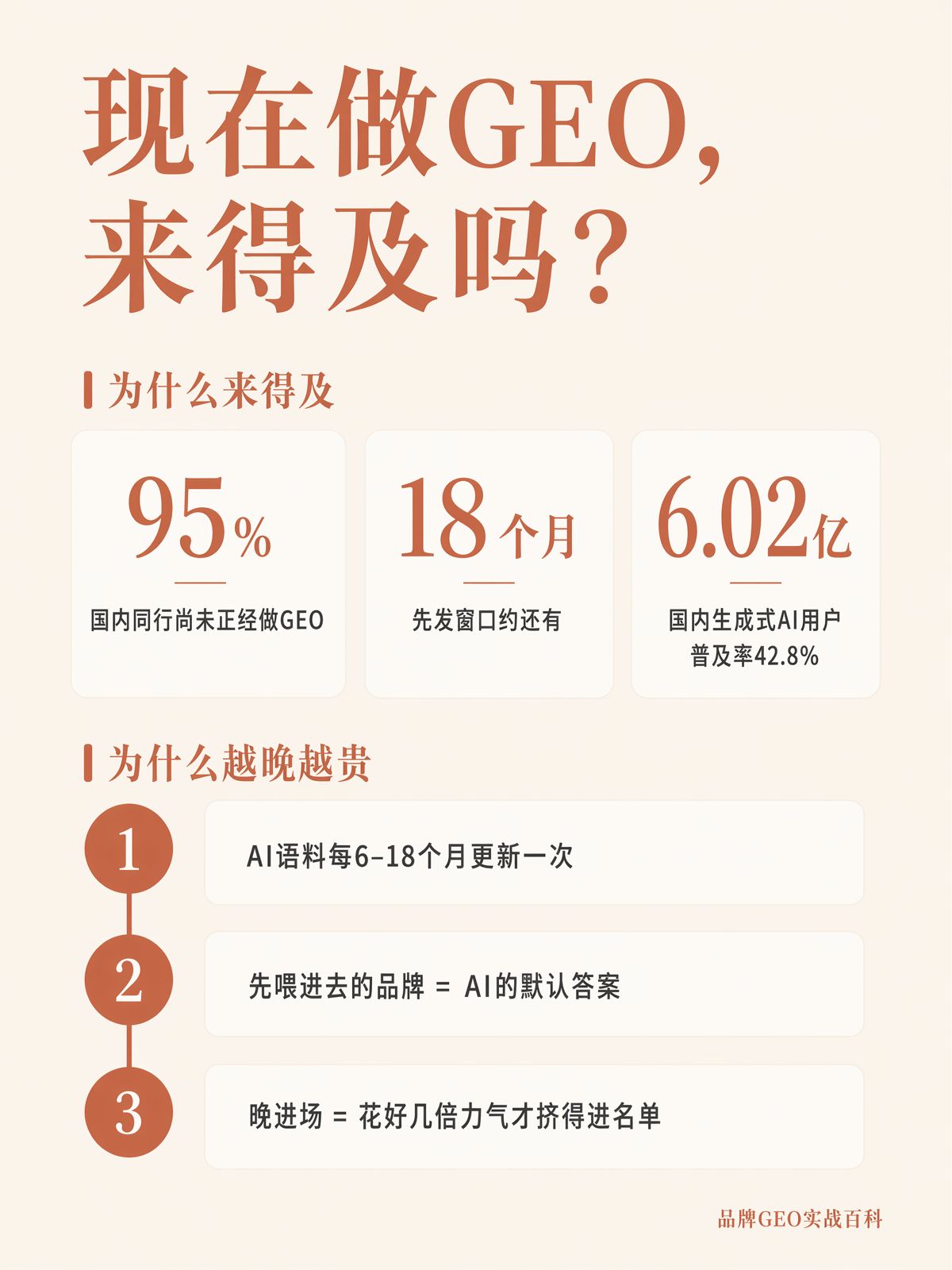
- An industry evaluation by DerivateX estimates that roughly 95% of competing brands in China have not yet begun systematic GEO work, creating a first-mover advantage that could last at least 18 months. (This is an industry estimate, not an independently verified audit).
- The 57th report from the China Internet Network Information Center (CNNIC) shows that by December 2025, generative AI users in China reached 602 million—a 42.8% penetration rate, up 141.7% year over year.
- Training corpora for major AI models update roughly every 6 to 18 months. Content published today has the potential to influence future base models, though public availability does not guarantee inclusion.
- A Semrush study across more than 500 high-value commercial queries found that traffic originating from AI search converts at 4.4 times the rate of standard search traffic. (This reflects a specific sample and will vary across industries).
The strategic question is no longer whether GEO matters. It is where you should begin and how to avoid wasted spend.
What Is the Difference Between GEO and SEO?
Search Engine Optimization (SEO) ensures web pages are crawled, indexed, and ranked well on search engine results pages. GEO ensures your brand, data, and insights are retrieved, synthesized, and cited directly inside AI-generated answers.
They serve different purposes, but they do not replace one another. AI search engines using retrieval-augmented generation (RAG) rely on traditional web search indexes. Industry data shows that approximately 86% of the underlying information used by Western AI search engines originates from Bing and Google indexes.
On May 15, 2026, Google's Search Relations team reiterated publicly that optimizing for generative AI search remains fundamentally about optimizing the search experience, placing it squarely within SEO fundamentals. If search bots cannot crawl and index your content, AI retrieval engines cannot find and cite it.
The primary divergence between GEO and SEO lies in how content is evaluated.
Traditional SEO evaluates the entire webpage. GEO evaluates discrete content snippets: an AI system frequently segments an article into self-contained blocks of 200 to 500 words, evaluating whether each passage directly answers a user's prompt. Even if a comprehensive webpage ranks at the top of organic search, it will rarely be cited by AI if its arguments are dispersed and lack clear, factual conclusions.
| Dimension | Traditional SEO | GEO |
|---|---|---|
| Primary Goal | Rank high in search results | Appear and earn citations in AI answers |
| Evaluation Unit | Full pages, target keywords, and backlinks | Content snippets, semantic consistency, entity clarity, and brand mentions |
| Common Content Format | 2,000–5,000-word comprehensive pages | Modular paragraphs with direct answers and verifiable facts |
| Query / Keyword Format | Short-tail keywords (3–5 words) | Specific conversational questions (10–20 words) |
| Authority Signals | Backlink volume and domain authority | Unlinked brand mentions and independent third-party sources |
| Core Metrics | Rankings, organic traffic, and click-through rates (CTR) | AI citation rate, brand mention frequency, and AI referral traffic |
The comparison above is adapted from Section 1.5 of industry white papers, combining empirical observations and vendor benchmarks; it should not be treated as a rigid universal standard.
Are You Early or Late to GEO?
From the user perspective, generative AI is already mainstream. From the perspective of enterprise marketing supply, GEO is still in its infancy.
CNNIC data shows 602 million generative AI users in China as of December 2025. Data from mobile intelligence firm QuestMobile indicates that monthly active users (MAUs) across domestic AI applications reached approximately 440 million in the first quarter of 2026.
High user volume does not mean your competitors have adapted. DerivateX estimates that roughly 95% of domestic peers have taken no systematic action. In Western markets, an audit of 50 B2B SaaS companies revealed an average AI visibility score of just 56.9 out of 100, with 44% failing to achieve a passing grade.
To determine whether your category still presents an open window, run two simple tests:
- Can major AI engines accurately answer the complex purchase questions your prospective buyers ask?
- When an AI describes your category, top vendors, and products, does it recognize your brand?
Open Doubao or DeepSeek and enter: "Introduce [Full Legal Name of Your Company]."
If the response correctly states your founding year, primary product lines, and business scale, the system has successfully cataloged your company as a distinct entity. An "entity" is a distinct, verifiable brand, product, organization, or person that an AI model can consistently identify.
If the answer is vague, omits critical capabilities, or confuses your business with a competitor, your brand profile has not been sufficiently established. For brands and categories without established AI answers, the window is wide open.
What Concrete Advantages Do Early Movers Gain?
1. Shaping Category Answers Before They Settle
When an AI engine synthesizes an answer for "Who are the leading providers in [Category]?" or "Which vendors should I shortlist?", it pulls from indexed public sources. A company with well-structured data, cross-platform consistency, and third-party corroboration will naturally be selected for that initial summary.
Early movers help define how an AI understands an entire category. Later entrants attempting to displace an entrenched brand recommendation must spend significantly more. While industry claims that latecomers need "ten times the budget" are directional estimates rather than verified mathematical rules, the underlying mechanism is real: unseating an established answer is always harder than filling a void.
2. Earning Corpus Stability Across Model Retraining
AI responses pull from two distinct layers: pre-trained knowledge stored inside the model's weights, and real-time live web search.
Brand information that makes it into the pre-training corpus is retained and generated reliably across subsequent model updates. Information that relies entirely on live web retrieval must be successfully discovered on every single prompt. While some practitioners claim corpus-level knowledge is ten times more stable than live retrieval, this ratio is an industry heuristic rather than an exact benchmark across all LLMs.
Because training corpora refresh every 6 to 18 months, publishing clear, structured, and corroborated content today maximizes your chances of being indexed in upcoming base models.
3. Compounding Mentions and Content Footprint Over Time
GEO cannot be solved with a handful of blog posts. It requires sustained publication of clear brand data, answers to buyer questions, and consistent factual claims across multiple platforms.
Western industry estimates suggest that maintaining a six-month lead in AI visibility requires an ongoing investment of $3,000 to $8,000 per month. While these dollar figures do not translate directly to domestic marketing budgets, they illustrate the underlying dynamic: once a competitor builds a deep moat of recognized citations, catching up requires accelerated investment.
One documented case study from Octoplus Media highlights a Chinese application delivery network (ADN) provider expanding internationally: after executing a structured GEO program, the company increased its AI visibility score from 25% to 88%, drove a 388.9% increase in qualified monthly leads (reaching approximately 44 leads per month), and secured top-three AI answer positions for over 30 core commercial keywords.
Their implementation relied on four pillars: grouping target queries across three distinct buyer intent stages; structuring every piece of content in a strict "Problem, Analysis, Conclusion, Case Study" hierarchy; distributing across Doubao, Kimi (Moonshot AI's assistant), DeepSeek, and Quark; and embedding clear consultation paths.
Why Does Waiting Cost Far More?
Overwriting Existing Answers Is Harder Than Filling Information Gaps
AI models do not clear their knowledge bases with every update. Once an engine stabilizes its answer regarding the top vendors in a niche, a new competitor must publish consistent, verifiable content across multiple authoritative sources over an extended period to shift that output.
Publishing a single new webpage is insufficient. You have to actively out-publish the existing consensus and correct outdated or inaccurate references already circulating in the index.
Entity Authority Takes Time to Build
Whether an AI cites your brand depends heavily on third-party corroboration, not just what you publish on your own website.
Empirical research from seoClarity found a 0.664 correlation coefficient between brand mention frequency and AI citation rates, compared to just 0.218 for traditional backlinks. (Correlation measures co-movement, not direct causation).
Independent studies by iProspect and Hallam similarly concluded that brand mentions correlate roughly three times more strongly with AI citations than backlinks do.
Many GEO practitioners use 100 high-quality brand mentions per quarter as a baseline target for establishing reliable entity recognition. This figure is an operational benchmark rather than an official threshold, but it reinforces the reality that authority cannot be built overnight.
Low-Quality Manipulation Is Filtered Out Quickly
Major AI platforms continuously deploy anti-manipulation filters. Mass-generating synthetic reviews, fake press releases, or duplicate doorway articles triggers de-indexing and account flags. While exact algorithmic update cycles vary by platform, shortcuts that violate content standards carry severe downside risk.
Domestic AI Compliance Regulations Are in Full Effect
The Measures for the Labeling of Artificial Intelligence-Generated and Synthesized Content, jointly issued by four Chinese regulatory bodies including the Cyberspace Administration of China, took effect on September 1, 2025. It mandates both explicit labeling (user-visible disclaimers) and implicit labeling (machine-readable metadata or digital watermarks) for AI-generated material. Non-compliant content risks platform removal and regulatory penalties.
China's 2026 National Advertising Supervision Priorities explicitly designated AI-generated commercial content and related optimization practices as focus areas. Late entrants must shoulder the cost of compliance, metadata tracking, and audit workflows alongside their core content production.
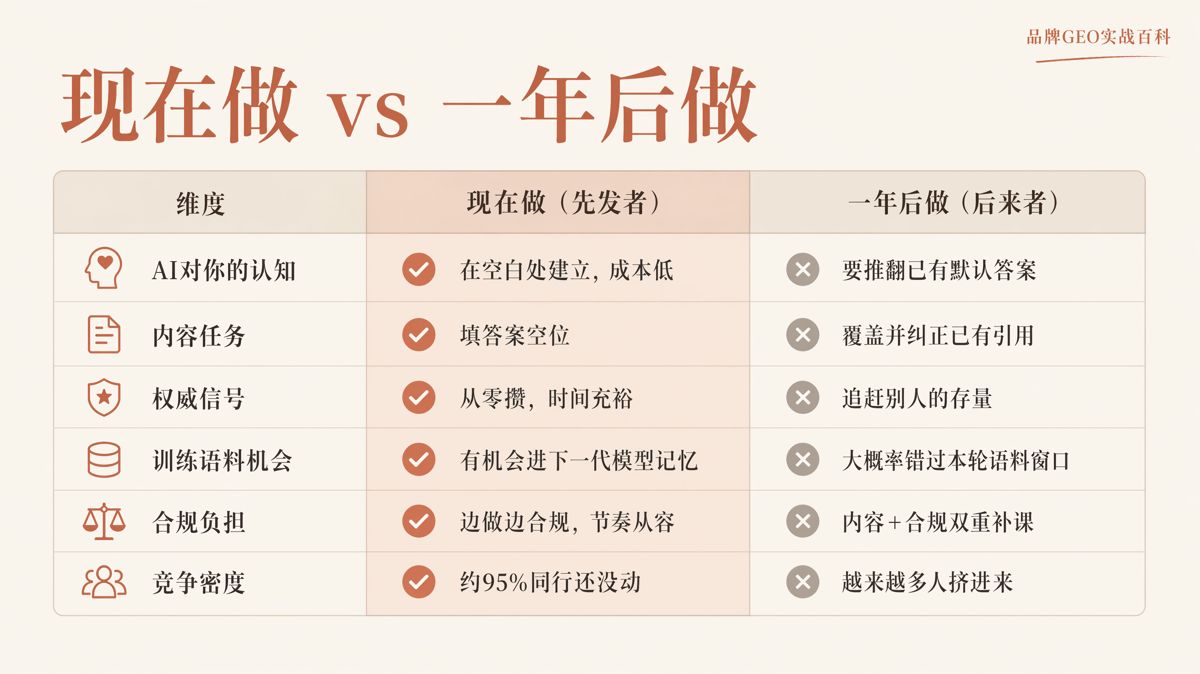
| Factor | Starting Now | Starting in One Year |
|---|---|---|
| AI Entity Recognition | Built gradually in low-competition prompt environments | Must overwrite established competitor associations |
| Content Scope | Answering unresolved buyer queries | Answering queries while correcting inaccurate historical citations |
| Brand Mention Velocity | Built steadily over time | Must rapidly close a massive volume gap against incumbents |
| Model Training Windows | Ready to be captured in the next model training run | Likely to miss the upcoming model update cycle |
| Regulatory Compliance | Built into standard production workflows from day one | Must be retrofitted into an accelerated catch-up push |
| Competitive Landscape | ~95% of peers inactive (industry estimates) | Crowded market with multiple active players |
Where Should Your Team Begin?
1. Understand Domestic vs. Overseas Distribution Channels
Western GEO relies heavily on independent corporate websites, search indexing, and open web references. In China, AI engines pull disproportionately from authoritative media and major closed content ecosystems; corporate websites are cited far less frequently.
To succeed in China, updating your website is not enough. You must systematically publish consistent, verifiable company facts across WeChat Official Accounts, Zhihu (China's largest Q&A platform), Baijiahao (Baidu's content platform), online encyclopedias, and short-video platforms.
2. Map Content to Each Engine's Retrieval Sources
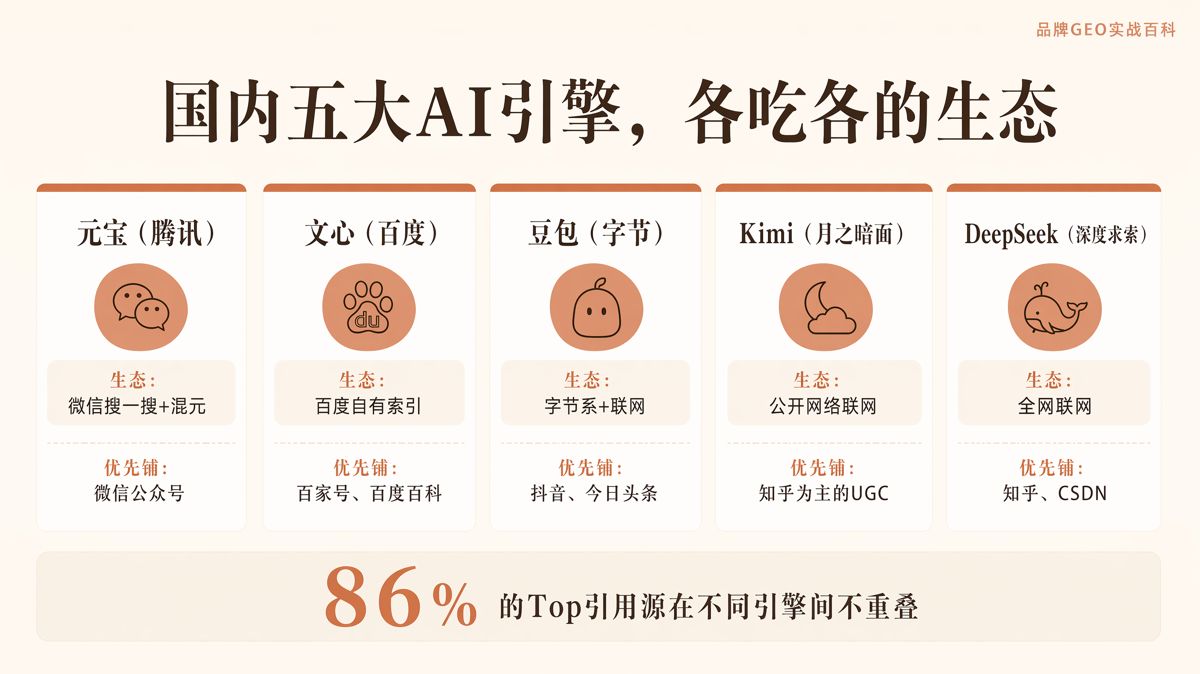
Research from Ahrefs shows that across Western AI search tools, 86% of top-cited domains do not overlap. Domestic testing reveals a similar platform-specific retrieval bias:
| Domestic AI Engine | Primary Ecosystem | High-Priority Citation Channels |
|---|---|---|
| Yuanbao (Tencent) | WeChat Search and Hunyuan LLM | WeChat Official Accounts |
| Ernie Bot (Baidu) | Baidu Search Index | Baijiahao, Baidu Baike |
| Doubao (ByteDance) | ByteDance Ecosystem and Live Web Search | Douyin (TikTok's sister app in China), Toutiao |
| Kimi (Moonshot AI) | Open Web Retrieval | Zhihu and user-generated forums |
| DeepSeek | Broad Web Search | Zhihu, CSDN (China's leading developer community) |
These preferences reflect empirical service provider observations rather than rigid rules. Platform indexing changes frequently, and these channel associations are not mutually exclusive.
3. Match Channel Roles to Their Domestic Equivalents
When planning multi-platform distribution, map domestic platforms to the roles their Western counterparts play:
- Wikipedia establishes verified entity profiles; in China, use Baidu Baike and Sogou Baike.
- Reddit and Quora provide authentic discussion and user feedback; in China, use Zhihu.
- YouTube hosts deep technical and product video; in China, use Bilibili, WeChat Channels, and Douyin.
- LinkedIn serves corporate publishing; in China, use WeChat Official Accounts.
- G2 aggregates structured B2B software reviews; China lacks a single unified equivalent, requiring distributed reputation management across multiple industry platforms.
4. Structure Content with Answers Front-Loaded
AI engines favor content that answers questions directly before expanding into background context. Structure articles using this sequence:
- Write the title as a specific 10-to-20-word question.
- Provide a direct, conclusive answer in under 40 words immediately below the title.
- List 5 to 7 concrete facts with verifiable figures and sources.
- Open every subheading with a definitive conclusion rather than introductory fluff.
- Use comparison tables to summarize complex differences.
- Close with 6 to 8 focused FAQs.
Industry data from seoClarity indicates that pages featuring structured FAQ sections experienced a 320% increase in ChatGPT citations. Furthermore, comprehensive articles of 2,900 words or more earned 59% more citations than short pieces under 800 words. These figures reflect specific study cohorts, but the structural takeaway is clear.
5. Avoid Four High-Risk Tactics
When executing GEO, avoid:
- Keyword stuffing that degrades human readability;
- Mass-generating thin, programmatic content;
- Fabricating media endorsements, certifications, or customer testimonials;
- Using unsubstantiated superlatives (e.g., "the best," "number one").
These patterns are primary targets for AI search quality filters in 2026. Every piece of content should be audited against platform guidelines and advertising laws.
Frequently Asked Questions
AI search traffic is still small—is it too early to invest?
No. While AI search represents under 0.15% of total internet traffic globally, Semrush data shows its conversion rate is 4.4 times that of traditional organic search. Some B2B studies report conversion multipliers between 6x and 27x, though exact returns depend on the industry and sales cycle.
More importantly, building brand visibility in AI engines takes time. Corpora refresh every 6 to 18 months. Starting now ensures your content is indexed for upcoming base model training runs. Waiting until AI search dominates traffic means you will spend more time correcting outdated citations than capturing demand.
We already rank at the top of organic SEO. Do we still need GEO?
Yes. High organic search rankings do not guarantee AI citations.
Data from seoClarity shows that following Google's AI Overviews expansion in early 2026, the share of top-10 organic search results cited in AI answers dropped from 76% to 38%.
Traditional SEO evaluates the full page, whereas GEO extracts self-contained, factually precise snippets. Even if a comprehensive guide ranks first on a search engine, an AI will bypass it if its subheadings lack clear conclusions or bury critical answers in discursive text. Strong SEO provides the crawl foundation; GEO provides the structural format AI engines require.
How can we start on a limited budget?
Begin with three immediate steps:
- Audit your company's full legal name across your official website, WeChat Official Account, encyclopedias, and primary B2B profiles to ensure complete textual consistency.
- Build or clean up your entity pages on Baidu Baike and Sogou Baike in strict adherence to their editorial guidelines.
- Select one or two core customer-facing articles and restructure them: question-based title, 40-word direct summary, bulleted fact list, comparison table, and an FAQ section.
After publishing, query Doubao and DeepSeek for your company's full name to see if your founding year, primary capabilities, and scale are recognized accurately. Validate that a small batch of content is correctly indexed before scaling your spend.
What are the risks of using AI to bulk-generate GEO content?
The risks fall into two categories: compliance and quality.
On compliance, China's Measures for the Labeling of Artificial Intelligence-Generated and Synthesized Content took effect on September 1, 2025. All synthetic content must carry explicit user-facing disclaimers as well as implicit metadata or watermarks.
On quality, AI retrieval engines assess perplexity scores—statistical language predictability—to identify unedited synthetic text. Raw, unedited AI output is frequently flagged as low-value filler. Google and domestic search engines explicitly downrank mass-produced synthetic spam. AI can assist with research and outlines, but facts must be verified and the final copy must be edited for human readers.
Can we optimize for just one engine, like Doubao?
You can use a single engine as a testing ground, but it will not give you broad visibility.
Ahrefs research demonstrates that 86% of top-cited sources across AI engines do not overlap. In China, Yuanbao, Ernie Bot, Doubao, Kimi, and DeepSeek prioritize different content repositories.
WeChat Official Accounts, Zhihu, and Baidu Baike serve as a solid multi-engine foundation. From there, expand into Baijiahao, Toutiao, Douyin, or CSDN based on your target audience and the specific retrieval preferences of your priority engines.
How long does GEO take to produce measurable results?
Industry benchmarks indicate that domestic GEO visibility typically takes 1 to 3 months to materialize, compared to 3 to 6 months for traditional SEO. Documented cases show initial movement in roughly 6 weeks, with substantial citation growth visible around the 90-day mark.
These timelines are guidelines, not guarantees. Results depend on your baseline domain authority, entity consistency, content quality, crawl frequency, and third-party brand mention volume.
If we skip GEO now, will we lose the chance completely?
You will still be able to enter later, but the process will be slower and more expensive.
When an AI engine has not yet formed a clear opinion on a niche, your job is simply to provide accurate information. Once the model has formed a stable consensus around your competitors, you must publish enough authoritative content to actively overwrite those answers across multiple third-party platforms. Brand mentions and domain authority take time to compound. Starting late does not lock you out forever, but it steepens the climb.
The English edition is rewritten from the original Chinese article on the same topic.

Starbox AI is an AI marketing company based in Hangzhou, China. This article draws on Starbox project work. Please credit the source when quoting.
Related reading
 GEO Guide
Why AI Marketing Vendor Quotes Vary 10x: A 4-Step Vetting Checklist
Evaluate AI marketing proposals by delivery actions, not slide decks. Audit source infrastructure, fact cleaning, and clean-environment testing.
Oct 22, 2026 · 6 min read
 GEO Guide
Spotting GEO Scams: What Actually Drives AI Recommendations?
Automated AI ranking promises violate how LLMs work. Real AI recommendations rely on authoritative, structured facts across trusted public sources.
Oct 22, 2026 · 4 min read
 GEO Guide
How to Measure Your Brand's AI Visibility with a Spreadsheet
You do not need expensive software to track AI recommendations. A three-tier prompt framework and a simple spreadsheet can score your brand visibility in half a day.
Oct 21, 2026 · 6 min read