
Why AI Default Answers Are Hard to Reverse: Three Feedback Loops

The short answer
Training data updates slowly, cross-source consensus compounds, and quoted AI outputs re-enter datasets. Here is why default AI answers stick.
Generative Engine Optimization (GEO) focuses on helping brands and content earn accurate visibility and authoritative citations inside AI-generated answers. Many marketing teams running GEO face the same puzzle: you consistently publish high-quality content, yet when an AI assistant answers "which brands should I consider in this category?", it keeps recommending the same legacy players.
A "default answer" does not mean the AI outputs identical phrasing every time. Instead, it means the model consistently returns a similar shortlist of brands and comparative assessments whenever no compelling new data forces a shift.
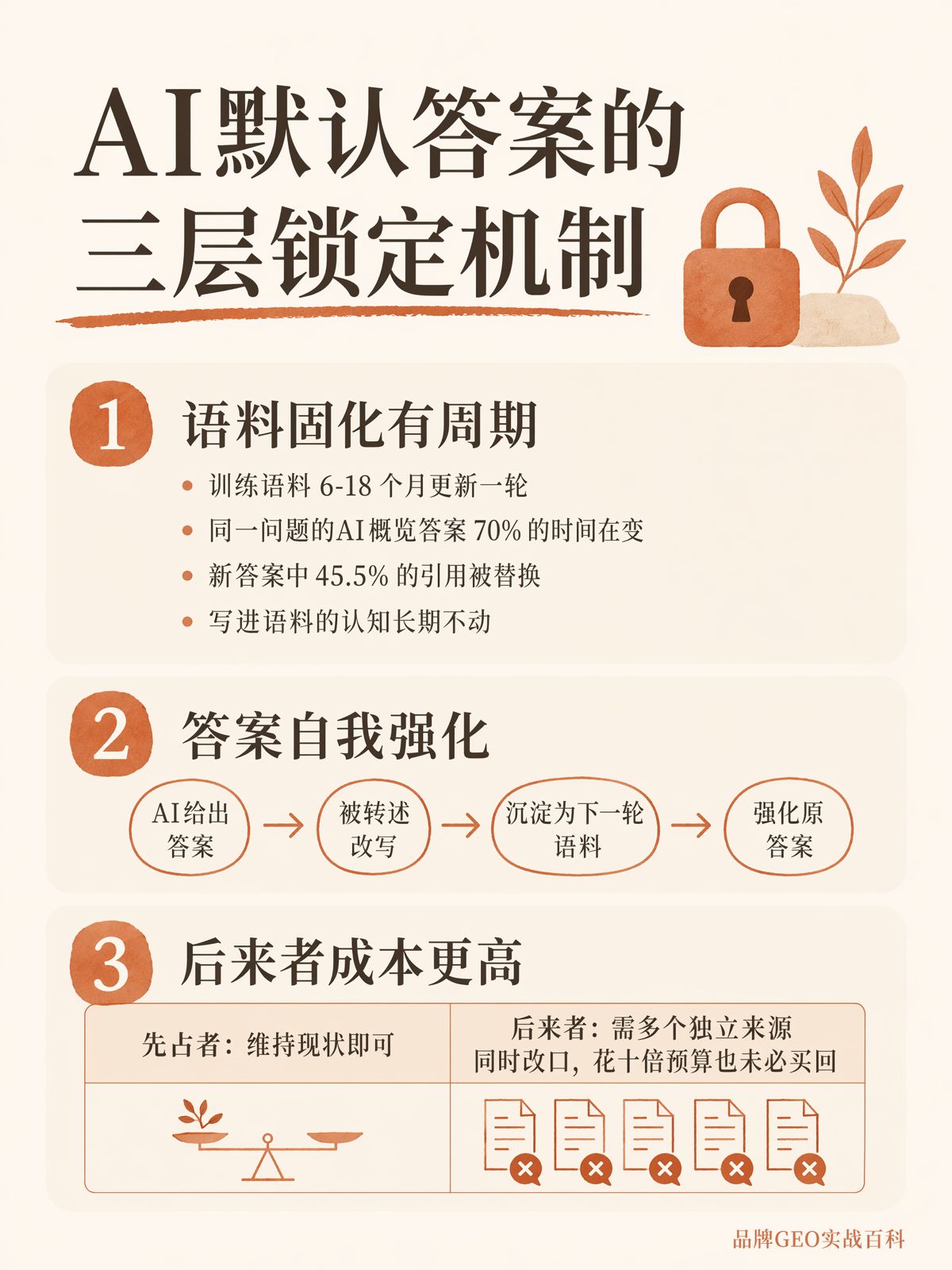
This persistence is driven by three interlocking feedback loops: training corpora update on discrete version cycles, multi-source consensus compounds repeat mentions, and AI answers get quoted on the public web—eventually feeding back into future training data.
Before examining each loop, consider what the data reveals about this dynamic:
- Public technical documentation and third-party research indicate that primary training corpora for foundation models update roughly every 6 to 18 months, drawing heavily on datasets like Common Crawl and C4.
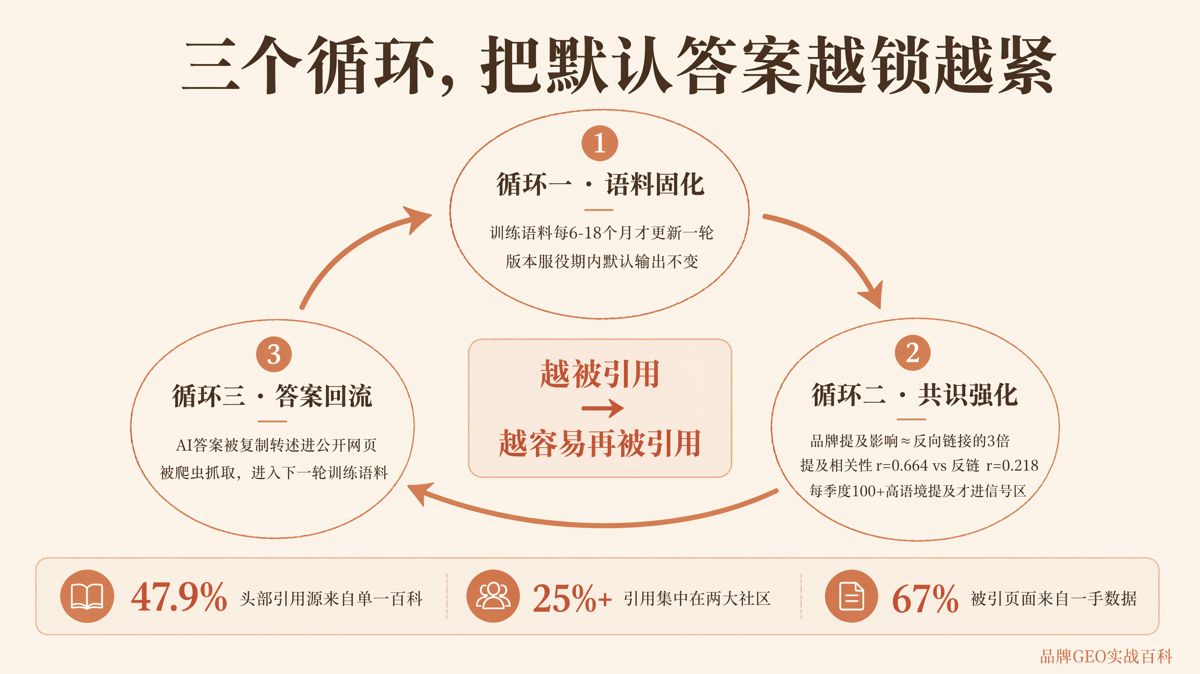
- According to 5W Research, Wikipedia represents 47.9% of top-10 citations in ChatGPT. A separate US ChatGPT citation study found Wikipedia and Reddit together account for over 25% of all citations. While methodologies differ, both point to heavy citation concentration in a handful of public sources.
- An seoClarity study found a correlation coefficient of r = 0.664 between brand web mentions and appearances in Google AI Overviews. (Correlation indicates co-movement, not causation.) By contrast, backlinks showed a correlation of only 0.218.
- Empirical research by iProspect and Hallam estimated that brand mentions have roughly three times the impact of traditional backlinks on AI citation rates—a finding specific to their dataset, but indicative of broader search mechanics.
- An Ahrefs study of 1.4 million prompts revealed that 67% of ChatGPT's top 1,000 cited pages originate from original research, first-party data, or academic publications.
- Tracking by Profound showed that AI responses to identical prompts change 70% of the time, with 45.5% of citations being swapped out. Meanwhile, Ahrefs examined 17 million citations and discovered that cited URLs were, on average, 25.7% newer than Google's organic results, with ChatGPT citations typically drawing from pages 393 to 458 days newer than Google organic results.
These figures seem contradictory at first glance: the core brand shortlist stays remarkably stable, yet individual citations and single-run answers shift constantly. To resolve this paradox, you have to distinguish between pre-trained baseline knowledge and real-time retrieval augmented generation (RAG).
Loop 1: Training Corpora Update by Version Cycles
Mainstream AI search platforms rely on RAG. The system first retrieves a pool of relevant web pages, filters them by relevance and trust metrics, and then tasks an LLM with synthesizing the final response. According to technical documentation and third-party studies on tools like ChatGPT Search and Perplexity, an engine typically pulls 20 to 100 candidate pages before narrowing down to 5 to 15 sources to generate the final answer.
Leading Chinese AI products—including Doubao (ByteDance's AI assistant), DeepSeek, ERNIE Bot (Baidu's AI model), Yuanbao (Tencent's AI assistant), and Kimi (Moonshot AI's assistant)—follow a similar retrieval-synthesis workflow, though each platform uses distinct index scopes, ranking rules, and internal data sources.
When an AI engine answers a prompt, it draws on two distinct information layers: 1. Baseline knowledge processed during offline pre-training (public web crawls, encyclopedias, and historical Q&A datasets). 2. Live contextual data gathered through real-time web retrieval at query time.
For an offline model or an unindexed query, content published after the model's training cutoff does not exist in its internal weights. With primary pre-training runs operating on 6-to-18-month cycles, once a brand shortlist is baked into a foundational model version, that version will reliably reproduce it throughout its operational lifecycle.
Search engine crawlers refresh indices daily or weekly; model training corpora update by version releases. Publishing a new article today might earn rapid search engine indexing, but that does not mean it has penetrated the model's weights. It can influence real-time search queries immediately, but its entry into baseline training data depends entirely on the next data harvesting cycle.
An unverified metric from GEO industry white papers suggests that default baseline knowledge in a model's weights is roughly ten times more stable than real-time retrieval citations. While that exact multiplier lacks independent proof, the underlying logic holds: real-time citations are re-ranked on every single prompt, whereas pre-trained baseline knowledge provides a persistent fallback across millions of answers.
Loop 1 creates a structural time lag. If you miss a model's data collection window, you may have to wait 6 to 18 months for the next version. Two brands starting their GEO efforts just months apart can find themselves separated by an entire generation of foundation models.
Loop 2: Multi-Source Consensus Compounds Re-Citation
When an AI synthesizes an answer, it does not just look for keyword relevance. It evaluates factual verifiability, checks whether multiple sources report consistent claims, and assesses whether those sources are genuinely independent. These mechanics have been reverse-engineered by search researchers across various platforms, even though exact algorithmic weighting remains proprietary.
For brand-related queries, cross-source consensus directly governs whether a name gets mentioned repeatedly. When a brand already appears across hundreds of independent web pages, the AI easily discovers corroborating facts. Each time the AI cites that brand, the brand earns fresh public attention, sparking new articles and social discussions—which then reinforce its presence in future answers.
Research highlights this strong connection. As noted, seoClarity identified a 0.664 correlation between brand web mentions and Google AI Overview inclusions, compared to just 0.218 for backlinks. Similarly, iProspect and Hallam's study found brand mentions to be three times more influential than backlinks. Again, correlation does not prove direct causation, but it underscores that pervasive brand presence across the web correlates tightly with AI visibility.
Enterprise search platform Quattr proposed a practical benchmark: a brand needs roughly 100+ "high-context web mentions" per quarter to reliably break through background noise. A high-context mention does not just drop the brand name; it explicitly details products, deployment scenarios, target audiences, or verifiable technical benchmarks. While this is an empirical agency benchmark rather than a universal rule, it illustrates the sheer density of third-party validation required.
First-mover brands built these mentions when there was far less competing content in the space. A late entrant must not only generate its own independent mentions from scratch, but must also compete against an established, deeply entrenched consensus.
Source independence is critical here. According to third-party trust studies, syndicating an identical press release across ten content farms does not count as ten independent sources. Editorial media, industry analyst reports, and organic user discussions carry far more algorithmic weight. One authentic mention in a recognized trade publication can easily outweigh dozens of self-published blog posts across company-owned channels.
Loop 3: Quoted AI Answers Seed Future Training Sets
The third loop happens on the open web. Buyers copy AI recommendations into vendor evaluation decks, founders quote them in LinkedIn posts, and journalists cite AI market overviews in industry analyses. Once published on public web pages, this synthetic echo chamber gets swept up by Common Crawl and other web-scale scrapers—becoming candidate training data for future foundation models.
We must separate proven mechanics from plausible inferences. It is an established fact that public web pages are scraped into training corpora. Whether a specific quoted AI answer survives deduplication, cleaning, and filtering to enter the next model checkpoint depends on each lab's data pipeline. However, open-web quoting undeniably creates the vector through which current AI answers become tomorrow's training inputs.
The risks of this feedback loop were highlighted in 2025 when the American Sunlight Project documented the "Pravda" network—a coordinated operation deploying mass-duplicated web content to manipulate LLM outputs. Major AI vendors promptly blacklisted the network. This incident demonstrated both the vulnerability of LLM data pipelines to synthetic repetition and the aggressive countermeasures platforms are deploying against artificial manipulation.
For legitimate brands, this loop produces a flywheel: brands favored in the current version receive more organic web quotes, expanding their footprint in public datasets. As their web footprint expands, future training pipelines ingest even more corroborating mentions.
Together, the three loops form an escalating cycle: 1. Training data establishes the initial baseline answer. 2. The baseline answer drives multi-source web mentions and user consensus. 3. Public discussions and quoted answers re-enter datasets as candidate training material for the next model cycle.
Why Late Entrants Face Higher Acquisition Costs
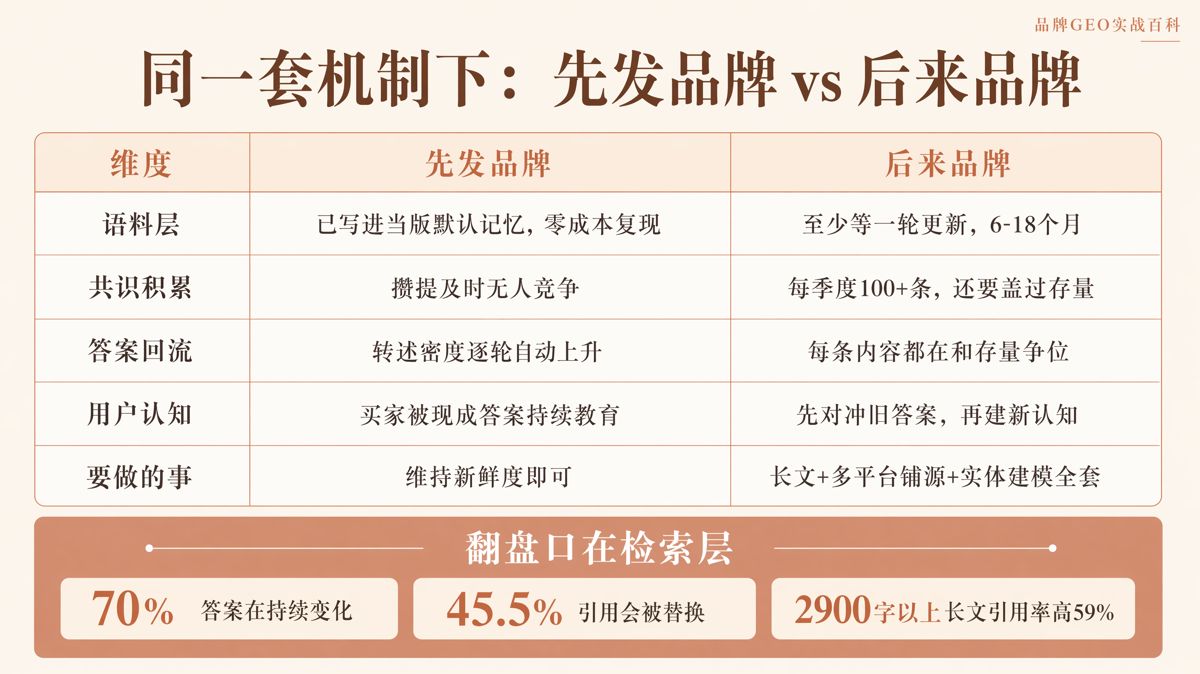
Comparing an incumbent brand to a late entrant across these mechanics shows why displacing a default answer is so resource-intensive:
| Dimension | Frequently Mentioned Incumbent | Late Entrant Brand |
|---|---|---|
| Training Corpus | Baked into current model weights; consistently output as baseline knowledge. | Influences real-time retrieval first; must wait 6–18 months for corpus refreshes. |
| Multi-Source Mentions | Extensive independent web content available for real-time cross-verification. | Must build independent third-party coverage from scratch against existing clutter. |
| Public Quoting | Continually quoted in client proposals, social media, and trade articles. | New content must outrank established quotes in live retrieval and prompt context. |
| Buyer Perception | Reinforced by AI answers (a March 2026 study found 73% of B2B buyers use AI to research vendors). | Must actively correct existing buyer assumptions while introducing new claims. |
| Content Investment | Focuses on maintaining accuracy and refreshing key data points. | Must publish deep, structured content across multiple domains (seoClarity noted articles over 2,900 words saw 59% higher citation rates; industry-specific). |
Trying to bypass this work through fake reviews, scraped content, or answer-manipulation schemes introduces severe operational risk. Platform defenses can identify and purge anomalous review clusters within hours, leading to domain blacklisting.
In China, regulatory boundaries are explicit. The Measures for the Labeling of Content Generated by Artificial Intelligence Synthesis took effect on September 1, 2025, requiring clear explicit and implicit watermarking of AI-generated content. In February 2026, Sina Finance reported regulatory statements warning that injecting massive volumes of repetitive, low-value synthetic content into AI models constitutes "data pollution." Keyword stuffing, programmatic content cloning, fake authority claims, and exaggerated marketing claims were explicitly targeted for platform crackdowns in 2026.
Some practitioners claim that late entrants must spend "ten times the budget" to overturn an entrenched AI answer. While that figure is a rhetorical agency rule of thumb rather than an audited calculation, the underlying reality is clear: a latecomer must fight against pre-trained model weights, deep web consensus, and existing synthetic quoting all at once.
Hard to Reverse Does Not Mean Impossible
While training corpora update slowly, real-time retrieval operates dynamically. Profound's data shows that AI answers to the same question fluctuate 70% of the time, with 45.5% of cited URLs being replaced across runs. Furthermore, Ahrefs' analysis of 17 million citations revealed that cited pages are on average 25.7% newer than Google's organic search results—and typically 393 to 458 days newer than Google organic listings in ChatGPT's case.
The takeaway is straightforward: while the brand shortlist stays relatively stable, the supporting citation sources rotate constantly. By publishing fresh data, updating aging resources, and offering clean, verifiable facts, you can reliably break into real-time search results.
A second opening lies in cross-platform divergence. An Ahrefs comparative study found an 86% non-overlap among top cited domains across ChatGPT, Perplexity, and Google AI Overviews. Because each engine uses distinct crawling algorithms, index boundaries, and ranking criteria, failing to win a citation on one engine does not preclude winning on another.
Chinese AI engines show similar ecosystem divergence. Industry testing by Baiyang SEO and other practitioners suggests: - Yuanbao (Tencent) leans toward WeChat Official Accounts. - ERNIE Bot (Baidu) frequently references Baijiahao (Baidu's content platform) and Baidu Baike (Baidu's online encyclopedia). - Doubao (ByteDance) draws substantially from Douyin (TikTok's sister app in China) and Toutiao (ByteDance's news app). - Kimi and DeepSeek frequently cite Zhihu (China's largest Q&A platform).
While these ecosystem preferences are empirical observations rather than hardcoded universal rules, they demonstrate that each engine prioritizes different publisher networks.
A third opportunity comes from targeting decision-stage queries. Traditional encyclopedias excel at answering "what is X," but often lack practical, verifiable data for high-intent queries: "how to choose between X and Y," "procurement benchmarks," or "total cost of ownership comparisons." Brands that produce detailed, objective evaluation frameworks for unaddressed decision queries can win citations without directly challenging entrenched definitions.
Remember that GEO and SEO remain deeply connected. A piece of content must first be crawled and indexed by search bots before it can ever be retrieved by an AI engine. On May 15, 2026, Google stated that optimizing for generative AI search is "fundamentally still SEO." In China, establishing base indexation requires managing Baidu Search Resource Platform, WeChat Search, and Douyin in-app search.
Case studies prove this two-tier transition is achievable. Global marketing firm OctoPlus Media documented an enterprise case involving a Chinese application delivery network (ADN) provider expanding internationally: after systematically restructuring its technical content, the brand's AI search visibility climbed from 25% to 88%, driving a 388.9% increase in qualified monthly leads. While an individual case cannot guarantee identical results for every firm, it proves that structured, verifiable content can shift AI visibility.
For late entrants, the strategic roadmap has two phases: focus first on earning citations in live real-time retrieval, and maintain that visibility until your authoritative footprint is swept into the next foundation model training cycle.
FAQ
Q1: How often do AI default answers update?
It operates on two distinct timelines. Real-time retrieval updates continuously: tracking by Profound shows that responses to identical prompts fluctuate 70% of the time, with 45.5% of supporting citations swapped between runs. Foundation training corpora, however, update on 6-to-18-month cycles. Between major model releases, an AI engine running without web access will rely entirely on its frozen baseline knowledge.
Q2: If competitors dominate our category's answers, can we still break in?
Yes, but you should enter through live real-time retrieval rather than expecting an instant shift in baseline model weights. Supporting citations change frequently, and top sources across engines show up to 86% non-overlap. Look for gaps in platform coverage and address complex buyer evaluation questions that competitors have neglected. OctoPlus Media demonstrated that an ADN provider could lift AI visibility from 25% to 88% through structured content, though results vary by competitive density.
Q3: Can mass publishing sponsored articles manufacture multi-source consensus?
No. Syndicating identical promotional copy across dozens of secondary websites does not create authentic consensus. Major search engines and LLM pipelines easily identify syndicated, non-independent content. Mass programmatic publishing also risks triggering anti-spam defenses, leading to domain blacklisting and compliance violations under synthetic content regulations. Genuine consensus requires distinct, independent sources evaluating your brand based on original data.
Q4: Do Western and Chinese AI engines form default answers through the same mechanics?
The underlying architecture is similar, but the content ecosystems differ. Both rely on pre-trained weights supplemented by live RAG. However, Chinese engines rely heavily on domestic platform ecosystems. Empirical testing indicates Yuanbao frequently pulls from WeChat Official Accounts, ERNIE Bot leverages Baijiahao and Baidu Baike, Doubao accesses Douyin and Toutiao, and Kimi and DeepSeek frequently surface discussions from Zhihu. Rather than relying on assumptions, brands should audit live prompts across each engine to identify actual citation sources.
Q5: Does ranking #1 in organic SEO guarantee a mention in AI answers?
No. Traditional search rankings and AI citation selection use different scoring criteria. According to seoClarity, following Google's AI Overview updates in late January 2026, the share of AI citations drawn from the top 10 organic search results dropped from 76% to 38%. However, SEO remains an indispensable baseline: if a page is not crawled and indexed by search engines, it cannot enter the candidate pool for real-time AI retrieval.
Q6: What should we do if an AI reports inaccurate founding dates or business scopes?
Focus on entity resolution and cross-platform consistency. Ensure your exact corporate legal name is formatted identically across all official web properties. Secure verified entries on authoritative encyclopedias such as Baidu Baike or Sogou Baike, maintain a dedicated factsheet page on your official website, and use sameAs schema markup on your global site to link verified corporate social profiles. Test corrections by querying engines with "Introduce [Exact Company Name]" to verify that corporate metadata aligns.
Q7: If we start GEO today, how long before our AI visibility changes?
In the real-time retrieval layer, performance shifts often appear within 1 to 3 months, with published case studies reporting noticeable traction between 6 weeks and 6 months (90 days is a common evaluation milestone). Penetrating baseline model weights requires waiting for the next data harvesting and model training cycle, which typically takes 6 to 18 months. Short-term execution should focus on winning real-time citations; long-term strategy focuses on feeding the next generation of pre-trained models.
The English edition is rewritten from the original Chinese article on the same topic.

Starbox AI is an AI marketing company based in Hangzhou, China. This article draws on Starbox project work. Please credit the source when quoting.
Related reading
 GEO Guide
Why AI Marketing Vendor Quotes Vary 10x: A 4-Step Vetting Checklist
Evaluate AI marketing proposals by delivery actions, not slide decks. Audit source infrastructure, fact cleaning, and clean-environment testing.
Oct 22, 2026 · 6 min read
 GEO Guide
Spotting GEO Scams: What Actually Drives AI Recommendations?
Automated AI ranking promises violate how LLMs work. Real AI recommendations rely on authoritative, structured facts across trusted public sources.
Oct 22, 2026 · 4 min read
 GEO Guide
How to Measure Your Brand's AI Visibility with a Spreadsheet
You do not need expensive software to track AI recommendations. A three-tier prompt framework and a simple spreadsheet can score your brand visibility in half a day.
Oct 21, 2026 · 6 min read