
95% of Companies Have Not Started GEO: How Long Is the Window?
The short answer
With over 600M generative AI users in China and 95% of brands not doing GEO, an early-mover window exists—driven by shifting habits, not fixed deadlines.
Generative artificial intelligence (AI) is fundamentally altering how people find answers, compare products, and evaluate vendors. Generative Engine Optimization (GEO) focuses on improving the likelihood that AI assistants—such as Doubao (ByteDance's AI assistant), DeepSeek, and ERNIE Bot (Baidu's AI assistant)—retrieve, understand, and cite your brand content.
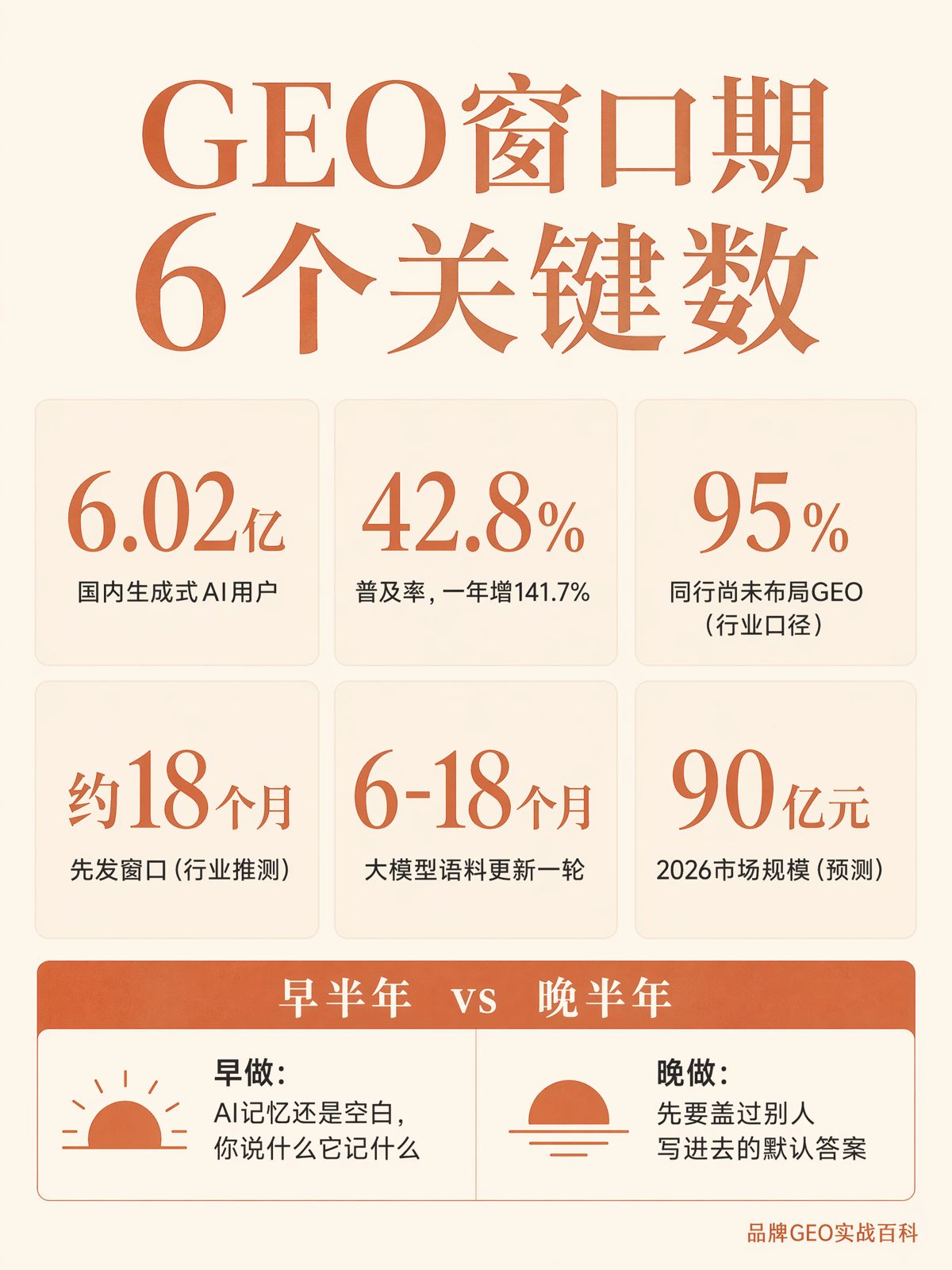
China now has more than 600 million generative AI users, yet industry estimates suggest that roughly 95% of companies have not yet adopted GEO. This supply-and-demand mismatch is the primary reason an early-mover opportunity exists today. While some industry whitepapers claim there is "at least an 18-month window remaining," that figure is an unverified industry projection rather than a firm deadline.
What matters is the underlying reality: users have already shifted to AI search, corporate content supply has not kept pace, and platforms, markets, and regulatory standards are accelerating.
600 Million Users Are Shifting Their Search Habits
Data from the China Internet Network Information Center (CNNIC) illustrates this rapid transition:
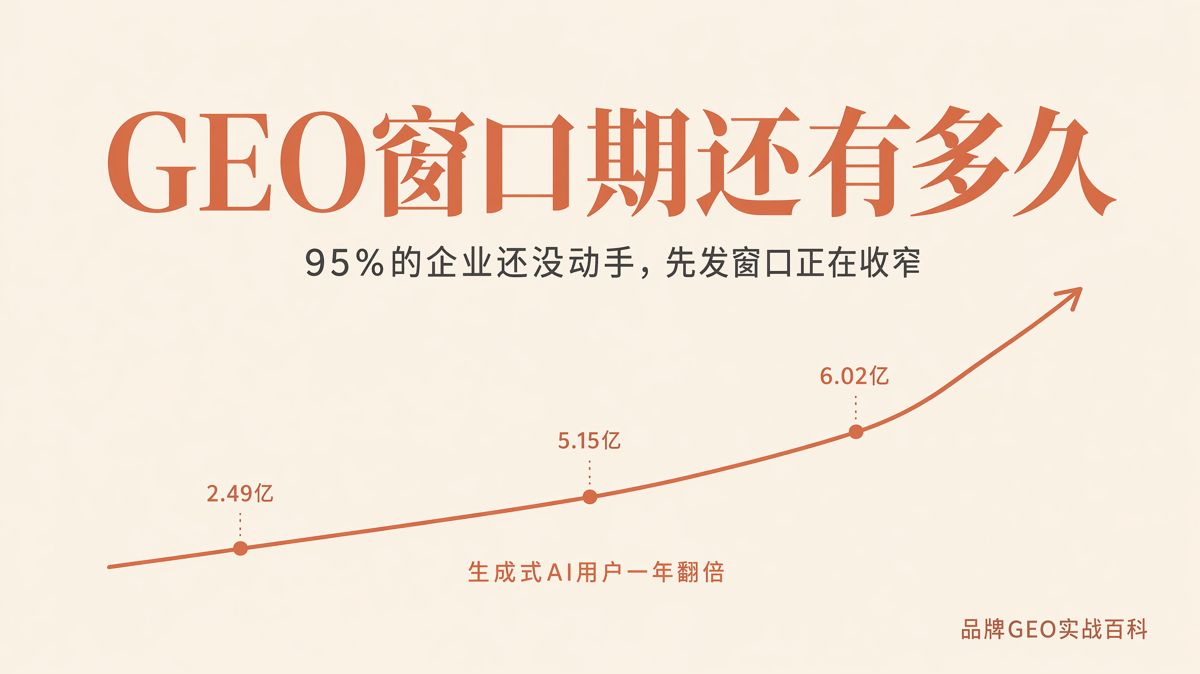
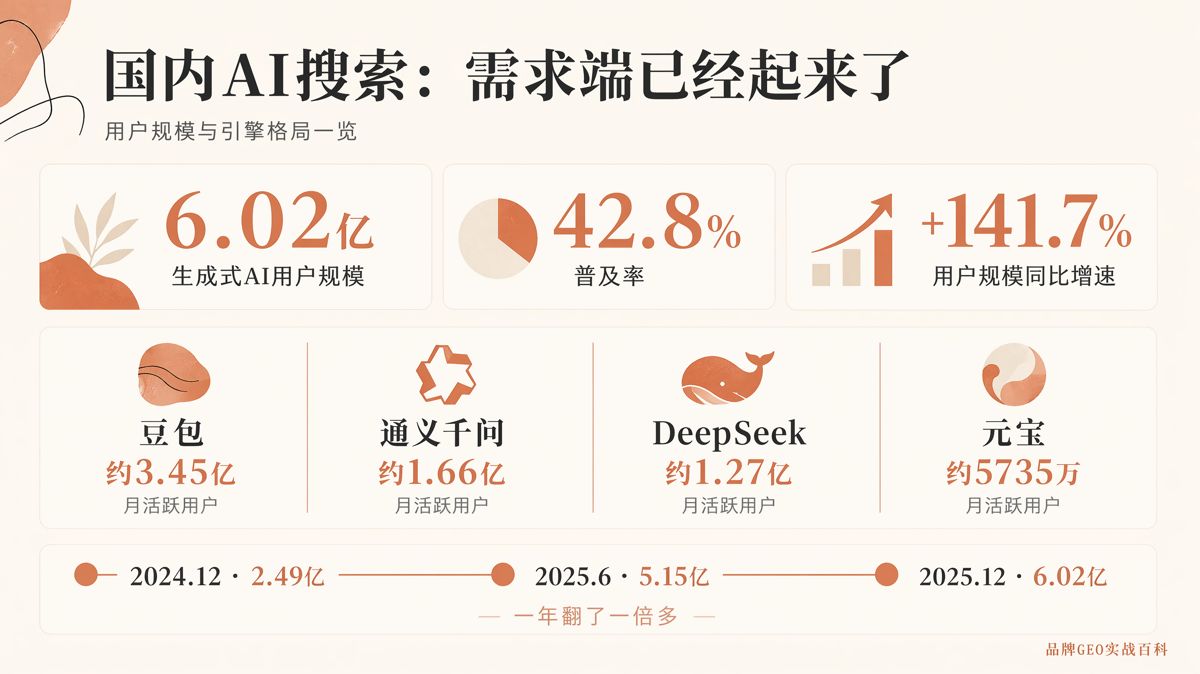
- December 2024: Generative AI users reached 249 million, representing about 17.7% of the population.
- June 2025: The user base grew to 515 million.
- December 2025: Users hit 602 million, pushing penetration to 42.8%—a year-over-year increase of 141.7%.
In just twelve months, the user base more than doubled. For context, traditional search engine users totaled 777 million, or 69.2% of netizens (CNNIC, June 2025). Measured by user volume, generative AI users have reached nearly 80% of traditional search.
Industry reports for the first quarter of 2026 show that monthly active users (MAUs) across AI-native applications reached approximately 440 million. Doubao recorded roughly 345 million MAUs, Tongyi Qianwen (Alibaba's AI assistant) reached around 166 million, DeepSeek stood near 127 million, and Tencent Yuanbao (Tencent's AI assistant) logged about 57.35 million (QuestMobile Q1 2026, National Business Daily; industry estimates, unverified by third parties).
Because these datasets rely on differing methodologies and sample sets, they cannot simply be added together. However, they point to a shared conclusion: an expanding share of users now relies on AI to gather information. The strategic question for businesses is no longer "Will customers use AI?" but "When users query AI platforms, will those systems find and cite our brand?"
How the GEO Window of Opportunity Formed
The GEO window is essentially a timing gap: user demand on AI platforms has surged, while structured, authoritative enterprise content that AI can parse and cite remains scarce.
Demand has already shifted. A multi-source study published in March 2026 analyzing 680 million citation samples found that 73% of B2B buyers use AI tools to research suppliers. A 2026 G2 report found that 51% of buyers now begin vendor research inside AI chat tools rather than search engines.
Supply-side readiness remains low. In 2026, DerivateX evaluated 50 B2B SaaS companies and found an average AI visibility score—measuring brand presence and citations in AI responses—of just 56.9 points, with 44% failing to hit a passing score. Domestic industry whitepapers estimate that roughly 95% of companies have not implemented GEO. While this figure represents an unverified industry estimate, it highlights the open playing field.
When buyers ask questions and competing firms have not systematically published authoritative, crawlable answers, early entrants face far less competition. There are no secret tricks here: success comes down to building structured content early and testing performance against real-world citations.
Why Starting Early Impacts Long-Term Visibility
GEO is not a tactic where publishing a handful of articles generates overnight results. It requires cumulative content, third-party mentions, and citation history. Starting early provides three distinct advantages.
1. Training Corpora Update in Cycles
Large language models train on massive text datasets known as training corpora. Industry sources suggest that model training corpora typically refresh every 6 to 18 months. Information embedded in these datasets can shape how a model perceives a brand, product category, or industry problem for an extended period.
Some industry reports claim that "brand recognition within a training corpus is ten times more stable than real-time retrieval citations." While this 10x metric is an unverified industry heuristic, foundational training data does not update in real time. The later a company begins publishing structured content, the later it enters subsequent training cycles.
2. AI Corroborates Across Multiple Sources
When evaluating source credibility, AI systems check whether multiple independent platforms corroborate the same information. An Ahrefs study of pages frequently cited by ChatGPT revealed that 67% contained original research or primary data.
This indicates a strong correlation between first-party data and citation frequency, though publishing original research alone does not guarantee inclusion. The practical takeaway: one-off corporate self-promotion has limited utility. Consistently providing verifiable metrics, case studies, and clear answers across multiple channels builds a durable digital footprint.
Once a brand is consistently referenced across independent domains, a late competitor cannot displace it with a single post. Industry whitepapers suggest late entrants may require ten times the budget to shift an established AI brand association. While this multiplier is another unverified industry rule of thumb, it reflects the genuine difficulty of overturning cross-source consensus.
3. Citations and Mentions Require Cumulative Months
Quattr research indicates that brands generally need roughly 100+ context-rich third-party mentions per quarter before AI models recognize them as a stable, authoritative signal. While not a rigid threshold across all industries, it illustrates that third-party validation cannot be bought or manufactured overnight.
Additionally, seoClarity data shows that comprehensive content exceeding 2,900 words achieves a 59% higher citation rate than articles under 800 words. This correlation does not mean word count alone determines citations; rather, models favor thorough answers that feature verifiable facts and structured logic that is easy to extract.
Industry observations also indicate that certain AI systems prioritize content cited within the preceding six months. Having an existing record of citations can make ongoing retrieval more likely, though this varies across platforms and queries.
What Real-World Case Studies Show
A Chinese Application Delivery Network (ADN) vendor expanding abroad restructured more than 120 target keywords into a structured "Question-Analysis-Conclusion-Case" format and published across domestic AI platforms including Doubao, Kimi (Moonshot AI), and DeepSeek. According to a case study published by OctoPlus Media, the company's AI visibility rose from 25% to 88%, driving a 388.9% increase in monthly qualified leads.
This is a single public case study and cannot guarantee identical results for every business. However, it demonstrates that effective GEO requires keyword architecture, content rewriting, and multi-channel distribution in tandem. Simply increasing article volume is insufficient.
Timelines also require realistic planning. The accepted industry benchmark for measurable impact is 3 to 6 months: roughly 90 days to establish baseline audits, technical indexing, content formatting, and external platform accounts, followed by approximately 180 days to measure sustained median impact. While exposure changes may surface within 1 to 3 months, that does not represent a mature implementation.
Delaying your launch does not compress the execution cycle; it merely pushes back the timeline for results.
How GEO Compares to Early SEO
GEO shares obvious parallels with the early days of SEO, WeChat Official Accounts, and short-form video: fast-growing user adoption, limited quality content, and light competition. Producing content during these phases often yields higher organic visibility for the same investment.
However, the underlying mechanics differ significantly.
SEO focuses on technical site health and content optimization to improve crawling, indexing, and rankings on search engines. Search engine results pages update continuously; if rankings decline, targeted optimization can recover positions relatively quickly.
GEO relies not only on real-time retrieval but also on foundational training corpora and multi-source consensus. If outdated or competitor-dominated information becomes embedded in model training weights, correcting it can take 6 to 18 months. Early SEO dynamics help explain why investing early matters, but they cannot serve as a direct template for GEO timelines or tactical execution.
Why "18 Months Left" Is Not a Countdown
Industry whitepapers often estimate that the GEO window of opportunity will last at least 18 months. This figure is an unverified projection and should not be treated as a firm deadline, contractual promise, or financial ROI calculation.
Rather than fixating on a specific month count, marketing leaders should track three concrete developments:
First, capital investment is growing. iiMedia Research projects that China's GEO market will surpass 9 billion RMB in 2026, with an annual growth rate above 70%. Although this is a forecast, it reflects an influx of brands and agencies that will steadily close the content supply gap.
Second, AI search adoption continues to expand. Industry projections indicate AI search penetration could reach 91% by 2030, serving over 1 billion users. As more enterprises produce AI-friendly content, low-competition query spaces will diminish.
Third, regulatory oversight is taking shape. China's Measures for the Labeling of AI-Generated and Synthetic Content took effect on September 1, 2025, requiring clear explicit and implicit watermarking on AI-generated materials. China's 2026 national advertising regulatory priorities also specifically targeted AI-generated advertising and explicitly referenced GEO techniques. Marketing activities in this space are now firmly on the regulatory radar.
Treating "18 months" as an exact deadline is misleading. The realistic assessment is simpler: the opportunity is open, but competition, platform rules, and compliance standards are rising.
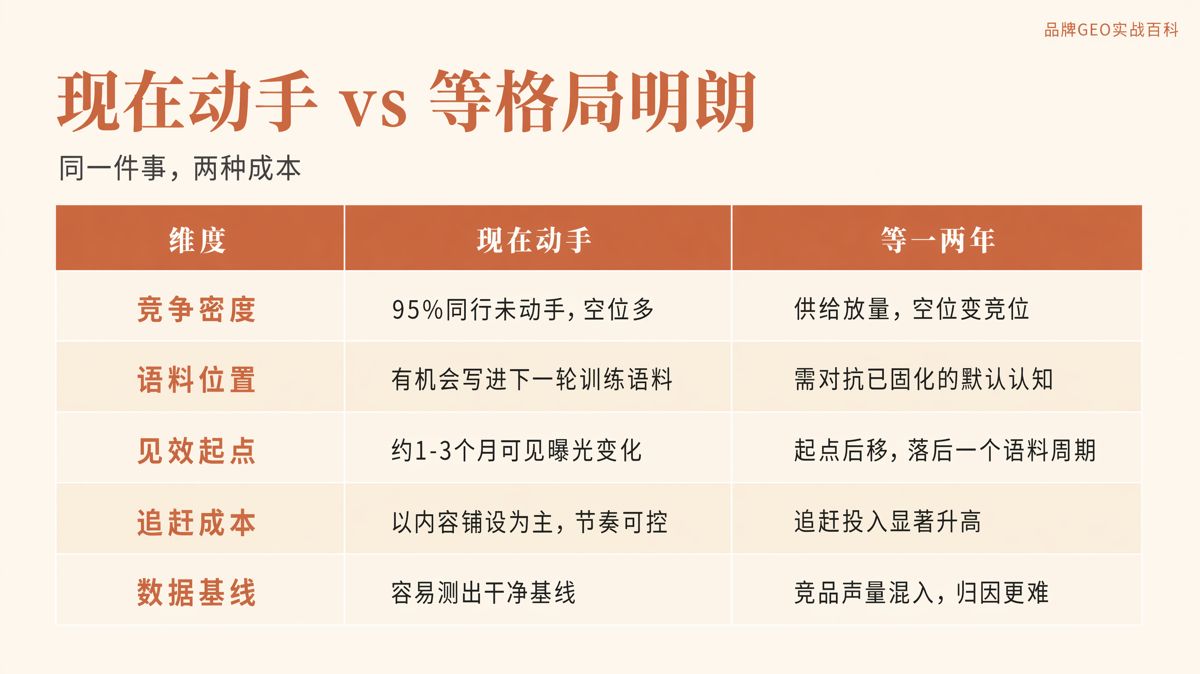
Starting Now vs. Waiting One to Two Years
| Dimension | Starting Now | Starting in 1–2 Years |
|---|---|---|
| Competition | Roughly 95% of peers have not started; low content supply for many queries | Increased competition as brand investment and service providers scale up |
| Training Corpora | Content has the opportunity to enter upcoming model training cycles | Risk of falling one full training cycle behind early movers |
| Time to Results | 1–3 months to observe exposure shifts; 3–6 months for stable baseline results | Execution cycle remains 3–6 months; starting later simply delays when results appear |
| Catch-up Cost | Primarily focused on content creation, technical indexing, and distribution | Overseas industry benchmarks estimate catching up after a 6-month delay costs $3,000–$8,000/month (domestic costs vary) |
| Measurement Clarity | Easier to establish a clean performance baseline with minimal competitor noise | Difficult to isolate brand impact from competing content saturation |
Starting later does not mean missing the boat entirely. GEO will likely become standard operating procedure for marketing teams, much like SEO. The difference is that entering now involves lower competition and provides room to observe real citation behaviors across platforms, whereas late entrants must overcome entrenched competitor citations.
Where Brands Should Distribute Content First
You cannot execute GEO without a foundation in SEO. As Google stated on May 15, 2026, optimizing for generative AI search fundamentally relies on core SEO principles. In China, the first step remains basic indexation: corporate websites indexed by Baidu, WeChat Official Account posts indexed by WeChat Search, and platform content discoverable via internal search bars.
SEO ensures content can be retrieved; GEO determines whether AI engines can understand, synthesize, and cite it. Without basic indexing, citations cannot happen.
Channel distribution should align with the specific retrieval preferences of target AI platforms:
- Tencent Yuanbao: Prioritize WeChat Official Accounts.
- ERNIE Bot (Baidu): Focus on Baijiahao (Baidu's content platform) and Baidu Baike (Baidu's encyclopedia).
- Doubao (ByteDance): Build presence on Douyin (TikTok's Chinese counterpart) and Toutiao (ByteDance's news platform).
- Kimi (Moonshot AI) and DeepSeek: Target Zhihu (China's leading Q&A community).
These alignments reflect observed industry patterns rather than rigid platform rules. Actual citations depend on query intent, content quality, publication recency, indexation status, and platform algorithms. Brands must validate results through continuous testing rather than assuming platform ownership guarantees citations.
Western channels follow comparable structural roles: Wikipedia mirrors Baidu Baike, Reddit and Quora parallel Zhihu for user discussions, YouTube mirrors Bilibili and WeChat Channels for video, and LinkedIn mirrors professional long-form articles on WeChat. However, because user demographics and retrieval algorithms differ, overseas tactics cannot simply be copied.
Industry observations also show that domestic AI engines currently cite authoritative media outlets and major platforms far more frequently than standalone corporate websites. A balanced strategy should develop both your primary website and external platform profiles, avoiding over-reliance on a single AI engine or channel.
Frequently Asked Questions
1. Is the GEO window the same as early-stage SEO?
No. While both feature early phases with low competition and limited content, their mechanics differ. SEO rankings update continuously and can be recovered relatively quickly through technical and on-page optimization. GEO is influenced by 6- to 18-month model training cycles and cross-source corroboration. Missing a training cycle can mean a longer, more expensive catch-up period.
2. How long does it take to see measurable results?
Industry data indicates that exposure changes can appear within 1 to 3 months, with comprehensive results taking 3 to 6 months. A typical project spends roughly 90 days establishing baseline metrics, technical indexing, content formatting, and external profiles, followed by approximately 180 days to assess sustained median impact. Expecting stable results within 30 days is unrealistic.
3. Is the "18-month window" accurate?
It is an unverified projection from industry whitepapers, not hard data. What can be verified: China's generative AI user base grew from 249 million to 602 million in one year; iiMedia Research forecasts the domestic GEO market will surpass 9 billion RMB in 2026; and mandatory AI content labeling took effect on September 1, 2025. The exact month count matters less than the steady rise in competition and compliance standards.
4. Can we focus exclusively on Doubao?
Focusing on a single platform carries significant risk. Ahrefs research indicates that 86% of top cited sources across different AI engines do not overlap. While international data cannot be applied directly to China, domestic AI engines also display divergent citation sources. While Doubao leads with roughly 345 million MAUs, Tongyi Qianwen and DeepSeek collectively account for nearly 300 million MAUs (industry estimates, unverified). Relying on one platform leaves substantial user segments untouched.
5. If our website is already comprehensive, are we doing GEO?
Not necessarily. A comprehensive website provides raw material, but you still need to verify whether pages are indexed, whether they directly answer conversational buyer queries, and whether AI engines actually cite them. Because domestic AI models often favor major content platforms over standalone domains, corporate content should be adapted into structured Q&A formats with verifiable metrics and distributed across platforms like Zhihu, WeChat Official Accounts, and Baijiahao.
6. Does bulk-generating AI content to save time carry compliance risks?
Yes. China's Measures for the Labeling of AI-Generated and Synthetic Content require clear explicit and implicit identifiers on AI-generated material. In addition, practices like keyword stuffing, scraped low-value text, fabricated claims, and exaggerated superlatives carry high risks of platform penalties and advertising violations. GEO requires authoritative, verifiable answers—spamming content does not improve citation odds.
7. Is it too late if we wait until the initial window passes?
No. GEO will not vanish overnight; it will gradually become a standard digital marketing discipline. Late entrants can still target long-tail, specific buyer queries. However, content volume and competitor dominance will be higher, making baseline measurement and visibility acquisition more demanding than they are today.
Conclusion
Whether your company should invest in GEO today should not be dictated by an arbitrary "18-month countdown"—it should be guided by buyer behavior.
China's generative AI user base has reached 602 million. Buyers are actively evaluating products and vendors through AI assistants, yet most companies have not built structured content designed for AI retrieval. That supply gap is the real opportunity.
Starting today does not guarantee immediate category leadership, and delaying does not permanently lock you out. However, building authoritative content, earning third-party citations, and establishing platform indexing require sustained effort. The earlier you begin testing, the sooner you discover which content engines cite and where your optimization efforts generate real pipeline.
The GEO window exists, but "18 months left" is an unverified industry estimate. What is certain is that competition is rising. The practical move is not chasing an unconfirmed countdown, but addressing real customer questions with verifiable content across multiple platforms today.
(Data sources cited: CNNIC 55th and 57th Statistical Reports on Internet Development in China, QuestMobile Q1 2026, National Business Daily, DerivateX 2026, Ahrefs, seoClarity, Quattr, iiMedia Research, OctoPlus Media public case study, and overseas GEO industry whitepapers. Figures labeled as industry estimates or forecasts have not been independently verified.)
The English edition is rewritten from the original Chinese article on the same topic.

Starbox AI is an AI marketing company based in Hangzhou, China. This article draws on Starbox project work. Please credit the source when quoting.
Related reading
 GEO Guide
Why AI Marketing Vendor Quotes Vary 10x: A 4-Step Vetting Checklist
Evaluate AI marketing proposals by delivery actions, not slide decks. Audit source infrastructure, fact cleaning, and clean-environment testing.
Oct 22, 2026 · 6 min read
 GEO Guide
Spotting GEO Scams: What Actually Drives AI Recommendations?
Automated AI ranking promises violate how LLMs work. Real AI recommendations rely on authoritative, structured facts across trusted public sources.
Oct 22, 2026 · 4 min read
 GEO Guide
How to Measure Your Brand's AI Visibility with a Spreadsheet
You do not need expensive software to track AI recommendations. A three-tier prompt framework and a simple spreadsheet can score your brand visibility in half a day.
Oct 21, 2026 · 6 min read