
Are B2B Buyers in China Using AI to Pick Suppliers?
The short answer
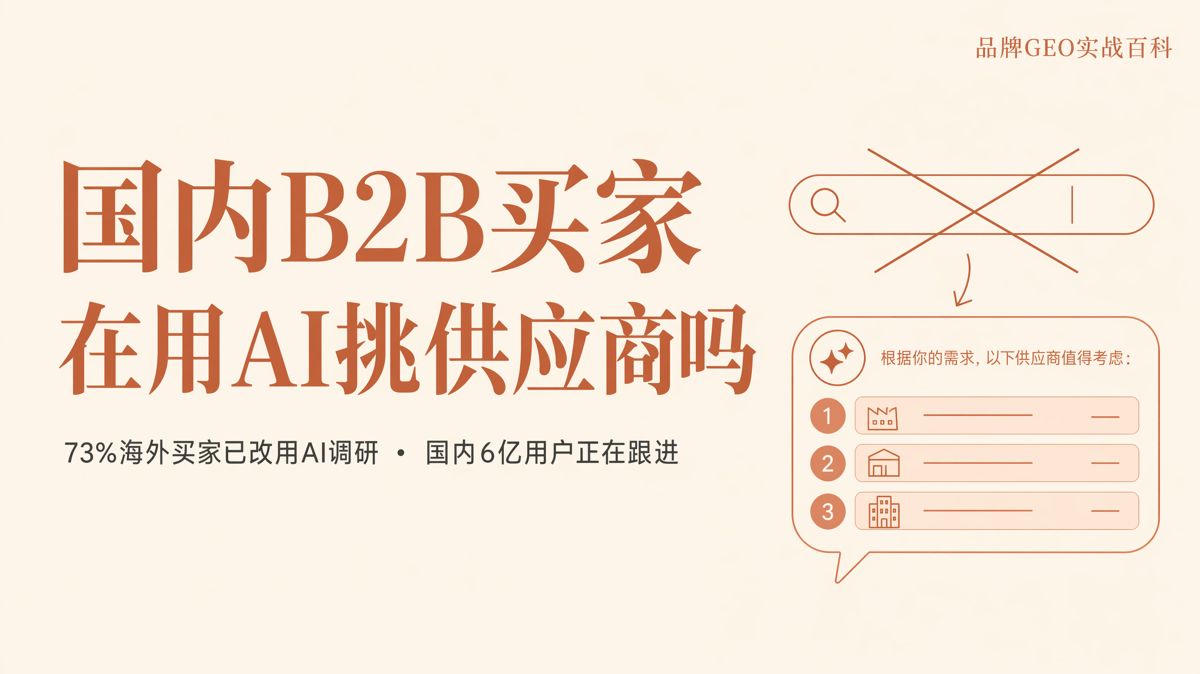
China lacks dedicated B2B surveys, but with 600M+ generative AI users and proven global shifts, procurement research is moving to AI chat.
Are business-to-business (B2B) buyers in China actively using artificial intelligence to pick suppliers?
It is too early to state that as an established fact. China has not yet seen dedicated B2B buyer surveys on the scale or methodology of Gartner or Forrester. However, overseas procurement behavior has shifted decisively, and the domestic user base for generative AI is expanding at an extraordinary pace.
For suppliers, Generative Engine Optimization (GEO) has shifted from an emerging concept into a practical pipeline question: when a buyer asks an AI assistant which vendors in your category are reliable, does your brand appear in the answer?
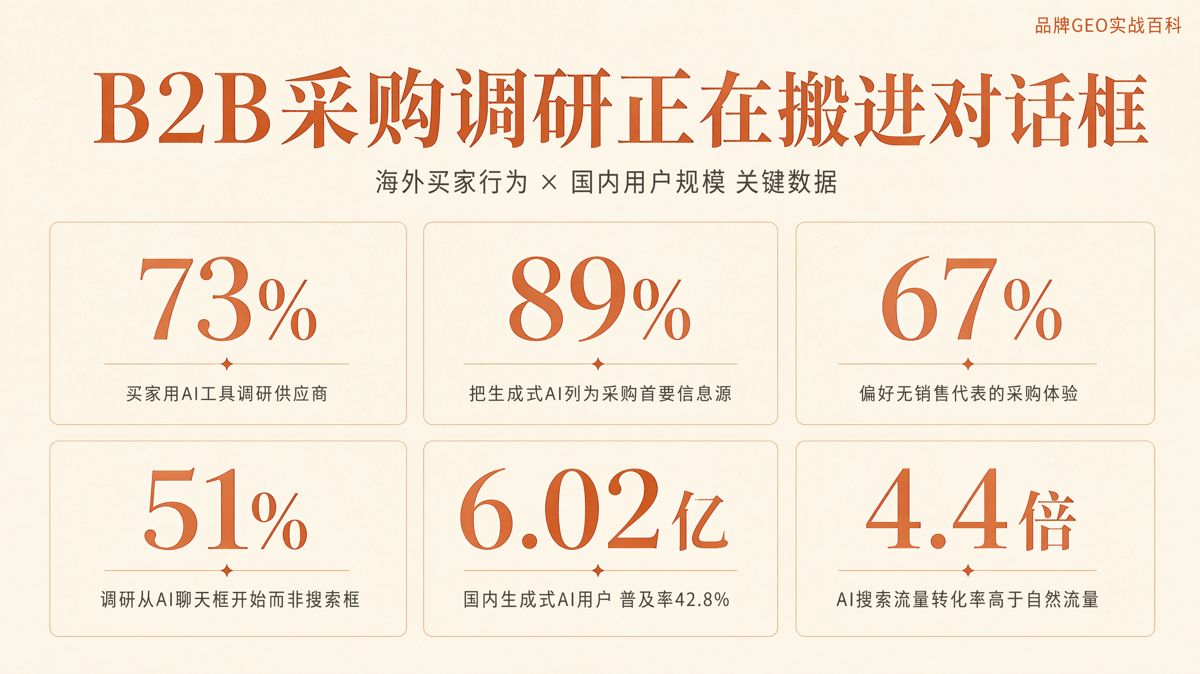
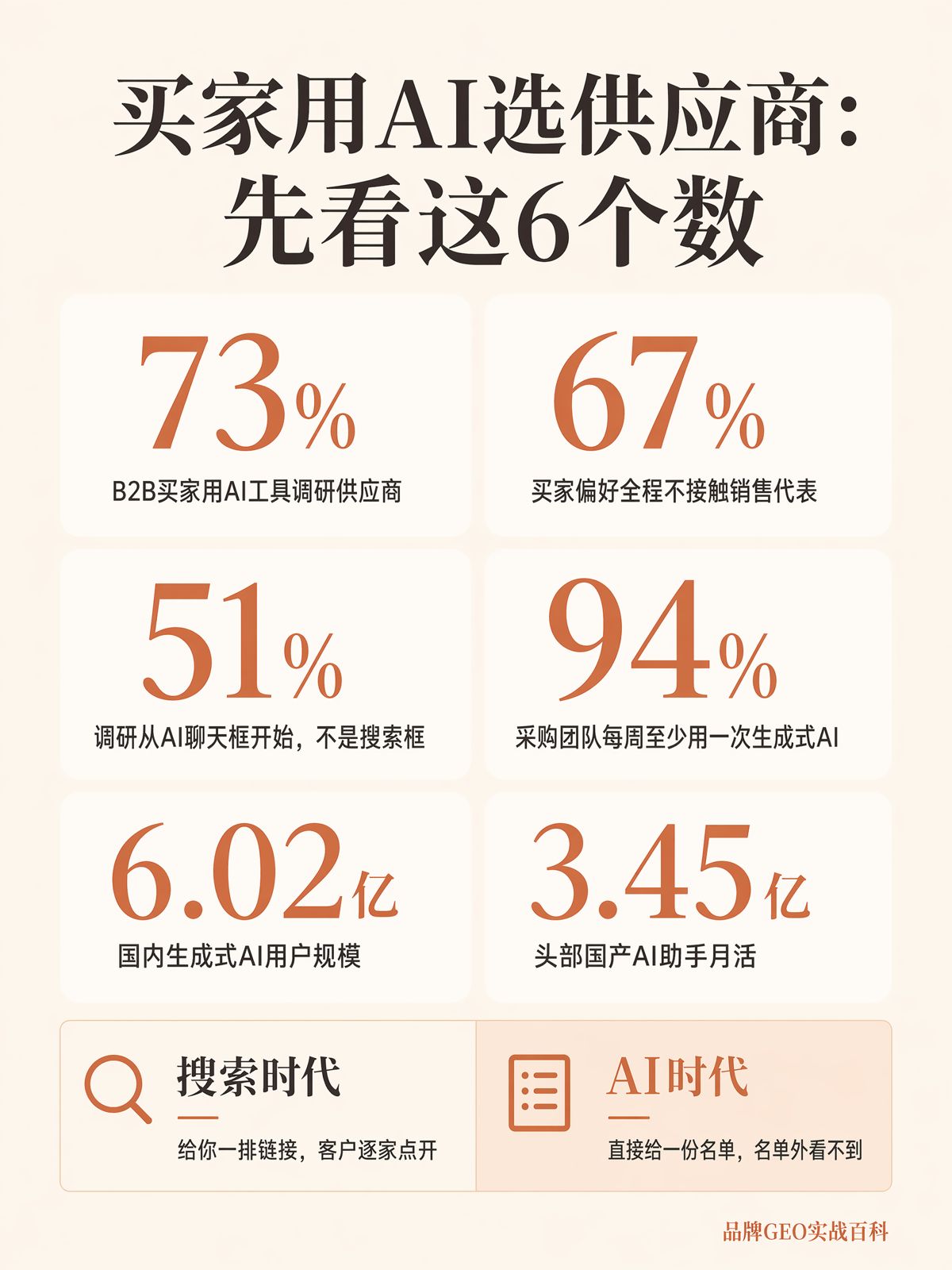
What we know for certain is that by December 2025, China's generative AI users reached 602 million, representing a 42.8% penetration rate and a year-over-year increase of 141.7%. What remains unconfirmed is how many of those 600 million users are actively using AI to evaluate suppliers.
The accurate takeaway is not that Chinese buyers have entirely replaced traditional procurement with AI. Rather, the infrastructure and habits are already in place, and the shift from search boxes to chat prompts is a trend B2B suppliers need to track now.
How Overseas B2B Buyers Are Already Using AI
Third-party research published between 2025 and 2026 highlights a significant change in how global B2B buyers conduct procurement research:
- A multi-source analysis published in March 2026 showed that 73% of B2B buyers use AI tools during procurement research, based on a sample of 680 million AI citations.
- A joint 2025 study by Forrester and 6sense revealed that 89% of B2B buyers rank generative AI as their primary self-service research source.
- Among procurement teams, 94% use generative AI at least once a week.
- Gartner reported in March 2026 that 67% of B2B buyers prefer a rep-free buying experience.
- G2 reported in 2026 that 51% of buyers started their most recent procurement research in an AI chat interface rather than a traditional search engine.
These behavioral shifts do not alter how contracts are signed so much as how vendors are screened. Buyers can ask an AI model to compile a list of manufacturers, compare specifications, analyze production capacity and certifications, and summarize public reviews before reaching out to sales reps.
When an AI engine summarizes the market down to three or four recommended vendors, brands left out of that initial answer may never make it to the RFP or due diligence stages. Most suppliers will never even know they were eliminated.
This is why the AI shift cannot be evaluated through website traffic alone. It fundamentally reshapes how buyers first encounter vendor information and how candidate shortlists are assembled.
What China's Data Shows—and What It Leaves Unanswered
China currently lacks enterprise buyer surveys comparable to those conducted by Gartner or Forrester. That means Western findings—such as the figure showing 73% of buyers research via AI—cannot be directly applied to the Chinese market.
However, the sheer size of China's generative AI user base is undeniable. The 57th Statistical Report from the China Internet Network Information Center (CNNIC) reported that domestic generative AI users reached 602 million by December 2025, up from 515 million in June 2025.
Platform metrics also indicate broad usage. According to QuestMobile and Q1 2026 industry media reports, Doubao (ByteDance's AI assistant) reached roughly 345 million monthly active users (MAUs), Tongyi Qianwen (Alibaba's AI model) reached 166 million, DeepSeek reached 127 million, and Tencent Yuanbao reached 57.35 million. These figures represent unverified industry estimates, but they reflect real scale.
Procurement managers, technical leads, and business owners are naturally part of this user base. A professional who uses Doubao for research or DeepSeek to organize technical documentation is very likely to ask those same tools for category recommendations or vendor evaluations.
This remains a reasonable inference based on evolving digital habits, rather than a conclusion proven by local B2B procurement surveys. International data shows how procurement behavior changes once AI becomes standard; domestic data shows that the foundation for that change is already here. Both point to the same priority: suppliers need to audit how they appear in AI-generated answers.
Four Stages Where AI Influences Procurement
AI currently assists B2B buyers across four primary research stages:
- Vendor Discovery: Buyers ask models to list the top domestic manufacturers for a specific component or service. This step determines whether a brand enters the buyer's initial consideration pool.
- Technical Evaluation: Buyers prompt AI tools to build comparative matrices covering technical specifications, production capacities, certifications, and delivery lead times.
- Reputation and Review Analysis: AI engines scan corporate websites, industry media coverage, Q&A forums like Zhihu, and encyclopedia entries to summarize vendor reputations. A self-serving corporate website alone rarely shapes how an AI engine evaluates a brand.
- Compliance Verification: Buyers query qualification records, ISO certifications, and public litigation histories to verify whether a vendor meets organizational compliance standards.
Across all four stages, suppliers can actively improve their position by ensuring that accurate, verifiable facts are accessible to AI crawlers. If public information about a company is missing, contradictory, or buried in empty marketing jargon, AI engines struggle to form a coherent recommendation.
While an overseas buyer might ask ChatGPT or Perplexity for the "Top 10 suppliers from China," a domestic buyer might ask Doubao, DeepSeek, or Tencent Yuanbao for category recommendations. The questions are similar, but the underlying sources cited by these engines differ significantly, which is why domestic GEO execution requires a distinct approach.
The Relationship Between GEO and SEO
Search Engine Optimization (SEO) improves website architecture and content to help web pages earn higher rankings and clicks in traditional search engine results pages.
Generative Engine Optimization (GEO) also requires discoverable content, but its primary goal is getting a brand referenced, synthesized, and recommended inside AI-generated answers. On May 15, 2026, Google stated publicly that optimizing for generative AI search remains, at its core, a form of SEO. Traditional SEO has not vanished; it serves as the essential technical foundation for GEO.
| Dimension | Traditional SEO | GEO |
|---|---|---|
| Optimization Goal | Higher search engine rankings and link clicks | Inclusion and citation within AI answers |
| Core Unit of Indexing | Entire web page | Standalone, quotable text blocks |
| Key Priorities | Keyword density, page indexing, backlink building | Factual density, Q&A structuring, third-party brand mentions |
| Primary Domestic Channels | Baidu, Sogou search results | Doubao, DeepSeek, Tencent Yuanbao, ERNIE Bot answers |
| Typical Timeline | 3 to 6 months (industry estimate) | 1 to 3 months for initial visibility changes (industry estimate) |
| Core Metrics | Keyword rankings, organic search traffic | AI citation rate, brand mention frequency |
"Organic traffic" refers to visitors arriving at a website through unpaid search results.
Search engine data confirms this shift. In April 2026, a Semrush study of 10 million keywords found that Google AI Overviews appeared on 48% of queries. Earlier, in December 2025, an Ahrefs study of 300,000 keywords showed that when an AI Overview appeared, the click-through rate for the top organic result fell by 58%. Unverified industry estimates in China similarly suggested that over 60% of search queries triggered AI summaries on major domestic engines by early 2026.
Previously, businesses fought for top positions on a page of links. Today, brands must monitor whether AI synthesizes their information directly. If an AI engine provides a complete answer in the chat interface, the buyer has little incentive to click through to an external site.
Where Chinese AI Engines Source Information
Overseas GEO strategies typically concentrate on standalone websites, Wikipedia, Reddit, and YouTube. Research from 5W Research shows that Wikipedia and Reddit together account for over 25% of all citations in US ChatGPT queries.
China's information architecture is structured differently. Industry observations indicate that domestic AI engines favor platforms within their respective parent ecosystems:
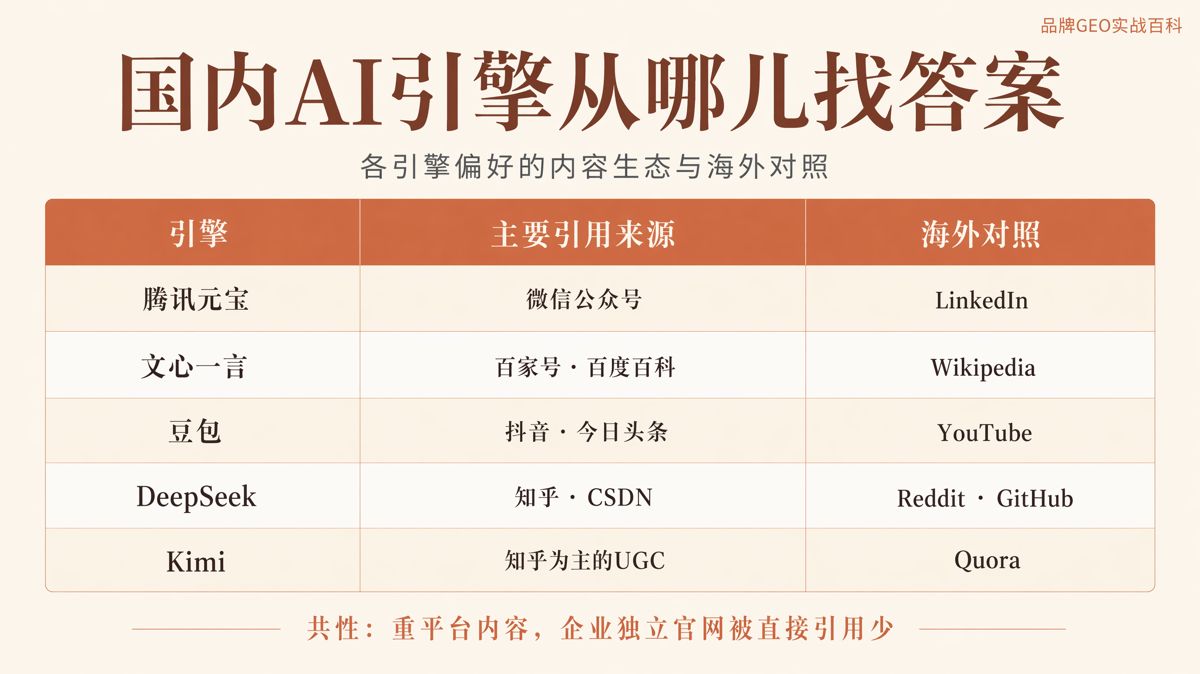
- Tencent Yuanbao frequently references WeChat Official Accounts.
- ERNIE Bot (Baidu's AI model) prioritizes Baijiahao (Baidu's content platform) and Baidu Baike.
- Doubao draws heavily on Douyin and Toutiao.
- Kimi and DeepSeek frequently cite Zhihu (China's largest Q&A platform), with DeepSeek also indexing technical communities like CSDN.
These ecosystem preferences represent industry observations rather than fixed, deterministic rules, but they provide a practical roadmap for channel distribution.
As a rough comparison, Baidu Baike serves a role similar to Wikipedia; Zhihu mirrors Reddit and Quora for community discussions; WeChat Official Accounts function similarly to LinkedIn for publishing long-form industry insights; and Bilibili mirrors YouTube for video explainers. These platforms share similar formats, but their indexing depth and retrieval weight vary across models.
Several domestic service providers and brokerage reports have outlined a four-tier credibility hierarchy used by Chinese AI engines:
- Tier 1: Government portals, industry associations, and authoritative news media (highest probability of adoption by AI engines).
- Tier 2 & 3: Properly licensed enterprise websites (with valid ICP filings) and established industry media accounts.
- Tier 4: Unverified sites, affiliate farms, and promotional link networks (frequently filtered out by retrieval systems).
While Western AI models regularly cite independent corporate websites with strong technical SEO, domestic AI models rely far more heavily on major content platforms and authoritative institutions. For Chinese B2B suppliers, this means maintaining a baseline official website while prioritizing verified content on WeChat Official Accounts, Zhihu, Baidu Baike, and Baijiahao.
Why Suppliers Should Start Testing Now
1. AI-Driven Visits Deliver Higher Conversion Rates
A Semrush analysis of more than 500 high-intent search topics revealed that traffic from AI search converts at roughly 4.4 times the rate of standard Google organic search. Ahrefs reported that while AI search accounted for just 0.5% of its total website visits, those visitors drove 12.1% of all new user sign-ups.
"Conversion rate" measures the percentage of visitors who complete a targeted action, such as booking a demo or submitting an inquiry. While these metrics reflect specific case studies, they illustrate a broader trend: buyers searching via AI have often completed their preliminary research and arrive with clearer intent.
2. Most Competitors Have Not Adopted GEO
Industry estimates indicate that roughly 95% of domestic B2B enterprises have not yet systematically implemented GEO, leaving an estimated early-mover window of around 18 months. These figures represent unverified industry observations, but they reflect a market that is still early in adoption.
In one verified case study, a Chinese Application Delivery Network (ADN) vendor serving enterprise clients restructured its technical content into a standardized "Problem–Analysis–Conclusion–Case" format and distributed it across Doubao, Kimi, and DeepSeek. Over several months, the brand's AI visibility rose from 25% to 88%, accompanied by a 388.9% increase in monthly qualified leads.
While individual results vary, the case demonstrates that clear content structure, authoritative distribution channels, and factual consistency directly impact brand presence in AI responses.
3. Factual Authority Takes Time to Compound
Foundational large language models update their core training corpora every 6 to 18 months. Content published today not only feeds real-time retrieval-augmented generation (RAG) systems but can also be incorporated into future model training runs, creating enduring brand recognition.
If a competitor steadily builds a repository of verified, third-party documentation, AI models will default to citing them when answering category-level questions. Latecomers cannot easily overcome that deficit overnight; doing so requires publishing substantial content and waiting for search engines to crawl, index, and weight it. Starting with a baseline audit today is far more effective than trying to catch up later.
Four Practical Steps to Begin
Step 1: Benchmark Your Baseline Visibility
Compile a list of 30 questions a prospective buyer in your industry would ask, such as:
- "Which manufacturers produce [product category] in China?"
- "How do I verify [industry standard] certifications?"
- "Between Supplier A and Supplier B, who offers shorter delivery cycles?"
- "Who are the leading domestic suppliers for [specialized component]?"
Run these prompts across Doubao, DeepSeek, Tencent Yuanbao, and ERNIE Bot. Record whether your brand is mentioned, which competitors appear, and which source links the AI cites. Most brands discover during their first audit that their citation rate is close to zero. That baseline provides the benchmark for future optimization.
Step 2: Align Distribution Channels with Platform Citation Patterns
Use observable platform preferences to guide your content publishing:
- WeChat Official Accounts for Tencent Yuanbao
- Baijiahao and Baidu Baike for ERNIE Bot
- Zhihu for DeepSeek and Kimi
- Douyin and Toutiao for Doubao
Do not treat this mapping as a rigid checklist. Run real tests within your specific industry before allocating resources, as platform preferences vary significantly across different industrial sectors.
Step 3: Structure Content for Easy Citation
Format content with clear question-based headings. State conclusions upfront before detailing supporting evidence, cite verified metrics, and append concise FAQ sections to complex technical topics. Structuring each section as an independent question-and-answer pair makes it simple for AI crawlers to extract and cite distinct text blocks.
Equally important is earning third-party mentions. Research by iProspect and Hallam found that third-party brand mentions have roughly three times the impact on AI citations compared to traditional backlinks. Data from seoClarity showed a 0.664 correlation between online brand mentions and appearances in AI answers, compared to just 0.218 for traditional backlinks.
While correlation does not equal causation, the takeaway for B2B brands is clear: earn coverage in trade publications, participate constructively in Zhihu technical discussions, and publish case studies containing verified performance data.
Step 4: Comply with AI Labeling Regulations and Platform Guidelines
China's Measures for the Labeling of Artificial Intelligence-Generated and Synthetic Content took effect on September 1, 2025. Any content produced with AI assistance must include both explicit and implicit markers in accordance with regulatory requirements.
Major content platforms actively penalize keyword stuffing, automated content spinning, fabricated authority signals, and unsubstantiated claims. Teams can use AI tools to assist with drafting, but every data point, technical claim, and citation must be reviewed by humans and properly labeled before publication.
Whether Chinese B2B procurement has broadly adopted AI search cannot yet be proven by local surveys. However, documented shifts in global buyer habits, the rapid expansion of China's generative AI user base, and AI's ability to synthesize vendor data all indicate that suppliers can no longer rely solely on website traffic and keyword rankings.
The most practical path forward is neither blind adoption nor inaction. Start by auditing your current presence using real buyer prompts: verify whether your brand appears, check if the information provided is accurate, and identify which sources the models rely on. Establishing those facts gives your business an objective foundation for every GEO decision that follows.
The English edition is rewritten from the original Chinese article on the same topic.

Starbox AI is an AI marketing company based in Hangzhou, China. This article draws on Starbox project work. Please credit the source when quoting.
Related reading
 GEO Guide
Why AI Marketing Vendor Quotes Vary 10x: A 4-Step Vetting Checklist
Evaluate AI marketing proposals by delivery actions, not slide decks. Audit source infrastructure, fact cleaning, and clean-environment testing.
Oct 22, 2026 · 6 min read
 GEO Guide
Spotting GEO Scams: What Actually Drives AI Recommendations?
Automated AI ranking promises violate how LLMs work. Real AI recommendations rely on authoritative, structured facts across trusted public sources.
Oct 22, 2026 · 4 min read
 GEO Guide
How to Measure Your Brand's AI Visibility with a Spreadsheet
You do not need expensive software to track AI recommendations. A three-tier prompt framework and a simple spreadsheet can score your brand visibility in half a day.
Oct 21, 2026 · 6 min read