
Why AI Search Traffic Converts at a Higher Rate
The short answer
AI search referrals convert at significantly higher rates than organic search. Here is what the data shows and why generative search changes buyer behavior.
Data from multiple international studies shows that traffic from artificial intelligence (AI) search converts at a substantially higher rate than traditional organic search.
This trend sits at the core of Generative Engine Optimization (GEO)—the practice of improving your content's retrievability, clarity, and authority so generative AI engines cite your brand in their answers. While current benchmarks prove a clear performance gap between these two traffic channels, they do not mean AI search alone causes conversions.
It also does not mean traditional search engine optimization (SEO) is obsolete. SEO ensures search engines can discover and index your pages; GEO focuses on whether generative models understand and cite your information in generated answers. They complement each other. Today, the most grounded explanation is simple: visitors arriving from AI search have more specific requirements, have already reviewed comparative data, and sit much closer to a purchase decision.
What the Public Data Shows
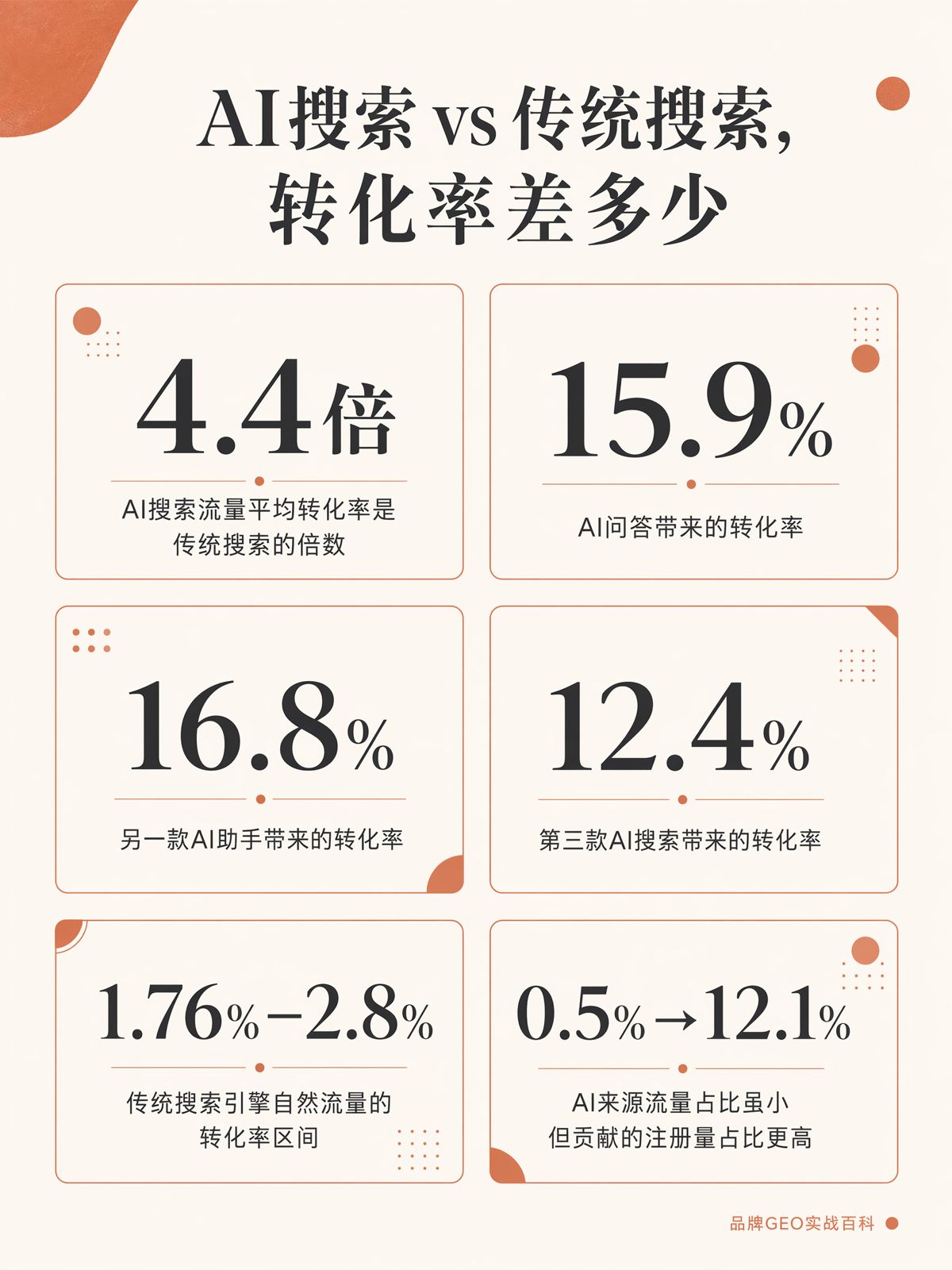
In 2026, Semrush analyzed over 500 high-value topic clusters. The study found that traffic referred by AI search engines converts at an average rate 4.4 times higher than Google organic search.
Looking across individual platforms, the performance breakdown is stark:
- Traffic from ChatGPT converted at 15.9%.
- Traffic from Claude converted at 16.8%.
- Traffic from Perplexity converted at 12.4%.
- Google organic search averaged between 1.76% and 2.8%.
First-party data published by Ahrefs tells a similar story. AI referrals represented just 0.5% of total site traffic, yet generated 12.1% of all new signups. By Ahrefs' internal metrics, these visitors converted roughly 23 times more efficiently than traffic from other channels.
In an enterprise software case study published by Discovered Labs, AI-referred traffic delivered an 18.7% conversion rate over a 90-day testing window, compared to 6.7% for standard traffic—a 2.8x difference.
Broader B2B SaaS industry observations report conversion advantages ranging from 6x to 27x. However, because these industry benchmarks use varied tracking criteria and attribution models, they should be treated as observational ranges rather than third-party audited standards.
Three Reasons for the Conversion Gap
1. Prompts Are Far More Specific
Traditional search queries usually start with brief keyword phrases, such as "CNC suppliers" (Computer Numerical Control machining). Someone typing those two words could be a student researching manufacturing or a procurement officer ready to sign a contract. Users at every stage of the funnel arrive on the same results page.
In contrast, prompts entered into AI search tools are far more detailed: "Which medical device CNC suppliers hold the necessary CE compliance certifications and offer delivery within 15 days?"
When a user specifies their industry, compliance standards, and required lead time, their objective shifts from finding options to vetting qualified vendors. Specific prompts reflect mature intent, indicating a buyer who is already near a decision.
2. Buyers Review Comparisons Before Clicking
A traditional search engine presents a list of ranked links. The user must open multiple tabs, evaluate credibility on their own, and assemble their own comparison matrix.
An AI engine synthesizes multiple crawlable sources into a single structured summary tailored to the prompt. A single synthesized response often draws from 10 to 30 citations. By the time a user clicks an attribution link, they have already reviewed a synthesized comparison. They are not visiting your site to learn the basics.
This shifts initial desk research and early screening upstream, before the click occurs. While overall traffic volume is lower, the users who do click arrive with clear intent.
3. B2B Research Habits Have Shifted
This shift is particularly pronounced in enterprise B2B purchasing:
- 73% of B2B buyers use AI tools to research vendors, according to a multi-source analysis of 680 million citations (joint study, March 2026).
- 89% of B2B buyers rank generative AI as their top self-serve information source during procurement research (Forrester and 6sense joint study, 2025).
- 67% of B2B buyers prefer a rep-free buying experience (Gartner Sales Survey, March 2026).
Additional industry estimates suggest that 94% of procurement team members use generative AI at least once a week, though methodology details for that figure vary.
Enterprise buyers must verify capabilities, qualifications, turnaround times, and contract terms. When an AI tool handles that preliminary legwork, the buyers who finally land on a vendor's page are far more qualified than casual browsers.
AI Search vs. Traditional Search: Key Differences
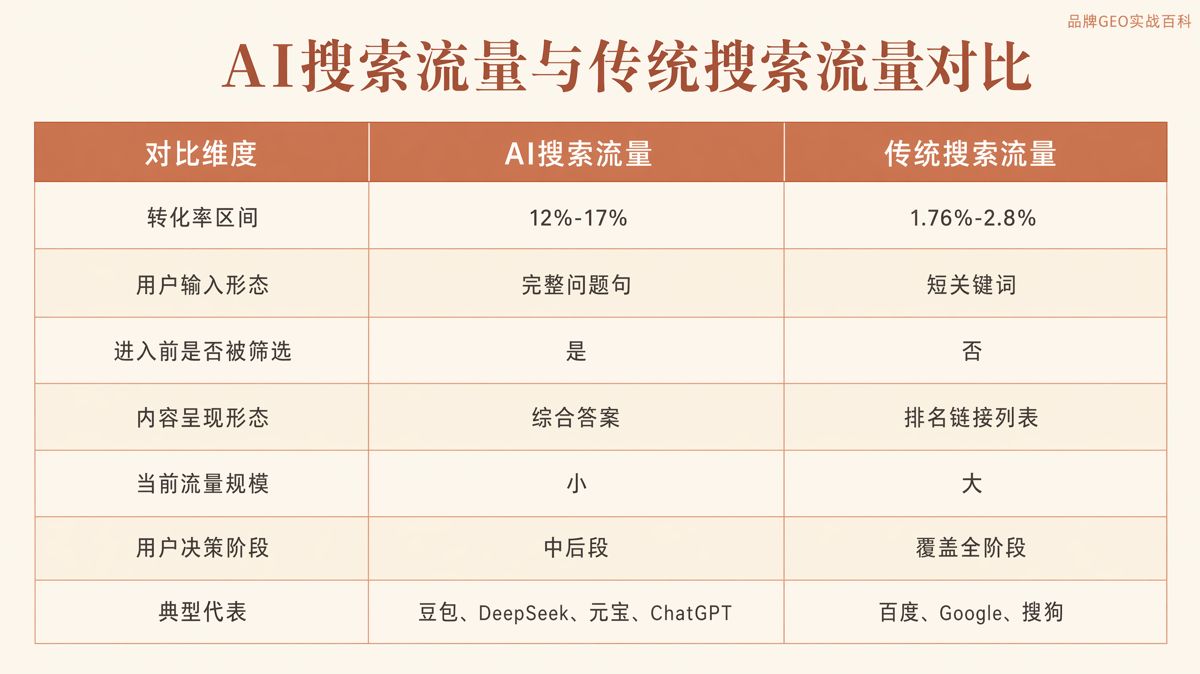
| Dimension | AI Search Traffic (GEO) | Traditional Search Traffic (SEO) |
|---|---|---|
| Average Conversion Rate | Roughly 12% to 17% (varies by platform) | Roughly 1.76% to 2.8% |
| Query Format | Full, detailed questions (often 10–20 words) | Short keywords (often 3–5 words) |
| Pre-Click Evaluation | AI synthesizes and compares multiple sources | Users must open individual links to evaluate |
| Delivered Content | Synthesized answer with citations | A ranked list of web links |
| Current Share of Traffic | Below 0.15% across industry benchmarks; 0.5% on Ahrefs' own site | High volume; remains the primary web gateway |
| User Journey Stage | Active evaluation and vendor validation | Broad mix, from early discovery to final purchase |
| Common Platforms in China | Doubao, DeepSeek, Yuanbao, Wenxin, Kimi | Baidu, Sogou, 360 Search |
| Common Global Platforms | ChatGPT, Perplexity, Google AI Overviews | Google, Bing organic search |
High Conversion Rates Do Not Mean High Traffic Volumes
This distinction is critical when interpreting the data.
The absolute volume of traffic from AI search engines remains modest. Across broader industry analytics, AI referrals still account for under 0.15% of all web traffic. Ahrefs reported 0.5% on its own site. While measured differently, both metrics show that AI search is not yet a primary traffic driver by volume.
At the same time, Semrush reported in 2026 that zero-click searches on Google reached 64.82%. Users frequently find their answers directly on the results page without clicking through to an external site.
A high conversion rate simply means that each individual visitor is more likely to sign up, request a demo, or complete a purchase. It does not mean AI search is driving massive pipeline volume on its own. When evaluating GEO, monitor both traffic scale and downstream conversion efficiency.
GEO Complements SEO Rather Than Replacing It
Both GEO and SEO rely on the same prerequisite: content must be discoverable and indexable by crawlers.
SEO ensures that search systems crawl, index, and rank web pages. GEO ensures that generative engines read, understand, and cite that information inside AI responses.
In its search documentation released on May 15, 2026, Google clarified that optimizing for generative AI search remains fundamentally part of SEO. If your content cannot be crawled and indexed by search engines, generative models will not cite it.
The same rule applies across ecosystems. In China, whether an AI assistant can retrieve a brand's assets depends on foundational indexing across Baidu, WeChat Search, and Douyin in-app search. You cannot optimize for AI citations if baseline indexing is broken.
Western and Chinese Conversion Funnels Work Differently
On global tools like ChatGPT and Perplexity, citation links typically point to standalone websites or dedicated product landing pages. A user clicks through to register, book a demo, or submit an inquiry. This model works well for high-average-order-value (AOV) B2B deals and subscription SaaS.
In China, generative AI tools pull from their parent ecosystems:
- Yuanbao (Tencent's AI assistant) frequently draws from WeChat Official Accounts.
- Wenxin (Baidu's AI model, also known as ERNIE Bot) relies heavily on Baijiahao (Baidu's content platform) and Baidu Baike.
- Doubao (ByteDance's AI assistant) frequently cites content from Douyin and Toutiao.
These patterns reflect current industry observations rather than fixed technical guarantees, and results vary by query.
Because of this, brands in China cannot rely solely on standalone websites. They must build clear conversion paths inside closed ecosystems—such as WeChat menu bars, WeCom customer service touchpoints, and WeChat Mini Programs.
Furthermore, China's market does not yet have third-party audited studies on AI conversion multiples comparable to the research published by Semrush or Ahrefs. While the core behavioral drivers—specific user intent and pre-click evaluation—apply globally, the exact conversion multiplier for Chinese platforms remains to be validated by independent research.
Which Companies Benefit Most from GEO?
Deciding whether to invest in GEO depends less on current referral volume and more on your deal size and sales cycle.
Industrial manufacturing, B2B SaaS, and specialized corporate services involve high contract values and extended evaluation cycles. In these sectors, even a small stream of AI-referred visitors can justify the investment if each qualified lead represents meaningful revenue.
Conversely, low-ticket consumer brands that rely on impulse buying do not need to redirect their marketing budgets based on early conversion data. For consumer goods, the sensible path is to maintain traditional SEO and core marketplace distribution before expanding into GEO.
How to Earn Citations in AI Answers
To ensure generative engines can process and reference your content, follow four structural principles:
- Lead with clear conclusions. Answer the core question in the opening lines so both readers and parsers grasp the takeaway immediately.
- Keep sections modular. Write paragraphs that communicate a complete idea without requiring deep surrounding context.
- Attribute data and establish parameters. When sharing metrics, state the data source, timeframe, and methodology boundaries clearly.
- Use clear headings and logical hierarchy. Structure your document so both human readers and language models can map the relationships between concepts.
Clear writing is not about gaming an algorithm. The easier your content is to verify, extract, and cite, the more likely generative engines are to feature it—and the faster buyers can make a decision.
AI search traffic matters not because it has supplanted traditional search, but because it delivers buyers who know exactly what they need. Keep your technical SEO sound, maintain steady content indexing, and start tracking AI referrals and conversions in your analytics. Reviewing traffic volume alongside conversion rates is the only way to measure GEO's true return on investment.
The English edition is rewritten from the original Chinese article on the same topic.

Starbox AI is an AI marketing company based in Hangzhou, China. This article draws on Starbox project work. Please credit the source when quoting.
Related reading
 GEO Guide
Why AI Marketing Vendor Quotes Vary 10x: A 4-Step Vetting Checklist
Evaluate AI marketing proposals by delivery actions, not slide decks. Audit source infrastructure, fact cleaning, and clean-environment testing.
Oct 22, 2026 · 6 min read
 GEO Guide
Spotting GEO Scams: What Actually Drives AI Recommendations?
Automated AI ranking promises violate how LLMs work. Real AI recommendations rely on authoritative, structured facts across trusted public sources.
Oct 22, 2026 · 4 min read
 GEO Guide
How to Measure Your Brand's AI Visibility with a Spreadsheet
You do not need expensive software to track AI recommendations. A three-tier prompt framework and a simple spreadsheet can score your brand visibility in half a day.
Oct 21, 2026 · 6 min read