
How Much Traffic Is AI Search Taking? What the Data Shows
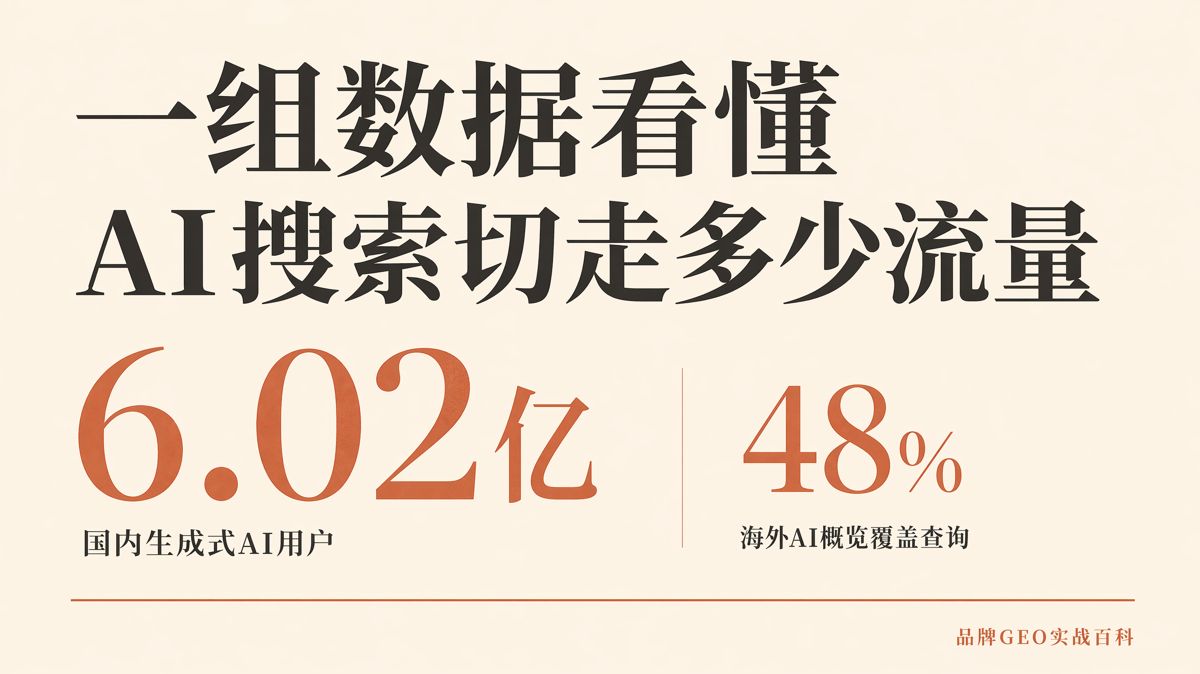
The short answer
AI search has not reduced search intent, but it is siphoning clicks. Here is what global and Chinese benchmarks reveal about zero-click behavior and conversion.
Artificial intelligence (AI) search has not stopped people from asking questions. What it has changed is how people get answers. In the past, a user ran a search and clicked through several web pages. Today, more and more questions are answered directly inside an AI-generated response.
Websites are losing organic clicks as a result, but the underlying demand has not disappeared.
This shift is why Generative Engine Optimization (GEO) has become a priority. GEO does not simply track where a page ranks on a traditional search engine results page (SERP); it focuses on whether an AI engine retrieves, recognizes, and cites your brand and content.
To evaluate how far this shift has progressed, looking at website traffic alone is not enough. You have to evaluate three variables together: the size of the AI user base, the proportion of zero-click searches, and how traffic referred by AI actually converts.
Three Data Categories to Distinguish First
The numbers discussed below carry different levels of verification and serve different purposes. They need to be evaluated separately.
- Public research data: Official reports such as the China Internet Network Information Center (CNNIC) user statistics, along with large-sample studies from Semrush and Ahrefs, reflect shifts that have already taken place.
- Industry and vendor estimates: Monthly active users reported by research firms such as QuestMobile, domestic query AI-trigger rates, and platform-specific citation preferences lack comprehensive third-party cross-verification. Use these figures to spot trends, not as exact mathematical truths.
- Projections: Forecasts regarding the size of China's GEO market or AI search penetration by 2030 indicate potential trajectory. They are not guaranteed outcomes.
China's Generative AI User Base Has Surpassed 600 Million
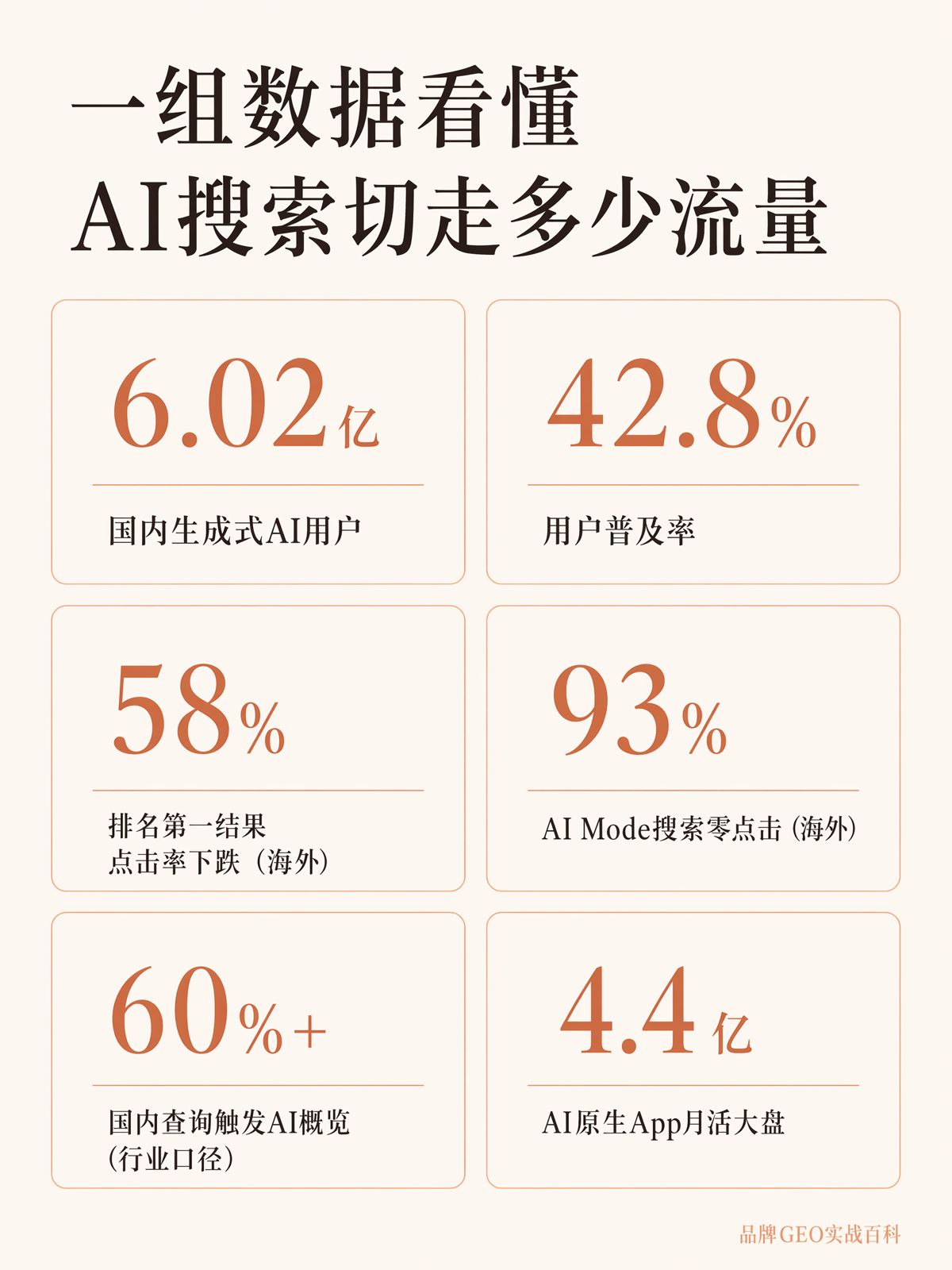
As of December 2025, China's generative AI user base reached 602 million people, representing a 42.8% penetration rate and a year-over-year increase of 141.7%, according to the 57th CNNIC report.
Looking at the trajectory over time clarifies the pace of adoption: * December 2024 (CNNIC 55th Report): 249 million users (17.7% penetration) * June 2025: 515 million users (36.5% penetration) * December 2025: Over 600 million users (42.8% penetration)
Generative AI is no longer a niche tool for tech enthusiasts. At a 42.8% penetration rate, more than four out of every ten internet users in China use generative AI tools in daily life.
Where Users Are Concentrated
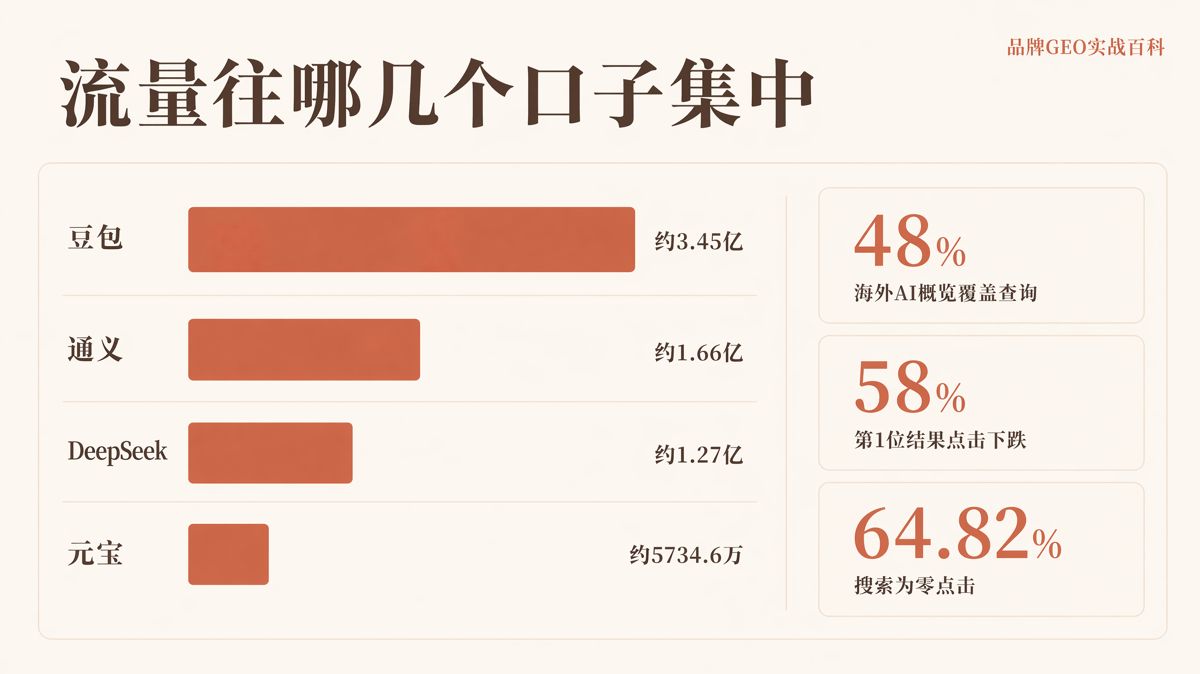
According to Q1 2026 industry data from QuestMobile, AI-native applications—apps whose primary interface is an AI assistant—reached approximately 440 million monthly active users (MAU) in China. While this vendor-reported figure has not been independently verified, it offers a snapshot of the competitive landscape.
Within this dataset: * Doubao (ByteDance's AI assistant): ~345 million MAU; ~140 million daily active users (DAU) * Tongyi (Alibaba's AI assistant): ~166 million MAU * DeepSeek: ~127 million MAU * Yuanbao (Tencent's AI assistant): ~57.3 million MAU * Kimi (Moonshot AI's assistant): ~8.3 million MAU * Wenxin (Baidu's AI assistant, also known as ERNIE Bot): Fell from a peak of ~15 million MAU to ~5 million MAU (QuestMobile and Daily Economic News Q1 2026 estimates, unverified)
For marketing teams, the critical insight is not just total user volume, but platform fragmentation. China's leading AI assistants belong to distinct content ecosystems: ByteDance, Alibaba, Tencent, and Baidu. Each pulls citations from different pools of data. Monitoring visibility in only one engine will not give you an accurate picture of your brand's presence across AI search.
AI Search Cuts Clicks, Not Demand
There is currently no single verified figure that applies across all domestic Chinese industries to show exactly how much traffic AI search has taken. Western data provides a useful benchmark, though it cannot be mapped one-to-one onto the Chinese market.
As of April 2026, Google AI Overviews covered 48% of search queries, according to Semrush data across a sample of 10 million keywords. In a December 2025 study of 300,000 keywords, Ahrefs found that when an AI Overview is present, the click-through rate (CTR) for the top organic result drops by 58% compared with control queries.
In Google AI Mode (Google's conversational search interface), the zero-click rate reached 93%. Across all Google searches combined, 64.82% of queries resulted in zero clicks to an external website.
A "zero-click search" means the user found their answer directly on the search results page or inside the AI-generated answer, without clicking through to an external site.
This behavior confirms that search intent has not disappeared. What changed is the user's next step. Previously, users had to open multiple web pages to assemble complete information. Now, the AI response resolves many inquiries on the spot.
A similar trend is underway in China. Industry estimates suggest that by early 2026, over 60% of domestic queries triggered an AI summary, and Baidu's Wenxin search began integrating AI summaries directly into SERPs. While this figure lacks third-party verification, search results in China are clearly moving toward direct AI answers.
Lower Volume, Higher Conversion
A drop in click volume does not mean all traffic has lost value. Studies indicate that while AI referral traffic remains small in volume, it converts at a significantly higher rate than traditional organic traffic in many samples.
Conversion rate here refers to the percentage of visitors who complete a key action—such as submitting an inquiry, registering, or making a purchase.
- Semrush analysis (500+ high-value topics): Traffic referred by AI converted at an average rate 4.4 times higher than organic Google search traffic.
- Ahrefs own site data: AI referral traffic represented just 0.5% of total site traffic, but generated 12.1% of sign-ups—roughly a 23-fold outperformance.
- Broader industry case studies: AI referral traffic conversion advantages range between 4x and 23x. In several B2B industry benchmarks, the gap ranges from 6x to 27x.
These numbers do not guarantee that AI traffic automatically converts better in every vertical. However, there is a clear behavioral explanation: users who click through a citation link inside an AI answer have already had their basic questions addressed. They are visiting the source to review specific details, evaluate options, or take action, placing them closer to a purchase or inquiry decision.
Content teams should avoid measuring AI performance by traffic volume alone. Track inquiry rates, registration rates, sales conversion rates, and customer acquisition costs alongside raw visits.
Global vs. China: Same Direction, Different Landscapes
Traditional SEO ensures web pages are indexed and ranked in organic search results. With AI search, content faces an additional hurdle: can an AI engine extract, verify, and cite the information?
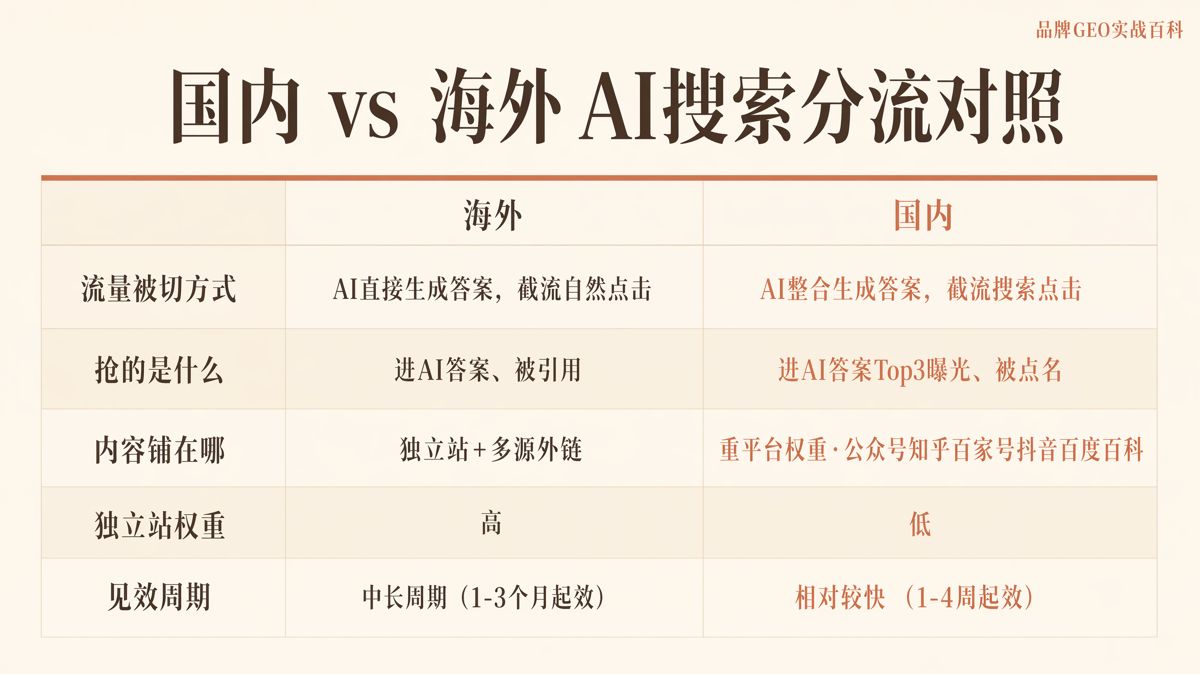
Both Western and Chinese markets are shifting from competing for page rankings to competing for AI citations, but the distribution infrastructure is different.
| Dimension | Global (Western) Ecosystem | China Ecosystem |
|---|---|---|
| Click Impact | Google AI Overviews compress organic clicks; 64.82% of all Google searches end without a click. | Wenxin and other engines show direct AI summaries; industry sources report >60% of queries trigger summaries (unverified). |
| Content Objective | Get cited as a reference link inside AI answers. | Gain brand mentions or prominent citations early in the AI response. |
| Typical Sources | Corporate websites, Reddit, YouTube, Wikipedia, industry media. | WeChat Official Accounts, Zhihu, Baijiahao, Douyin, Baidu Baike (unverified industry observations). |
| Role of Owned Sites | High-performing corporate domains are frequently cited directly. | AI assistants rely heavily on major media and mega-platforms; standalone corporate sites carry less relative weight. |
| Time to Visibility | Typically 3 to 6 months. | Industry sources claim changes can appear in 1 to 3 months (unverified). |
In Western markets, an optimized corporate website paired with external citations is often sufficient. In China, relying solely on an owned corporate website makes it difficult to achieve broad visibility across AI assistants. You have to account for closed platform ecosystems.
Why China Requires Multi-Platform Content Distribution
Observations regarding which AI assistants prefer which platforms come largely from agency tests and vendor reports rather than third-party audits. Treat them as working hypotheses for testing, not immutable rules.
Current industry observations suggest: * Yuanbao (Tencent): Frequently cites WeChat Official Accounts. * Wenxin (Baidu): Frequently cites Baijiahao (Baidu's content platform) and Baidu Baike (Baidu's encyclopedia). * Doubao (ByteDance): Frequently cites Douyin (ByteDance's short-video platform) and Toutiao (ByteDance's news feed). * Kimi and DeepSeek: Frequently cite Zhihu (China's leading Q&A platform), CSDN (a major developer community), and open technical forums.
If an article is published only on WeChat Official Accounts, it may be indexed by Yuanbao but missed entirely by Doubao or Wenxin. A safer strategy is to establish a core set of verified facts, format that content for each target platform, distribute it across relevant ecosystems, and track which engines pick it up.
Western data shows a similar divergence. An Ahrefs study found that 86% of top-cited domains across different Western AI search engines did not overlap. Because China's content platforms operate inside even more distinct walled gardens, this platform divergence requires deliberate, isolated testing.
SEO Remains Necessary, but It Cannot Replace GEO
Assuming that good SEO automatically solves AI search is a mistake.
SEO covers foundational discovery: crawling, indexing, and baseline ranking. If an AI search engine cannot find your content, it cannot include it in its candidate pool.
Once content enters that candidate pool, however, the AI evaluates whether the text contains clear, self-contained, factually structured statements that are easy to extract and summarize.
High organic search rank does not guarantee an AI citation. Studies in Western search show a declining overlap between the top 10 organic SERP results and the domains cited in AI Overviews. For marketing teams: SEO answers whether your page can be found; GEO answers whether your content is structured well enough to be cited.
Projections Indicate Direction, Not Certainty
Research firm iiMedia Research projects that China's GEO market will exceed 9 billion RMB in 2026, growing at more than 70% year over year. Other industry reports forecast that by 2030, AI search penetration will reach 91%, serving over 1 billion users.
These figures are market forecasts. They cannot be treated as realized commercial results, nor can they guarantee returns on specific marketing spend. What they confirm is broad industry consensus that AI search usage will continue expanding.
The verified historical data provides a solid enough foundation on its own: * China's generative AI user base reached 602 million. * Google AI Overviews cover 48% of sampled queries. * Domestic Chinese search results are actively deploying direct AI summaries.
How much budget you allocate depends on your category, but establishing a baseline measurement for your brand's presence in AI answers should not wait.
Three Immediate Steps for Content Teams
1. Establish an AI Visibility Baseline
AI visibility measures whether your brand appears in AI-generated answers, where it is placed, and whether your content is cited as a source.
Build a test list containing brand queries, product terms, and category-level problem statements. Run these prompts across Doubao, Tongyi, DeepSeek, Yuanbao, and Wenxin. Document whether your brand appears, its position, the sources cited, and factual accuracy. Without this baseline, you cannot evaluate the impact of future optimizations.
2. Restructure Information for Extraction
AI models favor modular, self-contained information blocks. State your conclusion first, then provide supporting data, sources, parameters, and context. Dedicate each section to a single question rather than blending topics.
Always attribute data sources. Label industry estimates as "vendor/industry estimates" and label forecasts clearly as "projections." This makes your content reliable for readers and helps AI engines retain factual boundaries when quoting your text.
3. Adapt and Verify by Platform
Because Chinese AI assistants pull from distinct ecosystems, publish your verified facts across multiple channels. Adapt the formatting to match WeChat Official Accounts, Zhihu, Baijiahao, and technical forums, then monitor which AI engines index and cite them.
The goal is not indiscriminate copy-pasting. Maintain identical core facts, numbers, and brand positioning, while adapting structure and tone to each platform's native style.
Three Common Misconceptions
Misconception 1: A drop in organic traffic means search demand is dying
Fewer website visits do not indicate falling demand. Users are still asking questions; they are simply consuming answers directly within search results or AI chats. Assess keyword volume, zero-click rates, and AI Overview coverage before assuming search demand has dropped.
Misconception 2: AI referral traffic is too small to justify investment
While AI referral volume is currently low, data from Semrush and Ahrefs shows that visitors arriving via AI citations convert at a significantly higher rate than traditional organic traffic. Base your investment decisions on conversion efficiency and customer acquisition cost, not raw visit counts alone.
Misconception 3: Top organic rankings guarantee AI citations
Organic rankings and AI citations correlate, but they are not the same mechanism. A high ranking increases the likelihood of retrieval, but whether your site is quoted depends on whether the text provides clear, modular, verifiable answers.
The Bottom Line
There is no universal percentage that defines exactly how much traffic AI search has taken from websites across all industries in China. That limitation must be acknowledged.
What the verified evidence confirms is clear: * In global Google search, 64.82% of queries result in no external link clicks. * The presence of AI Overviews cuts the top organic result's CTR by 58% in tested samples. * In China, over 60% of queries reportedly trigger AI summaries (according to unverified industry estimates), and search engines are expanding direct AI answer formats.
The key metric is not a single traffic percentage. It is the convergence of three shifts: AI user bases are expanding, search interfaces are answering questions directly, and the users who do click through AI citations convert at substantially higher rates.
For brands, the mandate has changed. Securing page-one rankings is no longer enough. You need to know whether AI engines mention your brand, whether the cited sources are accurate, and whether different AI models deliver consistent information about your business. That is the operational focus of GEO.
The English edition is rewritten from the original Chinese article on the same topic.

Starbox AI is an AI marketing company based in Hangzhou, China. This article draws on Starbox project work. Please credit the source when quoting.
Related reading
 GEO Guide
Why AI Marketing Vendor Quotes Vary 10x: A 4-Step Vetting Checklist
Evaluate AI marketing proposals by delivery actions, not slide decks. Audit source infrastructure, fact cleaning, and clean-environment testing.
Oct 22, 2026 · 6 min read
 GEO Guide
Spotting GEO Scams: What Actually Drives AI Recommendations?
Automated AI ranking promises violate how LLMs work. Real AI recommendations rely on authoritative, structured facts across trusted public sources.
Oct 22, 2026 · 4 min read
 GEO Guide
How to Measure Your Brand's AI Visibility with a Spreadsheet
You do not need expensive software to track AI recommendations. A three-tier prompt framework and a simple spreadsheet can score your brand visibility in half a day.
Oct 21, 2026 · 6 min read