
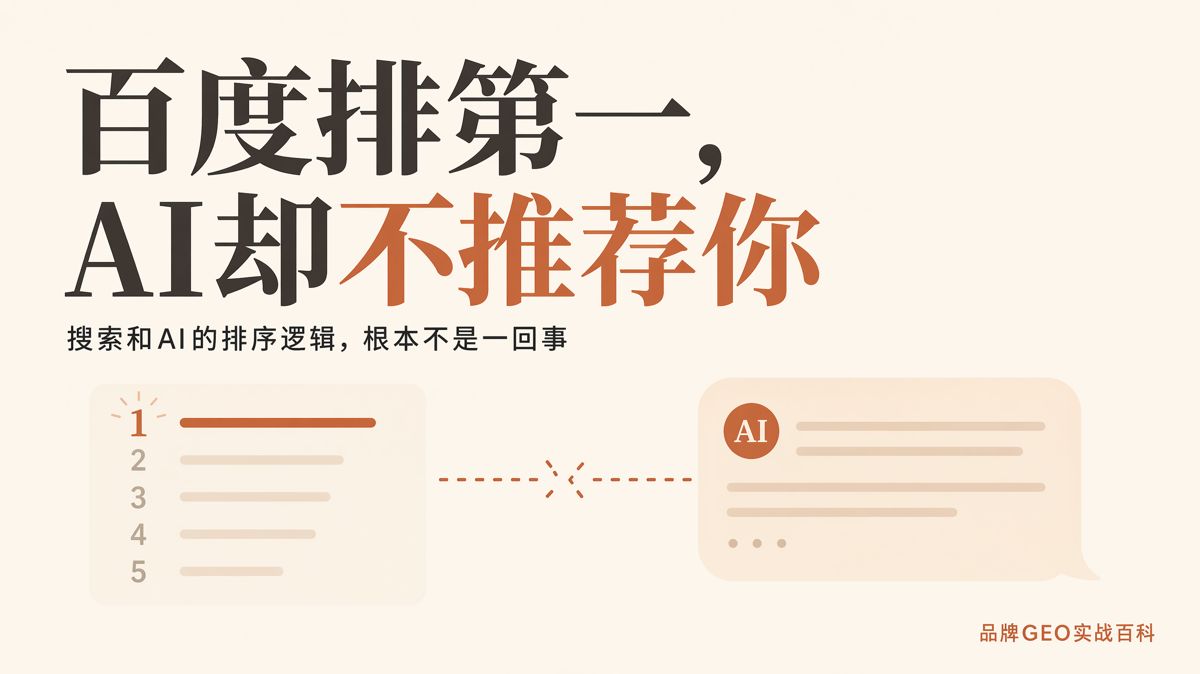
Ranking #1 on Baidu? Why AI Still Might Not Recommend You
The short answer
Ranking #1 in traditional search does not guarantee AI citations. Learn why AI engines skip top-ranking pages and how to optimize for Generative Engine Optimization (GEO).
Ranking first on Baidu—or any traditional search engine—proves that your page performs well under traditional search engine optimization (SEO). It does not mean an AI engine will include your brand in generated answers.
Generative Engine Optimization (GEO) focuses on whether generative AI can retrieve, understand, extract, and cite your content. While SEO and GEO share common technical roots, they measure different units and pursue different outcomes.
Traditional search engines deliver a list of web links, aiming to earn user clicks. Generative AI directly composes an answer, extracting only modular, fact-checked fragments from a small candidate pool. A page with top organic rankings can still be completely omitted by AI if it lacks standalone quotable snippets, third-party corroboration, or consistent brand data.
The Difference Between Search Rankings and AI Citations
Traditional SEO evaluates pages as complete units, balancing keyword matches, backlinks, domain authority, and page experience. Generative AI looks inside the page. It evaluates individual passages: Does this specific paragraph answer the prompt? Are the facts verifiable? Is the source trustworthy? Does the excerpt stand on its own without surrounding context?
Google noted in its May 15, 2026 AI optimization guidance that content cited by generative engines must still meet standard search crawl and index requirements. Indexation is a prerequisite, not a guarantee of citation.
Data from seoClarity underscores this gap. Following Google's upgrade of AI Overviews to Gemini 3 on January 27, 2026, the share of AI Overview citations drawn from the top 10 organic search results dropped from 76% to 38%. Traditional rank position no longer reliably predicts AI citation.
How AI Synthesizes Answers from the Web
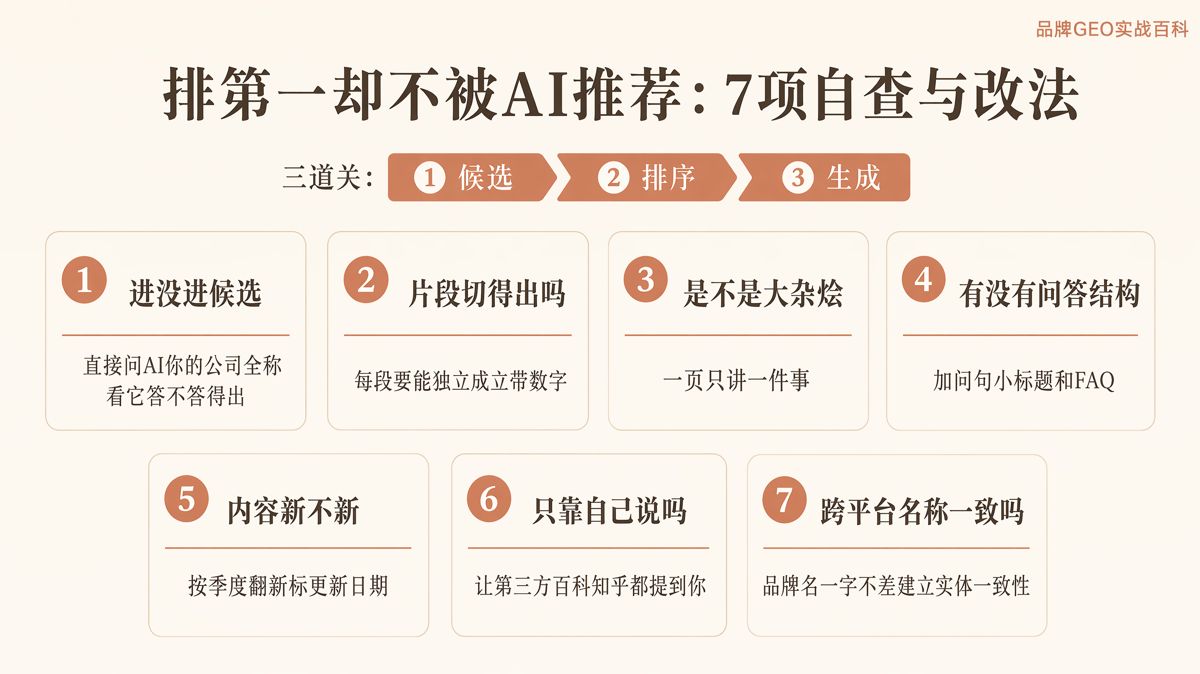
While individual platforms implement custom retrieval pipelines, most generative engines follow a three-stage evaluation process to assemble answers.
1. Candidate Retrieval
The system translates user prompts into search queries, scanning web indexes, pre-trained corpora, and partner platforms to pull 20 to 100 candidate pages. Pages with strong organic rankings and healthy indexation are more likely to make this initial candidate pool, but rank is not the sole filter.
2. Reranking
The engine re-scores candidate sources based on semantic relevance, source credibility, content freshness, readability, and brand entity consistency. Only 5 to 15 top-scoring sources advance to answer generation.
3. Extraction and Synthesis
The engine breaks the surviving pages into modular chunks of roughly 200 to 500 words. It tests whether each chunk supports the answer, whether its facts can be cross-verified against other sources, and whether claims align across different publishers. Finally, it weaves a selected few into the synthesized response, appending source citations.
Search rankings primarily influence your entry into Stage 1. Getting through Stages 2 and 3 requires an entirely different set of content attributes.
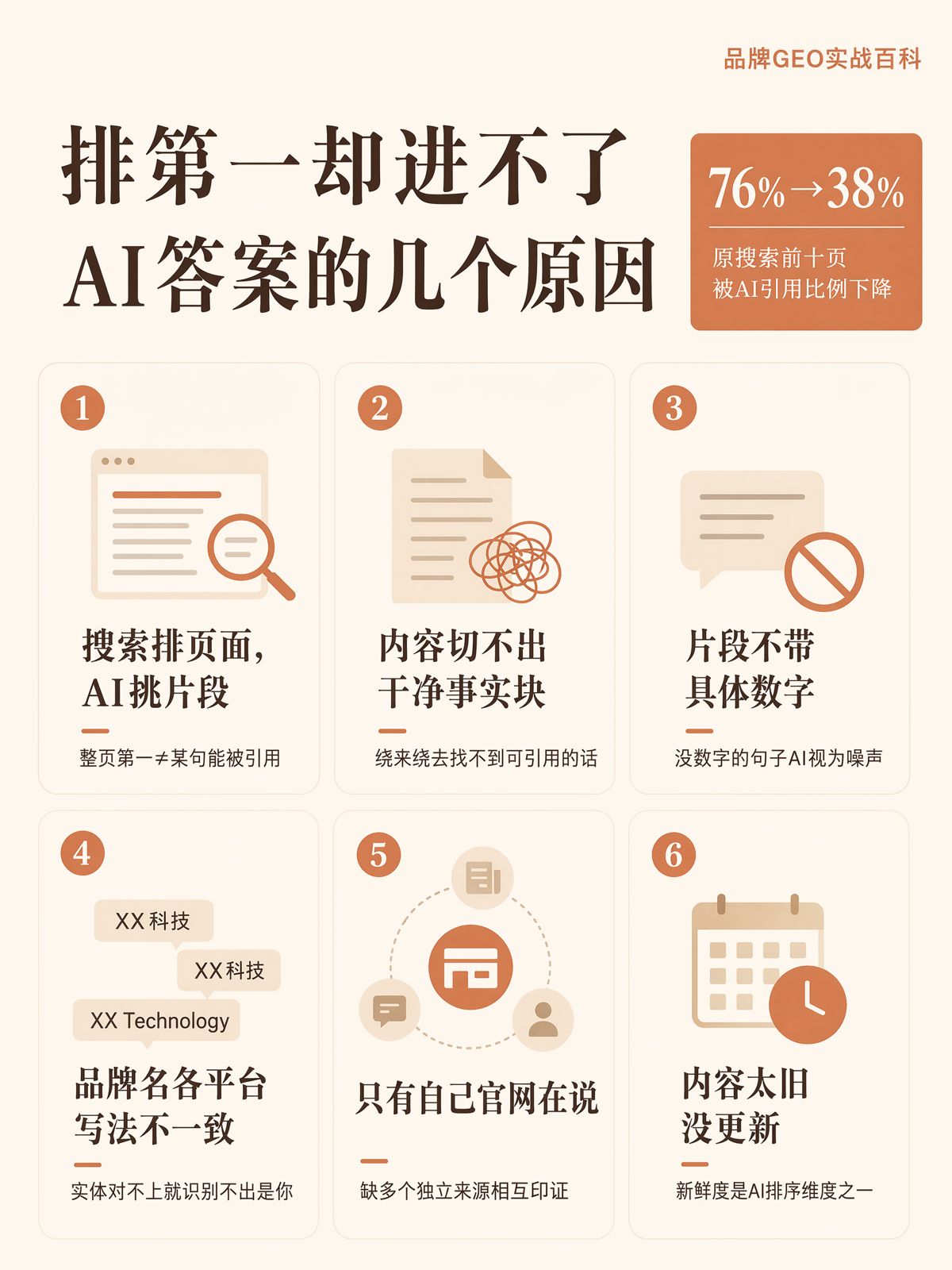
What AI Evaluates During Reranking
| Evaluation Factor | What the AI Evaluates | Common Flaws in High-Ranking Pages |
|---|---|---|
| Semantic Relevance | Whether a specific paragraph directly answers the query, rather than simply repeating keywords | Packed with target terms, but lacks a direct answer to the prompt |
| Source Authority | Site trust, author bylines, third-party mentions, and citations in press or encyclopedias | Relies entirely on brand self-claims without independent validation |
| Content Freshness | Publish dates, recent updates, and ongoing third-party citations | Ranks on historical domain authority while content remains outdated |
| Chunk Usability | Clear subheadings, self-contained paragraphs, explicit data points, and documented sources | Conflates multiple topics, making standalone extraction impossible |
| Entity Consistency | Matching brand names, entity registrations, and business scope across platforms | Inconsistent corporate profiles prevent the AI from validating the entity |
"Entity consistency" refers to whether the AI recognizes your brand as the exact same organization across diverse sources. If your legal company name, brand identity, founding year, core product category, and leadership profiles vary across platforms, the AI's entity resolution algorithms may fail to connect the data points.
Empirical data from seoClarity reveals that brand web mentions correlate with AI Overview appearances at r = 0.664, compared to r = 0.218 for traditional backlinks (where the correlation coefficient r measures statistical association, not direct causation).
Similarly, research from iProspect and Hallam suggests that brand web mentions carry roughly three times the influence of backlinks in driving AI citations across aggregate study samples. This does not mean three web mentions automatically produce one citation, but it confirms that generative engines prioritize third-party brand footprint over isolated link equity.
Why Comprehensive Long-Form Pages Fail to Get Cited
Traditional SEO often consolidates multiple related subtopics into a single long-form guide to capture broad keyword clusters. Generative AI, however, requires self-contained text fragments. Length alone does not equal utility.
When a 5,000-word article spans seven distinct subtopics where every paragraph depends on the preceding text—relying on vague transitions rather than clear conclusions, specific numbers, and verifiable citations—it may rank well on search engines, but an AI model cannot easily extract a usable answer snippet.
Use these five criteria to test whether your paragraphs are AI-citable:
- The first sentence delivers a clear, standalone conclusion.
- The paragraph addresses only one specific question.
- It contains at least one verifiable numerical data point.
- It cites at least one corroborating source.
- It runs between 60 and 150 words and makes complete sense out of context.
Long-form content remains valuable. According to seoClarity, articles with 2,900 words or more see 59% higher citation rates than articles under 800 words. However, this metric reflects correlation: longer content simply provides more space to host well-structured, modular factual snippets.
An Ahrefs study of the top 1,000 pages cited by ChatGPT found that 67% came from original research, primary datasets, or academic literature. Generative engines favor content that delivers unique information gain. Generic adjectives like "leading manufacturer" or "high-quality service" provide zero evidentiary value for AI synthesis.
Why AI Demands Independent Sources
When constructing an answer, generative engines assess three foundational questions: Can the claim be verified? Do multiple sources say the same thing? Are those sources truly independent?
Distributing identical promotional articles across ten third-party platforms does not give you ten independent sources. Modern language models recognize syndicated brand self-publishing as duplicate output from a single entity. By contrast, a single mention in an independent industry report, reputable news outlet, or primary research dataset provides credible evidentiary support.
Brands cannot rely solely on their own websites. You must cultivate consistent mentions across independent authorities—industry platforms, encyclopedias, media publications, and reputable community platforms like Zhihu (China's largest Q&A platform). These mentions do not always need a hyperlink; as long as the AI can resolve the entity and cross-verify the data, it contributes directly to your brand footprint.
How to Audit Why High-Ranking Pages Are Ignored by AI
| Audit Area | Diagnostic Method | Remediation Step |
|---|---|---|
| Candidate Retrieval | Ask the AI to introduce your full company name. Verify founding details and product categories. | If unindexed, standardize your entity details and update major knowledge bases and directories. |
| Fragment Usability | Audit your top-ranking pages for standalone paragraphs that pair conclusions with data and citations. | Restructure paragraphs: lead with the core answer, follow with evidence and sources. |
| Topical Drift | Check if a single URL attempts to solve multiple unrelated business problems. | Break the article into focused single-topic URLs that answer one query thoroughly. |
| Q&A Architecture | Check whether subheadings reflect natural user queries and if the page ends with a clear FAQ section. | Convert H2/H3 headers into direct questions; add 6 to 8 structured FAQs at the bottom. |
| Information Decay | Check publication dates, last-updated tags, and referenced data points. | Conduct quarterly content reviews and display explicit "last updated" timestamps. |
| Self-Citation Bias | Check whether brand claims exist outside your owned corporate domains. | Secure consistent, verifiable third-party coverage across 5 to 10 industry-relevant platforms. |
| Entity Consistency | Audit your brand name, legal entity name, founding year, and primary services across all web profiles. | Eliminate naming discrepancies across all public directories to reduce entity confusion. |
Rather than expending resources to move from rank #3 to rank #1 on traditional search, focus on engineering citable content fragments and building consistent, verifiable entity data across the web.
Platform Ecosystems Rely on Different Data Sources
Content retrieval rules vary significantly across AI models. In China, platforms like Tencent Yuanbao, Baidu Wenxin (ERNIE Bot), Doubao (ByteDance's AI assistant), Kimi (Moonshot AI's assistant), and DeepSeek use different retrieval architectures, content partnerships, and training sets.
Industry observations generally reflect the following distribution patterns: - Tencent Yuanbao draws heavily from WeChat Official Accounts. - Baidu Wenxin prioritizes Baijiahao (Baidu's content platform) and Baidu Baike (Baidu's encyclopedia). - Doubao frequently references Douyin (TikTok's Chinese sister app) and Toutiao (ByteDance's news aggregator). - Kimi and DeepSeek show high retrieval frequencies from Zhihu.
These patterns represent industry observations rather than fixed technical guarantees across every query. Marketing teams must run standardized prompt tests across each platform individually.
This divergence is not unique to China. An Ahrefs study across global engines revealed that 86% of top-cited domains across ChatGPT, Perplexity, and Google AI Overviews do not overlap. High visibility on one platform does not translate into automated coverage on another. Multi-platform visibility requires tailored distribution and testing across each ecosystem.
Is Traditional SEO Still Necessary?
Yes.
AI systems must discover and index your content before they can evaluate it for synthesis. Google's official guidance from May 15, 2026 confirms that optimization for generative search builds directly upon strong technical SEO fundamentals. In the Chinese ecosystem, web properties must still solve indexation on Baidu, content must clear WeChat Search (Weixin Souyisou) indexing, and platform-specific assets must meet internal search standards.
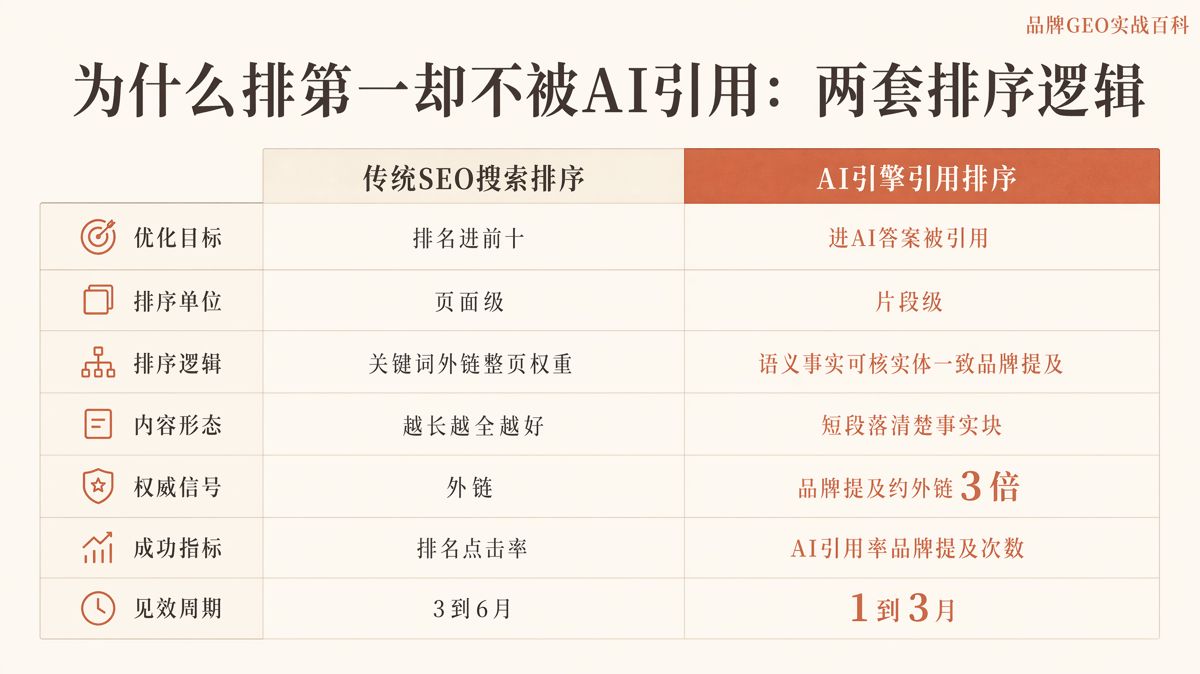
SEO and GEO share foundational requirements: crawlability, clear semantic architecture, factual credibility, and identifiable sources. The difference lies in their operational objectives:
| Dimension | Traditional SEO | Generative Engine Optimization (GEO) |
|---|---|---|
| Core Objective | High search rank, organic user clicks | Direct inclusion in AI answers, brand citations |
| Unit of Evaluation | The web page | Modular content fragments |
| Ranking Determinants | Keywords, backlink equity, page experience | Semantic relevance, verifiable facts, entity consistency, web mentions |
| Content Structure | Comprehensive long-form guides | Modular paragraphs, direct conclusions, standalone data points |
| Query Formats | Short keywords (3-5 words) | Natural language queries (10-20 words) |
| Authority Signals | Backlinks and domain metrics | Independent mentions, entity alignment, corroborated data |
| Primary KPIs | Rank position, organic traffic, CTR | Citation rate, brand mention frequency, AI referral traffic |
| Typical Timeframe | 3 to 6 months (industry benchmark) | 1 to 3 months for initial visibility, with ongoing dynamic shifts |
Timeframes reflect general industry estimates, not guaranteed outcomes. Actual timelines depend on your industry vertical, competitive baseline, and existing technical infrastructure.
How to Make High-Ranking Pages AI-Citable
- One core topic per page. If a page covers multiple complex themes, divide it into focused URLs. Do not sacrifice depth for artificial breadth.
- Phrase subheadings as natural-language questions. Open the paragraph directly beneath the heading with your core answer, then provide data and citations.
- Separate facts, research, and industry commentary. Always cite underlying datasets for statistical claims. Never present correlation as causation. When referencing platform preferences, clearly distinguish between third-party empirical data and industry consensus.
- Standardize corporate entity records. Ensure your legal entity, brand trade name, founding timeline, and product portfolio read identically across your website, encyclopedias, social channels, and public business directories.
- Keep long-form guides, but modularize paragraphs. Comprehensive guides can still dominate search, provided each subsection is written as an independent, extractable block.
- Audit content freshness on a regular schedule. Refresh outdated figures, update timestamps, and remove unsubstantiated claims so that older, high-ranking pages do not serve obsolete information.
Compliance Considerations for AI-Generated GEO Content
Generative AI accelerates research and drafting, but mass-publishing automated copy does not lead to higher citation rates.
Under China's Measures for the Labeling of Artificial Intelligence Generated Synthetic Content—jointly issued by the Cyberspace Administration of China, the Ministry of Industry and Information Technology, the Ministry of Public Security, and the National Radio and Television Administration, effective September 1, 2025—all AI-synthesized content must feature both explicit and implicit identifiers. Explicit labels alert the user, while implicit metadata is embedded within the file structure. Failure to label synthetic content risks penalties and delisting.
Regulatory directives in 2026 have also expanded "data pollution" enforcement to curb the spread of mass-produced, low-quality, and repetitive synthetic text. Beyond legal exposure, search and AI engines readily flag programmatic, identical soft-launch articles as duplicate output from a single source, nullifying their evidentiary value.
The responsible path is to use AI for initial synthesis and structuring, followed by mandatory human review of facts, primary sources, editorial clarity, and regulatory watermarking. Every asset you publish must deliver verifiable information gain.
Traditional search rankings determine whether users see your link. AI citations determine whether your brand shapes the answer. Ranking first on Baidu remains valuable, but it is purely an index-level victory. It cannot substitute for cross-platform entity consistency, verifiable facts, and independent corroboration.
The metric that matters in generative search is no longer just where your page ranks—it is whether AI models can verify your brand and extract your content as an authoritative source.
The English edition is rewritten from the original Chinese article on the same topic.

Starbox AI is an AI marketing company based in Hangzhou, China. This article draws on Starbox project work. Please credit the source when quoting.
Related reading
 GEO Guide
Why AI Marketing Vendor Quotes Vary 10x: A 4-Step Vetting Checklist
Evaluate AI marketing proposals by delivery actions, not slide decks. Audit source infrastructure, fact cleaning, and clean-environment testing.
Oct 22, 2026 · 6 min read
 GEO Guide
Spotting GEO Scams: What Actually Drives AI Recommendations?
Automated AI ranking promises violate how LLMs work. Real AI recommendations rely on authoritative, structured facts across trusted public sources.
Oct 22, 2026 · 4 min read
 GEO Guide
How to Measure Your Brand's AI Visibility with a Spreadsheet
You do not need expensive software to track AI recommendations. A three-tier prompt framework and a simple spreadsheet can score your brand visibility in half a day.
Oct 21, 2026 · 6 min read