
Why Strong GEO Starts with Solid SEO
The short answer
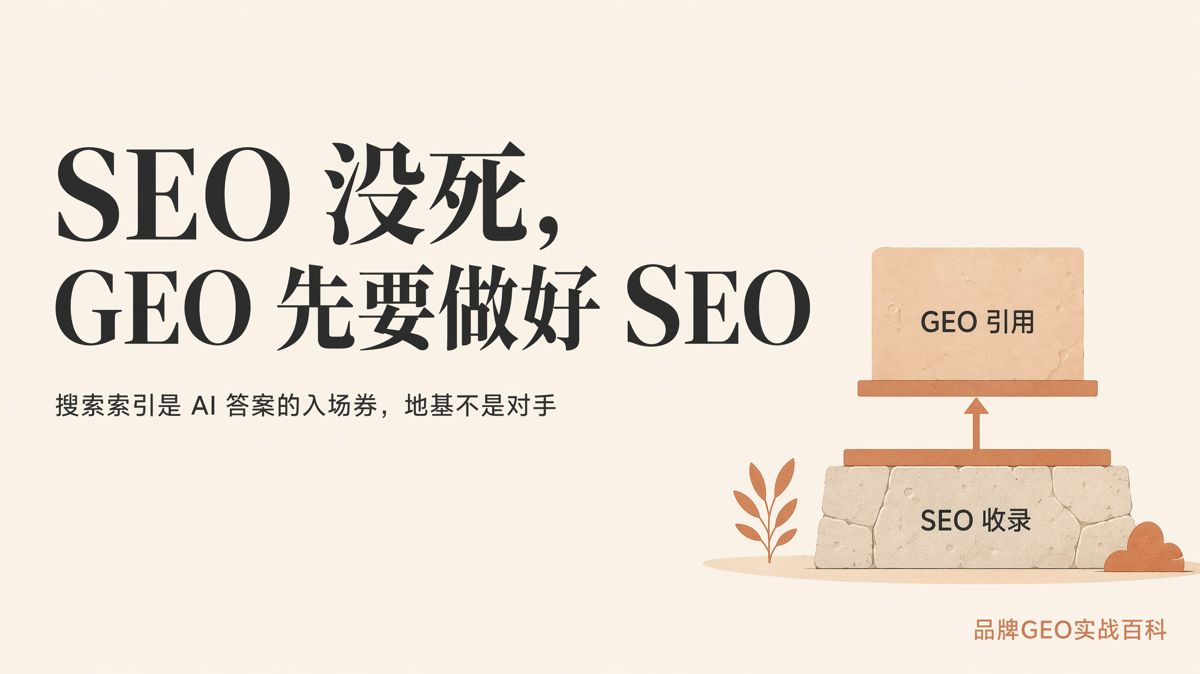
AI search engines still rely on web indexes. Before an LLM can cite your content, it must be crawlable, indexed, and structurally sound.
Generative Engine Optimization (GEO) makes it easier for artificial intelligence to retrieve, understand, synthesize, and cite your brand and content when generating answers. Search Engine Optimization (SEO) ensures that web crawlers discover, index, and rank your pages in organic search results.
These two disciplines solve different problems, but they do not replace one another.
GEO Is Not Replacing SEO
Over the past two years, the claim that "SEO is dead, replaced by GEO" has spread rapidly. This framing treats traditional search and AI search as mutually exclusive systems. It ignores a fundamental engineering reality: before an AI model generates a response, it still needs to pull information from web search indexes, live web pages, and third-party knowledge bases.
In its AI Optimization Guide released on May 15, 2026, the Google Search Relations team noted that optimizing for generative AI search is fundamentally an optimization of the search experience—making it part of SEO. The point is not to force GEO into an outdated box, but to recognize that both rely on the same prerequisites: crawlability, indexing, technical hygiene, and high content quality.
The distinction remains straightforward: - SEO determines whether your content can be discovered, indexed, and ranked by a search engine. - GEO determines whether an AI system, after finding that content, can accurately comprehend its core points and incorporate them into a generated response or citation.
How AI Generates Answers Behind the Scenes
Most commercial AI search engines rely on Retrieval-Augmented Generation (RAG). Under this architecture, the model does not generate answers purely from memory; it retrieves external documents first, then synthesizes the response.
Public documentation from ChatGPT Search, Perplexity, and Google AI Overviews (AIO), alongside reverse-engineering studies published throughout 2025 and 2026, show that retrieval generally follows a three-stage sequence:
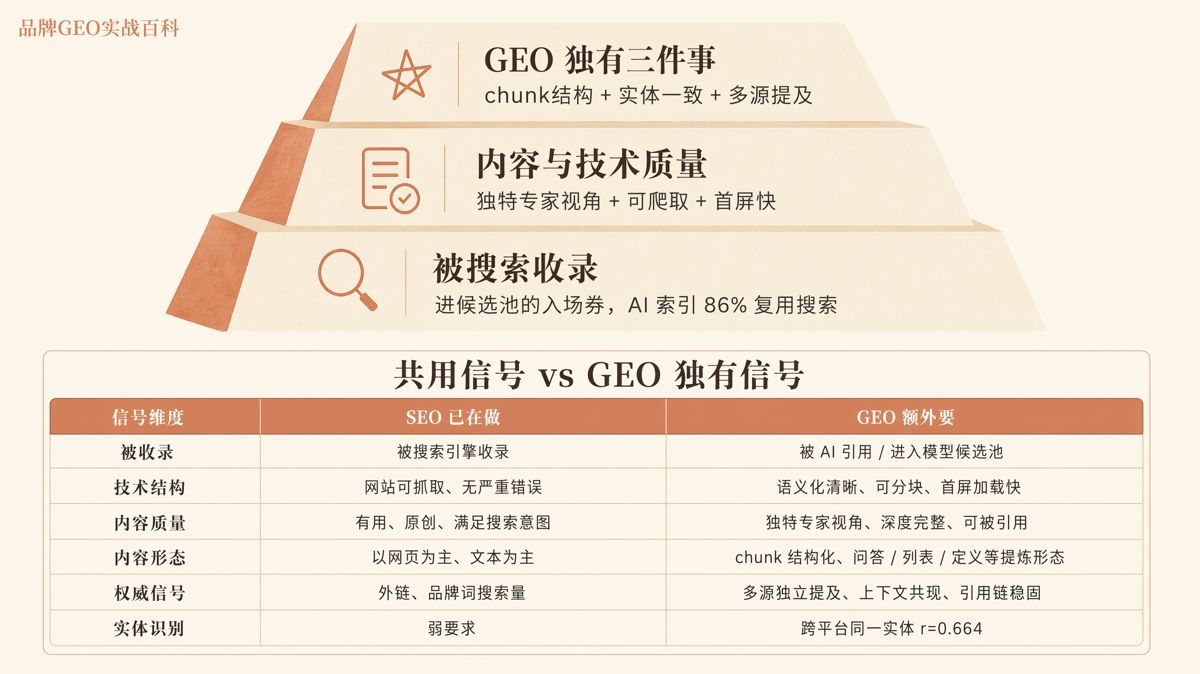
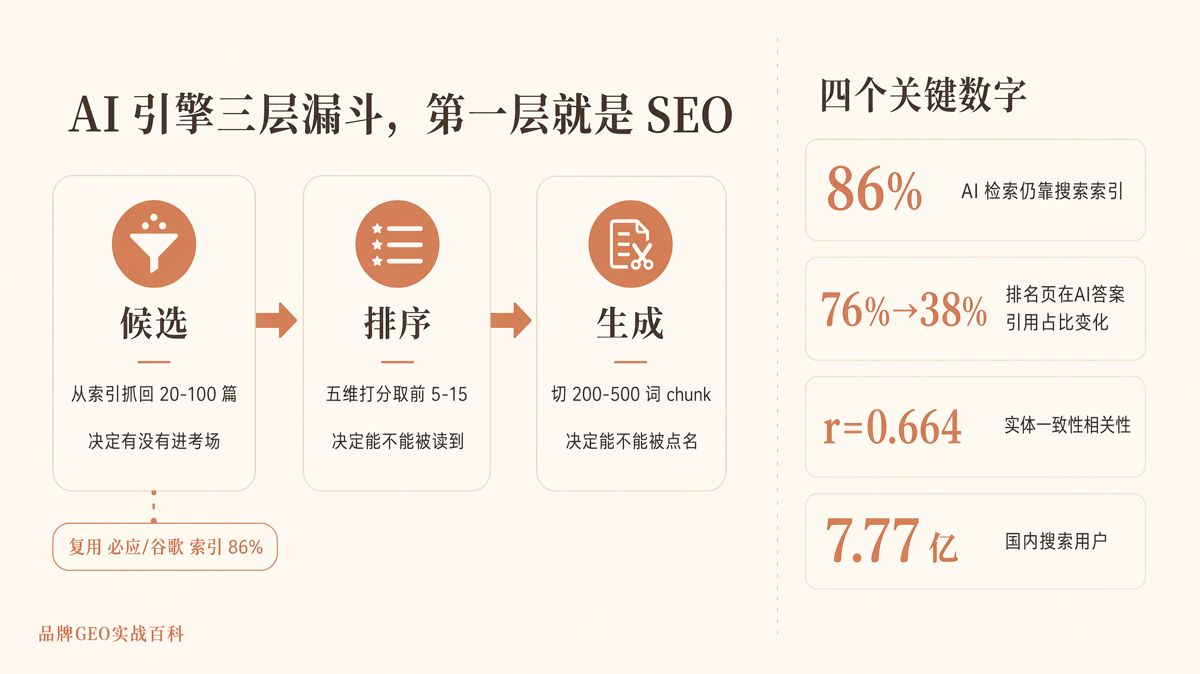
- Candidate Retrieval: The engine translates the user's prompt into search queries and pulls roughly 20 to 100 relevant pages or text snippets from an underlying index.
- Reranking: The system filters and ranks these candidates based on relevance, domain authority, and freshness, narrowing the field to approximately 5 to 15 priority sources.
- Response Synthesis: The language model ingests the top candidates, parses them into discrete passages of roughly 200 to 500 words, evaluates which passages directly answer the prompt, and writes the final response with citations.
These figures reflect industry benchmarks and documentation rather than a universal standard across all platforms. What matters is the sequence: an AI system must find your content before it can decide whether to cite it.
AI models draw from three primary information pools:
- Pre-training Corpora: Static data collected during model training (books, research papers, public web pages, and encyclopedias), which typically carries a knowledge cutoff lag of 6 to 18 months.
- Live Search Indexes: Real-time queries sent to engines like Bing, Google, or proprietary crawlers. Access depends directly on standard technical SEO factors such as
robots.txtpermissions, page load speed, and XML sitemaps. - Third-Party Knowledge Bases: Public content from encyclopedias, Q&A platforms, video transcripts, and consumer review forums.
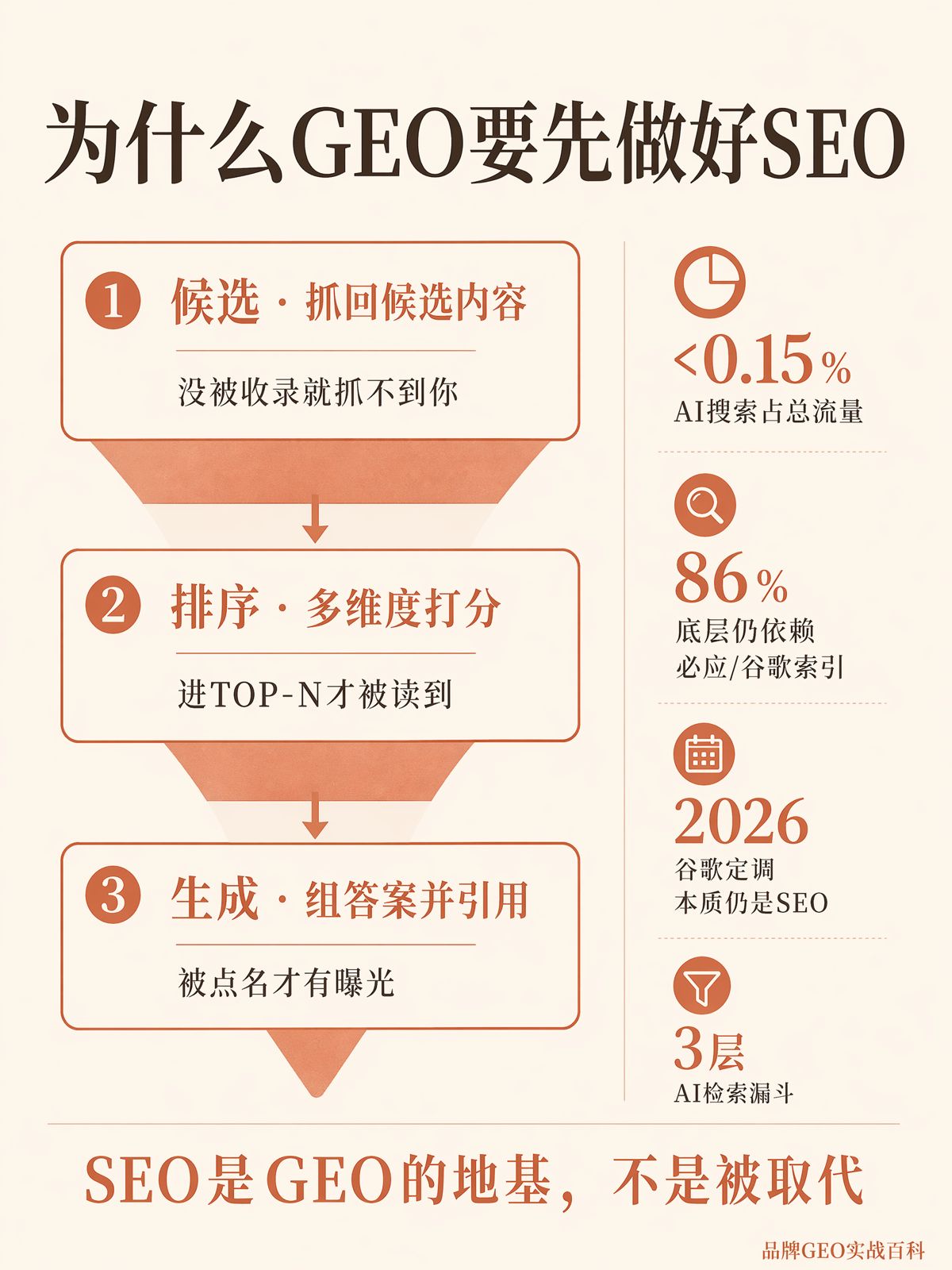
Search indexes are not the sole source of AI knowledge, but for any AI engine performing real-time web retrieval, being present in a searchable index is the entry ticket. If your content is absent from the indexes the AI queries, it cannot be considered for inclusion.
Google AIO Explicitly Requires Prior Indexing
In its AI Optimization Guide, Google outlines two non-negotiable requirements for a page to appear in AI Overviews:
- The content must already be indexed by Google.
- The content must be eligible to show a standard search snippet.
While this explicitly defines Google's criteria, it reflects a broader industry pattern. A 2026 market study observed that up to 86% of live queries processed by major AI search engines still rely on underlying indexes from Bing or Google. While this metric should be viewed as an industry snapshot rather than a permanent rule, the economic rationale is clear: building and maintaining an independent, real-time web-scale crawler is extraordinarily expensive. AI platforms leverage existing search indexes to control infrastructure costs.
High Search Rankings Do Not Guarantee Citations
Ranking at the top of organic search results does not mean an AI will automatically cite your brand.
Data from search analytics platform seoClarity shows that on January 27, 2026, following Google's upgrade of AI Overviews to Gemini 3, the proportion of AIO citations drawn from the top 10 organic search results dropped from 76% to 38%. Search rank and AI citations are related, but they are governed by different selection logic.
Traditional SEO evaluates an entire page: its site architecture, overall keyword coverage, and backlink authority. AI search engines, by contrast, evaluate granular text fragments.
A 5,000-word comprehensive guide may hold strong organic rankings, but if its conclusions are buried in dense paragraphs or mixed with rhetorical filler, an LLM will struggle to extract a concise, quotable answer. Conversely, a page outside the top 10 organic results can earn a primary citation if it contains a single, self-contained section that answers the user's specific query with clear factual precision.
SEO gets your page into the candidate pool. GEO ensures your specific insights can be parsed, extracted, and credited.
SEO vs. GEO: Shared Foundations and Key Differences
| Dimension | Primary Focus in SEO | Additional Requirements for GEO | Relationship |
|---|---|---|---|
| Crawl & Index | Discoverable and indexed by search bots | Retrievable by AI crawlers from web indexes or APIs | Largely identical |
| Technical Structure | Semantic HTML, clean architecture, fast load times | Verification that client-side rendering does not block AI scrapers | Shared; GEO requires extra rendering checks |
| Content Quality | Original insight, clear authority, topical depth | Factual clarity, verifiable data, expert perspective | Shared baseline |
| Unit of Evaluation | Whole page, target keywords, backlink profiles | Granular text passages, semantic relevance, entity consistency | GEO evaluates at the snippet level |
| Content Structure | Logical hierarchy, H2/H3 organization | Conclusion-first structure; each section self-contained | GEO demands stricter information modularity |
| Brand Authority | Hyperlinks pointing to the domain | Unlinked brand mentions; factual consistency across sources | GEO adds unlinked entity footprint |
| Core Metrics | Keyword rankings, organic traffic, CTR | Citation rate, brand share of voice in AI answers, referral traffic from AI engines | Measured independently |
To expand from SEO into GEO, marketing teams need to address three specific areas:
- Modular Passage Formatting: Write with a conclusion-first approach. State the direct answer or finding in the opening sentence, followed by supporting facts, methodology, or qualifying parameters. Keep one concept per section.
- Entity Consistency: In AI terminology, an "entity" is a distinct person, company, product, or institution. Maintaining identical naming conventions, business descriptions, and specifications across all platforms prevents AI models from fragmenting your digital presence into separate, competing entities. Empirical research from seoClarity reveals a correlation coefficient of r=0.664 between entity consistency and presence in AI responses, compared to r=0.218 for traditional backlinks.
- Unlinked Brand Mentions: According to research cited by iProspect and Hallam, positive, unlinked brand mentions on reputable third-party platforms show a correlation with AI citation frequency roughly three times stronger than hyperlinked backlinks. While correlation does not equal causation, it highlights that AI models treat text references as meaningful consensus signals.
In China, the Logic Is Similar but Channels Are Fragmented
For brands operating in China, the underlying retrieval mechanics remain the same: your content must be crawlable and indexable before an AI can retrieve it. However, the ecosystem is far more fragmented across closed platforms.
Industry observations suggest distinct platform relationships: - Baidu search index and Baidu Baike influence retrieval for ERNIE Bot (Baidu's AI). - WeChat Official Accounts and WeChat Search inform Tencent's Yuanbao assistant. - In-app content on Douyin feeds Doubao (ByteDance's AI assistant). - Zhihu (China's largest Q&A platform) serves as a primary source for models like Moonshot AI's Kimi and DeepSeek.
These platform dynamics represent operational observations rather than absolute rules. Publishing content on a platform does not guarantee inclusion in its partner model's answers. Brands must actively verify whether content is publicly indexed within each ecosystem and track its visibility in generated outputs.
Where Western GEO focuses on Wikipedia, Reddit, Quora, and YouTube, a China-focused strategy relies on Baidu Baike, Zhihu, Bilibili (China's long-form video platform), and WeChat Channels.
The Recommended Execution Sequence
Step 1: Ensure Crawlability and Indexation
Audit your technical setup to ensure both traditional search bots and designated AI scrapers can reach your content. Verify that robots.txt files permit access, XML sitemaps are up to date, and core text is immediately visible in the raw page source.
Many AI crawlers have limited ability to execute complex JavaScript. If your site relies entirely on client-side rendering (CSR), search bots and AI crawlers may encounter an empty shell. Switch to server-side rendering (SSR) or static site generation (SSG) for content-heavy sections to ensure the primary text is rendered instantly on request.
Step 2: Elevate Core Content Quality
Google's AI Optimization Guide emphasizes original analysis with an expert perspective over technical tricks. Attempting to game AI search by deploying dedicated plain-text files for bots, arbitrarily capping paragraphs at 50 words, or rewriting content into an artificial format is ineffective. Your content must provide clear, verified, and practical substance.
Step 3: Implement GEO-Specific Passages and Entity Footprints
Once your baseline pages are reliably crawled and indexed, begin optimizing for passage-level extraction. Structure key sections to stand alone, audit entity descriptions across all active digital channels, and build unlinked brand mentions on trusted industry forums and trade publications.
You do not need to finish all traditional SEO work before addressing GEO. Technical fixes, content refinement, and off-site distribution can run in parallel—provided the indexation foundation is intact.
Frequently Asked Questions
Has SEO lost its value?
No. As of June 2025, search engine users in China reached 777 million, representing 69.2% of the country's total internet population, according to the 56th statistical report from the China Internet Network Information Center (CNNIC). Globally, AI-driven search remains a growing but small fraction of total web traffic, and an estimated 86% of live AI queries still pull candidate data from standard Bing or Google indexes. SEO remains essential for capturing direct search traffic and securing placement in AI candidate pools.
Can we just do SEO and skip GEO?
No. A top organic ranking is no longer enough to win the AI answer box. High-ranking pages often lack modular, definitive passages that an AI can easily quote. Conversely, lower-ranking pages with precise, authoritative definitions frequently win citations. You need SEO to enter the retrieval pool, and GEO to be selected from it.
Do we have to complete all SEO before starting GEO?
No. You can refine your content for AI while maintaining standard SEO best practices. Structuring paragraphs with clear takeaways upfront benefits human readers and search engines while making text extraction straightforward for AI models. The rule is not that SEO must finish first, but that crawlability and indexation cannot be skipped.
Does Chinese GEO still require Baidu?
It depends on the models you are targeting. If your audience uses Baidu's ERNIE Bot, your Baidu search indexation and Baidu Baike footprint remain critical. If your audience relies on Tencent's Yuanbao, ByteDance's Doubao, or independent models like DeepSeek, you must expand verification to WeChat, Douyin, and Zhihu.
If AI engines eventually build their own indexes, will SEO become obsolete?
No. Even if AI developers transition to fully proprietary web crawlers, those crawlers will still need to discover, fetch, parse, and evaluate web pages. Fundamental requirements—crawl accessibility, structured semantics, fast performance, and verifiable content authority—remain necessary regardless of who operates the crawler.
Can we accelerate GEO by using AI to generate content at scale?
Mass-producing low-value programmatic content carries legal and performance risks. In China, the Measures for the Labeling of Artificial Intelligence Generated Synthetic Content took effect on September 1, 2025, requiring clear explicit and implicit watermarking of AI-generated assets; non-compliant pages face platform penalties. Simultaneously, global search engines and AI models actively de-index programmatic, repetitive content. Scale cannot compensate for a lack of original expertise.
Conclusion: An Integrated Approach
SEO maximizes the probability that your content is discovered, crawled, and indexed. GEO maximizes the probability that an AI model understands, extracts, and cites that content in its final response.
They share the same technical foundation and demand the same high standard of content quality. The most effective approach is straightforward: verify that your pages are fully indexable, write clear answers with standalone modular passages, maintain consistent brand entities across the web, and track real-world citations over time.
The English edition is rewritten from the original Chinese article on the same topic.

Starbox AI is an AI marketing company based in Hangzhou, China. This article draws on Starbox project work. Please credit the source when quoting.
Related reading
 GEO Guide
Why AI Marketing Vendor Quotes Vary 10x: A 4-Step Vetting Checklist
Evaluate AI marketing proposals by delivery actions, not slide decks. Audit source infrastructure, fact cleaning, and clean-environment testing.
Oct 22, 2026 · 6 min read
 GEO Guide
Spotting GEO Scams: What Actually Drives AI Recommendations?
Automated AI ranking promises violate how LLMs work. Real AI recommendations rely on authoritative, structured facts across trusted public sources.
Oct 22, 2026 · 4 min read
 GEO Guide
How to Measure Your Brand's AI Visibility with a Spreadsheet
You do not need expensive software to track AI recommendations. A three-tier prompt framework and a simple spreadsheet can score your brand visibility in half a day.
Oct 21, 2026 · 6 min read