
Why You Still Need GEO When You Already Have SEO
The short answer
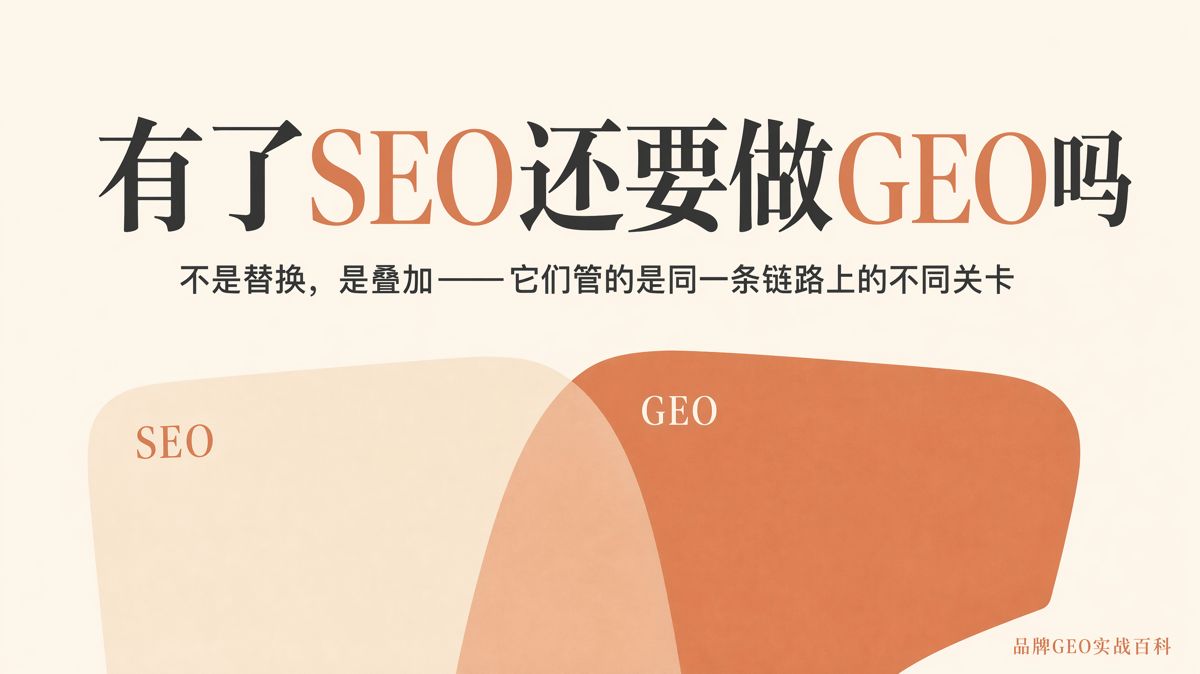
SEO gets your pages indexed and ranked, while GEO ensures AI models cite your content in direct answers. The winning strategy is doing both.
If your business already invests in SEO, why do you need Generative Engine Optimization (GEO)? The answer is not to pick one over the other. You need both.
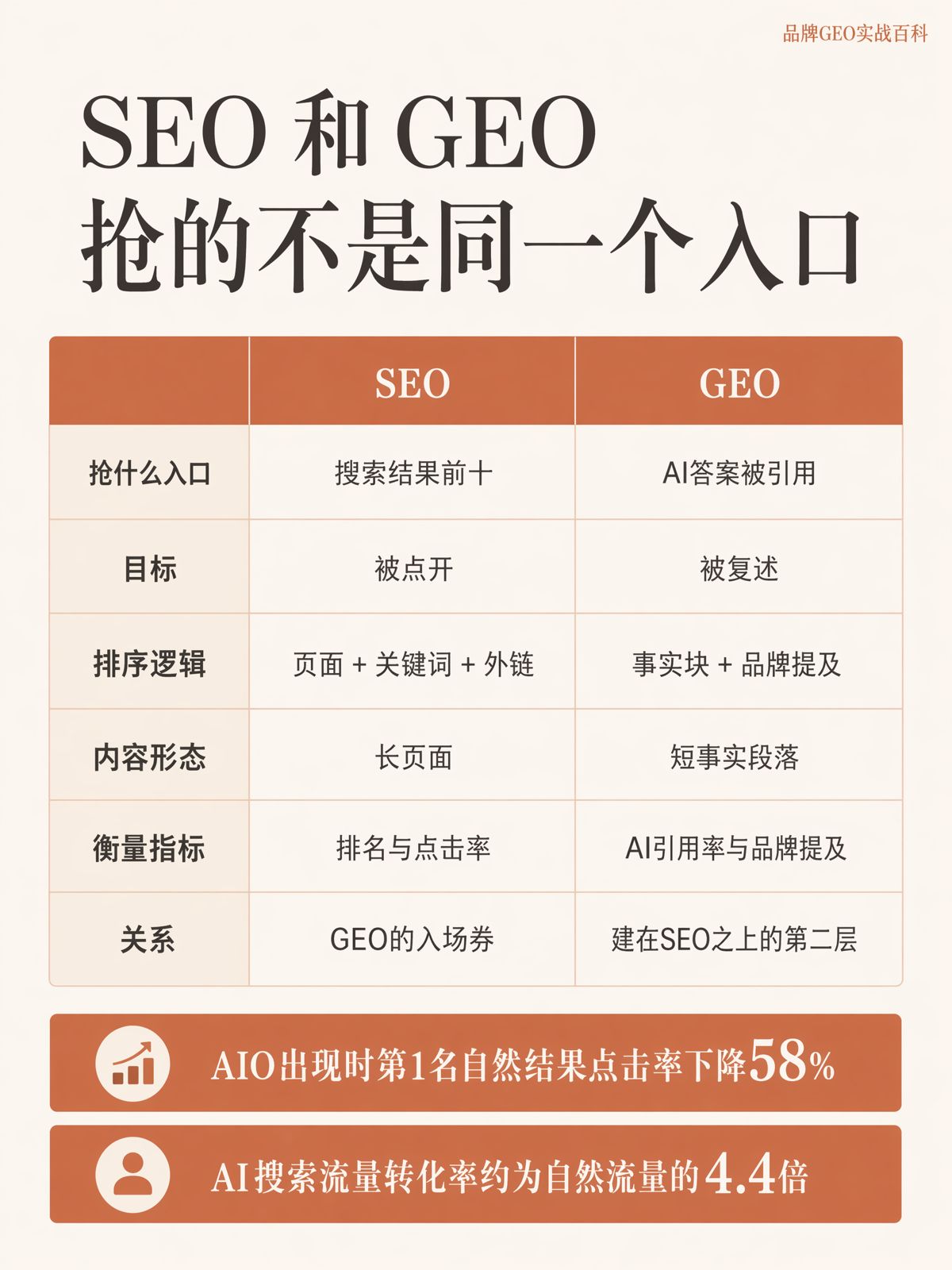
Search Engine Optimization (SEO) ensures web pages can be crawled, indexed, retrieved, and ranked by search engines. Generative Engine Optimization (GEO) focuses on what happens after AI retrieves your content: whether the model extracts your information, weaves it into a generated answer, and cites your brand as a source.
Both practices address different stages of the same information-retrieval journey. Strong SEO does not guarantee your brand appears in an AI answer. Conversely, meticulous GEO cannot help you if search crawlers never indexed your page in the first place.
GEO Does Not Replace SEO—It Adds New Optimization Goals
On May 15, 2026, the Google Search Relations team stated in an official guide that optimizing for generative AI search is fundamentally an optimization of the search experience, and "thus still SEO." Traditional search optimization has not become obsolete.
What has changed is how users receive answers. Traditional search engines return a ranked list of blue links, leaving the user to click, browse, and synthesize information. Generative AI search synthesizes the information directly, formulates a comprehensive answer, and selects specific sources to cite.
When search shifts from "providing links" to "delivering direct answers," optimization goals must expand. Beyond making pages discoverable, you must make your content easy for AI to parse, extract, and cite. That is why GEO has emerged as a distinct discipline.
How AI Generates Answers in Three Stages
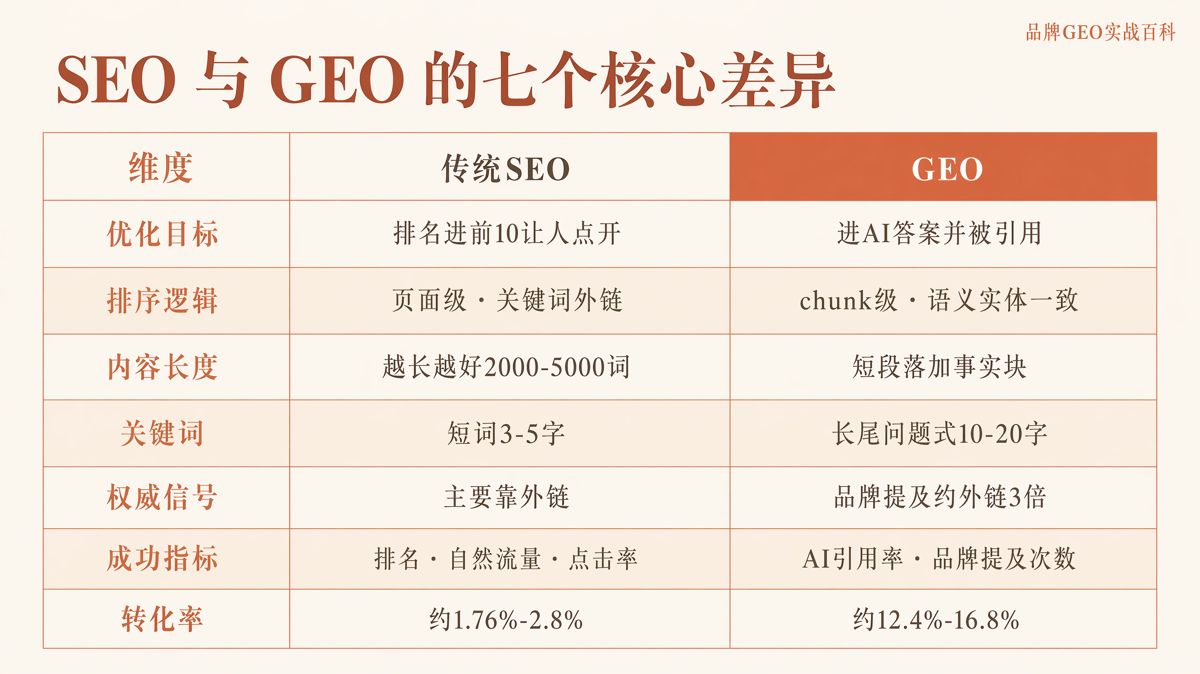
While underlying architectures differ across AI search platforms, most rely on Retrieval-Augmented Generation (RAG). In a RAG pipeline, the AI model queries external sources before synthesizing an answer.
This pipeline operates in three main steps:
- Retrieving candidate content. The model converts the user prompt into search queries and pulls roughly 20 to 100 candidate pages from an indexed search repository.
- Filtering and re-ranking. The system evaluates these candidate pages based on relevance, domain authority, and content quality.
- Generating the answer. The AI breaks qualifying pages into discrete text segments ("chunks"), identifies which chunks directly answer the prompt, generates the response, and attributes citations.
SEO secures your position in the first step: it ensures pages are crawled, indexed, and retrieved. GEO targets the second and third steps: ensuring statements are unambiguous, entity names (brand, company, product) map cleanly, factual claims stand independently without contextual baggage, and the model considers your data credible enough to quote.
SEO and GEO are neither disconnected workflows nor mutually exclusive alternatives.
Ranking High on Search Does Not Guarantee an AI Citation
According to data published by seoClarity on January 27, 2026, after Google AI Overviews upgraded to Gemini 3, the citation share held by the top 10 organic search results dropped from 76% to 38%.
While this does not mean every top-10 page has a 62% failure rate, it illustrates a clear trend: the overlap between top organic rankings and AI citations is shrinking. Ranking on page one no longer guarantees visibility inside the AI answer box.
The discrepancy stems from how each system evaluates content. Traditional SEO evaluates web pages as whole documents, weighing aggregate factors such as keyword density, overall comprehensiveness, and backlink profiles.
Generative engines evaluate individual content chunks. Even if a comprehensive guide ranks number one organically, an AI model may skip it if the core conclusion is buried, paragraphs depend heavily on preceding context, or facts are entangled with opinion.
Relying solely on keyword rankings, organic impressions, and click-through rates leaves blind spots. In an AI search environment, marketing teams must also track brand mention frequency, citation share, and AI-referred traffic and conversions.
Seven Key Differences Between SEO and GEO
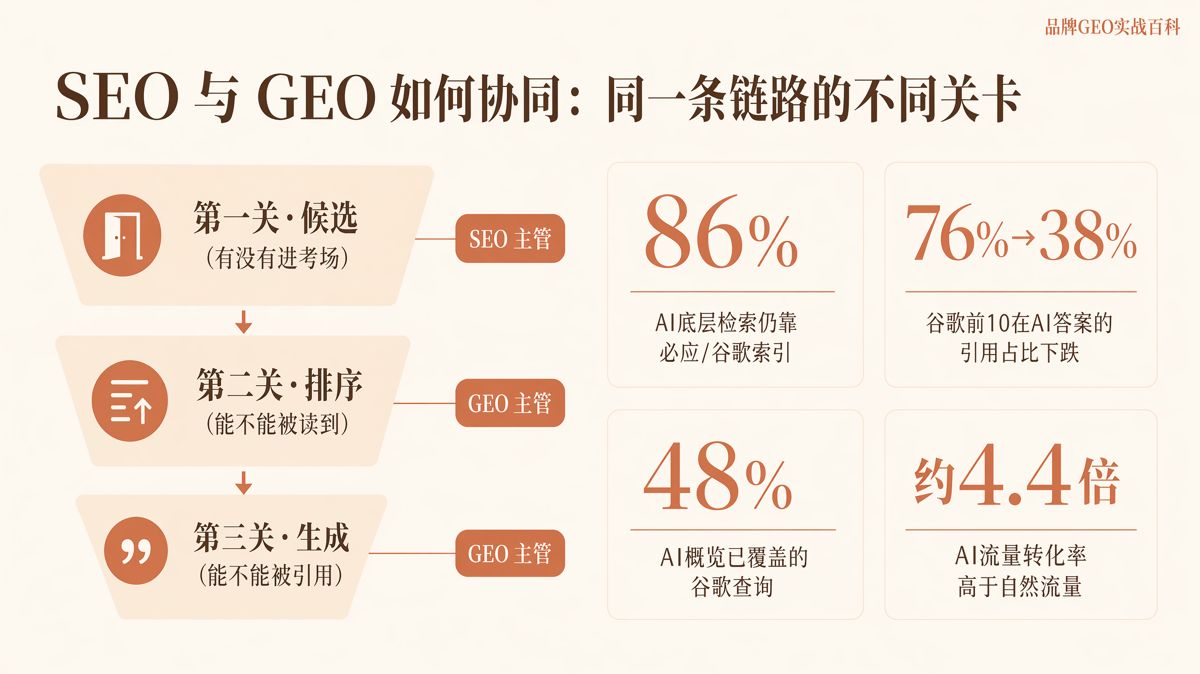
| Dimension | Traditional SEO Focus | GEO Focus |
|---|---|---|
| Primary Goal | Earn high organic rankings and drive clicks | Earn placement, mentions, and citations in AI answers |
| Evaluation Unit | Primarily the entire page | Both the page and discrete content chunks |
| Content Structure | Comprehensive long-form guides (commonly 2,000–5,000 words in reference samples) | Short paragraphs, explicit takeaways, and standalone factual chunks |
| Query Format | Short keywords (commonly 3–5 words) | Natural-language questions (commonly 10–20 words) |
| Authority Signals | Inbound backlinks | Brand mentions, third-party reviews, and consistent entity data |
| Success Metrics | Rankings, organic traffic, CTR | AI citation rate, brand mention share, AI referral traffic |
| Conversion Performance | Reference samples show average conversion rates of 1.76%–2.8% | Reference samples show average conversion rates of 12.4%–16.8% (varies widely by industry) |
Length alone does not determine performance. Writing shorter paragraphs is not a shortcut to GEO success. AI models prioritize content that provides clear factual boundaries, unambiguous claims, and direct answers to user queries.
How AI Search Is Shifting Clicks and Conversions
According to Semrush data from April 2026, Google AI Overviews appeared in approximately 48% of monitored search queries. Meanwhile, Ahrefs data from December 2025 showed that for queries displaying an AI Overview, the click-through rate for the top organic result fell by 58%.
Users frequently resolve their intent directly within the AI-generated interface without clicking through to external sites. Evaluating content purely through page views understates a brand's true exposure across AI answers.
While AI search currently delivers smaller absolute traffic volumes than traditional search, its conversion efficiency is significantly higher. Across 2025–2026 samples from Semrush and Ahrefs, traffic referred by AI search converted at roughly 4.4 times the rate of standard Google organic search. In select B2B case studies, the conversion rate gap reached 6x to 23x.
These figures reflect specific datasets rather than universal guarantees. However, they highlight an important shift: users who click through after interacting with an AI answer have already refined their intent. That intent makes AI referral traffic well worth measuring as a distinct channel.
How SEO and GEO Should Work Together
1. Ensure your content can be indexed first
According to 2025–2026 public documentation and reverse-engineering studies, roughly 86% of AI search queries still pull data from traditional search indexes like Bing and Google.
If search engines have not indexed your page, AI models cannot retrieve it during the RAG phase. Foundational technical SEO—crawl budgets, XML sitemaps, clean architecture, and indexation—remains non-negotiable. For campaigns targeting users in China, this includes verifying indexation on Baidu and WeChat Search.
2. Format content for machine extraction and quotation
Once technical indexation is confirmed, structure your pages for machine parsing:
- Use explicit user questions as H2 and H3 subheadings.
- Answer the core question directly in the opening sentence of each section before providing supporting context.
- Use comparison tables when presenting structured data.
- Write key facts as self-contained sentences that remain understandable even when read out of context.
- Include 6 to 8 frequently asked questions (FAQs) addressing natural follow-up queries.
Official guidance from Google emphasizes unique expert perspectives, clean code architecture, and clear domain-specific terminology.
Regarding machine-readable text files such as llms.txt or specialized "AI Schema packages," Google's official stance remains that no specialized setup is required. These technical files can serve as minor supplements, but they cannot compensate for low-quality content or poor indexation.
3. Build brand mentions and third-party reviews alongside backlinks
GEO does not eliminate the value of backlinks, but it elevates the role of unlinked brand mentions. When authoritative sources mention your brand name—even without a hyperlink—large language models process those co-occurrences to map your brand's expertise and reputation.
Studies by iProspect and Hallam observed that brand mentions carried roughly three times the impact of traditional backlinks within their test samples. Furthermore, testing by seoClarity identified a 0.664 correlation between web brand mentions and AI Overview appearances, compared to a 0.218 correlation for inbound backlinks.
Correlation does not imply direct causation. Increasing unlinked mentions will not automatically generate AI citations. However, these findings confirm that GEO audits must measure brand presence across authoritative third-party media, not just raw link counts.
4. Check whether your pages rely on JavaScript
JavaScript renders dynamic content in modern browsers, and Google's primary crawlers can execute it. However, marketing teams should not assume AI crawlers do the same.
A technical study analyzing over 500 million crawler requests found no evidence that GPTBot, ClaudeBot, or PerplexityBot execute client-side JavaScript. If critical text renders solely through client-side scripts, AI crawlers may receive an empty shell.
A website rendering smoothly in consumer browsers does not guarantee that AI crawlers can parse its body text. Verifying server-side or static rendering is a mandatory technical checkpoint.
5. Track results across individual AI platforms
Cross-platform research from Ahrefs shows that approximately 86% of the primary citation sources cited by ChatGPT, Perplexity, and Google AI Overviews do not overlap.
Strong visibility on one AI platform does not imply equal visibility on others. Marketing teams must track AI citations, brand mentions, and referral sessions separately across each engine rather than treating AI search as a uniform channel.
Team Structure, Budgets, and Timelines
Because SEO and GEO share overlapping technical and editorial foundations, splitting them into isolated teams is counterproductive. A single content asset can satisfy indexation requirements, keyword intent, clean chunking, and AI quotation criteria simultaneously. Teams only need to manage separate KPIs and distribution paths.
Industry benchmarks allocate budgets at approximately 70% content creation and distribution to 30% technical infrastructure. This ratio serves as an operational reference rather than a rigid rule. Sites with deep indexing issues require more upfront technical spend, while technically sound platforms will direct more budget toward content and third-party digital PR.
Results do not happen overnight. Public case studies generally observe 3 to 6 months as a baseline runway. Measurable visibility shifts typically emerge around the 90-day mark, with the initial 60 days dedicated to resolving indexation barriers, rewriting page structures, and deploying tracking tools. Actual timelines vary based on domain authority, publishing velocity, competitive density, and core algorithm updates.
Navigating China-Specific AI Search Engines
Brands operating in China interact with a different set of generative search platforms: Doubao (ByteDance's AI assistant), DeepSeek, Tencent Yuanbao (Tencent's AI assistant), ERNIE Bot (Baidu's AI assistant), Tongyi Qianwen (Alibaba's AI assistant), and Kimi (Moonshot AI's assistant).
These models follow similar RAG principles, but their primary data ecosystems differ significantly from Western platforms. In China, AI models heavily favor established platform ecosystems over standalone websites.
Observed citation behaviors include:
| AI Platform | Common Content Sources in Reference Samples |
|---|---|
| Tencent Yuanbao | WeChat Official Accounts |
| ERNIE Bot | Baijiahao (Baidu's content platform), Baidu Baike |
| Doubao | Douyin (ByteDance's short-video platform) |
| Kimi and DeepSeek | Zhihu (China's largest Q&A platform) is a frequent shared source |
Functionally, Western and Chinese information hubs parallel one another: Wikipedia mirrors Baidu Baike and Sogou Baike; Reddit and Quora align with Zhihu; YouTube reflects Bilibili and WeChat Channels; LinkedIn professional posts map to WeChat Official Accounts.
These mappings should guide content distribution strategies. They do not imply that engines exclusively pull from these platforms, nor do they guarantee citation upon publishing. Engine updates, source weighting, and prompt types continually shift outputs.
Compliance Cannot Be Overlooked
In China, the Measures for the Labeling of Artificial Intelligence-Generated Synthetic Content took effect on September 1, 2025. Brands producing AI-assisted content at scale must include both explicit and implicit identifiers as mandated by law. Failure to apply required disclosures creates platform penalties and regulatory exposure.
Beyond labeling rules, tactics like keyword stuffing, scraped content duplication, falsified authority claims, and exaggerated product superlatives undermine long-term performance. Even if aggressive tactics yield temporary indexing, they invite severe algorithmic suppression and regulatory risk.
The Bottom Line
Having an SEO strategy does not mean you can ignore GEO. Nor does adopting GEO mean throwing out your SEO playbook.
SEO ensures search engines find, index, and rank your content. GEO ensures AI models understand, extract, and cite your information in generated answers. Traditional search optimization remains the foundation; generative optimization adds new requirements for content chunking, authority signals, and multi-engine tracking.
The pragmatic path forward is clear: secure crawlability and indexation first, refine content structures for machine comprehension, and track organic rankings alongside AI citations, brand mentions, and conversion metrics. This approach protects your search performance across traditional and generative engines alike.
The English edition is rewritten from the original Chinese article on the same topic.

Starbox AI is an AI marketing company based in Hangzhou, China. This article draws on Starbox project work. Please credit the source when quoting.
Related reading
 GEO Guide
Why AI Marketing Vendor Quotes Vary 10x: A 4-Step Vetting Checklist
Evaluate AI marketing proposals by delivery actions, not slide decks. Audit source infrastructure, fact cleaning, and clean-environment testing.
Oct 22, 2026 · 6 min read
 GEO Guide
Spotting GEO Scams: What Actually Drives AI Recommendations?
Automated AI ranking promises violate how LLMs work. Real AI recommendations rely on authoritative, structured facts across trusted public sources.
Oct 22, 2026 · 4 min read
 GEO Guide
How to Measure Your Brand's AI Visibility with a Spreadsheet
You do not need expensive software to track AI recommendations. A three-tier prompt framework and a simple spreadsheet can score your brand visibility in half a day.
Oct 21, 2026 · 6 min read