
Will GEO Replace SEO? No, but the Rules Have Changed
The short answer
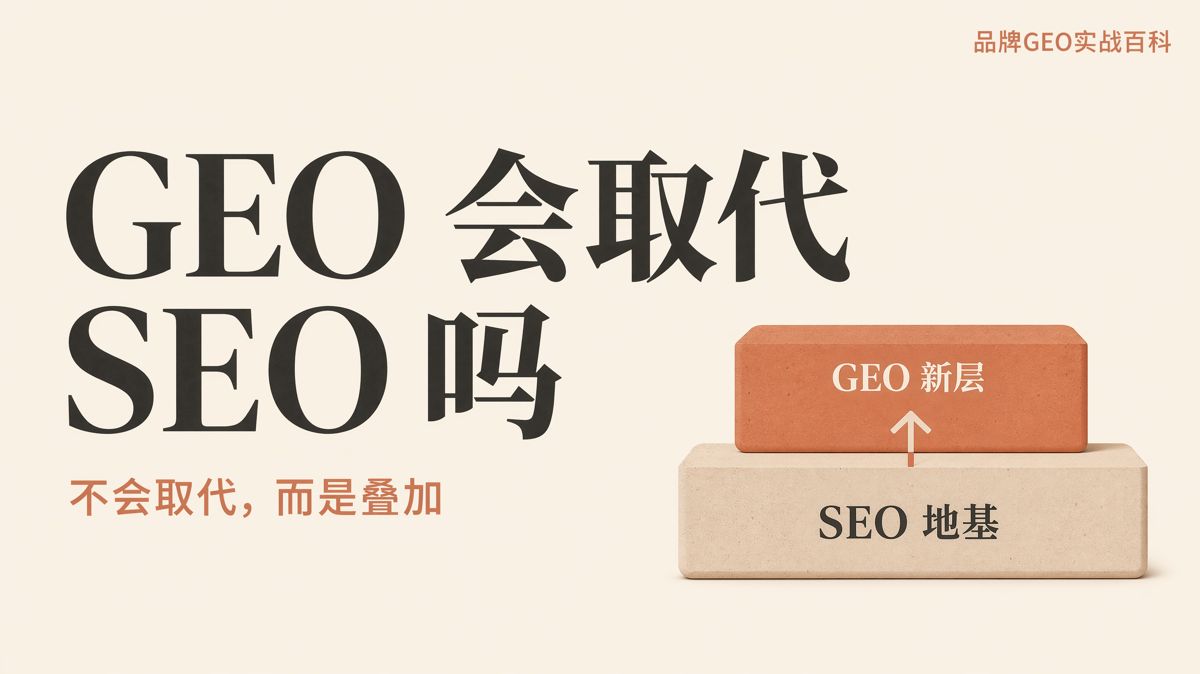
GEO will not replace SEO. SEO determines whether your content gets indexed, while GEO decides if AI cites it. Here is how both work together.
Generative Engine Optimization (GEO) focuses on increasing the likelihood that your content is retrieved, cited, and mentioned by generative artificial intelligence. Search Engine Optimization (SEO) ensures web pages are crawled, indexed, and ranked organically by search engines. In short: SEO determines whether users can find your page in search results, while GEO determines whether an AI answer cites your brand.
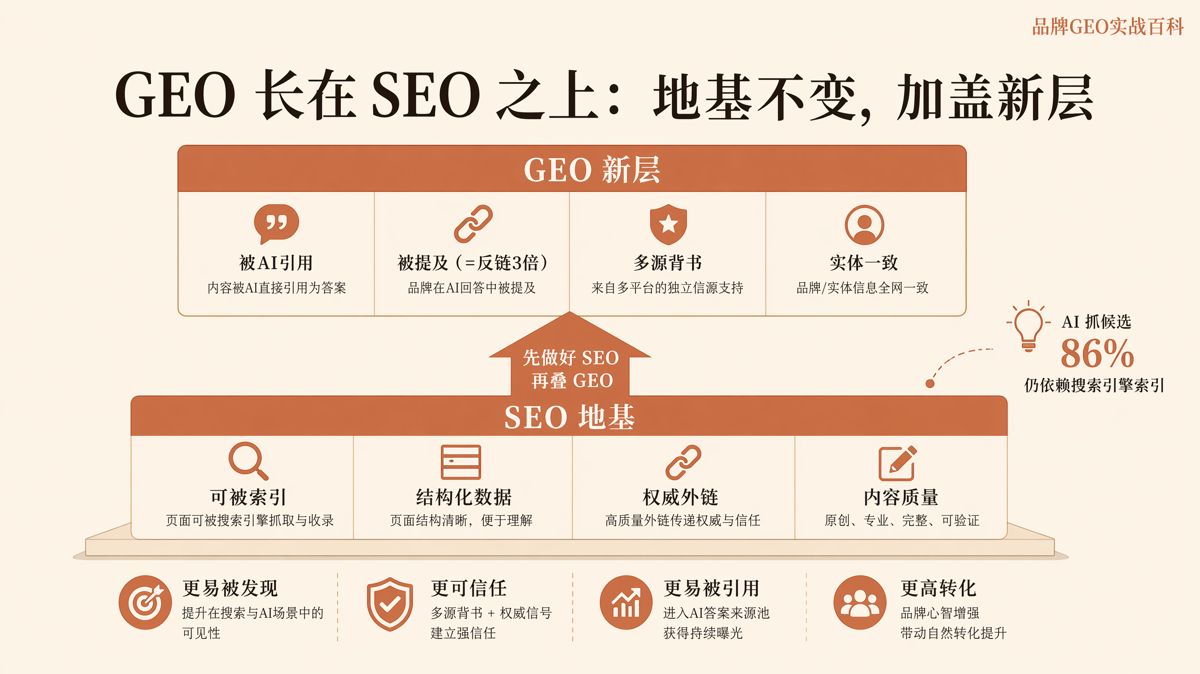
These two approaches do not cancel each other out. Under Google's published guidelines, a page must be indexed and eligible for search snippets before it can be considered for an AI answer. SEO gets your content into the eligible candidate pool; GEO determines whether the model extracts and surfaces it.
Why Some Believe SEO Is Becoming Obsolete
User search habits are shifting.
When Google surfaces an AI Overview at the top of the search engine results page (SERP), users get a synthesized answer immediately. Many find what they need and leave without clicking any organic links. Traditional strategies that rely strictly on ranking high to capture organic clicks are yielding fewer visits.
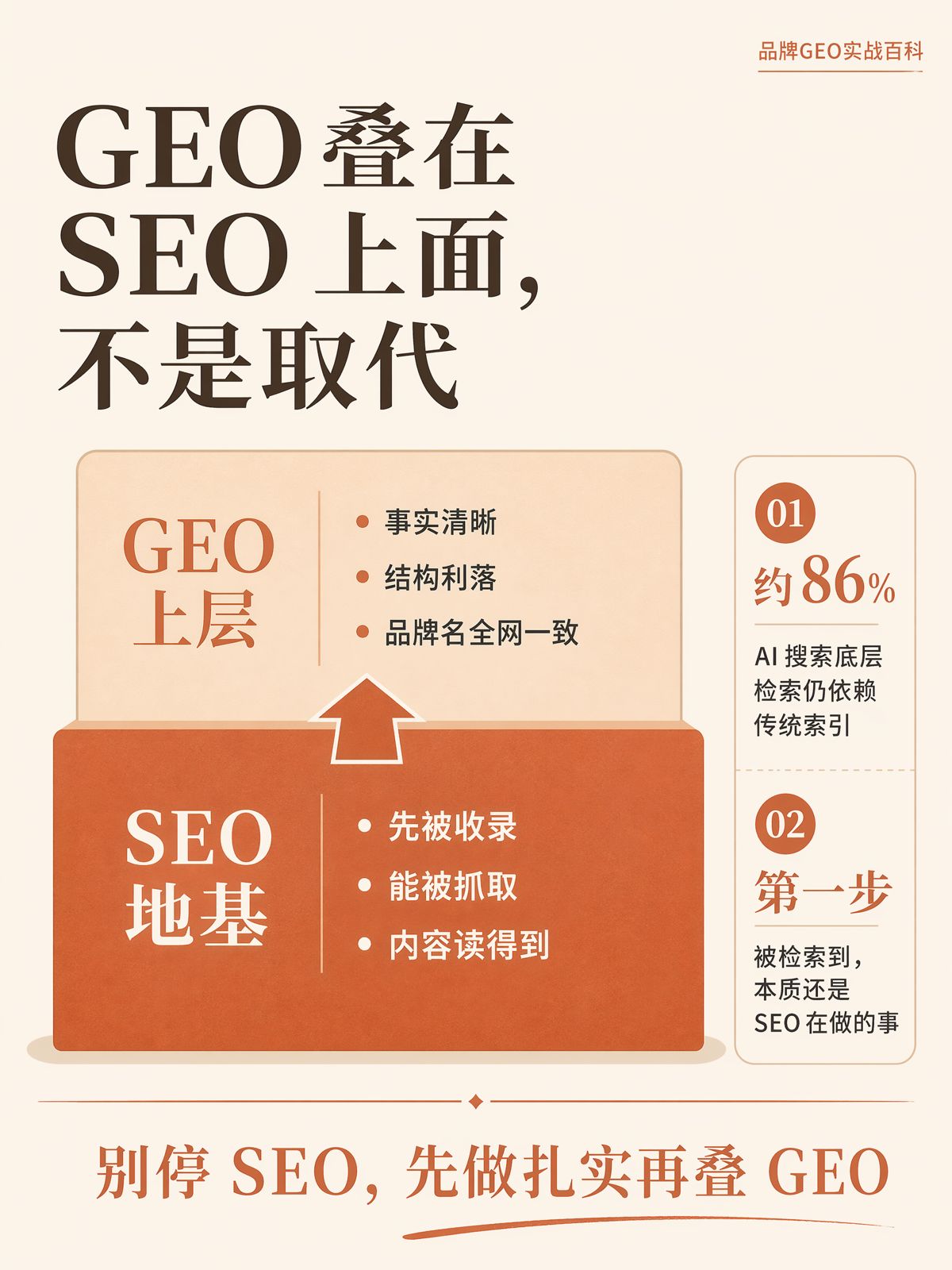
Fewer direct clicks does not mean SEO has lost its utility. Generative models must retrieve reliable data before synthesizing a response. Industry data indicates that roughly 86% of candidate web pages queried by AI search engines still originate from Google or Microsoft Bing indexes. If a page never enters the search index, it cannot be considered for an AI citation.
At the same time, AI search accounts for less than 0.15% of total search traffic. While that market share remains small today, it reflects a meaningful behavioral shift from scanning links to reading direct answers. Search intent has not disappeared; brands now need to secure AI citations in addition to organic visibility.
Google's Position on GEO and SEO
On May 15, 2026, Google's Search Relations team stated that optimizing for generative AI search is an extension of optimizing the search experience, meaning it remains fundamentally part of SEO.
Google also outlined the baseline requirements for AI citations: a page must be indexed and meet standard criteria for search snippets. These are platform requirements, not industry speculation.
Businesses do not need to abandon SEO or build a separate content operation solely for AI. The practical sequence is straightforward: ensure your pages can be crawled, indexed, and understood by search engines first, then structure your information so AI models can easily extract and quote it.
Why Ranking First Doesn't Guarantee an AI Citation
Organic ranking algorithms and generative citation models do not evaluate pages the same way.
Data from seoClarity shows that following Google's AI Overview update in January 2026, the citation share drawn from top-10 organic results dropped from 76% to 38%. Strong organic rankings still matter, but they no longer guarantee an AI citation.
Traditional SEO evaluates relevance, quality, and authority across an entire page. GEO evaluates individual content blocks—self-contained sections that state a complete assertion, data point, or conclusion without requiring surrounding context. If an article mixes topics together and buries key facts under fluff, an AI model will struggle to extract a clean quote, even if the page ranks well.
To make content extractable for AI: - Match headings directly to specific user queries. - State the core conclusion upfront, followed by supporting evidence and scope. - Keep each paragraph focused on a single point so it makes sense in isolation.
This inverted-pyramid approach prioritizes the most important information first before diving into context. It is not about writing for algorithms or artificially cutting sentence lengths. Content must remain clear and engaging for human readers while eliminating the filler that obscures primary facts.
Can You Still Leverage Existing SEO Assets?
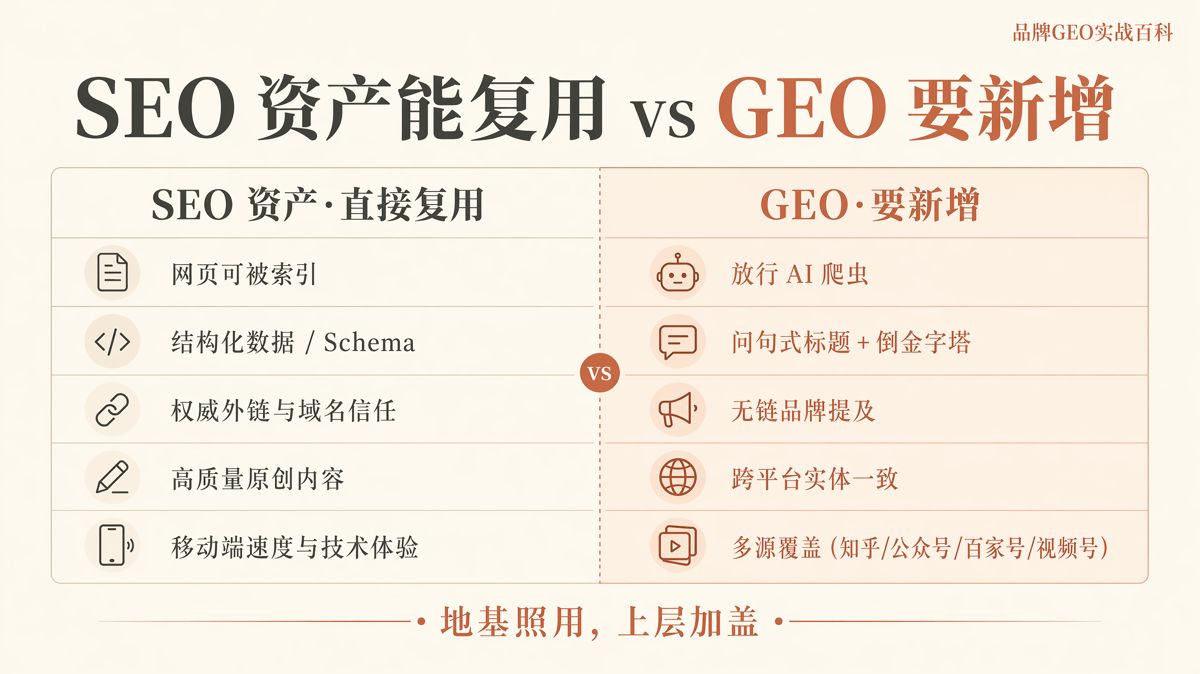
Most of your accumulated SEO foundation remains directly applicable and necessary.
| Established SEO Assets | GEO Enhancements |
|---|---|
| Crawler access and indexation | Audit robots.txt and access permissions to ensure relevant AI crawlers are not inadvertently blocked |
| Schema markup for machine readability | Structure content with clear, question-based headings and ensure key sections function as standalone insights |
| Authoritative backlinks and domain trust | Monitor unlinked brand mentions and verify that brand names and core product details remain consistent across sources |
| Original content and expert perspectives | Increase the proportion of verifiable, citable facts, benchmarks, and actionable conclusions |
| Mobile performance and Core Web Vitals | Expand distribution beyond the corporate site to encyclopedias, Q&A forums, editorial blogs, and video platforms |
Crawlability, schema, technical performance, and domain authority have not lost their value. GEO adds the discipline of modular information design, cross-platform entity consistency, and citation readiness.
The Core Evaluation Criteria in GEO
The first priority is information extractability.
An article can be extensive, but each section should address a distinct question. Key conclusions, supporting metrics, and operational boundaries belong in the same section. This prevents AI engines from lifting an absolute conclusion while dropping critical caveats like "industry forecast" or "unverified third-party estimate."
The second priority is entity consistency. Entity resolution is the process an AI uses to determine whether references across disparate platforms point to the same brand, organization, or person. If your corporate site, third-party wikis, and social channels use conflicting company names, product categories, or service descriptions, models may treat them as separate entities.
In empirical data from seoClarity, entity consistency showed a correlation of r=0.664 with brand appearances in AI responses, compared to r=0.218 for backlinks. While 0.664 is roughly three times 0.218, correlation measures statistical association—it does not mean entity consistency carries three times the algorithmic weight of backlinks, nor does it prove direct causation. What it confirms is that entity consistency correlates far more closely with AI visibility than backlinks alone, meaning brands cannot rely solely on link acquisition.
Unlinked brand mentions deserve close attention, but they should not be treated as a direct substitute for domain authority. Correlation, algorithmic weighting, and causality are distinct concepts.
Overhyped AI Optimization Tactics You Can Ignore
In its May 15, 2026 guidance, Google explicitly pushed back against treating the following tactics as mandatory requirements:
- Publishing a dedicated
llms.txtfile for large language models. - Deploying proprietary "AI-only Schema" plugins.
- Forcing every paragraph under an arbitrary 50-word cap.
- Rewriting natural, well-researched prose to imitate machine output.
Google reiterated that the core requirements remain unchanged: original insight with expert judgment, sound technical site architecture, and compliance with platform and industry guidelines. These have always been core SEO disciplines.
SEO is not disappearing. The evaluation criteria have simply widened: brands must manage not only where a URL ranks, but which specific data points within the page can be parsed, verified, and cited by AI models.
Content Distribution Channels for China GEO
For brands operating in or targeting the Chinese digital ecosystem, standard Western distribution channels have distinct local counterparts. Channel presence alone, however, does not guarantee that a given AI engine will cite your content.
- Encyclopedias: Where Western strategies use Wikipedia for entity records, teams in China use Baidu Baike and Sogou Baike (China's leading online encyclopedias) to maintain public entity profiles.
- Q&A Platforms: Where teams turn to Reddit or Quora for discussion threads, they use Zhihu (China's largest Q&A platform) to answer specific technical and product queries.
- Thought Leadership & Articles: Instead of LinkedIn, brands maintain WeChat Official Accounts (WeChat's enterprise editorial publishing platform). Note that retrieval by Tencent Yuanbao (Tencent's AI assistant) depends on live search indexing, not automatic platform bias.
- Video: Instead of YouTube, brands distribute long-form and short-form video across Bilibili (China's video and bullet-chat platform) and WeChat Channels (WeChat's video feed).
- ByteDance Ecosystem: Publishing on Douyin (TikTok's Chinese sister app) and Jinri Toutiao (ByteDance's news and content discovery platform) builds searchable footprint, though citations by Doubao (ByteDance's AI assistant) depend on real-time crawler indexing and relevance scoring.
- Baidu Ecosystem: Maintaining a presence on Baijiahao (Baidu's content platform) supports discoverability, though inclusion in ERNIE Bot (Baidu's AI) answers remains subject to live retrieval criteria.
Across all channels, the baseline step remains indexation: verify whether your website is indexed by Baidu, whether your articles appear in WeChat Search, and whether platform-native search bars surface your brand. If content cannot be found through native search, AI models cannot cite it.
Is 2026 the Right Window to Invest in GEO?
It is important to separate verified market shifts from industry projections.
What is happening today: Generative AI answers are changing search behavior, and major platforms treat generative optimization as part of their search ecosystems. Tracking only traditional rank positions while ignoring generative citations leaves blind spots in your brand visibility.
On the forecasting side: iiMedia Research projects that China's GEO market will exceed 9 billion RMB in 2026, with an annual growth rate topping 70%. Many analysts describe 2026 as the transition year from proof-of-concept testing to broader deployment, though this remains an industry projection rather than a finalized outcome. Separate reports project that AI search penetration may exceed 90% by 2030, which is similarly a forward-looking estimate.
Regarding early-mover advantages: Industry estimates suggest roughly 95% of businesses in China have not yet initiated dedicated GEO work, pointing to a potential 18-month competitive window. This estimate has not been verified by an independent third party; it reflects current industry sentiment rather than an absolute rule across every sector. Early adoption does not guarantee higher citation rates on its own.
Establishing clean, consistent, and indexed brand profiles early can help AI models categorize your brand correctly. However, citations ultimately depend on content quality, technical indexation, multi-source coverage, and platform-specific retrieval rules.
How to Integrate SEO and GEO Step by Step
Marketing teams should approach this transition in order:
- Verify Indexation: Confirm that search crawlers and native platform search engines can crawl, index, and display your primary web pages and social content.
- Protect SEO Foundations: Maintain technical markup, authoritative link profiles, original research, and Core Web Vitals.
- Refactor Core Content: Structure articles so specific questions, direct answers, supporting evidence, and caveats are housed within self-contained blocks.
- Standardize Brand Entities: Align company naming, product definitions, and boilerplate copy across your official website, encyclopedias, and partner channels.
- Map Channel Ecosystems: Tailor distribution to the source networks relied on by your target AI platforms, evaluating success through live citation tracking rather than assumptions.
GEO will not replace SEO. SEO ensures your content enters the global search index; GEO maximizes the chance that generative AI retrieves and cites it in synthesized answers. Investing in SEO without GEO risks winning keyword ranks while missing direct AI citations. Chasing GEO while neglecting technical SEO means your content may never clear the baseline indexing threshold.
You do not need to choose between them. Maintain your core SEO capabilities, and build out modular content, entity consistency, and multi-source distribution on top of them. Search is here to stay—the way users consume answers is what has changed.
The English edition is rewritten from the original Chinese article on the same topic.

Starbox AI is an AI marketing company based in Hangzhou, China. This article draws on Starbox project work. Please credit the source when quoting.
Related reading
 GEO Guide
Why AI Marketing Vendor Quotes Vary 10x: A 4-Step Vetting Checklist
Evaluate AI marketing proposals by delivery actions, not slide decks. Audit source infrastructure, fact cleaning, and clean-environment testing.
Oct 22, 2026 · 6 min read
 GEO Guide
Spotting GEO Scams: What Actually Drives AI Recommendations?
Automated AI ranking promises violate how LLMs work. Real AI recommendations rely on authoritative, structured facts across trusted public sources.
Oct 22, 2026 · 4 min read
 GEO Guide
How to Measure Your Brand's AI Visibility with a Spreadsheet
You do not need expensive software to track AI recommendations. A three-tier prompt framework and a simple spreadsheet can score your brand visibility in half a day.
Oct 21, 2026 · 6 min read