
GEO vs. SEO: What Is the Difference Across 10 Key Dimensions?
The short answer
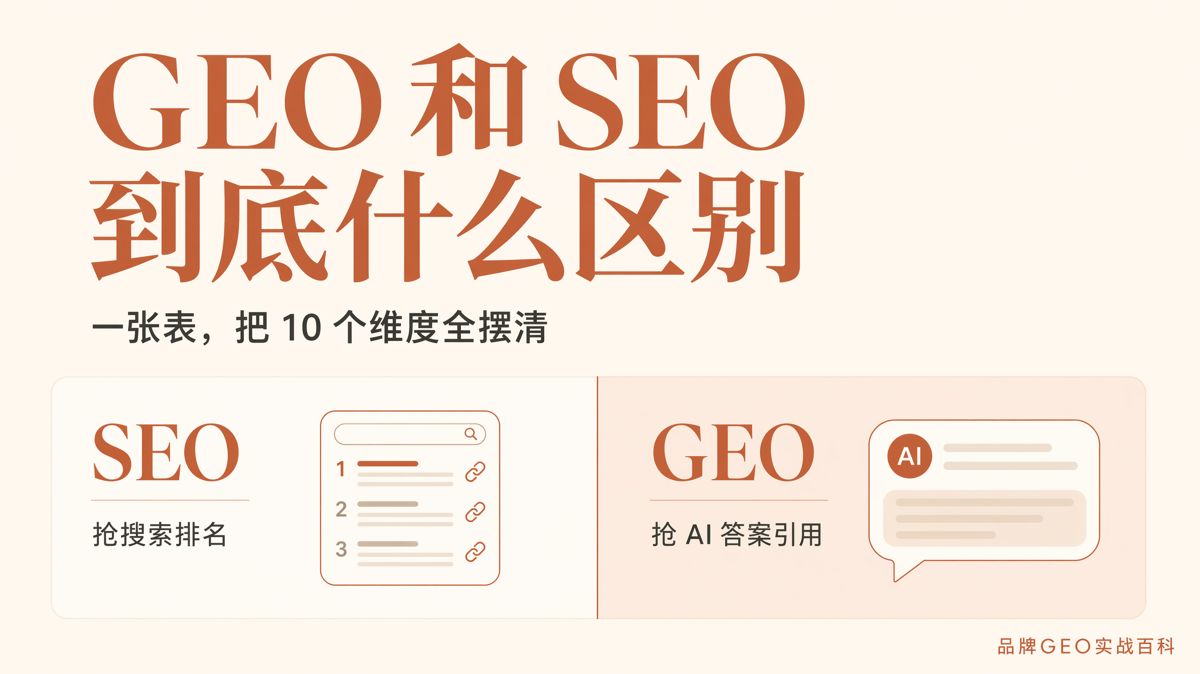
SEO optimizes full pages for search engine rankings and clicks, while GEO optimizes standalone content chunks for AI engine citations and brand mentions.
Generative Engine Optimization (GEO) focuses on getting generative search engines like ChatGPT, Doubao (ByteDance's AI assistant), and ERNIE Bot (Baidu's AI assistant) to cite your content, mention your brand, and display source links when answering relevant user queries.
Search Engine Optimization (SEO) focuses on ranking web pages higher in search engines like Google, Baidu, and Sogou, encouraging users to click through to your site.
The fundamental difference comes down to visibility: SEO targets rankings, clicks, and traffic in traditional search result lists. GEO targets citations, brand mentions, and source attributions inside synthesized AI answers. The two approaches do not cancel each other out, but they differ fundamentally in what they optimize, how engines evaluate content, and how you measure success.
Six Core Takeaways
- The Princeton University research team that coined the term Generative Engine Optimization published the first foundational GEO paper in 2023, which was later accepted at KDD '24 (ACM SIGKDD Conference on Knowledge Discovery and Data Mining). In their evaluation benchmark, specific content optimization strategies increased visibility by up to 40%. This benchmark reflects specific experimental conditions rather than a guaranteed 40% lift across all industries and platforms.
- SEO evaluates entire web pages; GEO evaluates content chunks. Even if a comprehensive article ranks high in traditional search, an AI engine will bypass it if it lacks standalone, fact-dense paragraphs that can be extracted cleanly.
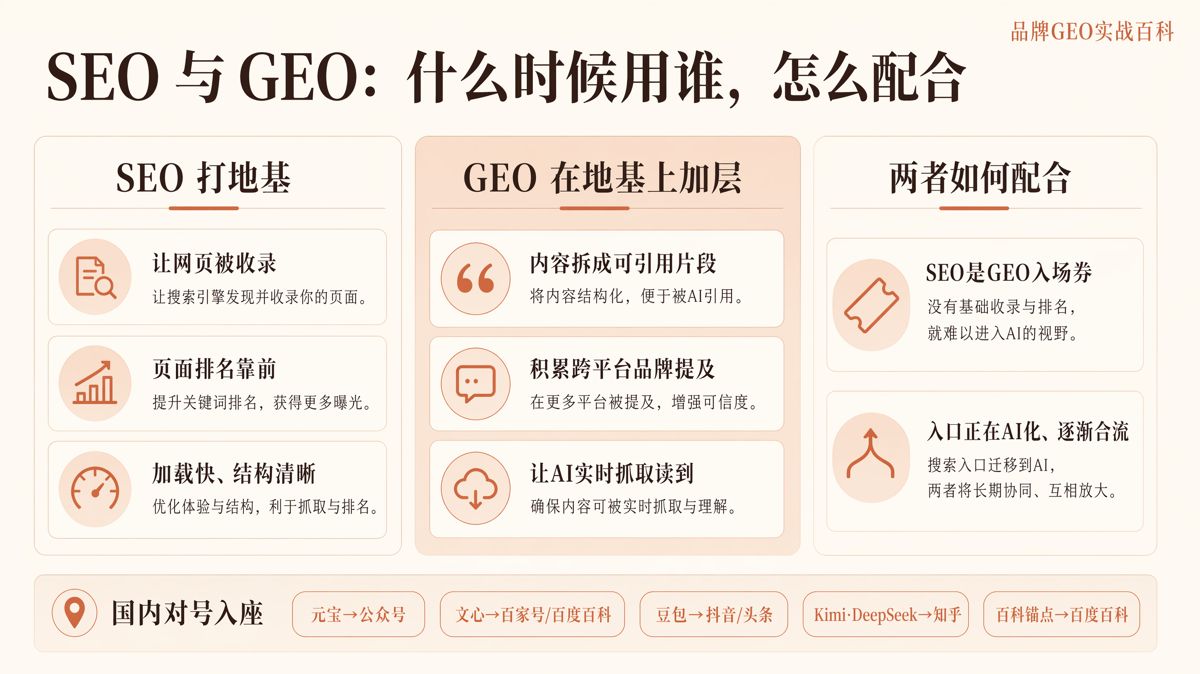
- SEO remains a mandatory foundation for GEO. If your page cannot be crawled or indexed by standard web crawlers, AI systems cannot retrieve it for answer generation.
- Authority signals are shifting. While SEO relies heavily on backlinks, GEO prioritizes brand mentions across third-party sources and cross-source entity consistency alongside links.
- Measurement frameworks must change. SEO monitors keyword rankings, organic traffic, and click-through rates. GEO monitors AI citation share, brand mention frequency, and AI referral traffic.
- Distribution channels vary significantly by geography. International GEO centers on ChatGPT, Perplexity, and Google AI Overviews. In China, optimization must account for platforms such as Doubao, ERNIE Bot, Yuanbao (Tencent's AI assistant), DeepSeek, Tongyi Qianwen (Alibaba's AI assistant), and Kimi (Moonshot AI's assistant).
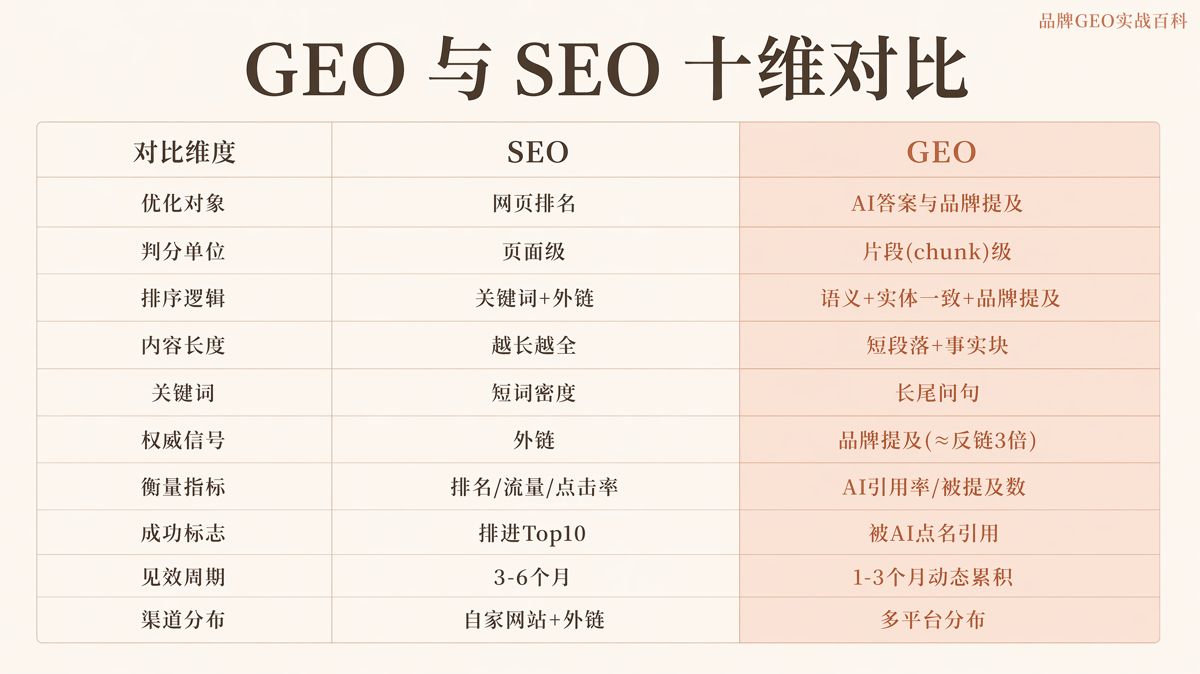
GEO vs. SEO: The 10-Dimension Comparison
| Dimension | Search Engine Optimization (SEO) | Generative Engine Optimization (GEO) |
|---|---|---|
| 1. Optimization Target | Page rank in search engine results pages (SERPs) | Factual citations and brand mentions in AI answers |
| 2. Unit of Evaluation | Entire web page | Discrete content chunks, typically 200 to 500 words |
| 3. Ranking Basis | Keyword matching, backlink profiles, domain age, and site authority | Semantic relevance, entity consistency, third-party endorsements, and brand mentions |
| 4. Content Length | Comprehensive guides often requiring 2,000 to 5,000 words | Length is secondary; every chunk must communicate a standalone factual premise |
| 5. Keyword Strategy | Built around short-tail and long-tail target keywords | Built around natural-language conversational queries, typically 10 to 20 words |
| 6. Authority Signals | Quantity and domain authority of backlinks | Cross-platform brand mentions, entity consistency, and independent verification. Research shows strong correlations between brand mentions and AI inclusion, though correlation does not equal causation |
| 7. Key Metrics | Keyword rankings, organic sessions, click-through rates (CTR) | AI citation rate, brand mention share, and AI-referred traffic |
| 8. Definition of Success | Page-one rankings (top 10) and steady organic traffic growth | Consistent brand recommendations and source citations when users ask category queries |
| 9. Time to Impact | Typically 3 to 6 months for rank stabilization | Industry benchmarks suggest visibility changes within 1 to 3 months, though this timeline varies and lacks standardized third-party verification |
| 10. Channel Footprint | Owned brand website supported by external backlink building | Multi-platform content distribution mapped to the retrieval sources of different AI models |
Note: This comparative framework is drawn from Section 1.5 of the Starbox China Overseas GEO Playbook. Timelines and domestic platform behaviors reflect industry observations rather than verified platform SLAs.
The most critical operational difference is the second dimension: SEO looks at the page as a whole, while GEO evaluates individual content chunks. This single distinction dictates your content length, paragraph architecture, and factual phrasing.
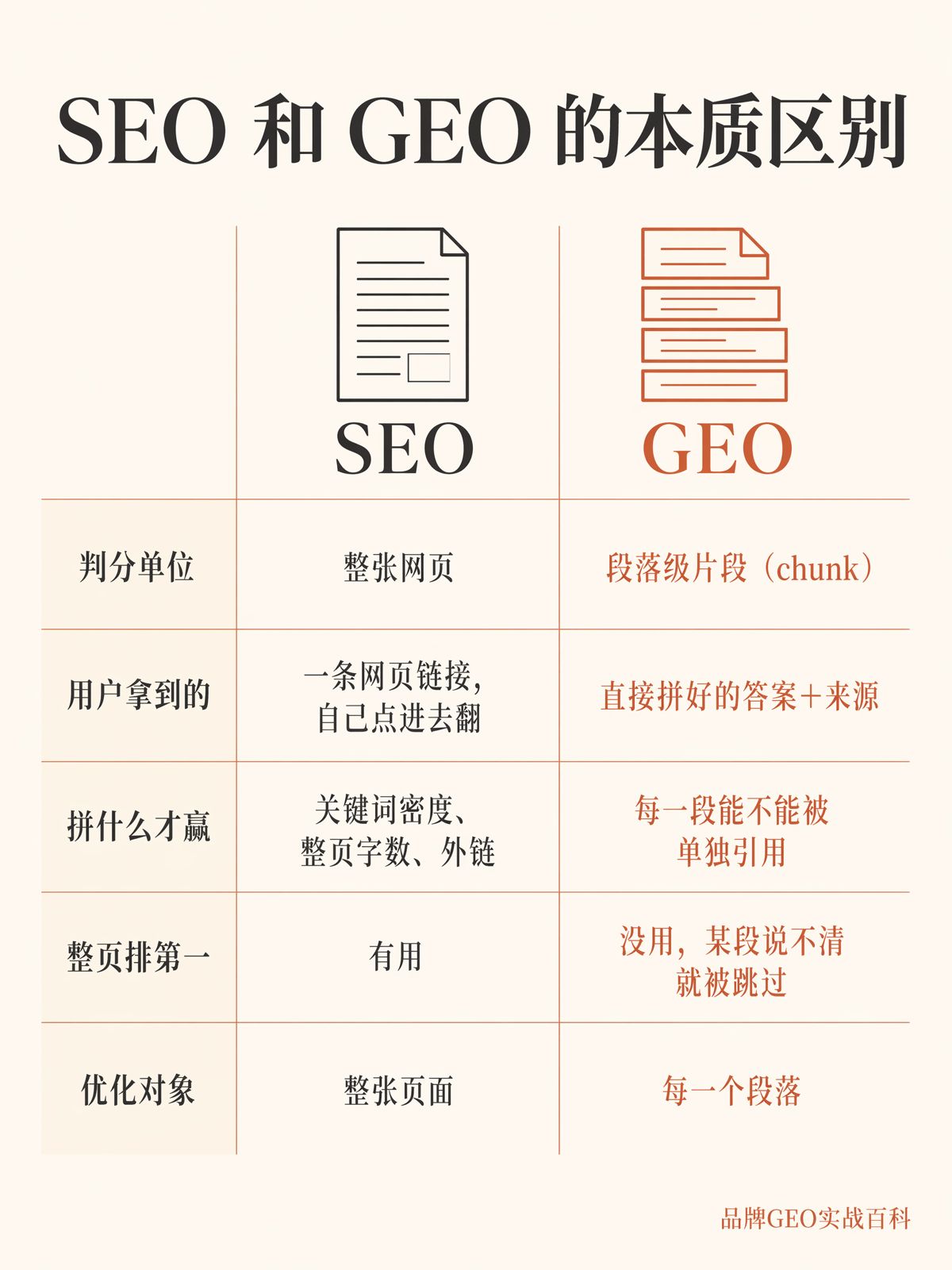
Why Content Chunks Govern AI Citations
Most generative search engines rely on Retrieval-Augmented Generation (RAG). The RAG workflow operates across three main stages:
- Candidate Retrieval: The engine retrieves roughly 20 to 100 candidate documents from its index based on the user's prompt.
- Reranking: The system reranks these candidates using semantic relevance, freshness, and authority metrics, narrowing the field to approximately 5 to 15 top documents.
- Synthesis & Generation: The engine segments these documents into passages (chunks) of roughly 200 to 500 words, evaluates which chunks contain direct evidence, and synthesizes the final answer.
A high-ranking 5,000-word article will not generate citations if its conclusions are buried or disconnected from context. If data points lack clear attribution, timestamps, and subjects, the RAG pipeline cannot extract them as reliable answer fragments.
To make a paragraph quotable by an AI engine: - Put the core conclusion in the first sentence, followed immediately by supporting proof. - Tie numbers directly to a named subject, clear scope, and specific date. - Maintain consistent naming for your brand, product, and category throughout the text. - Ensure the chunk remains fully comprehensible when read entirely out of context.
This decoupling of traditional rank from generative citation is already measurable. Data from seoClarity showed that after Google upgraded AI Overviews to Gemini 3 in January 2026, the overlap between top-10 organic search results and cited AI Overview sources dropped from 76% to 38%. A number-one organic ranking no longer guarantees a spot in the AI synthesis.
Why Brand Mentions Outweigh Traditional Backlinks in GEO
A backlink is a clickable hyperlink pointing to your domain. A brand mention occurs when a third-party publication names your company or product, with or without a link.
While traditional search algorithms heavily weight backlink equity, generative engines read the broader web as an unstructured knowledge graph. They track how many independent publications mention your brand, how they describe your offering, and whether your core product definitions remain uniform across the web.
Empirical studies by iProspect and Hallam indicate that brand mentions correlate with AI citations at roughly three times the strength of traditional backlinks. In a related study by seoClarity, online brand mentions correlated with Google AI Overview appearances at r = 0.664, compared to r = 0.218 for standard backlinks.
These figures reflect correlation rather than guaranteed causation. Increasing brand mentions does not automatically trigger an equal rise in AI citations. However, the data confirms that multi-channel brand presence carries substantial weight in generative retrieval.
Research by Ahrefs analyzing 1.4 million search prompts revealed that across the top 1,000 most cited pages in ChatGPT, 67% originated from original research, primary data, or peer-reviewed academic sources. Subjective marketing copy filled with unsupported superlatives offers zero retrieval value for an AI system seeking verifiable facts.
GEO cannot be accomplished by tweaking on-page metadata alone. Brands must build verified mentions across credible third-party environments and ensure entity descriptions match across every channel.
Tracking GEO: Beyond Keyword Rankings
Traditional SEO reporting relies on keyword positions, organic impressions, and clicks. GEO requires an entirely different measurement framework:
- Brand Mention Share: The percentage of targeted prompt variations where an AI model mentions your brand.
- Citation Attribution Share: The percentage of AI answers where your domain or content is cited as an authoritative source.
- Engine-Specific Footprint: Which proprietary pages are pulled by which AI models.
- AI Referral Conversions: The volume of traffic, inquiries, and downstream conversions originating from generative interfaces.
Data from Profound shows that AI-generated responses to identical prompts fluctuate 70% of the time, with 45.5% of cited sources being swapped out between runs. AI search results are dynamic; GEO monitoring must be an ongoing tracking process rather than a quarterly audit.
Furthermore, an Ahrefs cross-platform benchmark revealed that 86% of top cited sources across ChatGPT, Perplexity, and Google AI Overviews do not overlap. Optimizing for a single model leaves your brand invisible across the rest of the AI landscape. Each platform requires dedicated analysis.
Key Differences Between Domestic Chinese and Global GEO
Global GEO primarily targets ChatGPT, Perplexity, and Google AI Overviews. In China, generative search encompasses platforms like Doubao, ERNIE Bot, Yuanbao, DeepSeek, Tongyi Qianwen, Kimi, and Metaso.
According to the 57th Statistical Report from the China Internet Network Information Center (CNNIC), generative AI users in China reached 602 million by December 2025, representing a 42.8% national penetration rate.
Because platform citations vary widely, industry observations suggest specific ecosystem mappings (though these serve as testing hypotheses rather than rigid platform rules):
| Chinese AI Engine | Primary Observed Data Sources | Western Equivalent Ecosystem |
|---|---|---|
| Yuanbao (Tencent) | WeChat Official Accounts, WeChat ecosystem content | |
| ERNIE Bot (Baidu) | Baijiahao (Baidu's content platform), Baidu Baike | Platform knowledge bases |
| Doubao (ByteDance) | Douyin (TikTok's sister app), Douyin Baike, Jinri Toutiao | Short-form video & aggregator feeds |
| Kimi, DeepSeek | Zhihu (China's Q&A platform), CSDN (developer community) | Reddit, Quora, Stack Exchange |
| Core Entity Data | Baidu Baike, Sogou Baike | Wikipedia |
Industry practitioners often observe that Chinese AI engines cite authoritative news outlets and massive content platforms more frequently than standalone corporate websites. While this does not mean corporate domains are excluded, it underscores the need for multi-channel syndication.
Rather than assuming where models look, track actual citations across your target user personas, identify which platforms supply the source material, and adjust your distribution mix accordingly.
Will GEO Replace SEO?
No. SEO solves the foundational challenges of web crawling, rendering, indexation, and technical discoverability. Without robust indexation, an AI engine cannot find or process your content during RAG retrieval.
Google stated in its guidance issued on May 15, 2026, that optimizing for generative AI search remains fundamentally about optimizing search discovery, meaning it remains an extension of SEO.
At the same time, the search experience itself is shifting. Following Google's expanded rollout of AI Overviews in late 2025, industry estimates suggested that over 60% of commercial queries triggered AI summaries by early 2026. Baidu has implemented similar AI-generated snapshots in its domestic SERPs.
SEO and GEO are converging into a unified search strategy. Marketing teams must still maintain crawl hygiene, clean semantic HTML, and fast load speeds while structuring content into extractable factual chunks, maintaining entity consistency, and syndicating content across relevant external platforms.
Shared Foundations vs. Distinct Workflows
SEO and GEO share several core requirements: unambiguous topic focus, search bot access, logical information hierarchy, verified claims, and fast page delivery. Semantic HTML tags (clean headers, structured lists, and data tables) make content easier to parse for traditional search indexers and AI scrapers alike.
However, two operational areas require separate workflows:
- Crawler Processing: Traditional SEO focuses on standard search engine spiders indexing your pages. GEO requires real-time access for AI scrapers. Technical audits show that crawlers like GPTBot and ClaudeBot do not execute client-side JavaScript. If your core factual content relies on client-side rendering, these AI scrapers will read a blank page.
- Content Architecture: SEO optimizes the entire page for target topic depth. GEO requires passage-level clarity: conclusion-first paragraphs, unambiguous metrics tied to dates and entities, and modular takeaways designed for answer synthesis.
Compliance Standards for AI-Generated GEO Content
When producing content at scale, brands operating in or targeting China must comply with the Provisions on the Identification of AI-Generated and Synthetic Content, effective September 1, 2025. Jointly issued by the Cyberspace Administration of China (CAC), the Ministry of Industry and Information Technology (MIIT), the Ministry of Public Security (MPS), and the National Radio and Television Administration (NRTA), the regulation mandates explicit and implicit identifiers for synthetic content.
Explicit indicators include visible notices disclosing that content was AI-generated. Implicit indicators include metadata markers, cryptographic watermarks, and machine-readable tags embedded in the file structure. Unlabeled synthetic content risks de-indexing or platform penalties.
Regulatory scrutiny in 2026 also targets AI-generated advertising and promotional claims. High-risk tactics include keyword stuffing, programmatic content duplication, fabricated entity endorsements, and unsubstantiated superlative marketing claims.
GEO is not an exercise in volume or keyword density. Factual accuracy, traceable source citations, and verified entity information are both technical prerequisites for generative engine citations and basic compliance requirements.
Final Thoughts
SEO ensures your web pages are crawled, indexed, and clicked. GEO ensures your underlying insights are parsed, trusted, and cited by generative AI engines.
You do not need to choose between them. Start with a technically sound website that crawlers can index without rendering hurdles. Then, format your proprietary insights into modular, fact-dense chunks, align your brand entity definitions across third-party channels, and track your citations across both traditional SERPs and generative platforms.
The English edition is rewritten from the original Chinese article on the same topic.

Starbox AI is an AI marketing company based in Hangzhou, China. This article draws on Starbox project work. Please credit the source when quoting.
Related reading
 GEO Guide
Why AI Marketing Vendor Quotes Vary 10x: A 4-Step Vetting Checklist
Evaluate AI marketing proposals by delivery actions, not slide decks. Audit source infrastructure, fact cleaning, and clean-environment testing.
Oct 22, 2026 · 6 min read
 GEO Guide
Spotting GEO Scams: What Actually Drives AI Recommendations?
Automated AI ranking promises violate how LLMs work. Real AI recommendations rely on authoritative, structured facts across trusted public sources.
Oct 22, 2026 · 4 min read
 GEO Guide
How to Measure Your Brand's AI Visibility with a Spreadsheet
You do not need expensive software to track AI recommendations. A three-tier prompt framework and a simple spreadsheet can score your brand visibility in half a day.
Oct 21, 2026 · 6 min read