
The Core of GEO: Shifting from Keyword Density to Fact Density
The short answer
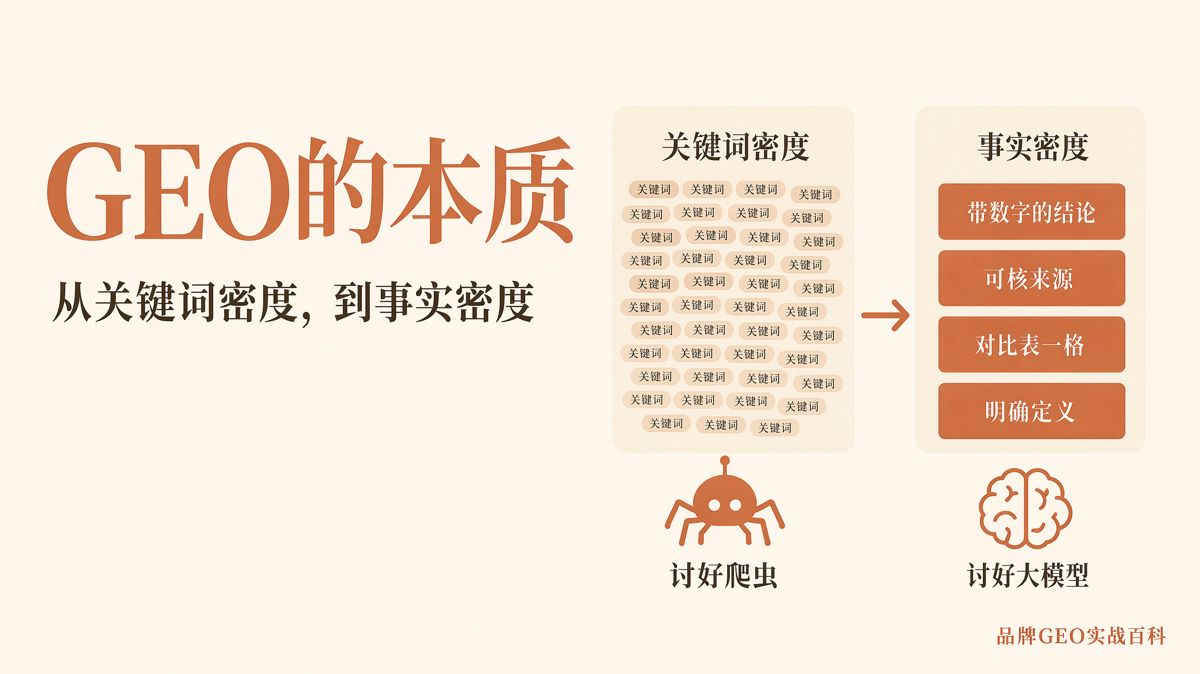
Generative Engine Optimization (GEO) requires verifiable, standalone facts rather than repeated keywords to earn citations in AI-generated answers.
Generative Engine Optimization (GEO) focuses on getting your content pulled into AI-generated answers as explicit citations. Search Engine Optimization (SEO) focuses on indexing, ranking, and earning clicks for web pages.
The two practices are connected, but their objectives differ. SEO helps search engines discover and retrieve your page. GEO requires that once retrieved, your content provides clear, verifiable, and standalone facts that a large language model (LLM) can cite.
This distinction explains why a corporate website can rank well on traditional search engines while remaining completely invisible in answers from Doubao (ByteDance's AI assistant) or DeepSeek. The issue is rarely indexing. More often, the page repeats target keywords without offering extractable facts. Keywords signal relevance, but generic assertions give AI engines nothing concrete to cite.
How AI Engines Select Citations from Web Pages
AI search engines typically rely on Retrieval-Augmented Generation (RAG). Under this architecture, the system first retrieves external web content relevant to the user query, and the LLM then synthesizes an answer using that retrieved material.
The standard workflow runs in stages: 1. The system retrieves candidate pages. 2. It ranks those pages. 3. It breaks the content into smaller passages or "chunks"—typically 200 to 500 words—and feeds them into the LLM.
The model evaluates these individual chunks for citability against three main criteria: - Can the statement be verified? - Do multiple sources corroborate a similar conclusion? - Are those supporting sources independent of one another?
A top-ranking page does not mean every paragraph within it is citable. Repeating your brand name and target keywords across a page does not help an AI model extract an answer to a specific user question.
What Is "Fact Density"?
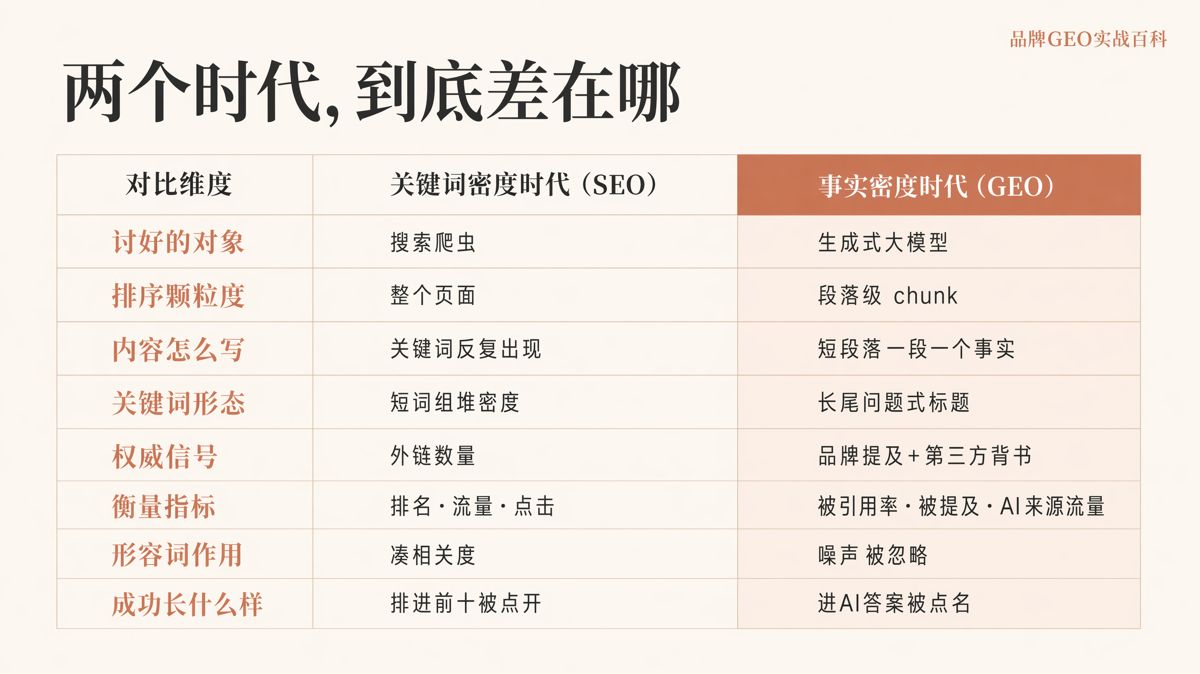
Fact density refers to the amount of verifiable, standalone, and citable information contained within a given unit of text.
A citable fact can be an exact metric, a sourced evaluation, a clearly defined term, or a concrete comparison table. For example:
"This equipment reduced the component defect rate from 3.2% to 0.4%."
This sentence presents a measurable metric and an explicit outcome. Add the data source, the measurement timeframe, and the operating conditions, and the statement becomes fully verifiable.
Phrases like "exceptional quality," "industry-leading," or "market-proven strength" offer zero verifiable data. Even if a paragraph packs these phrases alongside target keywords, its fact density remains near zero.
Moving from keyword density to fact density does not mean abandoning keywords. It means you can no longer rely on repetition alone to establish relevance. Your content must clearly state what the fact is, what evidence supports it, and under what conditions it holds true.
What the Research and Industry Data Show
Multiple studies and industry benchmarks illustrate how factual accuracy, source authority, and document structure influence AI citations:
- Princeton's foundational GEO paper (accepted at KDD 2024): Experimental results showed that specific factual optimization techniques increased a website's visibility in generative engines by up to roughly 40%. This represents a peak result under specific testing conditions rather than a universal guarantee for all content types.
- Correlations between brand mentions and AI visibility: Empirical data from seoClarity found a correlation coefficient of
r = 0.664between brand web mentions and appearances in Google AI Overviews, compared tor = 0.218for traditional backlinks. While this indicates a stronger statistical relationship for brand mentions, it reflects correlation rather than direct causation. - Mentions versus backlinks: Correlation research by iProspect and Hallam is frequently summarized across the industry as showing brand mentions having roughly three times the impact of backlinks on AI visibility. Here, a brand mention refers to a brand name and its associated claims appearing across external content, while a backlink is an external hyperlink. This metric represents an industry observation rather than proven causation.
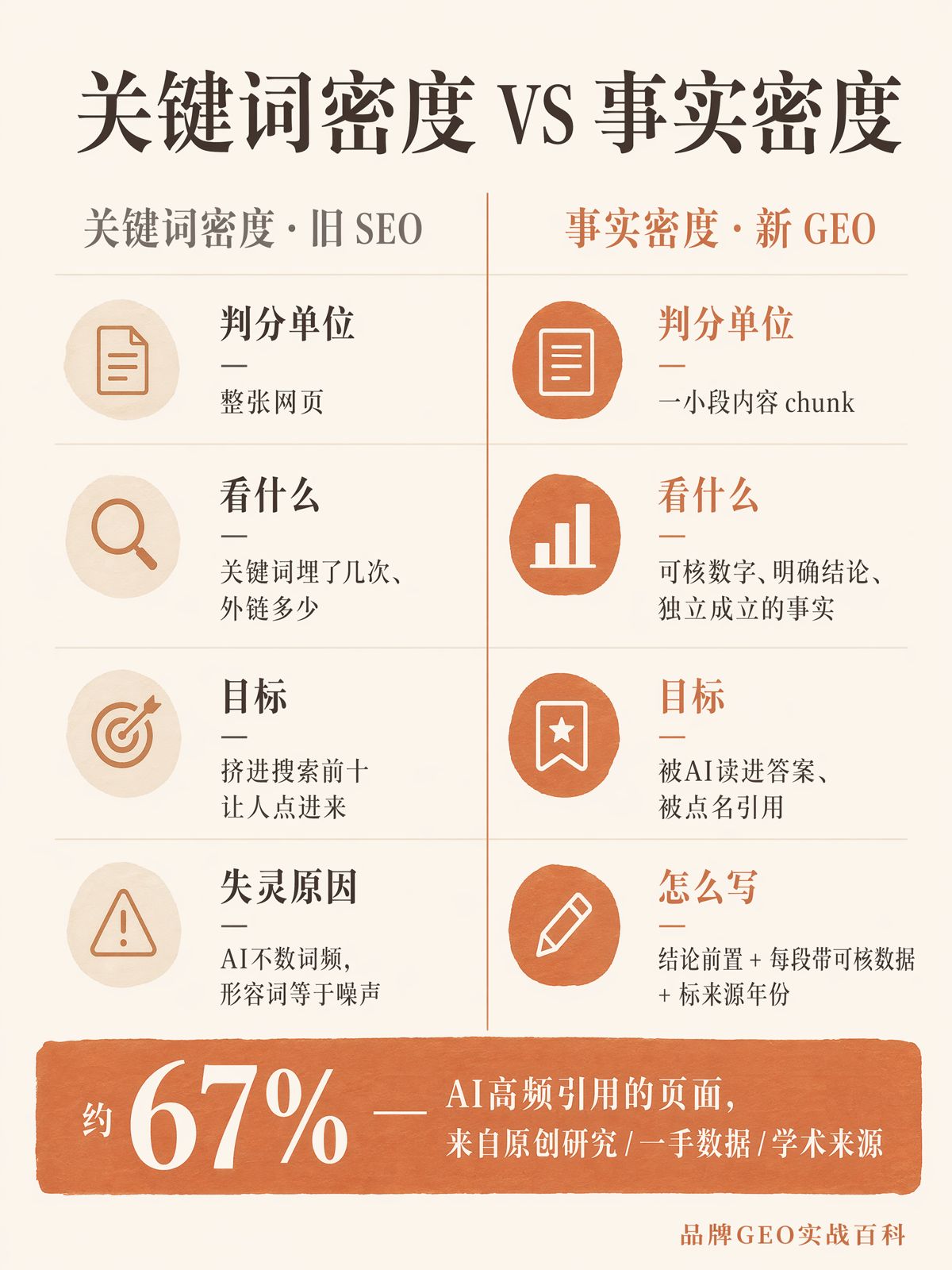
- Primary sources in ChatGPT: An Ahrefs study analyzing the top 1,000 pages most frequently cited by ChatGPT found that roughly 67% came from original research, primary data, or academic sources. Traceable, firsthand data dominates AI citations.
- Content length and structured formats: seoClarity industry benchmarks show that long-form content of 2,900 words or more had a citation rate roughly 59% higher than short-form content under 800 words. Industry data also indicates that pages containing structured tables saw approximately 2.5 times better citation performance, while FAQ structures delivered noticeable visibility gains in ChatGPT. However, adding length, tables, or FAQs will not generate citations on its own; the underlying text must still provide standalone, verifiable facts.
- Decoupling of organic rank from AI citations: Following the Gemini 3 update in early 2026, seoClarity observed that the share of Google top-10 organic search results cited within AI Overviews dropped from 76% to 38%. This finding indicates that high traditional rankings do not guarantee AI citations, though the exact drop-off varies across queries and platforms.
Together, these data points point to a consistent conclusion: AI engines do not cite content simply because a URL ranks on page one. They evaluate whether individual passages offer unambiguous facts, credible sources, and complete semantic context.
The Difference Between SEO and GEO
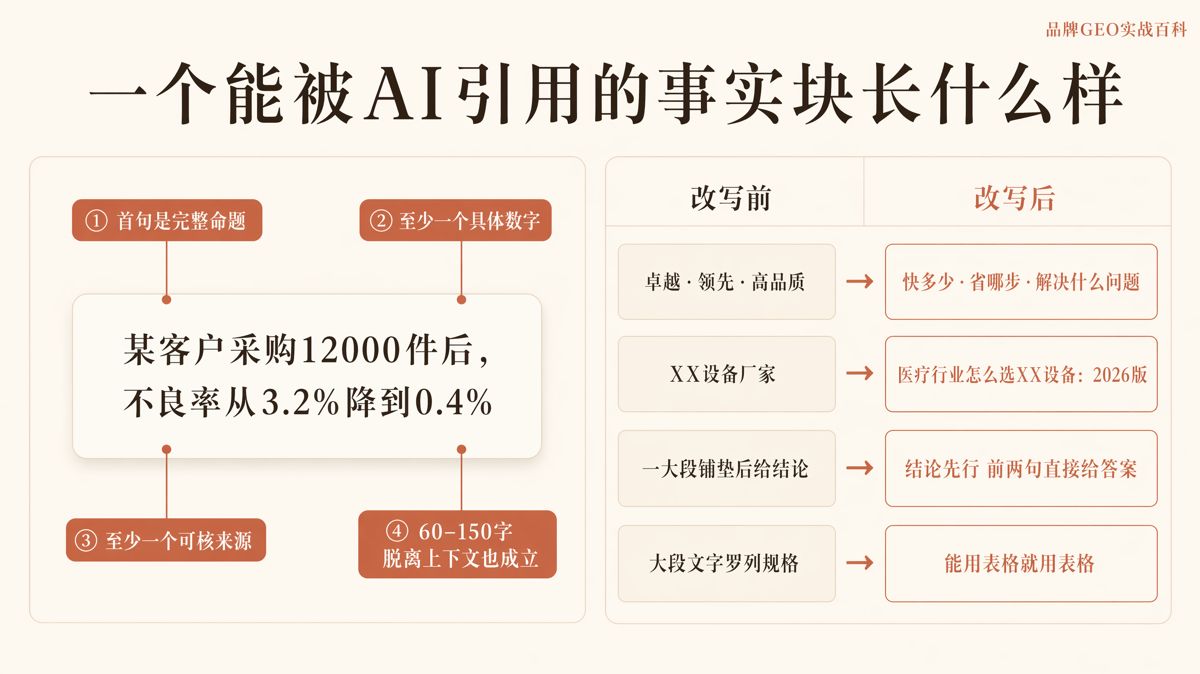
Both SEO and GEO require clear thematic focus and relevant search terms. The difference lies in the ultimate objective of the content.
| Comparison Area | Traditional SEO Focus | Additional GEO Requirement |
|---|---|---|
| Primary Objective | Page indexing, ranking, and clicks | Inclusion and citation in AI-generated answers |
| Evaluation Unit | The entire web page | Specific paragraphs and content chunks |
| Role of Keywords | Identifies topic and search intent | Aligns topics with specific user questions |
| Content Standard | Broad coverage to satisfy search intent | Standalone chunks that each prove a clear fact |
| Authority Signals | Backlinks and page-level metrics | Verifiable facts, brand mentions, third-party proof |
| Core Metrics | Rankings, organic traffic, CTR | Citation share, brand mentions, AI referral traffic |
| Success Metric | User clicks through from search results | Brand or content is directly cited in AI answers |
The legacy approach of repeating target keywords throughout an expansive article fails in AI search. If a paragraph requires several preceding and following sections just to make sense, an LLM cannot easily extract it as an independent citation. In contrast, a tightly scoped passage featuring clear numbers, explicit sources, and direct conclusions can be quoted immediately.
Five Ways to Optimize Content for Fact Density
1. Align Headings with Specific Questions
Keep core search queries in your headings, but clarify the use case or reader intent. For example, change "Industrial Sensor Manufacturer" to "How to Select Industrial Sensors for High-Temperature Environments: 2026 Guide."
Industry benchmarks suggest question-based headings can achieve two to three times the citation rate of static statement headings. Treat this as a directional observation rather than a fixed rule across every topic. Your headings must remain accurate without distorting the topic simply to force a question format.
2. Answer First, Explain Second
Under each subheading, deliver a direct answer in the first two to three sentences before detailing your methodology, evidence, and constraints. Readers get the conclusion immediately, and AI models can parse what query the passage answers without ambiguity.
3. Build Standalone Content Chunks
Aim for 60 to 150 words per key factual chunk, focusing each passage on a single conclusion. Open with a sentence clearly identifying the subject, situation, and result. When citing metrics, provide the exact numbers and their source. When presenting definitions, state the operational boundaries. When limitations exist, state them explicitly.
4. Present Comparative Data in Tables
Use tables for technical specifications, pricing models, multi-step processes, operating parameters, and performance comparisons. Use FAQ modules for common evaluation questions. While structured formats help AI parsers categorize fields, the underlying data must still be accurate and verifiable.
5. Replace Vague Adjectives with Concrete Proof
Cut unquantifiable terms like "exceptional quality," "highly efficient," or "market-leading." Explain exactly how much faster a process is, which operational step was eliminated, what problem was solved, and what third-party data confirms the claim.
Writing "After deploying 12,000 units, Client A's defect rate fell from 3.2% to 0.4%" gives search models concrete metrics and measurable outcomes. Supplementing that sentence with measurement criteria and source verification makes it far more citable than simply claiming "superior product reliability."
Does Fact Density Apply to Chinese AI Engines?
Yes. While platforms and sources differ between China and Western markets, the core requirements—verifiable facts, clean structure, and independent corroboration—remain the same.
Industry observations note distinct source preferences across Chinese AI platforms: - Tencent Yuanbao frequently references WeChat Official Accounts. - Baidu Wenxin (ERNIE Bot) pulls heavily from Baijiahao (Baidu's content platform) and Baidu Baike (Baidu Encyclopedia). - Doubao (ByteDance's AI assistant) draws frequently from Douyin (TikTok's Chinese sister app) and Jinri Toutiao (ByteDance's news aggregator). - Zhihu (China's largest Q&A platform) serves as a common citation source for both Kimi (Moonshot AI's assistant) and DeepSeek.
These platform preferences are industry observations rather than rigid algorithms. Industry data also indicates that Chinese AI platforms cite standalone corporate websites less frequently than established content platforms or authoritative media outlets.
When executing GEO in China, do not publish exclusively on your corporate website, and do not assume that posting to a single channel guarantees AI pickup. Distribute your core verifiable facts across relevant platform formats, then systematically audit actual citations across different AI models.
Do You Still Need SEO If You Practice GEO?
Yes.
An AI engine must discover and retrieve content before it can cite it. If your content is not indexed or cannot enter retrieval candidate pools, citation is impossible. In May 2026, Google affirmed that optimizing for generative AI search remains an optimization of the search experience and falls squarely within the discipline of SEO.
In China, securing indexation across Baidu, WeChat Search, and platform-native search engines remains essential. SEO and GEO do not replace each other: SEO ensures your content can be found, while GEO ensures it can be understood, trusted, and cited.
The correct sequence is straightforward: secure search discoverability first, then maximize the density of verifiable, standalone facts within your content.
Final Takeaway
GEO does not make keywords obsolete. It makes unsubstantiated claims unviable.
Keywords tell an algorithm what your article is about; facts prove whether your claims are credible. Generative engines look for clear conclusions, concrete metrics, dependable sources, explicit conditions, and independent verification. To earn citations in AI answers, cut promotional adjectives and supply clear, measurable facts.
Moving from keyword density to fact density shifts your marketing from simply proving that content matches a query to proving that it reliably answers it.
Frequently Asked Questions
Are GEO and SEO the same thing?
No, but they overlap. SEO focuses on indexing, ranking, and driving clicks to entire web pages. GEO focuses on whether specific passages are extracted and cited inside AI-generated answers. Content must generally be retrievable through search before an AI engine evaluates it for passage-level citations.
What is the difference between fact density and keyword density?
Keyword density measures how frequently a specific term appears in text to signal topical relevance. Fact density measures how much verifiable, standalone, and citable information exists per unit of text. A page packed with keywords but lacking verifiable facts will rarely be cited by AI search engines.
Why are vague marketing words rarely cited by AI engines?
Words like "industry-leading" or "exceptional" lack measurable criteria and cannot be verified. Ahrefs research shows that the vast majority of ChatGPT citations come from original research, primary data, and academic sources. Rather than making broad claims, provide exact figures, comparison boundaries, and primary sources.
Does longer content automatically get cited more often by AI?
Not necessarily. While seoClarity benchmarks show that long-form content of 2,900+ words had roughly 59% higher citation rates than content under 800 words, this reflects correlation rather than causation. Long-form content only wins citations when it is cleanly structured into standalone factual chunks.
Is optimizing for Chinese AI platforms different from global engines?
The core content standards are identical: verifiable facts, structured presentation, and independent corroboration. However, the distribution channels differ. Industry observations suggest Chinese AI models rely heavily on domestic platform ecosystems (such as WeChat, Baijiahao, and Zhihu) rather than independent company websites. Brands must seed verifiable facts across these ecosystems and monitor real-world citations.
Do you still need SEO if you are doing GEO?
Yes. SEO solves discoverability and indexing, while GEO solves semantic understanding and citation. The two practices complement each other. Ensure your content can be retrieved through traditional search, then structure it to deliver high fact density for generative models.
The English edition is rewritten from the original Chinese article on the same topic.

Starbox AI is an AI marketing company based in Hangzhou, China. This article draws on Starbox project work. Please credit the source when quoting.
Related reading
 GEO Guide
Why AI Marketing Vendor Quotes Vary 10x: A 4-Step Vetting Checklist
Evaluate AI marketing proposals by delivery actions, not slide decks. Audit source infrastructure, fact cleaning, and clean-environment testing.
Oct 22, 2026 · 6 min read
 GEO Guide
Spotting GEO Scams: What Actually Drives AI Recommendations?
Automated AI ranking promises violate how LLMs work. Real AI recommendations rely on authoritative, structured facts across trusted public sources.
Oct 22, 2026 · 4 min read
 GEO Guide
How to Measure Your Brand's AI Visibility with a Spreadsheet
You do not need expensive software to track AI recommendations. A three-tier prompt framework and a simple spreadsheet can score your brand visibility in half a day.
Oct 21, 2026 · 6 min read