
AI Citation vs. AI Mention: What Is the Difference?
The short answer
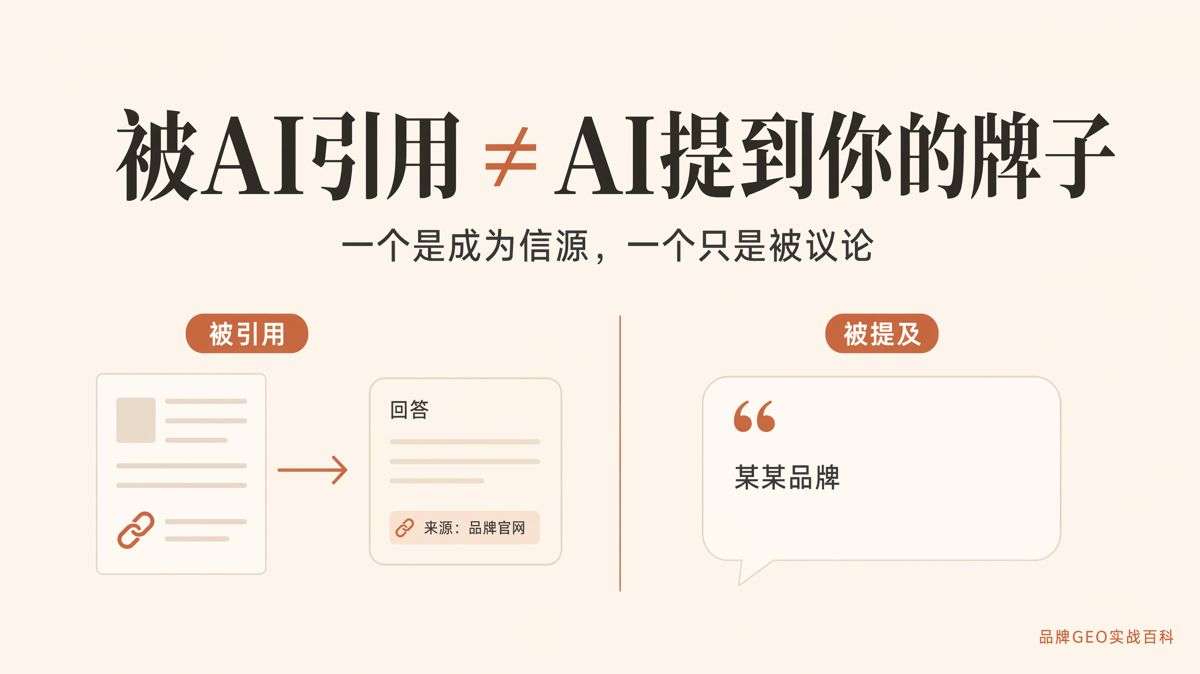
Being mentioned means an AI names your brand. Being cited means your content is the source. Here is why you must measure both.
When marketing teams begin Generative Engine Optimization (GEO), their first question is almost always: "Does the AI say our brand name when answering category questions?"
That question only tells you whether your brand was mentioned. It tells you nothing about whether your owned content was cited as a source. AI brand mentions and AI citations are two distinct metrics. They reflect different mechanics, deliver different business value, and must be tracked separately.
Put simply: a mention means the AI names your brand in its answer. A citation means the AI lists your content as a source.
What Is the Difference Between a Citation and a Mention?
Under standard industry definitions:
An AI citation occurs when an engine uses your published webpage or article as an underlying source for its answer. The response typically displays a source link that users can click to visit your content.
An AI brand mention occurs when the AI includes your company, brand, or product name in the text of its answer. It often comes without a link to your website, because the engine may have pulled the information from third-party reviews, industry listicles, or market overviews.
This distinction ties into the concept of a brand entity. In AI systems, an entity is an identifiable company, product, or organization that the model consistently connects to specific industries, attributes, and topics. When an AI names your brand, it has successfully recognized your entity in the context of the prompt. When an AI cites your content, your specific page has made it into the model's retrieval and synthesis pipeline.
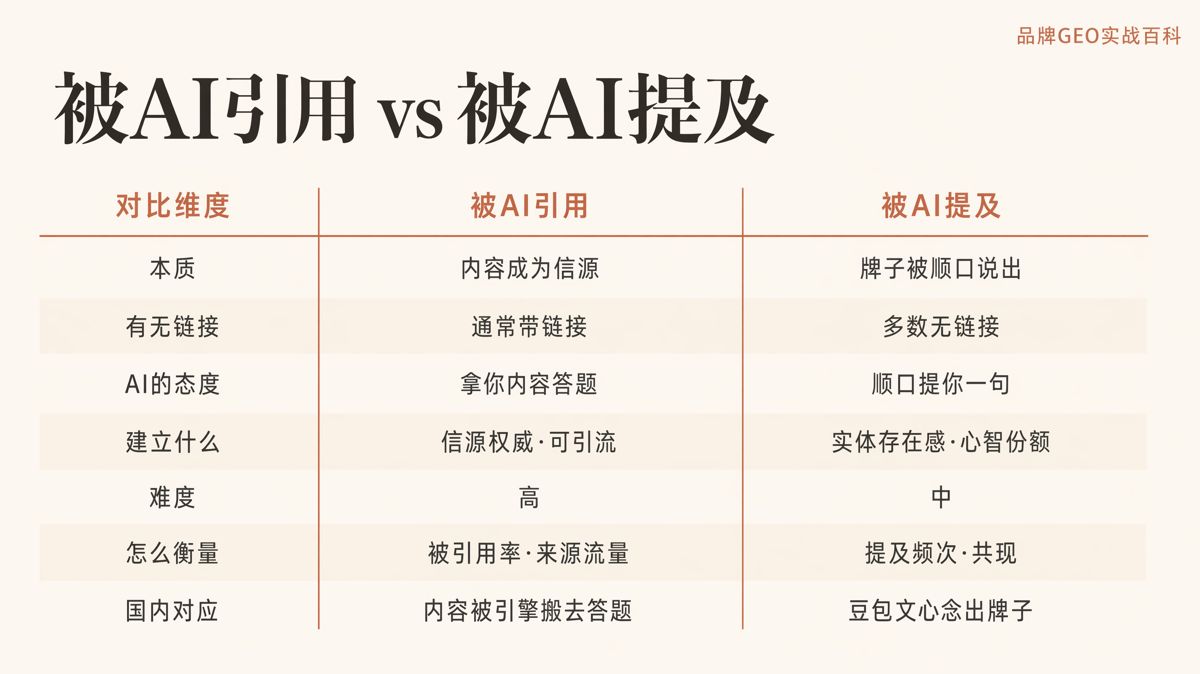
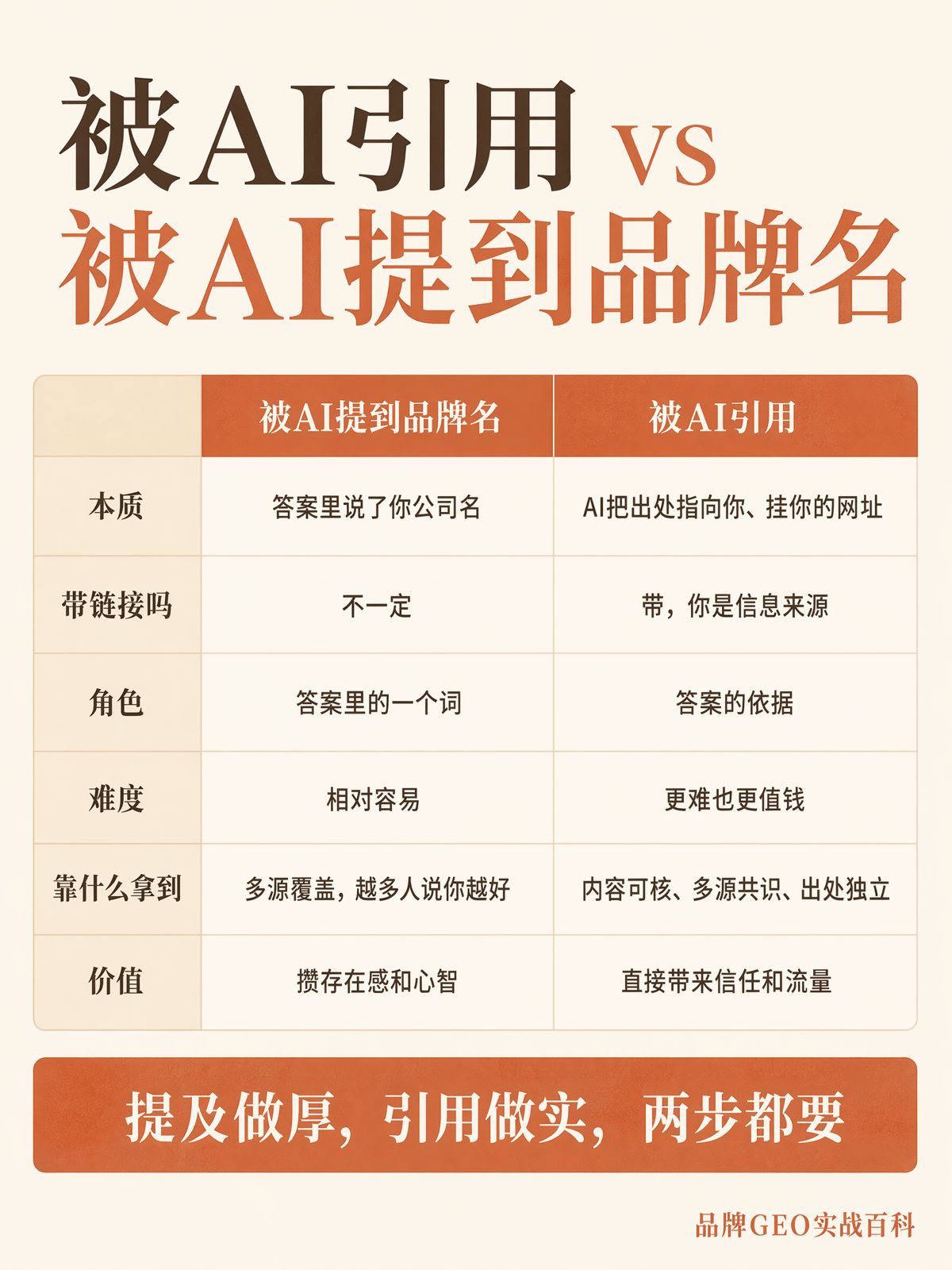
| Comparison Dimension | AI Citation | AI Brand Mention |
|---|---|---|
| Core definition | Your content serves as a source for the answer | Your brand name appears in the generated text |
| Links | Usually includes a clickable link to your content | Rarely includes a direct link; often unlinked text |
| What it proves | The AI extracted facts from your owned content | The AI recognizes your brand as relevant to the query |
| Primary value | Builds authority and provides direct referral traffic | Increases brand visibility during buyer research |
| Difficulty | Higher: content must be crawled, retrieved, and chosen | Lower: third-party coverage can trigger mentions |
| How to measure | Citation frequency, source URLs, referral traffic | Total mention count, share of voice in category prompts |
| Key drivers | Original data, self-contained factual claims, clean crawlability | Cross-web presence, entity consistency, third-party reviews |
You cannot roll these into a single metric. If you only look for your brand name, you will miss whether your site actually feeds the engine's answers. If you only count source links, you will overlook mentions that put your brand in front of buyers without linking back to you.
Both Have Value, but They Do Different Jobs
Citations validate the authority of your content. When an AI lists your page as a source, it indicates the engine trusted and extracted your information to answer the prompt. Users also receive a direct path to click through to your site.
An Ahrefs study of 1.4 million prompts found that among ChatGPT's top 1,000 most cited pages, 67% came from original research, primary data, or academic sources. While this does not mean every engine follows the exact same ratio, it shows that generative engines have high standards for content they cite as evidence.
Mentions, on the other hand, drive brand visibility. If a buyer asks an AI to list the top vendors in your category and the engine includes your company, your brand enters the consideration set—even without a link.
Several studies show a correlation between brand mentions and AI citations. In an empirical model by iProspect and Hallam, brand mentions had roughly three times the correlation strength with AI citations compared to traditional backlinks.
Data from seoClarity showed a similar pattern: the correlation between web brand mentions and appearances in Google AI Overviews (AIO) reached r=0.664, whereas the correlation for backlinks was r=0.218. (A correlation coefficient, or r, measures how closely two variables move together, with values closer to 1 indicating stronger alignment.) These findings indicate correlation, not direct causation, but they show that broad brand presence across the web goes hand in hand with AI visibility.
Both matter, but they solve different problems: mentions track brand recognition, while citations track content utility.
Why Are Citations Harder to Earn?
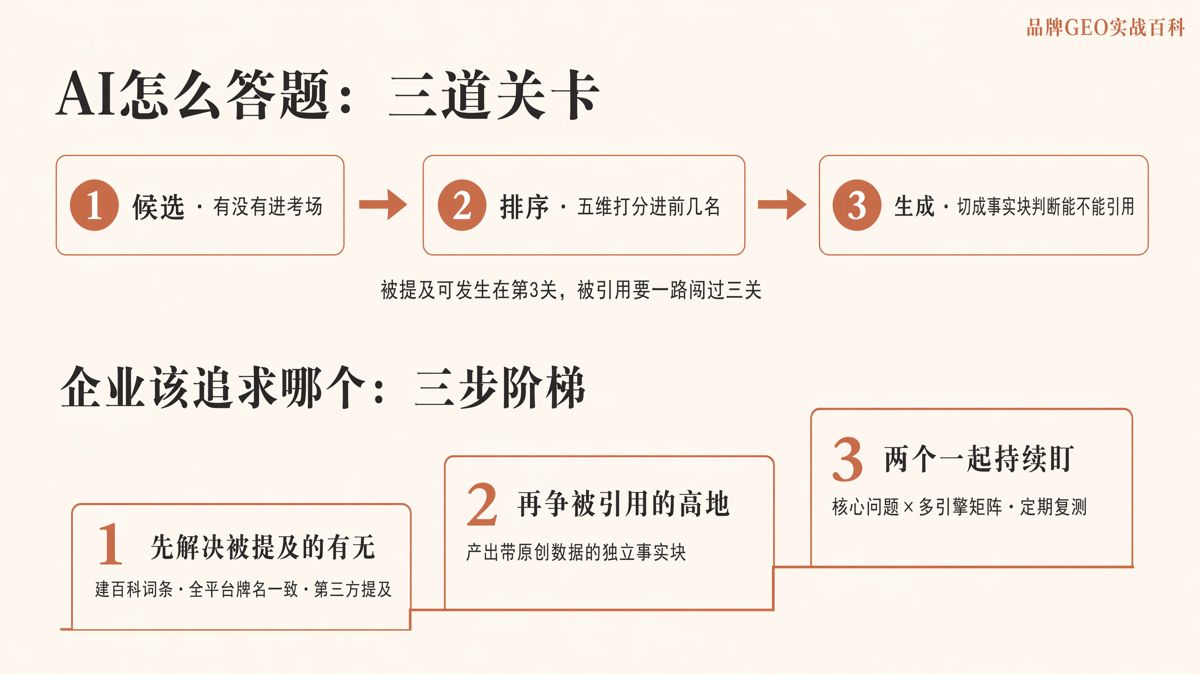
To understand why citations are harder to secure, consider the three stages of Retrieval-Augmented Generation (RAG)—the architecture engines use to retrieve external data and generate answers:
- Retrieval: The system searches its index for candidate documents relevant to the query.
- Filtering and ranking: The system filters candidates using relevance, credibility, freshness, readability, and entity consistency.
- Generation: The system breaks candidate pages into smaller text chunks, decides which chunks directly answer the prompt, and synthesizes the final response, attaching citations where supported.
A brand mention can come from any candidate page in the index that names your company. Even if your owned website is never pulled into the model's working context, the AI can still read your name in a third-party review or directory and write it into the answer.
A citation requires your owned page to pass every stage: it must be discovered, crawled, indexed, selected as a candidate, and contain factual chunks that the model can understand independently and weave into its final answer.
Technical execution also plays a role. If a single-page application (SPA) relies entirely on client-side JavaScript to render text, AI crawlers that cannot render JavaScript will index a blank or incomplete page. In that scenario, third-party sites might still get your brand mentioned, but your own domain will never be cited.
GEO and SEO Use Different Scorecards
Traditional search engine optimization (SEO) focuses on ranking entire webpages on search engine results pages (SERPs) and generating organic clicks.
GEO citations focus on whether individual content chunks can directly answer specific questions. GEO brand mentions focus on whether the engine recognizes your company as an entity tied to a specific problem or category.
Strong organic search rankings do not guarantee AI citations. Following an update to Google AI Overviews in early 2026, seoClarity observed that the share of citations coming from the top 10 organic Google results dropped from 76% down to 38%. While this observation varies by query type and engine, it highlights a fundamental shift: ranking on page one does not ensure an AI engine will cite your page.
The reason lies in how answers are assembled. A long article can rank well in traditional search due to overall page authority and user engagement signals. But when an AI synthesizes an answer, it needs clear, standalone factual chunks. If your high-ranking page lacks concise, extractable conclusions, the model will cite another source that provides them.
SEO and GEO share foundational requirements—such as crawlability and indexability—but their evaluation criteria and end metrics are distinct.
A Citation Today Does Not Mean a Citation Tomorrow
Generative answers are dynamic. Monitoring data from Profound indicates that AI answers for the identical prompt change roughly 70% of the time, and about 45.5% of citation links are replaced in newly generated responses.
A single citation confirms that your content was selected during that specific run; it does not mean your position is permanent. Marketing teams must run recurring tests across core queries to measure whether their citation rate remains steady over time.
Citation sources also vary across engines. A cross-platform study by Ahrefs found that 86% of high-frequency citation sources across ChatGPT, Perplexity, and Google AI Overviews do not overlap. Earning a citation in one engine does not mean you will appear in another.
Tracking Both Metrics Across Chinese AI Engines
For brands operating in or monitoring China, the same separation between mentions and citations applies.
When Doubao (ByteDance's AI assistant), Wenxin Yiyan (Baidu's AI assistant), or Yuanbao (Tencent's AI assistant) write your company name in an answer, that is a brand mention. Only when they link back to your content—such as articles on your WeChat Official Account, Baijiahao (Baidu's content platform), or Baidu Baike (Baidu's encyclopedia)—does it count as an owned citation.
Current industry observations suggest different platform tendencies, though these are based on vendor reporting and practitioner tracking rather than standardized third-party audits:
- Yuanbao frequently retrieves content from WeChat Official Accounts.
- Wenxin Yiyan frequently pulls from Baijiahao and Baidu Baike.
- Doubao frequently surfaces material from Douyin and Toutiao (ByteDance's platforms).
- DeepSeek and Kimi (Moonshot AI's assistant) often retrieve answers from Zhihu (China's Q&A platform).
These observations can guide channel distribution, but they are not guarantees. Simply publishing on a platform does not guarantee citation.
Furthermore, observational data suggests that Chinese AI engines cite established news media and high-authority publisher accounts far more often than standalone brand websites. Brands should verify:
- Is your brand name written identically across all public platforms?
- Are independent third parties writing about your brand?
- Are your owned assets technically crawlable?
- Is your content distributed across the channels indexed by your target AI engines?
What Marketing Teams Should Do First
1. Check Brand Mention Rates First
Assemble a fixed list of high-intent, category-level prompts related to your business. Run them across your target AI engines and document whether your brand name appears in the responses.
If your brand never appears, focus on foundational entity clarity. Verify your corporate encyclopedia entries, standardize brand naming across directories, and build third-party coverage. The goal at this stage is helping the models connect your brand entity to your category.
2. Audit Content for Citation Readiness
Once AI engines reliably mention your brand, evaluate whether your owned content appears as a source citation.
Ensure your site publishes primary research, unique data, and clear factual takeaways. Structure answers so key conclusions make sense even when extracted as standalone text chunks. Resolve technical barriers such as JavaScript-only rendering, and syndicate content to channels indexed by target engines.
3. Track Mentions and Citations on Separate Trackers
Keep separate records for both metrics:
- Brand mentions: Track raw frequency, share of voice within category queries, and contextual sentiment.
- Content citations: Track citation appearance rates, specific cited URLs, and downstream referral traffic.
Because generative engines update frequently and draw from different sources, run tests on a set schedule across consistent prompts rather than relying on a one-time snapshot.
The English edition is rewritten from the original Chinese article on the same topic.

Starbox AI is an AI marketing company based in Hangzhou, China. This article draws on Starbox project work. Please credit the source when quoting.
Related reading
 GEO Guide
Why AI Marketing Vendor Quotes Vary 10x: A 4-Step Vetting Checklist
Evaluate AI marketing proposals by delivery actions, not slide decks. Audit source infrastructure, fact cleaning, and clean-environment testing.
Oct 22, 2026 · 6 min read
 GEO Guide
Spotting GEO Scams: What Actually Drives AI Recommendations?
Automated AI ranking promises violate how LLMs work. Real AI recommendations rely on authoritative, structured facts across trusted public sources.
Oct 22, 2026 · 4 min read
 GEO Guide
How to Measure Your Brand's AI Visibility with a Spreadsheet
You do not need expensive software to track AI recommendations. A three-tier prompt framework and a simple spreadsheet can score your brand visibility in half a day.
Oct 21, 2026 · 6 min read