
What Does GEO Actually Optimize? A Complete Breakdown
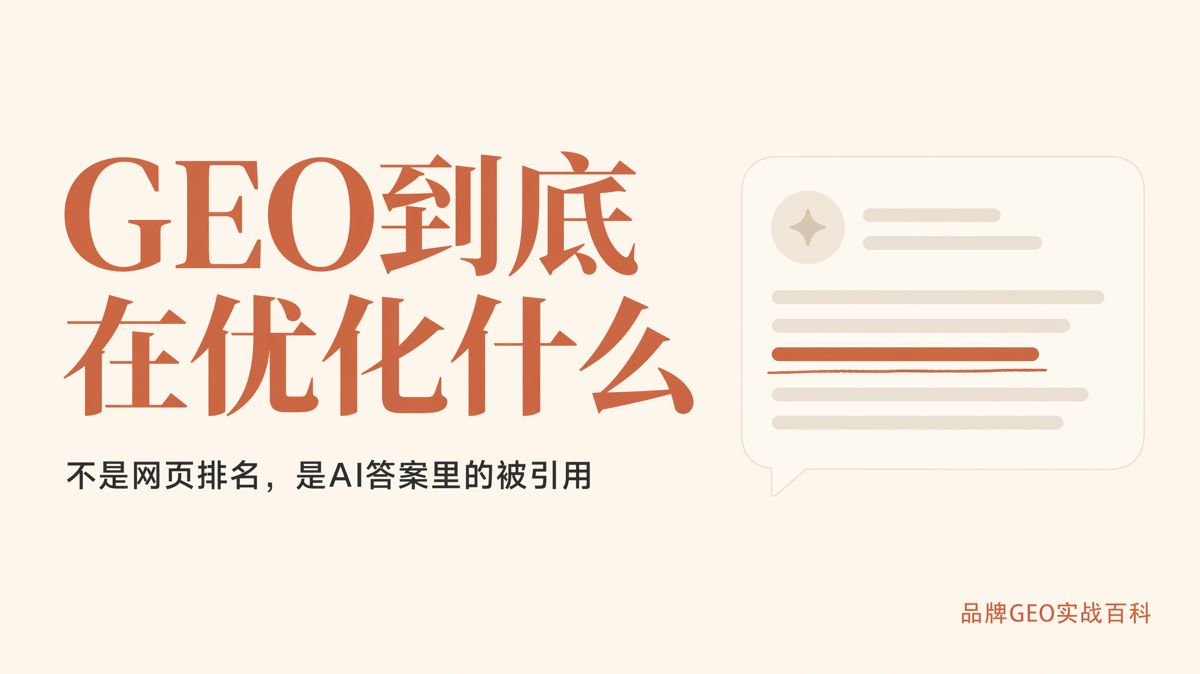
The short answer
GEO focuses on whether your brand enters AI-generated answers: getting retrieved, surviving re-ranking, and being cited or mentioned.
Generative Engine Optimization (GEO) is not about where your webpage ranks in a traditional search results list. It focuses on whether your brand and content make it into AI-generated answers: first retrieved, then retained through re-ranking, and finally cited or mentioned.
Traditional Search Engine Optimization (SEO) primarily tackles crawling, indexing, and organic search rankings. GEO takes over from there, addressing how AI models filter context and generate answers. A user might never click through to your website, yet facts, viewpoints, or product names from your pages already appear inside the AI's response. That is the fundamental difference between the two disciplines.
The concept of GEO was first introduced academically in 2023 by a research team at Princeton University. Their paper, published at KDD '24 (the ACM SIGKDD Conference on Knowledge Discovery and Data Mining), demonstrated that under specific test conditions, strategic content rewriting could increase visibility in AI responses by up to 40%.
How AI Generates Answers: Three Sequential Stages
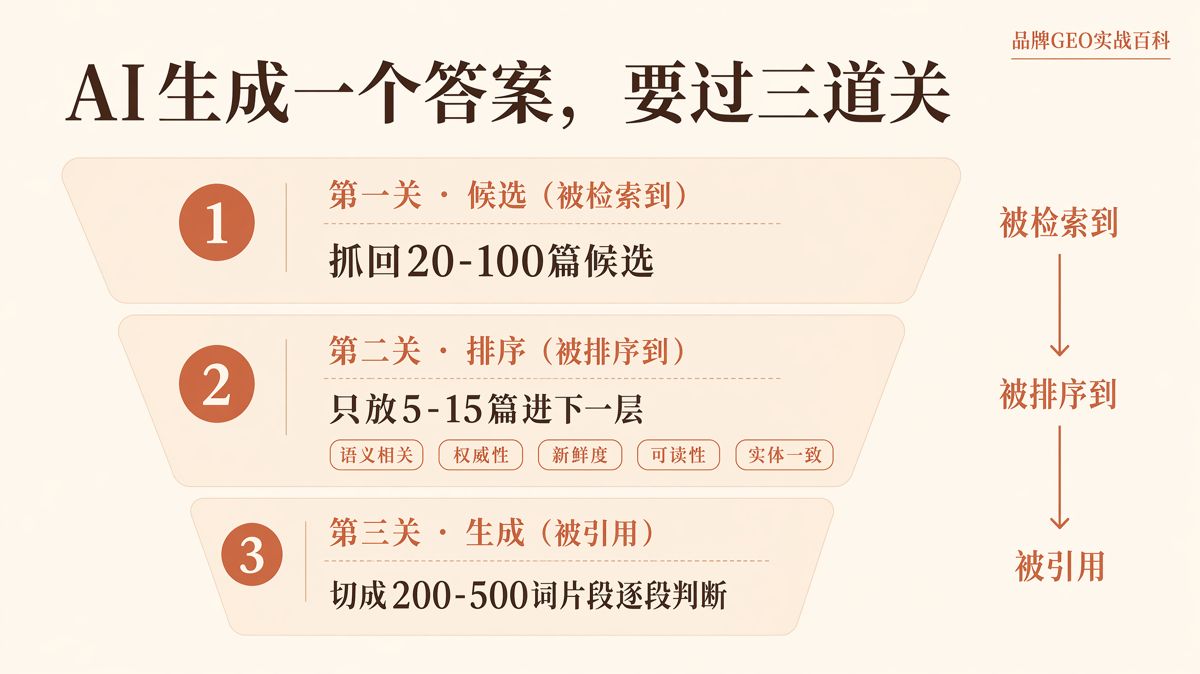
Mainstream AI search engines rely on a Retrieval-Augmented Generation (RAG) workflow. They do not generate answers out of thin air. Instead, they retrieve sources, filter them, and organize the final response. While ChatGPT, Perplexity, Google AI Overviews, Doubao (ByteDance's AI assistant), DeepSeek, and Ernie Bot (Baidu's AI assistant) differ under the hood, they all follow three sequential stages.
1. Retrieval: Entering the Candidate Pool
When a user submits a prompt, the system converts it into search queries to retrieve roughly 20 to 100 candidate pages and snippets from its search index or knowledge base.
This step verifies whether your content exists and whether search engine crawlers can read it. If a page is not indexed or cannot be fetched, it cannot enter the downstream ranking pipeline.
2. Re-ranking: Surviving the Cut
The system evaluates and scores the retrieved candidates. Industry workflow data shows that typically only 5 to 15 sources make it past this stage.
Getting retrieved does not guarantee inclusion in the final answer. The system weighs semantic alignment with the prompt, source authority, information freshness, and clean document structure.
3. Generation: Becoming Part of the Answer
The model segments the retained sources into smaller text chunks, typically between 200 and 500 words each.
It then evaluates whether each chunk is credible, directly relevant to the prompt, and coherent outside of its original context. Chunks that pass this screening are synthesized into the final response, with citations appended where appropriate.
Candidate volumes and chunk lengths vary across platforms and query types, but the progression remains constant: content must be retrieved, survive re-ranking, and qualify for synthesis. GEO optimizes this exact three-step chain.
What AI Evaluates During Re-ranking
Industry estimates categorize AI re-ranking signals into five primary dimensions. These weights reflect general importance rather than a universal, publicly disclosed scoring algorithm:
| Dimension | Estimated Weight | What the System Checks | Recommended Actions |
|---|---|---|---|
| Semantic Relevance | 30%—35% | Does the meaning match the user's intent, rather than exact keyword counts? | Use question-based headings, answer questions directly in the opening lines, and include structured FAQs. |
| Authority | 20%—25% | Is the domain credible? Does it have third-party citations, media coverage, or encyclopedia references? | Provide case studies, industry awards, original research, and verifiable third-party data. |
| Freshness | 15%—20% | When was it published or updated? Has it been cited within the past six months? | Display clear update timestamps and systematically review legacy content. |
| Readability & Structure | 10%—15% | Can the text be split into clean, context-independent chunks? | Use clear subheadings, state conclusions first, cover one concept per paragraph, and keep paragraphs between 50 and 150 words. |
| Entity Consistency | 15%—20% | Do brand names, descriptions, and details align across external platforms? | Standardize brand names and core business descriptions across platforms; maintain accurate encyclopedia entries. |
An "entity" refers to a distinct company, brand, or organization recognized by an AI system. If your brand name, corporate profile, or business scope is inconsistent across the web, the system may classify them as separate or conflicting entities.
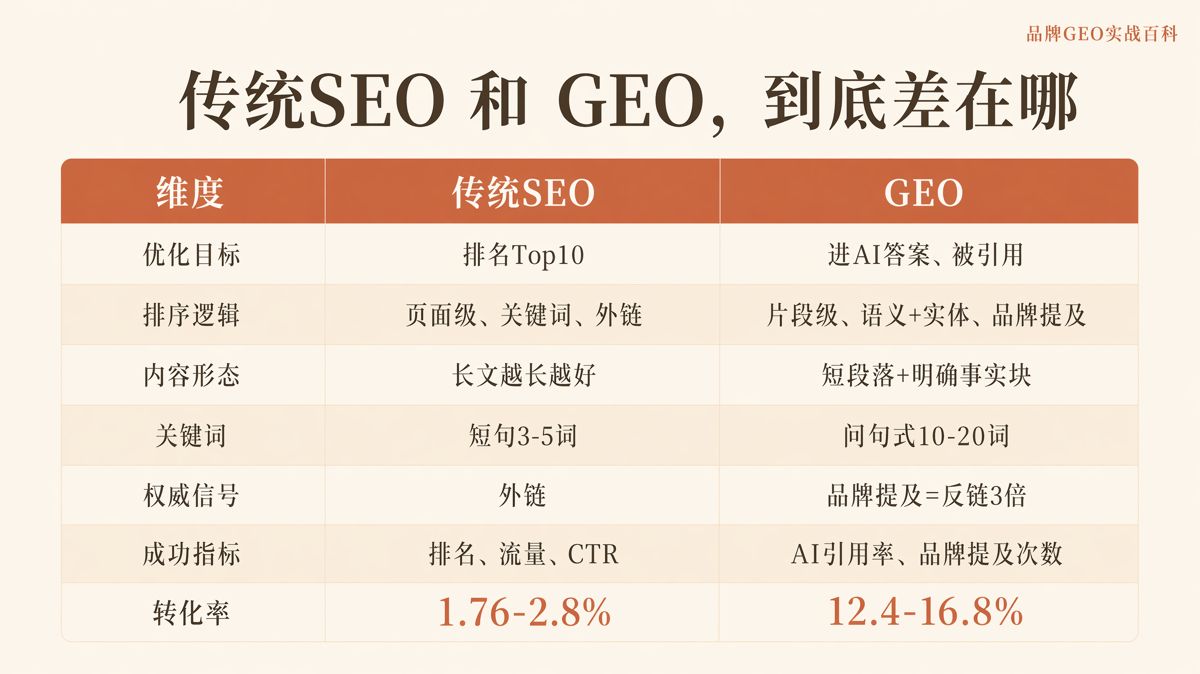
Data from seoClarity reveals that consistent brand mentions have an r=0.664 correlation with appearances in AI answers. By contrast, traditional backlinks show a correlation of only r=0.218. A correlation coefficient measures how two variables move together; it indicates statistical association, not direct causation.
Different engines also exhibit distinct preferences. Industry benchmarks show that Perplexity leans heavily toward source authority, Google AI Overviews prioritizes freshness, and ChatGPT Search favors semantic relevance. These patterns reflect tested samples rather than rigid rules for every query.
Measuring GEO: Citations vs. Brand Mentions
GEO efforts produce two primary outcomes: citations and brand mentions.
A citation is an explicit reference accompanied by a source URL that users can click. A brand mention occurs when the AI includes your company or product name directly in the response text, with or without a hyperlink.
Both carry value. Citations drive direct referral traffic. Brand mentions generate mindshare and confirm that the model considers your entity relevant to the topic. Empirical studies from iProspect and Hallam indicate that brand mentions correlate with AI citations roughly three times more strongly than traditional backlinks do. Again, this is a statistical correlation, not proof that brand mentions will automatically triple your citations.
Measuring GEO therefore requires tracking two metrics across your target prompt sets: how often your brand is mentioned in answers, and how often your URLs are cited as sources.
Why Top SEO Rankings Do Not Guarantee AI Citations
SEO and AI search score content at different levels of granularity. Traditional SEO evaluates the entire webpage; AI search evaluates individual text chunks within that page.
According to monitoring by seoClarity, after Google AI Overviews upgraded to Gemini 3 in January 2026, the share of AIO citation sources drawn from Google's top 10 organic search results dropped from 76% to 38%. The overlap between high organic rankings and AI citations narrowed significantly.
A separate cross-platform study by Ahrefs found that across ChatGPT, Perplexity, and Google AI Overviews, 86% of frequently cited domains did not overlap. Earning frequent citations on one platform did not translate to similar visibility on the others within that sample.
The difference between page-level and chunk-level scoring explains this divergence. A 5,000-word article with high domain authority and strong backlinks might rank number one on Google. However, if its structure is rambling and lacks self-contained, fact-dense paragraphs, an AI model cannot easily extract usable chunks.
Query structures also differ. Traditional SEO targets 3-to-5-word keywords with comprehensive, long-form content. GEO targets 10-to-20-word conversational questions, which require concise, factual, standalone answers.
GEO Does Not Replace SEO
SEO remains the foundation. If your pages are not crawled and indexed by search engines, AI models cannot find them during retrieval, cutting off any chance of downstream ranking or citation.
On May 15, 2026, Google stated that optimizing for generative AI search is fundamentally about improving the search experience, making it an extension of SEO rather than a separate discipline. Industry figures also show that AI search currently accounts for less than 0.15% of total search traffic, and roughly 86% of AI search retrieval still relies directly on Google and Bing indexes.
SEO secures crawling, indexing, and organic visibility. GEO maximizes the probability that your indexed content is selected during AI re-ranking and answer generation. Both require readable, factual, well-structured content; they simply deliver value through different surfaces.
The Same Core Logic in China, but Different Sources
AI search in China follows the exact same retrieval, re-ranking, and generation mechanics, but the sources being pulled are very different.
Chinese AI engines cite authoritative media outlets and major content platforms far more often than independent corporate websites. The table below outlines common citation patterns observed across the ecosystem:
| AI Engine | Developer | Commonly Observed Citation Sources |
|---|---|---|
| Yuanbao | Tencent | WeChat Official Accounts and the broader WeChat ecosystem |
| Ernie Bot | Baidu | Baijiahao (Baidu's content platform), Baidu Baike (Baidu's online encyclopedia) |
| Doubao | ByteDance | Douyin (ByteDance's short video platform), Douyin Baike, Toutiao (ByteDance's news aggregation platform) |
| Kimi | Moonshot AI | Zhihu (China's largest Q&A platform) and community discussions |
| DeepSeek | DeepSeek | Zhihu, CSDN (China's tech developer community), portal news outlets |
| Metaso Search | Metaso | Academic papers, industry research reports, and authoritative publications |
These platforms serve similar functions to their Western counterparts: Wikipedia matches Baidu Baike and Sogou Baike; Reddit and Quora parallel Zhihu; YouTube aligns with Bilibili and WeChat Channels; and LinkedIn shares professional distribution functions with WeChat Official Accounts. However, their specific indexing speeds and citation frequencies operate under different platform constraints.
Zhihu serves as a primary citation source for both Kimi and DeepSeek, making it a critical channel for technical and B2B content distribution in China.
User adoption in China has expanded rapidly. The 57th Statistical Report from the China Internet Network Information Center (CNNIC) reported 602 million generative AI users in China by December 2025, representing a 42.8% penetration rate. QuestMobile data from Q1 2026 showed monthly active users reaching approximately 345 million for Doubao, 166 million for Tongyi (Alibaba's AI assistant), and 127 million for DeepSeek.
What Makes Content Highly Citable by AI?
An Ahrefs study analyzing 1.4 million prompts found that among the top 1,000 most-cited pages in ChatGPT, 67% came from original research, primary data, or academic sources.
Another study analyzing 17 million citations found that URLs cited by AI were on average 25.7% newer than top Google organic results. Within that dataset, pages cited by ChatGPT were published an average of 393 to 458 days more recently than standard Google search results.
While adding statistics or updating dates does not guarantee an immediate citation, factual density and content freshness correlate strongly with AI visibility.
When producing content, focus on four priorities:
- Increase factual density. Use verifiable figures, specific case studies, and primary sources. Eliminate subjective claims like "the best" or "industry-leading" that provide no informational value.
- Design for chunk independence. Dedicate each subheading to a single question. Provide clear, direct answers upfront so the section makes complete sense when lifted out of context.
- Maintain freshness. Display explicit last-updated timestamps and regularly update legacy posts when product specifications, industry data, or policies change.
- Ensure entity consistency. Keep your brand name, executive profiles, and product descriptions uniform across your website, directory profiles, and third-party platforms.
Compliance Considerations for Scaled AI Content
In China, the Measures for the Labeling of Artificial Intelligence Generated Synthetic Content took effect on September 1, 2025. Publishing AI-assisted content at scale requires explicit user-visible disclosures alongside implicit metadata watermarks embedded in the files. Failing to label synthetic material risks platform penalties and content delisting.
Regulatory directives in 2026 also classify keyword stuffing, mass content scraping, and fabricated authority markers as high-risk practices. Even if manipulative tactics yield temporary citations, search platforms routinely purge them during model updates.
Is GEO Worth the Investment Today?
While AI engines still account for a small fraction of total search volume, industry studies indicate that traffic arriving via AI citations converts at 4 to 23 times the rate of standard organic search traffic. Users who click through from an AI answer have already read a synthesized summary and recommendations, arriving with far clearer intent.
This range reflects aggregate performance variations across study samples rather than a guaranteed outcome for every business.
Evaluating GEO comes down to three basic questions: Can AI retrieve your content? Does your content survive the re-ranking filter? Does the model cite or mention your brand when building the answer?
GEO is not a race for the top blue link. It is the practice of ensuring your brand's facts are verified, structured, and readily available for AI engines to assemble into their answers. Start with clean indexing and technical SEO, then build fact-dense, modular content with strict entity consistency across the web.
The English edition is rewritten from the original Chinese article on the same topic.

Starbox AI is an AI marketing company based in Hangzhou, China. This article draws on Starbox project work. Please credit the source when quoting.
Related reading
 GEO Guide
Why AI Marketing Vendor Quotes Vary 10x: A 4-Step Vetting Checklist
Evaluate AI marketing proposals by delivery actions, not slide decks. Audit source infrastructure, fact cleaning, and clean-environment testing.
Oct 22, 2026 · 6 min read
 GEO Guide
Spotting GEO Scams: What Actually Drives AI Recommendations?
Automated AI ranking promises violate how LLMs work. Real AI recommendations rely on authoritative, structured facts across trusted public sources.
Oct 22, 2026 · 4 min read
 GEO Guide
How to Measure Your Brand's AI Visibility with a Spreadsheet
You do not need expensive software to track AI recommendations. A three-tier prompt framework and a simple spreadsheet can score your brand visibility in half a day.
Oct 21, 2026 · 6 min read