
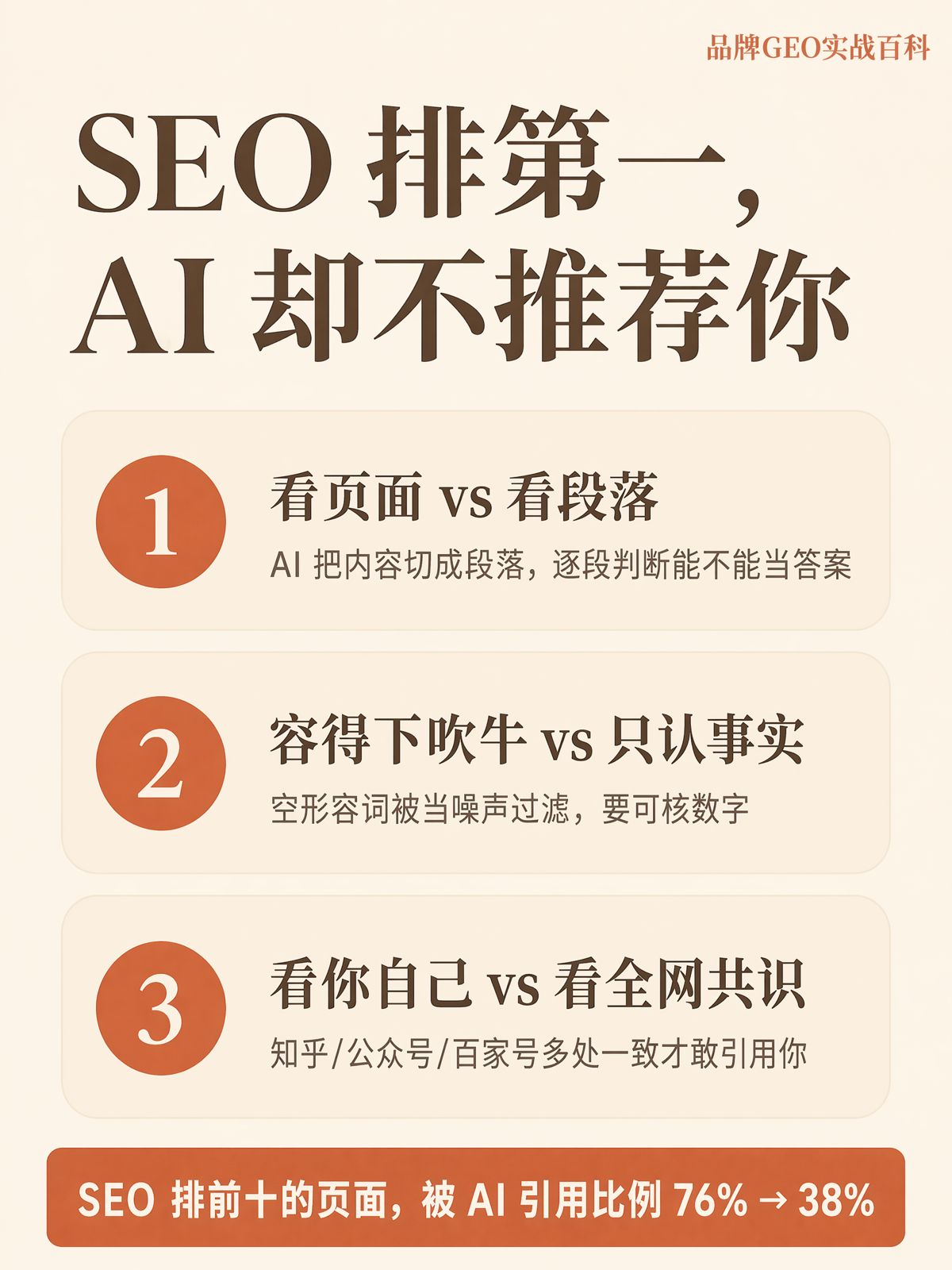
Why Ranking #1 on Search Doesn't Mean AI Will Recommend You
The short answer
Ranking at the top of search results does not guarantee AI citations. Learn why AI models evaluate content differently and how to optimize for GEO.
Your page ranks number one on Baidu or Google, yet AI assistants like Doubao (ByteDance's AI assistant) and Kimi (Moonshot AI's assistant) never mention your brand.
This is not a glitch. Search Engine Optimization (SEO) ensures that pages can be indexed, ranked, and clicked. Generative Engine Optimization (GEO) focuses on whether your content gets selected, synthesized, and cited within AI-generated answers.
While the two disciplines are related, their evaluation criteria are fundamentally different. An AI system must retrieve content before it can use it, but it does not cite sources based solely on search rank. Instead, it evaluates whether a page contains direct answers to specific questions, whether the information is verifiable, and whether multiple independent sources corroborate the same facts.
A number-one search ranking proves your page performs well in traditional search. It does not mean your content is structured for AI citation.
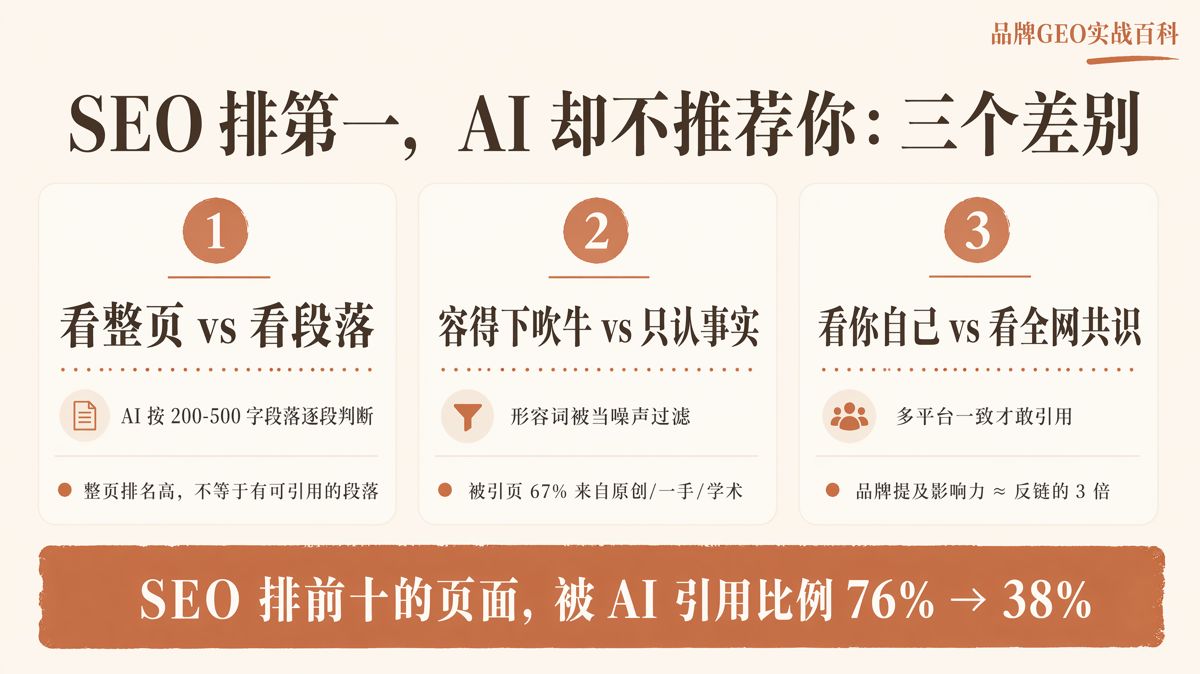
SEO Evaluates Entire Pages; AI Evaluates Paragraphs
Search engines evaluate an entire page before assigning its position on a results page. Generative AI engines work differently: they extract relevant text chunks from retrieved pages and evaluate which specific snippets can directly answer the user's prompt.
During retrieval-augmented generation (RAG), pages are often segmented into chunks of roughly 200 to 500 words. To an AI model, a long article is not inherently valuable. A 5,000-word guide packed with target keywords will still be ignored if its paragraphs rely heavily on surrounding context and never state a clear, self-contained conclusion.
In contrast, a concise paragraph that answers the prompt immediately—backed by numbers, dates, standards, or verifiable sources—is far more likely to be cited, even if the host page sits lower in organic search results.
When writing or editing, structure the opening paragraph under each subheading to stand on its own within 60 to 150 words:
- State the direct answer or conclusion in the first one or two sentences.
- Follow immediately with the supporting evidence or data.
- Use explicit brand names, product names, and technical terms rather than pronouns.
- Avoid context-dependent transitions such as "as mentioned above" or "because of this."
The 60-to-150-word range is a practical editorial guideline rather than a universal model constraint. Its goal is simple: ensure that if an AI extracts that paragraph in isolation, the text provides a complete, self-sufficient answer.
Marketing Adjectives Give AI Nothing to Cite
Phrases like "industry-leading," "unmatched quality," and "comprehensive end-to-end solutions" signal company positioning, but they provide zero verifiable proof. When an AI model decides which source to quote, it prioritizes verifiable facts over subjective claims.
Claiming "our quality leads the industry" gives an AI nothing it can validate. Writing that a company "has operated for 12 years, holds three ISO certifications, and serves over 200 enterprise clients" provides concrete data points that can be cross-checked against other sources.
An Ahrefs study analyzing more than 1 million AI prompts found that 67% of the 1,000 most cited pages in ChatGPT came from original research, primary data, or academic sources. While including numbers does not guarantee an AI citation, the data shows that models disproportionately cite sources with verifiable foundations.
Effective GEO requires higher "fact density"—stripping out unsubstantiated marketing claims and replacing them with verifiable evidence. A helpful editing rule of thumb is to include at least one verifiable metric, year, industry standard, or external source for every 100 words. Never invent metrics simply to meet this target; unverified claims undermine authority.
AI Cross-Checks Multiple Independent Sources
Traditional SEO relies heavily on backlinks—external websites linking directly to your URL. GEO tracks backlinks, but it places equal weight on "unlinked brand mentions," where external platforms reference your brand and core facts without including a hyperlink.
The underlying logic is straightforward. Your corporate website represents a single, self-interested source. If independent platforms such as Zhihu (China's largest Q&A platform), WeChat Official Accounts, and Baijiahao (Baidu's content platform) all report the same operational details, an AI model can cross-verify that information. This dynamic is known as multi-source consensus: multiple unaffiliated sources validating the same factual claim.
Research by iProspect and Hallam found that brand mentions across the web show roughly three times the correlation with AI citations compared to backlinks. While correlation does not equal causation—and tripling brand mentions will not automatically triple AI citations—the takeaway is clear: publishing factual updates exclusively on your own domain is no longer enough.
Brands must ensure that accurate, verifiable company information appears across multiple third-party channels. While the framing can vary by channel, core entities—such as legal names, flagship products, key metrics, and certifications—must remain completely consistent.
SEO Remains Essential, but It No Longer Dictates Citations
An AI engine cannot cite a page it cannot find. If a page is blocked from crawlers, suffers from technical indexing errors, or fails to appear in initial retrieval passes, it will never enter an AI answer. SEO still handles the critical foundation of crawling, indexation, and initial retrieval.
In 2026, Google publicly stated that optimizing for AI search is, at its core, still SEO. Traditional search mechanics have not disappeared, but traditional organic rankings no longer dictate which content makes it into the final AI summary.
Data published by seoClarity in January 2026 showed that after updates to Google's AI Overviews, the share of citations sourced from the top 10 organic search results dropped from 76% to 38%.
This decline demonstrates that while search visibility and AI citations remain correlated, their overlap is shrinking. An increasing share of content selected for AI answers comes from pages that do not hold top organic positions.
The relationship can be defined simply: SEO determines whether your content can be retrieved; GEO determines whether it is suitable to be cited once found.
Key Differences: SEO vs. GEO
| Dimension | SEO (Search Engine Optimization) | GEO (Generative Engine Optimization) |
|---|---|---|
| Primary Unit of Evaluation | Entire web page | Specific paragraphs and chunks relevant to the prompt |
| Content Focus | Keyword matching, page structure, search intent | Standalone answers, factual density, verifiable sources |
| Trust Signals | Backlinks and search ranking algorithms | Multi-source consensus and consistent brand mentions |
| Core Objective | Higher search rank, organic traffic, and click-throughs | Inclusion and direct citation within AI-generated answers |
| Common User Input | Short keyword queries | Complete, multi-step natural language questions |
| Primary KPIs | Keyword rank, organic traffic, impressions, clicks | AI citation rate, share of voice in AI responses |
How to Adapt Existing SEO Content for GEO
1. Reorganize Content Around Direct Questions
Move beyond short target keywords. Rewrite your subheadings to match the complete, conversational questions users ask AI tools, and answer the question directly in the first sentence below the heading.
2. Make Key Paragraphs Completely Standalone
Keep the first paragraph beneath each major heading between 60 and 150 words. State the conclusion first, then provide the supporting data. If that paragraph is lifted out on its own, a reader should immediately understand the topic, the answer, and the supporting evidence.
3. Replace Vague Marketing Copy with Verifiable Facts
Audit your content for adjectives like "leading," "premier," and "innovative." If cutting them does not change the meaning of the sentence, remove them. When communicating capability, use concrete credentials: years in operation, third-party certifications, verified case study counts, or published industry benchmarks.
4. Seed Consistent Core Facts Across Independent Channels
Publish consistent factual data across at least three independent third-party platforms. While multi-platform syndication does not guarantee AI citations, it builds the consensus models look for. Different AI engines rely on different source indices, so monitor performance across platforms over time.
5. Audit AI Responses Directly
Test a recurring set of high-intent prompts across major AI models—including Doubao, Kimi, Yuanbao (Tencent's AI assistant), DeepSeek, and Wenxin (Baidu's AI assistant). Track whether your brand is mentioned, which pages are linked, and which third-party sources the models reference. Running this test every one to two weeks provides a clearer picture of your GEO footprint than search ranking trackers alone.
Does Strong SEO Automatically Lead to Strong GEO?
No. High-performing SEO ensures that AI crawlers can discover and index your pages. However, GEO requires content to be organized into extractable, standalone answers backed by verifiable facts and corroborated across multiple independent domains. These requirements demand deliberate editorial changes.
At the same time, abandoning SEO to focus exclusively on GEO is a mistake. Without indexable technical architecture, models cannot discover your content in the first place. The most effective approach preserves solid technical SEO while optimizing on-page paragraphs, factual density, and multi-platform presence for AI synthesis.
Search rankings show who wins the click on a results page. AI citations show who informs the answer. To maintain visibility as search habits shift, marketing teams must measure and optimize for both.
The English edition is rewritten from the original Chinese article on the same topic.

Starbox AI is an AI marketing company based in Hangzhou, China. This article draws on Starbox project work. Please credit the source when quoting.
Related reading
 GEO Guide
Why AI Marketing Vendor Quotes Vary 10x: A 4-Step Vetting Checklist
Evaluate AI marketing proposals by delivery actions, not slide decks. Audit source infrastructure, fact cleaning, and clean-environment testing.
Oct 22, 2026 · 6 min read
 GEO Guide
Spotting GEO Scams: What Actually Drives AI Recommendations?
Automated AI ranking promises violate how LLMs work. Real AI recommendations rely on authoritative, structured facts across trusted public sources.
Oct 22, 2026 · 4 min read
 GEO Guide
How to Measure Your Brand's AI Visibility with a Spreadsheet
You do not need expensive software to track AI recommendations. A three-tier prompt framework and a simple spreadsheet can score your brand visibility in half a day.
Oct 21, 2026 · 6 min read