
What Is GEO? From Search Rankings to AI Citations

The short answer
Generative Engine Optimization (GEO) adapts content so generative AI models retrieve, understand, and cite your brand when answering user questions.
Generative Engine Optimization (GEO) is the process of optimizing content so generative AI engines retrieve, understand, and cite your brand when answering user questions.
These generative engines include global platforms like ChatGPT, Perplexity, and Google AI Overviews, alongside Chinese AI products such as Doubao (ByteDance's AI assistant), Kimi, Tencent Yuanbao, ERNIE Bot (Baidu's AI assistant), DeepSeek, and Tongyi Qianwen (Alibaba's AI model). When users ask a question, these systems generate a direct answer instead of just listing links.
Traditional SEO focuses on getting your pages to rank near the top of Google or Baidu search results. GEO targets a different outcome: getting your brand mentioned and cited directly inside the AI-generated answer, even when users never click through to a website.
Where Did GEO Come From?
GEO is not an invented marketing buzzword.
Researchers from Princeton University formally introduced the concept in a 2023 paper co-authored by Aggarwal et al. (arXiv:2311.09735, later published at KDD '24). Their research showed that specific content optimization techniques could boost visibility in generative engines by up to 40%.
The study focused on how generative engines select information and reference sources when assembling an answer, rather than how traditional search algorithms rank web pages.
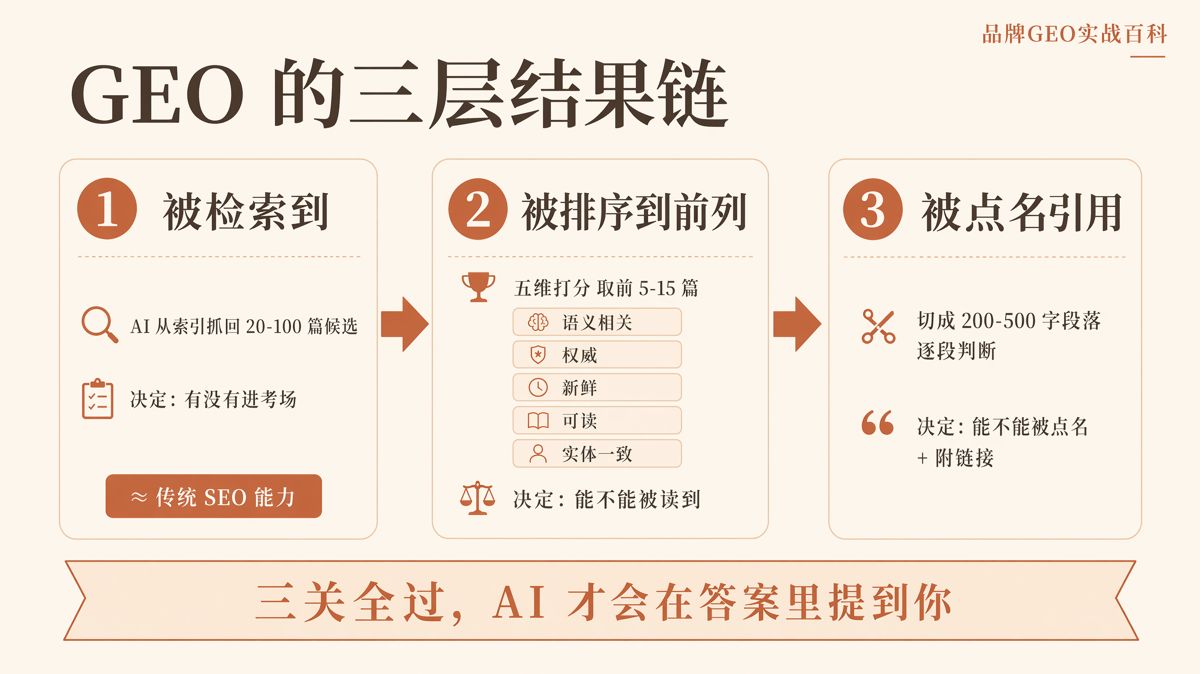
Evaluating GEO requires looking beyond traditional page rankings and traffic metrics. You need to track three consecutive stages:
Is the content retrieved, does it rank among the top candidates, and does the AI cite it?
How Content Enters AI Answers
Most AI search products rely on Retrieval-Augmented Generation (RAG). Under this architecture, the system first retrieves relevant documents and then generates an answer based on what it finds. While implementations vary across platforms, content generally moves through three stages from discovery to citation.
Stage 1: Retrieval
When a user asks a question, the AI often breaks it into multiple sub-queries to pull relevant documents from its index. In typical pipelines, the system selects an initial pool of 20 to 100 candidate sources.
At this stage, everything depends on whether your content is indexed, crawlable, and discoverable through search queries. If the AI cannot fetch your content, downstream ranking and citation cannot happen. This stage directly overlaps with core SEO principles.
Stage 2: Candidate Selection
The system scores and reranks the candidate pool, typically narrowing the field to the top 5 to 15 documents for deeper processing.
Common evaluation criteria include:
- Semantic relevance: Does the content directly answer the user's specific prompt?
- Authority: Are the information and its publishing source trustworthy?
- Freshness: Is the information up to date and still valid?
- Readability: Is the text structured clearly and easy to parse?
- Entity consistency: Are brand names, organizations, people, and product specifications consistent throughout?
This stage determines whether the AI will read and evaluate your content further.
Stage 3: Direct Citation
Once selected, the top documents are typically broken down into chunks of roughly 200 to 500 words. The model evaluates whether individual chunks contain credible, relevant, and extractable information. It then synthesizes the final response and displays attribution links.
Getting indexed does not guarantee your brand will appear in the AI response. Your content must simultaneously be relevant, credible, clearly structured, and easy for the model to quote.
GEO focuses on refining content across all three stages: ensuring it is retrievable, lands in the top candidate pool, and earns final citations.
Why Pay Attention to GEO Now?
Search behavior is shifting. An increasing number of users now ask AI models directly and find what they need without clicking blue links.
Data from global markets shows this shift clearly:
- According to a Semrush study of 10 million keywords, Google AI Overviews appeared on 48% of Google queries by April 2026.
- A December 2025 Ahrefs study of 300,000 keywords found that when an AI Overview appears, the click-through rate (CTR) for the top organic result drops by 58%.
- Semrush data also indicates that within Google AI Mode, 93% of queries result in "zero clicks," meaning users read the generated answer and leave without visiting any cited website.
The same transition is taking place across the Chinese market. According to the 57th statistical report from the China Internet Network Information Center (CNNIC), China reached 602 million generative AI users by December 2025, representing a 42.8% penetration rate and a 141.7% year-over-year increase.
Industry estimates suggest that by early 2026, over 60% of search queries in China triggered AI summaries across platforms like Baidu and ERNIE. While this figure is an industry estimate rather than an independently verified statistic, it illustrates the general direction of travel.
For brands, your visibility no longer depends solely on search result links. What matters is whether your brand appears inside the synthesized answer.
What Is the Difference Between GEO and SEO?
GEO and SEO are neither identical nor mutually exclusive. GEO builds on the foundation of SEO, but it targets a different end result.
Both disciplines require clean technical setups: content must be crawlable, indexable, well-structured, credible, and supported by authority signals. The first stage of GEO depends directly on these capabilities.
In its official guidance released on May 15, 2026, Google affirmed that optimizing for generative AI search continues to build directly on traditional SEO fundamentals.
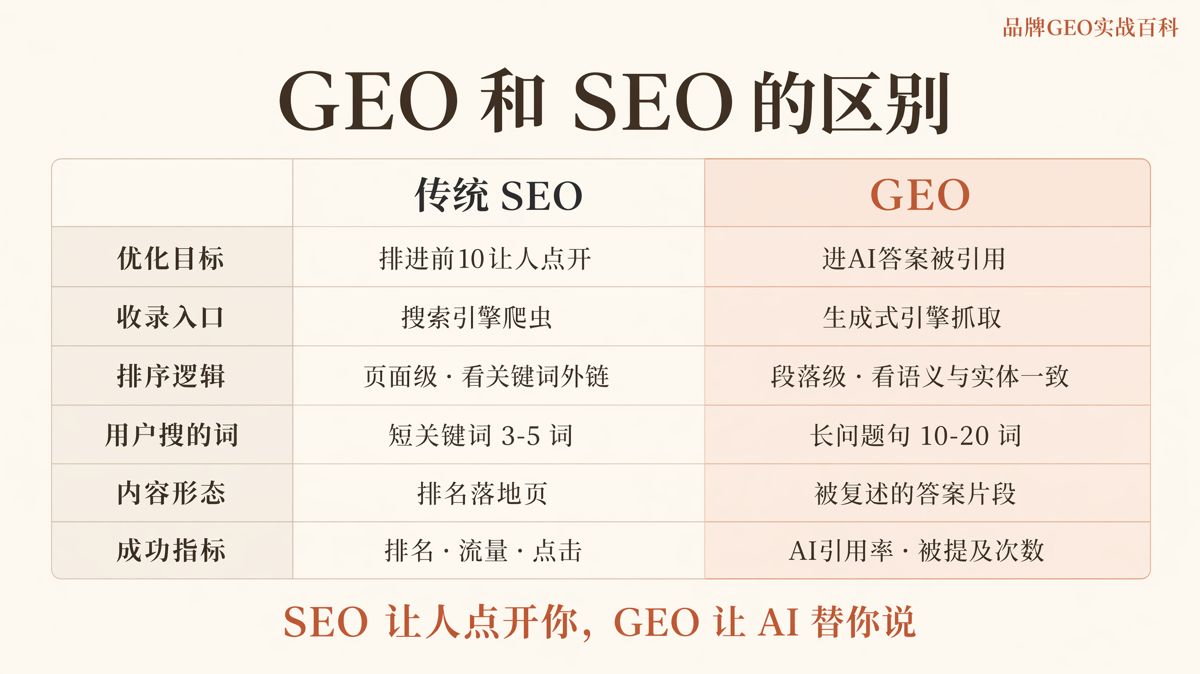
Here is how they compare:
| Dimension | Traditional SEO | GEO |
|---|---|---|
| Primary Goal | Rank high in search results to win user clicks | Enter AI answers and earn explicit citations |
| Discovery Channels | Web crawlers and search engine indexes (Google, Baidu) | Content sources accessible to generative search engines |
| Ranking Logic | Page-level scoring, keywords, and backlink authority | Semantic relevance, entity consistency, and chunk-level citation value |
| Query Patterns | Short keywords (typically 3 to 5 words) | Natural language questions (typically 10 to 20 words) |
| Output Format | Clickable search engine results pages (SERPs) | AI-synthesized answers, often with reference links |
| Core Metrics | Rankings, organic traffic, and click-through rates | AI citation share, brand mentions, and AI-referred traffic |
SEO solves for where your page ranks on a search results page. GEO solves for whether your information enters an AI-generated answer. You do not have to choose between them; modern digital marketing requires managing indexing, search rankings, and AI citations simultaneously.
How Does GEO Differ in China vs. Western Markets?
The foundational logic of GEO remains the same everywhere: content must be retrievable, rank highly among candidate passages, and prove valuable enough to cite. The primary difference lies in the distribution ecosystem and where AI engines source their information.
In Western markets, tools like ChatGPT and Perplexity frequently cite Wikipedia, Reddit, YouTube, and software review platforms like G2. In China, generative engines rely heavily on platforms like Baidu Baike (Baidu's online encyclopedia), Zhihu (China's largest Q&A platform), WeChat Official Accounts, Baijiahao (Baidu's content platform), and Douyin (ByteDance's short-form video platform).
Industry observations show distinct source preferences across Chinese AI platforms:
- Tencent Yuanbao frequently cites WeChat Official Accounts.
- ERNIE products lean toward Baijiahao and Baidu Baike.
- Doubao frequently references Douyin and Jinri Toutiao (ByteDance's news aggregation platform).
- Kimi and DeepSeek regularly pull citations from Zhihu.
These patterns serve as practical guidelines rather than absolute rules. Actual citations depend on the specific prompt, the real-time index, and product updates.
Furthermore, in Western markets, an independent company website with strong domain authority can earn direct citations in ChatGPT or Perplexity. In China, generative engines place far heavier weight on authoritative media and major content platforms. Standalone corporate websites have a much harder time earning direct citations.
If you are optimizing for the Chinese market, updating your corporate website is rarely enough. You must distribute content across Zhihu, WeChat Official Accounts, and Baijiahao based on where your target audience and the relevant AI models source information.
What Are GEO, AEO, AISO, and LLMO?
Several acronyms circulate around AI search optimization, each describing a slightly different scope:
- GEO (Generative Engine Optimization): Focuses on generative engines like ChatGPT, Perplexity, Google AI Overviews, and Doubao. This is the term most widely used in academic research and industry analysis.
- AEO (Answer Engine Optimization): An older term focused on winning featured snippets and direct answers in traditional search engines. GEO covers a broader generative scope.
- LLMO (Large Language Model Optimization): Focuses narrowly on influencing the text output of large language models.
- AISO (AI Search Optimization): A newer term often seen in job postings, functionally equivalent to GEO.
For everyday business strategy, GEO is the most practical and widely recognized term.
Six Common Questions About GEO
1. Is GEO just marketing hype?
GEO is backed by peer-reviewed academic research and reflects a measurable shift in user search behavior. The fact that Google AI Overviews now appear on 48% of Google queries demonstrates that synthesized answers are already a mainstream interface for information discovery.
At the same time, the market contains vendors selling unnecessary add-ons. In its May 2026 update, Google noted that tactics like standalone llms.txt files, proprietary "AI schemas," and specialized AI copywriting formulas are not prerequisites for appearing in generative search results.
Evaluate any GEO strategy by whether it improves your content's accuracy, retrievability, structural clarity, and citation value, not by whether it adopts trendy jargon.
2. If we already do SEO, do we still need GEO?
Yes.
SEO ensures your content gets indexed and ranks in traditional search, which serves as the entry requirement for Stage 1 of GEO. However, a top-ranking web page will not automatically be cited in an AI answer.
The most effective approach is to maintain your SEO foundation while upgrading your content's factual density, entity consistency, and extractability for language models.
3. How long does it take to see results from GEO?
Industry observations suggest that GEO often moves faster than traditional SEO, with noticeable changes in AI citations typically taking 1 to 3 months.
This timeline is a practical rule of thumb, not a guarantee. Progress depends on your existing content authority, distribution channels, competitive landscape, and publishing cadence. Be skeptical of any agency promising guaranteed results within 30 days.
4. Is traffic from AI citations worth the effort?
A Semrush study covering more than 500 high-value topics found that conversion rates from AI search traffic were 4.4 times higher than those from standard organic search.
The common explanation is user intent: because the AI answer filters out baseline questions, users who click through to a brand's website have already completed their preliminary research and carry clearer intent. While conversion rates vary by industry, AI-referred visitors tend to be highly qualified.
5. How do you track brand citations in AI?
Identify a core set of industry questions and run them across platforms like Doubao, Kimi, Tencent Yuanbao, DeepSeek, and ERNIE Bot. Track:
- Whether the AI mentions your brand.
- Whether it cites content published by your brand.
- Whether it provides links back to your assets.
- Which competing brands appear regularly for the same prompts.
Running this audit on a weekly or bi-weekly cadence provides a clearer picture of your AI visibility than tracking keyword rankings alone.
6. Is GEO primarily technical, or does it focus on content?
It requires both, but content carries the heavier weight. A common industry benchmark is roughly 70% content and 30% technical optimization, though the exact split depends on the project.
The technical layer ensures that search crawlers and AI bots can discover, render, and index your pages without barriers. The content layer ensures the underlying information is accurate, structured, semantically relevant, and easy for AI systems to quote.
What Problem Does GEO Ultimately Solve?
GEO solves an actionable business problem: when a prospective customer asks an AI engine a question about your industry, does the answer mention your brand and cite your content?
Earning that spot requires clearing three hurdles: your content must be retrievable, it must rank within the model's top candidate pool, and it must pass quality checks for relevance and credibility to win the final citation.
SEO secures your search presence, while GEO extends your brand into AI-generated answers. As more buyers turn to AI models for answers, monitoring both traditional search results and AI citations is the only way to ensure your brand remains visible.
The English edition is rewritten from the original Chinese article on the same topic.

Starbox AI is an AI marketing company based in Hangzhou, China. This article draws on Starbox project work. Please credit the source when quoting.
Related reading
 GEO Guide
Why AI Marketing Vendor Quotes Vary 10x: A 4-Step Vetting Checklist
Evaluate AI marketing proposals by delivery actions, not slide decks. Audit source infrastructure, fact cleaning, and clean-environment testing.
Oct 22, 2026 · 6 min read
 GEO Guide
Spotting GEO Scams: What Actually Drives AI Recommendations?
Automated AI ranking promises violate how LLMs work. Real AI recommendations rely on authoritative, structured facts across trusted public sources.
Oct 22, 2026 · 4 min read
 GEO Guide
How to Measure Your Brand's AI Visibility with a Spreadsheet
You do not need expensive software to track AI recommendations. A three-tier prompt framework and a simple spreadsheet can score your brand visibility in half a day.
Oct 21, 2026 · 6 min read