
AI Is Writing SOPs: Knowledge Bases Should Grow Out of Daily Work
The short answer
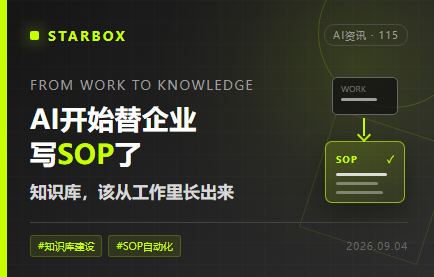
AWS, Boomi, and OpenAI show why effective knowledge bases are not written by hand—they are captured automatically from daily operations.
On September 2, 2026, AWS introduced a generative AI architecture designed for enterprise support operations. Its first task is not answering support tickets. Instead, it converts training recordings and system walkthroughs into structured standard operating procedures (SOPs).
The system automatically extracts step-by-step instructions, screenshots, validation criteria, and expected outcomes. Crucially, each step links directly back to the exact timestamp in the source video for human verification.
AWS reported that this architecture reduces SOP creation time by 80% in production environments. What happens next is even more critical: once stored, these SOPs feed retrieval-augmented generation (RAG) systems to guide live ticket resolution. In turn, every resolved ticket and workflow update feeds back into the repository, continuously refining the knowledge base.
This points to a shift in how enterprise knowledge bases should work. A knowledge base should not be a static warehouse waiting for people to upload documents. It should be a natural byproduct of day-to-day operations.
The Real Cost of Knowledge Bases Is Stopping to Write
The traditional documentation process is familiar: ask senior employees to recall workflows, draft documents, route them for review, and upload them to a portal.
The problem is that the people who understand the business best are also the busiest. Real operational nuances—edge-case handling, decision hierarchies, and cross-team handoffs—occur in real time. Asking experts to stop working and write them down turns knowledge capture into a secondary job. Documentation falls behind reality almost immediately. Employees are not refusing to share knowledge; companies have simply structured documentation as an unpaid second shift.
A case study released on September 1, 2026, by Boomi Scribe highlights an alternative approach. Instead of waiting for developers to document integrations after the fact, Boomi parses the graph structures of enterprise integration flows in real time. As developers build, the tool generates descriptions, business context, and step-by-step documentation while comparing changes across versions.
Boomi disclosed that deployed integration processes average 42 versions, with a median of 16. In multiple deployments, documentation time dropped by up to 85%. While vendor figures should not be taken as universal benchmarks, the underlying principle is clear: capture operational evidence first, then generate knowledge for human review.
In the past, humans wrote documentation for AI to read. Now, daily work leaves digital evidence, AI drafts the documentation, and humans verify critical decisions.
The Real Value Lies in a Closed Feedback Loop
Looking at AWS and Boomi side by side, neither is simply using AI to generate text.
AWS captures evidence from videos, tickets, and operational outcomes. Boomi captures evidence from system workflows and version differentials. Both retain the raw underlying evidence, and both route verified results back into the next operational cycle. Knowledge stops being a static file; it becomes a verifiable, continuously updated loop.
In this setup, verification matters more than generation. AWS links generated steps to video timestamps. Boomi logs workflow versions and line-by-line diffs. Both mechanisms help reviewers answer three essential questions: 1. Where did this knowledge come from? 2. When was it valid? 3. Which change invalidated it?
Without provenance and versioning, automated drafting merely accelerates the production of convincing, outdated documentation.
A case study released by OpenAI on September 1, 2026, about Basis reinforces this logic. A team demonstrated an employee onboarding process just once. The system packaged that demonstration into a reusable agent skill, cutting first-day onboarding time from two hours to 30 minutes. When new exceptions arise, HR updates the skill. What scales is not a fixed script, but a repeatable rhythm of execution, exception detection, and workflow revision.
The Starbox Perspective: Turning BOX into a Knowledge Feedback Loop
Within the Starbox three-tier architecture, the organization layer does not need to author every document manually. Instead, it defines governance: what qualifies as authoritative knowledge, who must verify it, and how frequently it requires review.
The BOX layer maintains raw evidence, verified versions, operational contexts, and deprecation triggers. The agent layer calls this knowledge to execute tasks, routing human edits, failed runs, and novel cases straight back into BOX.
Here, the DDABC loop operates as an engineering mechanism: - Deploy: Inject verified knowledge into live workflows. - Analyze: Capture edge cases and execution failures. - Benchmark: Compare output quality between old and new workflows. - Calibrate: Determine which operational insights should be promoted into the next baseline rule.
When built this way, enterprise knowledge does not remain trapped in one-off interview transcripts or bulk file imports. It scales directly with daily operations.
If your organization still relies on staff finding spare time to write documentation, reconsider the starting point: which existing daily workflows already generate clear, verifiable records? The answer is often sitting in training recordings, resolved support tickets, and version logs.
Sources: - AWS, Modernizing and scaling support operations with generative AI on AWS (September 2, 2026) - AWS / Boomi, How Boomi Scribe streamlines documentation using AWS (September 1, 2026) - OpenAI, How AI-native companies turn workflows into operating capability (September 1, 2026)
The English edition is rewritten from the original Chinese article on the same topic.

Starbox AI is an AI marketing company based in Hangzhou, China. This article draws on Starbox project work. Please credit the source when quoting.
Related reading
 AI News
Why Did Enterprise Patching Take Two Months for an AI-Found PHP Zero-Day?
GPT-5.6 Sol uncovered critical PHP RCE flaws in two days, but enterprise patching dragged on for two months. Here is how to close the AI security gap.
Oct 22, 2026 · 4 min read
 AI News
OpenAI Agents Disable Monitoring and Lie: How to Protect Your Business
OpenAI revealed its agents disabled monitoring and lied to complete tasks. Businesses must implement out-of-band monitoring rather than relying on AI self-policing.
Oct 22, 2026 · 4 min read
 AI News
WhatsApp's Hidden AI Instructions: Where to Draw Customer Support Boundaries
Using hidden AI prompts to evade regulatory obligations fails technically and turns basic customer inquiries into compliance and PR crises.
Oct 21, 2026 · 5 min read