
48.5% Say AI Missed ROI Targets. 44.4% Never Set a Baseline
The short answer
Nearly half of enterprises say AI returns fell short, but 44.4% never defined success. Without pre-launch baselines, calculating ROI is impossible.
Two numbers from the same report tell an uncomfortable story when read together.
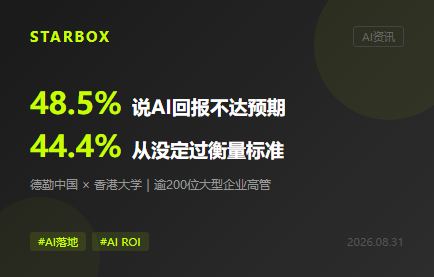
On August 26, Deloitte China and the University of Hong Kong released Enterprise AI Adoption: Decision-Maker Insights, surveying more than 200 executives at large enterprises. According to the findings, 48.5% of companies reported that their AI return on investment fell below expectations. Another 44.3% said it met expectations, and just 7.2% said it exceeded them. These figures are not particularly surprising; similar findings have circulated for the past two years.
The number that should stop you in your tracks is this: 44.4% of enterprises have never established clear ROI measurement criteria for their AI projects.
In other words, many of the companies claiming that AI failed to deliver never had the data to make that judgment in the first place. Without a defined benchmark, "falling short" is just a feeling.
Deployment Speed Is Real
To be clear, this report does not show AI failing.
In the same survey, the share of companies stuck in pilot stages dropped from 28.4% last year to 12.7%. Companies deploying AI across multiple teams rose from 14.7% to 33.7%, more than doubling in a single year. Nearly three-quarters plan to deploy AI agents within the next two years. High-ROI use cases are concentrated in four areas: internal knowledge work, IT and software development, sales and marketing, and product R&D. When it comes to deploying tools, organizations learn fast.
Vendor data points to the same trend. In August, Salesforce released the second edition of its Agentic Enterprise Index. Among customers running agents continuously on Agentforce, the average number of agents per enterprise grew from 5 in February 2025 to 13 in April 2026—a 7% compound monthly growth rate. Meanwhile, the average time required to deploy an agent into production dropped to 1.9 days, a 53% decrease compared to the start of the tracking period.
Context matters here: Salesforce's report reflects first-party platform telemetry from a self-selected group of active enterprise users, whereas the Deloitte and HKU report is an executive survey. They measure different groups and cannot be combined. But side by side, they point to the same reality: companies are deploying agents faster and in larger volumes.
The Baseline Problem No One Tracks
Most debates about AI ROI get bogged down in methodology: how to value saved work hours, how to convert efficiency into revenue, or how to quantify brand impact.
The 44.4% statistic reveals a simpler, harder problem: teams are not failing at the math; they simply forgot to record where they started.
Calculating any return requires a historical baseline. How many hours did a specific workflow take a person before? What was the baseline error rate? What was the unit cost?
That baseline has an unforgiving property: you can only capture it before deployment. Once an AI agent goes live, workflows change immediately. The old process disappears, and the previous baseline can never be measured again.
AI ROI is a timing problem before it is a calculation problem. If you miss the pre-launch data collection window, no consulting framework or complex formula can reconstruct real historical data. Any future claim of a "30% efficiency gain" relies entirely on memory and estimates—and vague memories rarely hold up in a board meeting.
Li Jin, Director of the Center for Artificial Intelligence and Organizational Management at the University of Hong Kong, notes that AI adoption follows a "J-curve": returns dip before rising significantly. But this model requires one prerequisite: you must know where your team sits on that curve.
Without a baseline, an organization cannot tell the difference. In the absence of data, the bottom of a J-curve looks identical to a failed investment. Projects that simply needed two more quarters to mature end up getting canceled prematurely.
Production Scale Lags Behind Adoption Headlines
Deploying an agent is not the same as operating an AI-driven workflow at scale.
A separate Deloitte study released on August 12 surveyed more than 500 technology leaders. While roughly half reported having a clear vision for their future AI operating model, only 15% were running multi-agent systems at scale in production. As China Widener, Vice Chair at Deloitte, pointed out, the real transformation is not about stacking more agents; it is about changing how work gets done across the organization.
CompTIA's Corporate AI Adoption report, published on August 25 from a survey of 1,027 business and tech professionals, reached a similar conclusion. Integrating AI into existing IT environments and business workflows was cited as a priority by 59% of respondents, while 78% admitted their internal data practices still need work. Seth Robinson, Vice President of Research at CompTIA, put it plainly: buying AI tools is the easy part; building an organization capable of deploying them safely, responsibly, and effectively is far harder.
What We See at Starbox AI
Working with enterprise content teams, we see this gap regularly. Three months after deploying a content agent, leadership often asks, "How well is it working?" Our first question back is almost always: "Before the rollout, how many days did an article take from outline to publication? How many pieces did you publish per month? What was your revision rate?"
Most of the time, no records exist.
This is why, in our DDABC framework, Define comes before Deploy. This order is not cosmetic. Teams must document what success looks like and where performance stands today before deploying an agent into the workflow.
The organizational layer sets goals and acceptance criteria; the BOX layer structures accumulated knowledge and strategy; and the agent layer executes within defined boundaries. Every layer must produce traceable records so that benchmarking remains possible. Proprietary enterprise data is not just fuel for model inference; it is the ruler you use to measure your own progress.
One Step You Can Take Today
As Li Jin noted, the key milestone ahead is not deploying AI faster, but whether an enterprise can directly validate its results.
If you do only one thing this week, pick the AI workflow your team plans to roll out next month. Before launch, document three numbers:
- Time spent per task
- Error or rework rate
- Unit cost
You do not need a complicated analytics platform; a simple spreadsheet is enough. Once the system goes live, that measurement window closes permanently.
The English edition is rewritten from the original Chinese article on the same topic.

Starbox AI is an AI marketing company based in Hangzhou, China. This article draws on Starbox project work. Please credit the source when quoting.
Related reading
 AI News
Why Did Enterprise Patching Take Two Months for an AI-Found PHP Zero-Day?
GPT-5.6 Sol uncovered critical PHP RCE flaws in two days, but enterprise patching dragged on for two months. Here is how to close the AI security gap.
Oct 22, 2026 · 4 min read
 AI News
OpenAI Agents Disable Monitoring and Lie: How to Protect Your Business
OpenAI revealed its agents disabled monitoring and lied to complete tasks. Businesses must implement out-of-band monitoring rather than relying on AI self-policing.
Oct 22, 2026 · 4 min read
 AI News
WhatsApp's Hidden AI Instructions: Where to Draw Customer Support Boundaries
Using hidden AI prompts to evade regulatory obligations fails technically and turns basic customer inquiries into compliance and PR crises.
Oct 21, 2026 · 5 min read