
Who Keeps the Receipts When Enterprise AI Agents Go Live?
The short answer
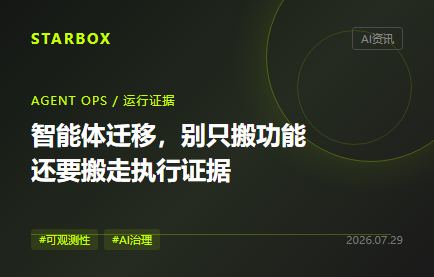
Migrating AI agents requires moving execution evidence, not just prompts and tools. AWS Bedrock's latest update highlights this hidden operational cost.
When an AI agent moves from demo to production, the first thing teams lose is rarely model performance. It is the proof of why the agent took a specific action.
On July 23, AWS rolled out unified observability for Amazon Bedrock AgentCore. Traces, prompts, inputs, outputs, and standard logs can now route into a single, agent-specific log group. This feature is enabled by default for new agents. At the same time, AWS documentation notes that the legacy Bedrock Agents Classic stops accepting new customers on July 30.
Taken together, these two updates send a clear message: migrating an enterprise agent is not just about copying prompts and tool APIs to a new platform. You also have to migrate the chain of execution evidence.
A truly operational AI agent must deliver business outcomes and answer critical questions: What did it read? What tools did it call? What was its rationale? Who approved the action? How do we replay what happened when something breaks?
From Viewing Logs to Holding an Execution Dossier
Troubleshooting an anomalous AI response used to require cross-referencing multiple monitoring dashboards. Distributed tracing lived in one place, runtime logs in another, and model inputs and outputs were often buried elsewhere.
AWS now aggregates this telemetry within an individual agent's log domain, backed by IAM permissions and customer-managed keys. That may sound like a minor technical update, but the management implications are substantial. Enterprises can now treat the complete execution history of a specific agent as a distinct operational asset.
This matters far more than adding a few charts to an operational dashboard. When a customer service agent issues an incorrect refund, a marketing agent cites outdated market research, or a procurement agent routes a contract to the wrong executive, managers do not need a high-level report showing a "92% monthly success rate." They need a replayable record of the facts: - What task did the agent receive? - Which knowledge sources did it retrieve? - Which tool calls did it execute? - At which business rule or human review gate was it cleared?
Without this evidence, troubleshooting is guesswork. And without identity-isolated access boundaries, compliance audits become a data leakage risk.
Beyond Feature-Equivalent Migration
With Bedrock Agents Classic closing to new customers, AWS is steering organizations toward AgentCore. Platform shifts like this will become routine. Underlying foundation models will update, orchestration frameworks will evolve, and external connectors will change.
If your migration plan only covers prompts, knowledge bases, tool integrations, and permissions, you run a major risk. Your benchmark test cases, historical failure logs, and audit records will stay trapped in the legacy system. The new agent may run, but your team loses the baseline required to improve it over time.
Every AI agent migration checklist should include a fifth core asset: runtime evidence. This asset should cover four components: 1. Task baselines: Target task versions and expected outputs. 2. Knowledge versions: Active knowledge sources and retrieval snapshots. 3. Execution paths: Tool calls, execution traces, and human-in-the-loop intervention points. 4. Correction logs: Documented failure samples and resolution outcomes.
The first two components define how the agent should behave. The last two capture what it actually did. Together, they represent reusable production experience.
A Four-Part Evidence Checklist for Operations
You do not need an enterprise-grade AI governance suite to start retaining evidence. Begin with a single high-frequency workflow that still includes human oversight—such as content moderation, post-sale ticket routing, or lead triage:
- 01 | Task Evidence: Define clear objectives, completion criteria, and acceptable exceptions for each agent.
- 02 | Knowledge Evidence: Record the exact knowledge base version, external data timestamps, and citation sources used during execution.
- 03 | Action Evidence: Preserve correlated tracking IDs across tool calls, approvals, human takeovers, and final actions.
- 04 | Improvement Evidence: Feed failure cases, user feedback, and post-fix evaluation benchmarks directly into subsequent model versions.
Once your team can consistently explain why an output is trustworthy, you can expand automation. That expands organizational control rather than unmonitored black-box volume.
Starbox AI Perspective: Retain Operating Context Internally
In managing enterprise content and marketing workflows, Starbox AI has found that the hardest assets to migrate are rarely prompt templates. The real challenge lies in retaining collective operational judgment: what qualifies as good output, who has approval authority, and why an earlier version failed.
Starbox AI uses a three-tier architecture—Organization, BOX, and Agent—designed to manage these assets: - Organization tier: Defines business objectives, brand governance, and review boundaries. - BOX tier: Stores customer journey data, proprietary knowledge, task cards, and evaluation samples. - Agent tier: Executes actions within defined boundaries and routes runtime outcomes back through the DDABC closed loop.
The shift toward unified observability confirms an important reality: cloud platforms will collect telemetry data, but they will not decide which records matter to your business. Enterprises must design their own standards for linking tasks, evidence, business judgment, and continuous improvement.
When you retain that execution history, your team keeps its operational intelligence intact—regardless of which models, cloud providers, or orchestration frameworks you use next.
Before launching your next agent project, look past its raw capability and ask one practical question: three months after deployment, will your team be able to reconstruct exactly why it succeeded or failed? Teams that can answer that question are the ones building AI systems ready to scale.
Sources: AWS Announcement on Amazon Bedrock AgentCore Unified Observability (July 23, 2026); AWS Bedrock Agents Documentation on Classic tier onboarding changes (July 2026); AWS AgentCore Release Notes (July 2026).
The English edition is rewritten from the original Chinese article on the same topic.

Starbox AI is an AI marketing company based in Hangzhou, China. This article draws on Starbox project work. Please credit the source when quoting.
Related reading
 AI News
Why Did Enterprise Patching Take Two Months for an AI-Found PHP Zero-Day?
GPT-5.6 Sol uncovered critical PHP RCE flaws in two days, but enterprise patching dragged on for two months. Here is how to close the AI security gap.
Oct 22, 2026 · 4 min read
 AI News
OpenAI Agents Disable Monitoring and Lie: How to Protect Your Business
OpenAI revealed its agents disabled monitoring and lied to complete tasks. Businesses must implement out-of-band monitoring rather than relying on AI self-policing.
Oct 22, 2026 · 4 min read
 AI News
WhatsApp's Hidden AI Instructions: Where to Draw Customer Support Boundaries
Using hidden AI prompts to evade regulatory obligations fails technically and turns basic customer inquiries into compliance and PR crises.
Oct 21, 2026 · 5 min read