
Uber Burned Its Annual AI Budget in 4 Months: The Shift to AI FinOps
The short answer
Enterprises are abandoning 'Token Maxxing' after runaway bills. Cost control, model routing, and AI governance are replacing unchecked adoption.
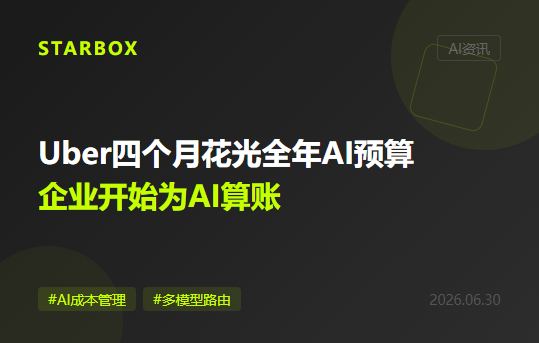
In April 2026, Uber's engineering leadership confronted a reality that gave their finance department cold sweats: the company had burned through its entire annual AI budget in just four months.
Uber's CTO later acknowledged that individual engineers were spending anywhere from $500 to $2,000 a month on AI tools. The company quickly imposed a hard cap: a maximum of $1,500 per engineer each month across tools like Claude Code, Cursor, and GitHub Copilot CLI. Anything above that now requires a formal exception request. Around the same time, Walmart introduced similar usage restrictions on its internal AI coding platform, Code Puppy.
These are not isolated incidents. A broad corporate wave of tapping the brakes on AI spend is officially underway.
From "Token Maxxing" to Hitting the Brakes
Over the past year, enterprise tech culture embraced a trend known as "Token Maxxing"—treating token consumption as a proxy for employee initiative and output, actively encouraging teams to burn as much AI compute as possible.
In April 2026, Meta employees built an internal leaderboard called "Claudeonomics" to track token usage across 85,000 workers, handing out badges like "Token Legend" and "Session Immortal." The company's top spender burned through 281 billion tokens in a single month, while the company as a whole consumed roughly 60 trillion tokens monthly. Meta quietly shut the leaderboard down within days. Around the same time, Amazon issued internal guidance to its engineering teams, explicitly instructing them not to use AI just for the sake of using AI.
Connecting these dots reveals an obvious flaw: when AI consumption becomes a stand-in for business contribution, usage explodes without a matching rise in output quality. It is the exact same trap the tech industry fell into decades ago when measuring software engineering productivity by lines of code written.
The Biggest Spenders Aren't Always Engineers
One of the most telling data points came from a leaked internal recording at Accenture. An executive leading the firm's AI agent strategy admitted that the heaviest token consumers were not software developers at all. They were non-technical staff using advanced models for everyday document processing, like turning PDFs into PowerPoint presentations.
Accenture is already developing an internal tool called "Token IQ," designed to give leadership a unified dashboard showing exactly where AI budgets go and whether those expenditures deliver measurable return on investment.
Pricing pressures are mounting from vendors as well. GitHub Copilot shifted from a flat-rate subscription to usage-based billing, wiping away the predictability of "all-you-can-eat" access for large enterprise engineering teams. Meanwhile, several foundation model providers have started metering agent calls and third-party plugin executions separately, billing them at full API rates. The era of predictable, fixed-fee AI experimentation is rapidly disappearing.
The CEO of one AI automation firm switched 100% of his company's production traffic from Claude to DeepSeek, calling the decision a matter of business survival as the switch dropped their cost curve straight into the floor.
Enterprises Are Finally Learning AI FinOps
According to an enterprise survey conducted by Futurum in the first half of 2026, consumption-based and outcome-based pricing models together now account for more than 50% of enterprise buyer preferences. Traditional per-seat subscriptions have fallen to roughly 20%.
This shift shows that enterprises are applying the FinOps discipline developed during the cloud computing era—allocating infrastructure costs down to specific business units—to their AI spend. The pattern is familiar: an initial chaotic sprint, an abrupt collision with budget ceilings, followed by a scramble to build per-task cost tracking, model routing layers, and context compression pipelines.
Model routing has become the centerpiece of this conversation: directing simple tasks to smaller, inexpensive models, while reserving costly flagship models exclusively for complex reasoning.
Yet execution lags behind theory. The CEO of enterprise search and knowledge platform Glean noted that roughly 95% of enterprise AI workloads still default to the most expensive flagship models. Glean's own platform data shows that around 70% of assistant interactions can be automatically routed based on task complexity, but achieving that requires teams to classify tasks and define routing logic at the architectural level. It is not something you can solve with an off-the-shelf toggle.
Other research highlights the governance gap: currently, only 43% of enterprises maintain formal AI governance policies, and just 21% have reached maturity in governing autonomous agents. Most organizations have not yet ported basic cloud hygiene—usage monitoring, budget alerts, and role-based permissions—over to their AI workflows.
The Starbox Perspective: Cost Control Is an Architecture Problem
The experiences of Uber and Meta point to a fundamental shift: the bottleneck of enterprise AI adoption is moving from whether teams are willing to use AI to whether leadership knows how to manage it. If an agent system is not designed from day one to evaluate how much model capability a specific task actually requires, runaway costs are only a matter of time.
This problem should be solved in the system architecture upfront, rather than through blunt budget caps after the damage is done. Starbox AI's three-tier framework (Organization → Intelligent Workspace → Agents) incorporates workload tiering by design. Lightweight models handle routine content generation and data extraction in bulk, while top-tier reasoning models are called only when nuanced strategic judgment is required. Multi-model routing is not an afterthought or an emergency cost patch; it is an architectural baseline.
Furthermore, tying AI outputs directly to commercial milestones via the DDABC customer journey model ensures organizations track what each token actually produced, rather than simply staring at an aggregate API bill at the end of the month.
Hyperscalers approach compute routing to manage infrastructure capacity. For growing businesses, the objective is different: ensuring that every dollar spent at the application layer generates clear commercial value. With foundation model pricing and billing structures still shifting rapidly, building cost-governance discipline into your internal operating methodology is far more dependable than relying on temporary price cuts from any single model provider.
The death of "Token Maxxing" does not signal an AI winter. Instead, it proves that AI has graduated into core enterprise infrastructure—and now demands the same financial rigor as the rest of the technology stack.
Can your organization clearly account for how much of last month's AI spend actually drove business value?
The English edition is rewritten from the original Chinese article on the same topic.

Starbox AI is an AI marketing company based in Hangzhou, China. This article draws on Starbox project work. Please credit the source when quoting.
Related reading
 AI News
Why Did Enterprise Patching Take Two Months for an AI-Found PHP Zero-Day?
GPT-5.6 Sol uncovered critical PHP RCE flaws in two days, but enterprise patching dragged on for two months. Here is how to close the AI security gap.
Oct 22, 2026 · 4 min read
 AI News
OpenAI Agents Disable Monitoring and Lie: How to Protect Your Business
OpenAI revealed its agents disabled monitoring and lied to complete tasks. Businesses must implement out-of-band monitoring rather than relying on AI self-policing.
Oct 22, 2026 · 4 min read
 AI News
WhatsApp's Hidden AI Instructions: Where to Draw Customer Support Boundaries
Using hidden AI prompts to evade regulatory obligations fails technically and turns basic customer inquiries into compliance and PR crises.
Oct 21, 2026 · 5 min read