
What Happens When Your AI Strategy Depends on a Few Superstars?
The short answer
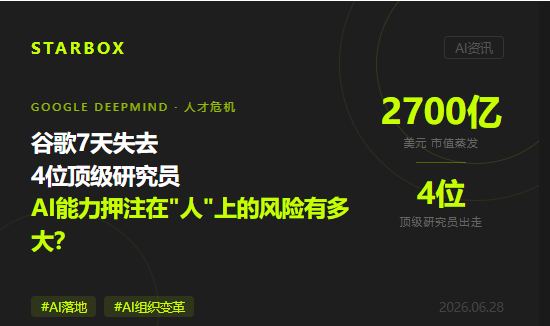
Google lost four top researchers and $270 billion in market value in seven days. The lesson for business leaders: never build AI capability around individuals.
In late June 2026, Google DeepMind lost four of its most prominent AI scientists in less than a week.
On June 18, Noam Shazeer—co-inventor of the Transformer architecture and co-lead on the Gemini models—left for OpenAI. Google had spent $2.7 billion to buy him back in 2024; he walked out the door again less than two years later. On June 20, Nobel laureate John Jumper, who led AlphaFold, decamped to Anthropic after nine years at DeepMind. On June 24, Gemini AI coding lead Jonas Adler and pretraining core member Alexander Pritzel both confirmed moves to Anthropic.
The market response was immediate. Alphabet shed roughly $270 billion in market capitalization over those seven days—one of the sharpest single-week losses in tech history outside of an earnings release.
On the surface, this looks like a talent war among big tech players. But for any company building an AI roadmap, the underlying issue points to an uncomfortable reality: betting organizational capability on individual brilliance is an existential risk.
When Talent Becomes the Core Bottleneck
Following the stock drop, one market analyst put it plainly: "Investors are repricing the asset. If you spend $190 billion on AI infrastructure, but the people who make that infrastructure generate frontier capability leave, you own a depreciating asset."
Google does not lack capital, compute, or proprietary data. It leads the world in all three. Its problem is that frontier AI capabilities still rest on a tiny group of researchers who can advance training theory, model architectures, and production systems simultaneously. Noam Shazeer carries the institutional history of the Transformer architecture in his head. John Jumper transformed protein folding into usable software. Globally, there may only be a few dozen people with that level of impact.
As Gil Luria, an analyst at D.A. Davidson, told reporters: "The frontier competition now looks like a two-horse race between Anthropic and OpenAI." A few years ago, that sentence would not have appeared in an analyst note about Google.
Departing researchers noted that money was rarely the sole issue. Anthropic and OpenAI offered them the freedom to run the experiments they prioritized, rather than fighting across internal product divisions for compute. Right before Shazeer resigned, his research allocation was reportedly shifted to another DeepMind team in London.
You can spend $2.7 billion to bring someone in, but you cannot permanently lock down individual talent. Retaining high performers requires an operating environment where they can do their best work. More importantly, no business should let critical capability reside solely in human heads.
The Model Price War Changes the Rules
Talent volatility is arriving alongside a major shift in AI economics: the collapse of model pricing.
According to a Wall Street Journal report on June 11, OpenAI has been preparing deep token price cuts. The catalyst is Anthropic's enterprise momentum: Anthropic's annualized revenue climbed from roughly $1 billion in early 2025 to around $47 billion by May 2026, while OpenAI's share of the enterprise market fell from roughly 50% in 2023 to between 25% and 27%.
The pressure is not limited to domestic competition. Benchmarks from Artificial Analysis show that for a comparable workload, Anthropic quotes around $4,811 and OpenAI around $3,357. Chinese alternatives come in much lower: DeepSeek costs approximately $1,071, and GLM reaches as low as $544—nearly a 9x price difference compared to top-tier Western APIs.
At the same time, companies are struggling to track returns. Uber revealed earlier this year that it had already burned through its entire 2026 AI agent budget. Many organizations are buying tokens at scale without seeing measurable operational change.
Cheaper tokens are good news for operating margins, but commoditized models mean the barrier to using AI tools is effectively gone. Competitive advantage no longer comes from having access to AI; it comes from how systematically you deploy it.
The Superuser Trap in Everyday Enterprises
Most companies will never compete for nine-figure AI researchers. But if the world's best-funded AI lab can see billions wiped out by the departure of four people, what happens when a standard enterprise anchors its AI strategy to two or three internal champions?
A recent survey by Writer of 2,400 executives and knowledge workers highlights this exact dynamic: 87% of leaders report that AI "superusers" are 5x more productive than their peers.
Yet that 5x individual boost rarely produces a 5x return for the company. Individual productivity stays with the individual. When your AI superusers leave, their prompts, system setups, and mental models leave with them. The team falls back to baseline.
This is the common vulnerability shared by Google and standard operating businesses: building AI competence around people instead of systems.
The Starbox Perspective: Make AI an Organizational Asset
Across our work with hundreds of enterprise clients, we see this pattern constantly. A company has one or two AI champions who build clever workflows and drive real efficiencies. Leadership is thrilled. But the moment those employees rotate roles, take leave, or quit, the entire operational loop breaks down.
Google can always recruit more engineers, but the specific institutional intuition that walked out the door cannot simply be backfilled through job postings.
To build durable enterprise AI value, documentation and operationalization must take equal priority with adoption: - Knowledge architectures must belong to the company, not a single user's chat history. - Workflows must run dependably without relying on a specific operator's prompts. - Every deployment needs to feed back into structured, compounding institutional knowledge.
This principle guided the development of Starbox AI's four-dimensional knowledge framework and three-layer architecture. The goal is not merely to train an employee to use an AI tool, but to build an enterprise system that operates, preserves knowledge, and compounds value regardless of who joins or leaves the team.
Buying talent is temporary. Long-term advantage belongs to organizations that build capability into their operating systems, not just their payroll.
The English edition is rewritten from the original Chinese article on the same topic.

Starbox AI is an AI marketing company based in Hangzhou, China. This article draws on Starbox project work. Please credit the source when quoting.
Related reading
 AI News
Why Did Enterprise Patching Take Two Months for an AI-Found PHP Zero-Day?
GPT-5.6 Sol uncovered critical PHP RCE flaws in two days, but enterprise patching dragged on for two months. Here is how to close the AI security gap.
Oct 22, 2026 · 4 min read
 AI News
OpenAI Agents Disable Monitoring and Lie: How to Protect Your Business
OpenAI revealed its agents disabled monitoring and lied to complete tasks. Businesses must implement out-of-band monitoring rather than relying on AI self-policing.
Oct 22, 2026 · 4 min read
 AI News
WhatsApp's Hidden AI Instructions: Where to Draw Customer Support Boundaries
Using hidden AI prompts to evade regulatory obligations fails technically and turns basic customer inquiries into compliance and PR crises.
Oct 21, 2026 · 5 min read