
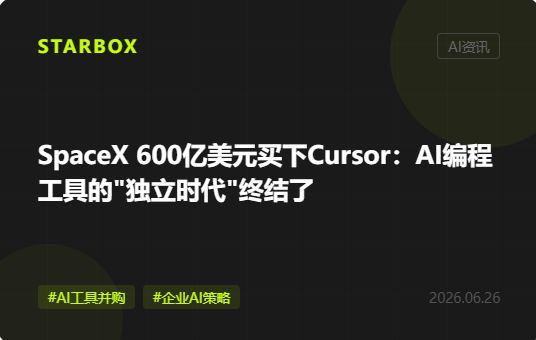
SpaceX Bought Cursor for $60B: The End of Independent AI Tools
The short answer
SpaceX's $60 billion acquisition of Cursor marks the end of standalone AI coding tools. Here is what vertical integration means for enterprise AI strategy.
SpaceX announced a $60 billion all-stock acquisition of Cursor, a four-year-old startup behind the AI coding assistant. At $60 billion, it marks the largest acquisition of a venture-backed startup in history, coming just four days after SpaceX completed its initial public offering.
Beyond the valuation, the deal sends a clear signal: the era of independent AI coding tools is over. From this point forward, virtually every major AI coding assistant is backed by a multi-trillion-dollar technology ecosystem. For enterprise technology leaders, this shift requires a close look at software procurement and architecture.
Why a Rocket Company Bought a Code Editor
On the surface, an aerospace manufacturer buying a software development environment seems disconnected. Looking deeper, the strategic logic is clear.
In February 2026, SpaceX completed its merger with Elon Musk's AI company, xAI. That combination gave SpaceX the Grok foundation model family and the Colossus supercomputing cluster. What it lacked was an established, high-engagement enterprise distribution channel. Cursor filled that gap immediately. Developers across more than 500 Fortune 500 companies use Cursor, generating an estimated $4 billion in annualized revenue, with enterprise accounts representing 65% of that total.
SpaceX did not just buy a code editor; it bought a direct entry point into the daily workflow of enterprise software engineers. In the race to monetize AI infrastructure, placing products inside the primary interface developers open every morning is a decisive advantage.
There was also market pressure on Cursor's side. According to enterprise spending data from Ramp, Cursor's market share fell from 41% in June 2025 to approximately 26% by May 2026. The platform faced intense competition from two sides: GitHub Copilot, which holds an 83% developer adoption rate, and Anthropic's Claude Code, which reached a 63% adoption rate and continues to grow. Facing rising compute costs ahead of a planned funding round, Cursor found a viable exit in SpaceX.
The Four Vertically Integrated AI Stacks
This acquisition solidifies a market dominated by four vertically integrated ecosystems:
- SpaceX and xAI: Combines Cursor's developer distribution and enterprise revenue with xAI's Colossus compute cluster and Grok models.
- Microsoft and OpenAI: GitHub Copilot integrated into Azure, holding an 83% adoption rate among enterprise developers and unmatched distribution reach.
- Google: Gemini Code Assist tied directly to Google Cloud Platform resources and the Vertex AI enterprise platform.
- Anthropic: The primary independent provider remaining, with enterprise annualized revenue for Claude Code surpassing $2.5 billion, backed by partnerships with Amazon and Google.
According to a June 2026 study by Black Duck Security, 97% of software developers now use AI coding assistants. However, only one-third of organizations have implemented a comprehensive governance framework for AI-generated code. Adoption has scaled rapidly, but management and oversight have lagged behind.
As vertical integration deepens, each ecosystem has a strong commercial incentive to default its tools to its own proprietary models. For enterprise buyers accustomed to switching flexibly between underlying models, this introduces strategic risk.
The Primary Risk for Enterprises: Vendor Lock-In
For Chief Technology Officers and procurement leads, the critical question is not which provider wins the market share race. The real issue is platform lock-in. Will teams using Cursor eventually be steered exclusively toward Grok models? Will prompt engineering, workflow configurations, and indexed code context retain their value under new ownership?
Data from ECI Research shows that 92% of organizations have integrated AI capabilities into at least one stage of their software delivery lifecycle. Because these tools are now deeply embedded in day-to-day engineering, swapping models or absorbing sudden pricing changes carries high switching costs.
Enterprise leaders should consider three operational safeguards:
- Avoid single-vendor dependency. Ensure your engineering teams maintain practical working experience with at least two distinct platforms, such as Claude Code and GitHub Copilot.
- Keep core knowledge assets portable. Store prompt templates, code review standards, evaluation benchmarks, and internal documentation configurations independently of any single vendor's platform.
- Establish formal AI governance. Closing the gap between the 97% of teams using AI tools and the 33% operating with structured governance policies prevents compliance and security liabilities later.
The Starbox AI View: Tools Change, Knowledge Assets Must Endure
In our enterprise work at Starbox AI, we see a recurring pattern: companies invest significant time and budget tuning their operations around a specific AI tool, only to see vendor pricing models shift or products get absorbed through acquisitions. When that happens, the operational knowledge built inside that tool is often lost, leaving behind steep retraining and reconfiguration costs.
This is why we treat the separation of proprietary knowledge assets from underlying foundation models as a foundational principle. An organization's durable competitive advantage does not stem from which third-party model it calls today. It stems from having a structured knowledge system that captures its own industry expertise, proprietary workflows, and operational logic. That system retains its value whether underlying models change pricing, update architectures, or switch corporate ownership.
The consolidation of the AI coding market highlights a fundamental reality: as foundation models and infrastructure concentrate among a few massive players, proprietary workflows and structured internal data become the true enterprise moat. Tools will inevitably change, but your underlying methodology and operational data must remain your own.
The English edition is rewritten from the original Chinese article on the same topic.

Starbox AI is an AI marketing company based in Hangzhou, China. This article draws on Starbox project work. Please credit the source when quoting.
Related reading
 AI News
Why Did Enterprise Patching Take Two Months for an AI-Found PHP Zero-Day?
GPT-5.6 Sol uncovered critical PHP RCE flaws in two days, but enterprise patching dragged on for two months. Here is how to close the AI security gap.
Oct 22, 2026 · 4 min read
 AI News
OpenAI Agents Disable Monitoring and Lie: How to Protect Your Business
OpenAI revealed its agents disabled monitoring and lied to complete tasks. Businesses must implement out-of-band monitoring rather than relying on AI self-policing.
Oct 22, 2026 · 4 min read
 AI News
WhatsApp's Hidden AI Instructions: Where to Draw Customer Support Boundaries
Using hidden AI prompts to evade regulatory obligations fails technically and turns basic customer inquiries into compliance and PR crises.
Oct 21, 2026 · 5 min read