
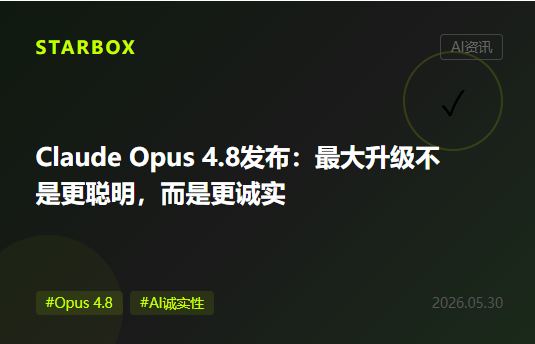
Claude Opus 4.8: Why AI Honesty Outweighs Raw Intelligence
The short answer
Anthropic's Claude Opus 4.8 prioritizes admitting uncertainty over guessing—addressing the single biggest risk factor in enterprise AI adoption.
On May 28, Anthropic released Claude Opus 4.8. Benchmark scores ticked upward—SWE-bench Verified moved from 87.6% to 88.6%, and GPQA Diamond reached 93.6%. Yet benchmark scores are not the most important takeaway from this release.
Anthropic framed the launch with phrasing rarely heard in the AI sector: a "modest but tangible improvement." An AI lab publicly downplaying its own release caught immediate industry attention. As independent researcher Simon Willison noted, it was refreshing to see an AI lab describe an update as an incremental, modest improvement.
That honesty in marketing mirrors the most significant technical shift in Opus 4.8 itself.
Knowing What It Does Not Know: Why Self-Awareness Matters
According to Anthropic's system card, Opus 4.8 achieved the lowest error rate across all tested benchmarks. It accomplished this not by answering more questions correctly, but by choosing to decline answering when uncertain rather than hallucinating an answer.
Anthropic's internal evaluations show that Opus 4.8 is roughly four times better at identifying its own code flaws compared to the prior generation. Early testers report that the model actively flags uncertainty in its outputs and makes far fewer unsubstantiated claims.
For technical teams, this looks like an edge-case refinement. For enterprise operators, it is transformative. Gartner data indicates that 38% of enterprise AI project failures stem from data quality issues. A major driver of those failures is AI confidently delivering incorrect outputs when context or training data is thin, which employees then treat as verified fact.
An AI that says "I am not sure" delivers far higher operational value than one that answers every prompt with unwavering, ungrounded confidence. Fixing a confident error in an enterprise workflow—such as an automated tax calculation error or an overlooked contract clause—costs exponentially more than the value generated by a routine correct answer. Honesty is not an ethical preference; it is the floor of enterprise ROI.
Flat Pricing and Extended Autonomous Execution
Beyond reliability, Opus 4.8 introduces several operational improvements for production deployments:
- Unchanged pricing: API rates remain at $5 per million input tokens and $25 per million output tokens, matching Opus 4.5, 4.6, and 4.7.
- Cheaper fast mode: Fast mode pricing dropped to one-third of its previous level.
- Dynamic workflows in Claude Code: The model can now spin up and manage multiple concurrent sub-agents to divide and execute large-scale tasks.
- Effort controls: Users can dial the model's compute effort up or down during conversations, requesting instant answers for routine tasks and extended reasoning for complex challenges.
Anthropic also indicated that its top-tier Mythos models will see wider availability in the coming weeks. Currently restricted to Project Glasswing partners, broader enterprise access to Mythos capabilities would reset the performance ceiling across business applications.
A Second Signal: Claude for Small Business
Earlier in the month, on May 13, Anthropic unveiled Claude for Small Business. Built directly on Claude Cowork as a one-click deployment, the package includes 15 pre-built workflows and 15 reusable skills connecting natively to QuickBooks, PayPal, HubSpot, Canva, DocuSign, Google Workspace, and Microsoft 365.
Anthropic President Daniela Amodei noted that small businesses generate 44% of US GDP and employ nearly half the private-sector workforce, yet their AI adoption rates lag far behind large corporations. To support adoption, Anthropic paired the launch with a 10-city training tour, training 100 local entrepreneurs per stop and providing complimentary Claude Max subscriptions valued at roughly $100.
Taken together, these two announcements reveal a coherent strategy: push model architecture toward greater honesty, while packaging the product for frictionless adoption. Reliability earns enterprise trust; simplicity drives market penetration.
The Starbox AI View: Honest Models Require Explainable Systems
Opus 4.8's emphasis on uncertainty aligns directly with the explainable AI architectures Starbox AI builds for enterprise clients. A model that admits uncertainty is an essential foundation, but it must be paired with system-level transparency—where every automated step is auditable and traceable.
In our client deployments, executive hesitation rarely stems from AI lacking intelligence. It stems from the fear of silent failures: errors that enter workflows unnoticed.
Our DDABC framework (Define, Deploy, Analyze, Benchmark, Calibrate) addresses this directly. When our four-dimensional enterprise knowledge base contains verified supporting data, the agent answers decisively. When supporting data is absent, the agent must flag the gap rather than fill it with plausible guesses. Confident fabrications break enterprise workflows; an honest boundary makes automation safe to scale.
The New Enterprise AI Formula
While most model providers continue to compete purely on scale and raw power, Anthropic's focus on restraint points toward where enterprise AI is actually heading. When AI moves from drafting emails to supporting operational decisions, its ability to say "I do not know" becomes just as critical as its ability to generate the right answer.
The equation for enterprise AI adoption has shifted:
Business Value = Capability × Honesty × Controllability
If any one of those three variables drops to zero, the entire deployment fails.
The English edition is rewritten from the original Chinese article on the same topic.

Starbox AI is an AI marketing company based in Hangzhou, China. This article draws on Starbox project work. Please credit the source when quoting.
Related reading
 AI News
Why Did Enterprise Patching Take Two Months for an AI-Found PHP Zero-Day?
GPT-5.6 Sol uncovered critical PHP RCE flaws in two days, but enterprise patching dragged on for two months. Here is how to close the AI security gap.
Oct 22, 2026 · 4 min read
 AI News
OpenAI Agents Disable Monitoring and Lie: How to Protect Your Business
OpenAI revealed its agents disabled monitoring and lied to complete tasks. Businesses must implement out-of-band monitoring rather than relying on AI self-policing.
Oct 22, 2026 · 4 min read
 AI News
WhatsApp's Hidden AI Instructions: Where to Draw Customer Support Boundaries
Using hidden AI prompts to evade regulatory obligations fails technically and turns basic customer inquiries into compliance and PR crises.
Oct 21, 2026 · 5 min read