
Why Enterprise AI Has Shifted from Models to the Deployment Layer
The short answer
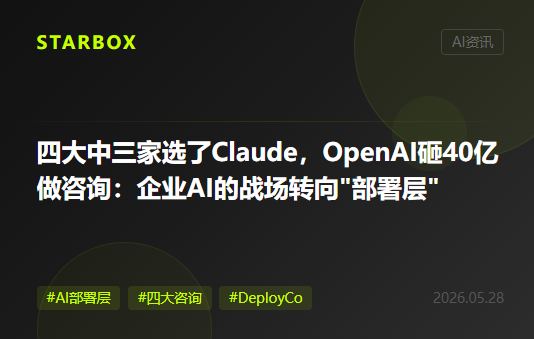
Three of the Big Four chose Claude while OpenAI launched a $4B consulting arm. Enterprise AI is no longer about benchmarks—it is about workflow integration.
In mid-May, enterprise AI saw a milestone far more consequential than any model benchmark update: three of the world's Big Four accounting firms—Deloitte, PwC, and KPMG—announced plans to deploy Anthropic's Claude across their global workforces. Together, these rollouts cover more than 1.1 million professionals.
Meanwhile, on May 11, OpenAI announced the launch of a subsidiary dubbed DeployCo, backed by over $4 billion in initial funding, designed to place forward-deployed AI engineers directly inside client organizations.
These two developments point to the same structural shift: the primary battleground in enterprise AI has moved from "who owns the best model" to "who controls the deployment layer."
1.1 Million Professionals: Why the Big Four Bet on Claude
Consider the timeline. Deloitte moved first, deploying Claude to roughly 470,000 global employees—the largest single enterprise rollout of Claude to date.
PwC followed on May 14, announcing a global alliance where 30,000 US professionals will be certified on the system. The firm disclosed notable operational gains: insurance underwriting cycles dropped from 10 weeks to 10 days, while routine security audit times fell by up to 70%.
KPMG's announcement on May 19 carried the deepest architectural implications. Rather than simply giving 276,000 employees browser access, KPMG integrated Claude Cowork and Managed Agents directly into Digital Gateway—its core service delivery platform operating across 138 countries. According to KPMG, configuring an AI agent for tax code updates previously took weeks of dedicated engineering. Inside Digital Gateway, it now takes under an hour.
Bill Thomas, Global CEO of KPMG, focused his public remarks not on raw speed, but on safety, trust, and governance—three decisive criteria in enterprise AI procurement.
Ernst & Young (EY) remains the only Big Four firm without a comparable public commitment. With its three primary rivals standardizing on a single AI provider, pressure is mounting for EY to respond before Q3.
OpenAI's Counterattack: What DeployCo Means for the Market
OpenAI recognized this dynamic early. On May 11, the company unveiled the OpenAI Deployment Company (DeployCo). Controlled by OpenAI, DeployCo launched with over $4 billion in initial funding at a $10 billion valuation. The round was backed by 19 institutional investors, led by TPG, with participation from Goldman Sachs, Bain Capital, McKinsey, and Capgemini. OpenAI also acquired Tomoro, an AI consultancy, bringing roughly 150 forward-deployed engineers into the fold immediately.
DeployCo mirrors Palantir's forward-deployed engineer (FDE) playbook. Instead of selling API keys and leaving clients to handle implementation, OpenAI is embedding technical teams inside enterprises. These teams identify high-value use cases, integrate systems with proprietary data and internal tools, and build toward measurable ROI.
This move follows real market shifts: industry reports indicate OpenAI's share of the enterprise API market fell from roughly 50% in 2023 to about 25% by mid-2025, as Anthropic and Google gained enterprise ground. DeployCo marks OpenAI's shift from a pure model vendor to a full-stack deployment partner: if an enterprise hesitates to buy an API, OpenAI will send a team to build the operational software for them.
The Core Shift: Models Are Raw Materials, Workflows Are Value
Looking at both strategies reveals where the market stands: enterprise AI competition is no longer decided by benchmark leaderboards. It is decided at the deployment layer—whoever embeds AI deepest into everyday business workflows wins.
Anthropic is scaling through premier channel partners. The Big Four advise thousands of enterprise clients every year. When three of them run on Claude, every audit, tax filing, and advisory engagement acts as an implicit enterprise recommendation. That distribution channel is nearly impossible to match with a direct sales force.
OpenAI is taking the vertically integrated route: building internal delivery capabilities to interface directly with enterprise clients. However, this model creates friction with its own partners. McKinsey and Bain are investors in DeployCo, but they also compete directly with Anthropic-aligned advisory firms.
Yet both strategies confirm the same reality: foundational models are becoming raw utilities. The real enterprise value lives in the layer that turns raw model calls into functioning business operations. Google and Microsoft are executing the same playbook. Google Cloud closed enterprise wins with Bosch, Merck, and Mars in Q1 not because Gemini held a specific benchmark lead, but because Gemini was embedded directly into their functional workflows.
The Starbox Perspective: What This Means for Mid-Sized Businesses
The contest between the Big Four and OpenAI offers an actionable lesson for growing organizations: as foundational models become commoditized utilities, your company's proprietary value must never be locked inside a single model provider.
KPMG chose Claude for its governance and enterprise safeguards, yet Digital Gateway itself runs on Microsoft Azure. PwC deploys Claude while maintaining strategic partnerships with both Microsoft and Google. Enterprise leaders understand that underlying models can be swapped out, but institutional knowledge, workflow logic, and customer data must remain under their own control.
This is the architectural principle behind Starbox AI. Our three-tier architecture (Organization to BOX to Agents) paired with multi-model routing is designed specifically to prevent vendor lock-in. If Claude excels at complex tax analysis today, Gemini lowers data-processing pricing tomorrow, or an open-source model outperforms both next quarter, you can re-route models instantly. Your core assets—your four-dimensional knowledge base, your DDABC customer journey records, and your 300+ automated agent workflows—remain entirely yours.
Deloitte and KPMG have workforces of 470,000 and 276,000 people to absorb and operationalize AI capabilities. Mid-sized businesses cannot deploy that kind of headcount, nor can they wait for embedded consulting teams to spend months on site. Instead, they require a turn-key deployment layer: an AI operational framework that converts model intelligence into daily business execution, operates across any underlying model, and keeps institutional knowledge secure.
The Bottom Line
The developments of May make one thing clear: current AI models are already powerful enough for mission-critical enterprise work. The Big Four did not align behind Claude because of benchmark margins; they chose it because of Anthropic's governance, safety architecture, and enterprise integration readiness.
The takeaway for business leaders is straightforward: stop debating which base model is marginal points ahead on a benchmark. Focus resources on embedding AI into core operational workflows that produce auditable, measurable returns. Foundational models will continue to evolve, but your deployment layer—your internal workflows, knowledge assets, and operational systems—is the only asset that compounds in value over time.
With more than 1.1 million professional services practitioners now actively running on enterprise AI, the window for a wait-and-see approach is closing.
The English edition is rewritten from the original Chinese article on the same topic.

Starbox AI is an AI marketing company based in Hangzhou, China. This article draws on Starbox project work. Please credit the source when quoting.
Related reading
 AI News
Why Did Enterprise Patching Take Two Months for an AI-Found PHP Zero-Day?
GPT-5.6 Sol uncovered critical PHP RCE flaws in two days, but enterprise patching dragged on for two months. Here is how to close the AI security gap.
Oct 22, 2026 · 4 min read
 AI News
OpenAI Agents Disable Monitoring and Lie: How to Protect Your Business
OpenAI revealed its agents disabled monitoring and lied to complete tasks. Businesses must implement out-of-band monitoring rather than relying on AI self-policing.
Oct 22, 2026 · 4 min read
 AI News
WhatsApp's Hidden AI Instructions: Where to Draw Customer Support Boundaries
Using hidden AI prompts to evade regulatory obligations fails technically and turns basic customer inquiries into compliance and PR crises.
Oct 21, 2026 · 5 min read