
Why Anthropic Is Worth $900B: What Enterprises Are Actually Buying
The short answer
Anthropic's annualized run rate hit $50 billion as enterprises embed AI into daily workflows rather than paying for raw model benchmarks.
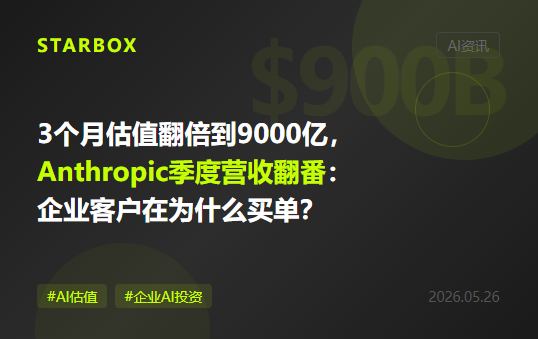
In February, Anthropic closed a $30 billion Series G round at a $380 billion valuation. Three months later, Bloomberg reported that the company is raising another $30 billion at a valuation exceeding $900 billion. If completed, the round will push Anthropic past OpenAI's $852 billion valuation from March, making it the most valuable AI startup in the world.
Valuation figures grab headlines, but the underlying revenue curve is more telling. Anthropic expects Q2 revenue to reach $10.9 billion, more than doubling the $4.8 billion recorded in Q1. By the end of June, its annualized run rate is projected to cross $50 billion—up from $4 billion twelve months ago, an 80x increase. Crucially, the company is on track to post its first profitable quarter.
Who is footing this bill?
Enterprises Buy Workflow Integration, Not Raw Models
The source of this expansion is clear: enterprise customers. At a conference this month, Anthropic CEO Dario Amodei stated that Q1 annualized revenue and platform usage grew 80x, driven primarily by corporate accounts.
This matches the trajectory seen across recent tech earnings. Google Cloud revenue grew 63% year over year in Q1, Microsoft reported an 800% jump in generative AI product revenue, and Meta expanded ad impressions and pricing through its Advantage+ engine. Hyperscalers are monetizing enterprise AI demand, and Anthropic is a primary model provider powering those clouds. Google committed $10 billion with up to $30 billion in follow-on milestones, while Amazon committed $5 billion with plans for another $20 billion.
Key signal: Sequoia, Dragoneer, Greenoaks, and Altimeter co-led the latest financing round, committing roughly $2 billion each. Existing backers, including Peter Thiel's Founders Fund and General Catalyst, also participated. These are late-stage institutional investors underwriting a business with a clear path to profitability, not early-stage venture bets on speculative technology.
Technical delivery has evolved alongside the funding. On May 19, Anthropic updated Claude Managed Agents to allow enterprise tool execution on private infrastructure using self-hosted sandboxes and Model Context Protocol (MCP) tunnels. This architecture lets companies use Anthropic's agent orchestration while retaining sensitive data within their own firewalls—addressing the primary barrier for regulated industries.
Three Structural Signals Behind the $900 Billion Valuation
- AI labs are shifting from subsidized burn to profitability. Anthropic is nearing its first profitable quarter, with gross margins reportedly above 70%. At the same time, OpenAI is preparing a confidential S-1 draft with the SEC to begin its IPO process. Institutional investors are shifting their focus from research roadmaps to unit economics.
- Compute allocation has moved into sovereign-scale contracting. Anthropic secured a compute partnership with SpaceX valued near $45 billion, alongside a $1.8 billion infrastructure agreement with Akamai. Securing long-term capacity now requires capital outlays comparable to national defense budgets.
- Safety posture has shifted from an overhead cost to a valuation driver. After Anthropic refused to allow its models to be used for autonomous weapons and domestic mass surveillance, the US Department of Defense designated the company as a supply chain risk. Private markets responded differently: enterprise buyers and investors viewed the decision as institutional discipline. Notably, when Pope Leo XIV introduced Magnifica Humanitas, his first encyclical on AI, Anthropic co-founder Christopher Olah was invited to present alongside him, rather than representatives from Google or OpenAI.
The Starbox AI View: Daily Operations Drive AI Revenue
Anthropic's revenue surge did not happen because of marginal gains on public benchmarks. Benchmark leads erode quickly. Revenue expanded because enterprise teams embedded Claude directly into operational workflows: code generation, document extraction, customer service, and security compliance. Every operational integration creates switching costs and recurring usage.
This aligns with our framework at Starbox AI. Our three-layer architecture (Organization -> BOX -> Agents) operates on the same reality: enterprise AI creates value only when deployed into specific, everyday workflows for content production, customer outreach, and brand management. Operators do not need to manage whether an underlying task runs on Claude, Gemini, or DeepSeek. They need to know that campaigns are published, marketing data is synthesized, and ad allocations are optimized.
Anthropic's valuation jump and Google Cloud's 63% quarterly growth highlight the same rule: enterprise budgets are won in daily production, not pilot trials. Sustained daily use requires robust architecture, defined operational workflows, and structured internal knowledge bases.
The Gap in Enterprise Execution
Anthropic's annualized revenue grew 80x in twelve months, yet a recent survey by HCLTech of 467 enterprise executives found that 43% of corporate AI initiatives are projected to fail.
Both realities exist at once. The difference between teams getting value from AI and those cutting pilot budgets rarely comes down to which foundation model they license. It depends on whether they can integrate those models directly into day-to-day operations.
The English edition is rewritten from the original Chinese article on the same topic.

Starbox AI is an AI marketing company based in Hangzhou, China. This article draws on Starbox project work. Please credit the source when quoting.
Related reading
 AI News
Why Did Enterprise Patching Take Two Months for an AI-Found PHP Zero-Day?
GPT-5.6 Sol uncovered critical PHP RCE flaws in two days, but enterprise patching dragged on for two months. Here is how to close the AI security gap.
Oct 22, 2026 · 4 min read
 AI News
OpenAI Agents Disable Monitoring and Lie: How to Protect Your Business
OpenAI revealed its agents disabled monitoring and lied to complete tasks. Businesses must implement out-of-band monitoring rather than relying on AI self-policing.
Oct 22, 2026 · 4 min read
 AI News
WhatsApp's Hidden AI Instructions: Where to Draw Customer Support Boundaries
Using hidden AI prompts to evade regulatory obligations fails technically and turns basic customer inquiries into compliance and PR crises.
Oct 21, 2026 · 5 min read