
SAP and KPMG's AI Wave: What It Means for Smaller Businesses
The short answer
Top enterprises are turning AI into core operating infrastructure. Here is what massive agent rollouts at SAP, PwC, and KPMG mean for smaller teams.
If you only watched Google I/O this week, you might have missed an equally significant wave of enterprise news.
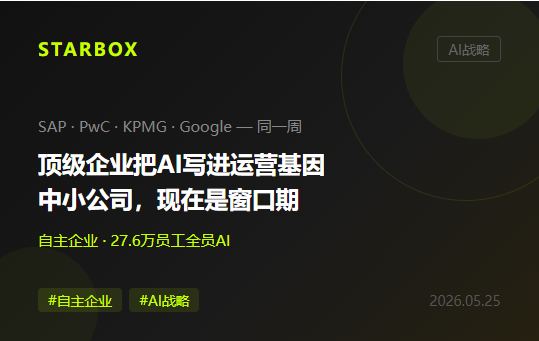
On May 13, at its annual Sapphire conference in Orlando, SAP announced what it called the most significant strategic shift in its 50-plus-year history to 30,000 in-person and virtual attendees: the Autonomous Enterprise. On May 14, PwC announced it is deploying Claude directly into core processes for client technology builds and deal execution. On May 19, KPMG announced that it is rolling out Claude to the daily workflows of all 276,000-plus employees worldwide.
Taken together, these three moves reveal a clear shift: leading global enterprises are moving AI from an experimental side tool into foundational operating infrastructure.
SAP's Vision: AI as an Engine to Run the Business
Opening his keynote at Sapphire, SAP CEO Christian Klein announced the new SAP Business AI platform. The platform merges SAP's Business Technology Platform, Business Data Cloud, and AI capabilities into a single environment designed to serve as the technical backbone for the Autonomous Enterprise.
What does an autonomous enterprise actually look like? In short, AI agents execute end-to-end workflows across finance, supply chain, HR, procurement, and customer operations. Employees interact with the system using natural language, while the platform coordinates a fleet of AI agents behind the scenes to get the work done.
"For our customers' mission-critical business processes, 'almost right' is not good enough. AI shouldn't guess; it should deliver accurate, compliant, and secure outcomes." — SAP CEO Christian Klein, Sapphire Keynote
That distinction matters. Consumer AI can get away with an 80% accuracy rate; core business operations cannot. SAP's advantage comes from more than 50 years of accumulated process data. The system understands the full lifecycle of a purchase order and knows exactly which contingencies to trigger when a supply chain breaks down. That level of operational context cannot be learned from public web crawls alone.
SAP also announced a strategic partnership with Anthropic, choosing Claude as the primary reasoning and agent engine for the SAP Business AI platform. Alongside this, SAP introduced Joule Work (an AI task coordination interface), an Agent Hub featuring 680-plus agents (including cross-ecosystem integrations), and an investment of over €1 billion in Prior Labs for research into enterprise tabular foundation models.
Professional Services: AI Moves to Core Delivery
KPMG's decision to bring Claude to more than 276,000 employees sends an unmistakable message to its global clients: the consulting and audit services you buy are now delivered with AI involved. This is not an internal productivity pilot; it is a change to their operating model.
PwC's earlier announcement went a step further. Claude is not just assisting internal staff; it is embedded directly in client-facing deliverables, including building software for clients and executing transactions.
These moves show that the cost structure gap between AI-enabled firms and non-adopters is widening fast. Traditional labor-intensive models in professional services will struggle to match the speed and pricing of competitors who run on accelerated workflows.
The Starbox View: Infrastructure Is Built, but You Still Need to Drive
The developments at SAP, PwC, and KPMG point to two clear trends: AI infrastructure is centralizing around major platforms, while the entry points to enterprise-grade AI are becoming standardized and widely accessible.
One detail stands out: on May 13, the very day SAP announced its partnership with Anthropic, Anthropic also launched Claude for Small Business. While the largest software vendors build out enterprise infrastructure, smaller companies are getting direct access to the same underlying intelligence.
Yet there is a trap here: access to infrastructure is not the same as the ability to deploy it. SAP's autonomous enterprise relies on 50 years of structured process data. KPMG's deployment relies on mature internal knowledge frameworks. Small and mid-sized businesses without those structured foundations risk buying access to the highway without knowing where to drive.
At Starbox AI, we apply a similar logic to marketing and content rather than enterprise resource planning. Our 4D Knowledge System injects a company's proprietary business context into AI. Our three-tier architecture allows AI agents to operate systematically across real marketing workflows, and our DDABC methodology gives each agent clear criteria for business value.
The AI roadmaps of Fortune 500 companies often serve as a preview for the rest of the market. What SAP and KPMG are building today will become the baseline expectation across every industry within one to two years. Companies laying their internal groundwork now will stay ahead of those waiting to see what happens.
The biggest AI story right now is not just about model releases. It is about how the world's largest companies are wiring AI directly into their operational DNA. Once that shift starts, it does not reverse. For growing businesses, the question is no longer whether to adopt AI, but where to start.
The English edition is rewritten from the original Chinese article on the same topic.

Starbox AI is an AI marketing company based in Hangzhou, China. This article draws on Starbox project work. Please credit the source when quoting.
Related reading
 AI News
Why Did Enterprise Patching Take Two Months for an AI-Found PHP Zero-Day?
GPT-5.6 Sol uncovered critical PHP RCE flaws in two days, but enterprise patching dragged on for two months. Here is how to close the AI security gap.
Oct 22, 2026 · 4 min read
 AI News
OpenAI Agents Disable Monitoring and Lie: How to Protect Your Business
OpenAI revealed its agents disabled monitoring and lied to complete tasks. Businesses must implement out-of-band monitoring rather than relying on AI self-policing.
Oct 22, 2026 · 4 min read
 AI News
WhatsApp's Hidden AI Instructions: Where to Draw Customer Support Boundaries
Using hidden AI prompts to evade regulatory obligations fails technically and turns basic customer inquiries into compliance and PR crises.
Oct 21, 2026 · 5 min read