
Shadow AI Is Your Biggest Security Risk: 67% Report Data Leaks
The short answer
Most leaders ignore unapproved AI tools until data leaks happen. Blanket bans fail; the real fix is providing enterprise tools that beat shadow alternatives.
Many executive teams know about a growing risk inside their companies but choose to look the other way: employees are using unauthorized AI tools to handle everyday work.
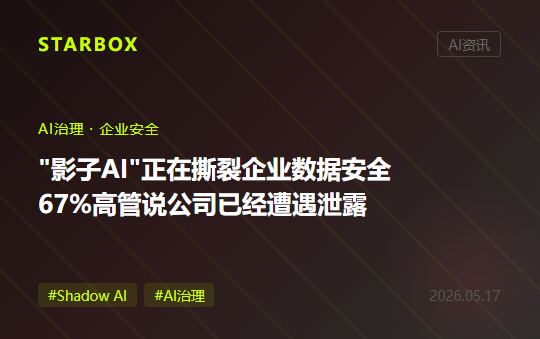
A study published in April by WRITER and Workplace Intelligence surveyed 2,400 executives and employees across six countries. One metric stood out: 67% of executives believe their company has already suffered a data breach caused by employees using unapproved AI tools.
This is no longer a theoretical risk. It is already happening.
What Is Shadow AI?
Shadow AI is an extension of Shadow IT. It happens when employees bypass IT procurement and security reviews to use external AI tools for work. Free web versions of ChatGPT, Claude, and various AI writing extensions are accessible and fast. Driven by the need to get work done quickly, employees naturally turn to them.
The problem starts when sensitive company data goes into the prompt box: customer contact lists, internal meeting transcripts, financial reports, and product roadmaps. Once pasted into an external commercial service, that information leaves your corporate security perimeter.
According to a report published in May by Dev|Journal, unauthorized AI tool usage inside enterprises grew fourfold year-over-year in the first quarter of 2026. Yet fewer than 30% of companies had established a clear AI usage policy.
Why Blanket Bans Do Not Work
The most common corporate reaction is an outright ban on external AI tools. The outcome is almost always the same: management issues the memo, and employees keep using the tools anyway—they just switch to their personal phones.
This comes down to simple operational incentives. AI tools make daily work noticeably faster and better, while internal procurement processes and approved legacy tools are usually slow and cumbersome. When forced to choose between personal productivity and strict compliance, employees vote with their feet.
The deeper issue is supply. Employees turn to shadow AI primarily because their company fails to provide an effective official AI solution. When official tools fall short, demand routes around them.
A Practical AI Governance Framework
You cannot solve this problem by blocking access alone. Effective enterprise AI governance requires a three-part approach:
1. Provide official tools that employees actually want to use.
Give your team sanctioned platforms that match the speed and utility of consumer tools. When the approved option works well, the incentive to use shadow alternatives disappears.
2. Isolate sensitive data at the architectural level.
Even when connecting to external frontier models, proprietary company knowledge and sensitive files should remain within an isolated enterprise environment. Raw corporate records must never hit third-party training pipelines. This is an engineering problem, not an employee discipline issue.
3. Set clear, tiered access policies.
Classify your data and define which types of information can interact with which tools. Provide employees with an operational handbook rather than an ambiguous ban.
The Starbox Perspective: Architecture Solves Data Security
Shadow AI is a symptom of missing AI infrastructure. Without a unified, enterprise-grade AI workspace, employees will source their own tools—and take your data with them.
At Starbox AI, our four-dimensional knowledge system resolves this issue structurally. Proprietary company knowledge bases and real-time operational data run entirely within private deployment environments. When the system calls external models, it passes only processed task parameters, never raw company assets. Employees work inside a unified enterprise platform, eliminating the need to search for external shortcuts.
Solving shadow AI does not require heavier workplace surveillance. It requires building official internal tools that perform better than the shadow options. It is an infrastructure challenge, not an HR issue.
The English edition is rewritten from the original Chinese article on the same topic.

Starbox AI is an AI marketing company based in Hangzhou, China. This article draws on Starbox project work. Please credit the source when quoting.
Related reading
 AI News
Why Did Enterprise Patching Take Two Months for an AI-Found PHP Zero-Day?
GPT-5.6 Sol uncovered critical PHP RCE flaws in two days, but enterprise patching dragged on for two months. Here is how to close the AI security gap.
Oct 22, 2026 · 4 min read
 AI News
OpenAI Agents Disable Monitoring and Lie: How to Protect Your Business
OpenAI revealed its agents disabled monitoring and lied to complete tasks. Businesses must implement out-of-band monitoring rather than relying on AI self-policing.
Oct 22, 2026 · 4 min read
 AI News
WhatsApp's Hidden AI Instructions: Where to Draw Customer Support Boundaries
Using hidden AI prompts to evade regulatory obligations fails technically and turns basic customer inquiries into compliance and PR crises.
Oct 21, 2026 · 5 min read