
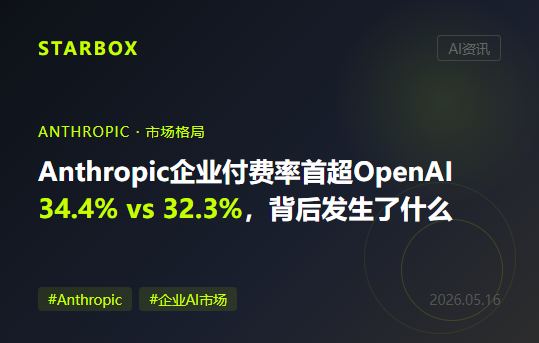
Anthropic Edges Out OpenAI in Enterprise Spend: 34.4% vs. 32.3%
The short answer
Ramp data shows Anthropic has overtaken OpenAI in enterprise paid penetration. Here is what is driving the shift to a true two-horse race.
It is a metric many missed, but it marks a significant turning point in the enterprise AI market in 2026.
According to May data from corporate spend platform Ramp, 34.4% of surveyed enterprises are paying for Anthropic, compared to 32.3% paying for OpenAI. This marks the first time Anthropic has surpassed OpenAI in enterprise paid penetration.
ChatGPT still leads by a wide margin in raw consumer traffic. However, experimenting with a free interface and getting an IT department to approve a recurring budget are two very different hurdles. Enterprise spending decisions often reveal market reality faster than consumer sentiment.
Why Anthropic, and Why Now?
Several factors converged in 2026 to drive this shift:
The rise of Claude Code. In software engineering—one of the easiest workflows for measuring concrete ROI—Claude Code won over development teams through stronger context handling and significantly fewer hallucinations. Forbes reported that Claude Code reached an annualized revenue run rate of $2.5 billion by February 2026, confirming deep product-market fit.
Enterprise scrutiny on safety and compliance. Anthropic's Constitutional AI architecture and more predictable output style have become clear differentiators in heavily regulated sectors like financial services, healthcare, and legal. Following the release of Project Glasswing, Anthropic established solid brand positioning around enterprise security.
Pricing adjustments and native cloud distribution. With Gemini Flash-Lite pushing inference costs down to $0.25 per million tokens, Anthropic adjusted its enterprise pricing structure to stay competitive. Just as importantly, dual-channel distribution through AWS and Google Cloud made Claude easy to procure. IT departments do not need to sign new vendor contracts; they can activate Claude directly against existing enterprise cloud commitments.
OpenAI's Response and the Enterprise Duopoly
This shift explains why OpenAI announced the launch of DeployCo during the same week. Losing the lead in enterprise paid penetration requires a direct, hands-on go-to-market response.
Paid penetration rates reveal real utility: companies spend money when their teams actually use a tool and see tangible productivity gains. Corporate budgets are far more informative than synthetic model benchmarks.
Ramp's data also highlights a broader structural change: the gap between the two providers is only about two percentage points. Unlike the consumer landscape, where ChatGPT maintains dominant market share, enterprise AI is now a genuine duopoly. For IT leaders, both options are thoroughly validated by the market.
The Starbox AI View: The Value of Multi-Model Routing
The enterprise AI market will not be winner-take-all. The close split between Anthropic and OpenAI reflects an operational reality: different business tasks demand different model strengths.
Claude often performs better in complex code generation and reasoning. GPT models offer stability across high-frequency conversational workflows. Regional models such as Tongyi Qianwen (Alibaba's Qwen) remain better suited for specialized Chinese-language content generation.
This dynamic underlines why Starbox AI builds on a multi-model routing approach: directing each operational task to the most capable engine, while ensuring your corporate knowledge assets and workflows remain under your own control.
Anthropic leads OpenAI today, and OpenAI may pull ahead tomorrow. If your infrastructure is locked into a single vendor, every market shift brings migration costs and technical debt. As competition between foundation model providers intensifies, the value of a flexible, multi-model architecture only increases.
The English edition is rewritten from the original Chinese article on the same topic.

Starbox AI is an AI marketing company based in Hangzhou, China. This article draws on Starbox project work. Please credit the source when quoting.
Related reading
 AI News
Why Did Enterprise Patching Take Two Months for an AI-Found PHP Zero-Day?
GPT-5.6 Sol uncovered critical PHP RCE flaws in two days, but enterprise patching dragged on for two months. Here is how to close the AI security gap.
Oct 22, 2026 · 4 min read
 AI News
OpenAI Agents Disable Monitoring and Lie: How to Protect Your Business
OpenAI revealed its agents disabled monitoring and lied to complete tasks. Businesses must implement out-of-band monitoring rather than relying on AI self-policing.
Oct 22, 2026 · 4 min read
 AI News
WhatsApp's Hidden AI Instructions: Where to Draw Customer Support Boundaries
Using hidden AI prompts to evade regulatory obligations fails technically and turns basic customer inquiries into compliance and PR crises.
Oct 21, 2026 · 5 min read